
Message 20 of December 16, 1949
While the Lady looks on sternly and waggles her finger in warning, I hear her say,
"Poor, poor Germany. Finally accept the crosses and place them in the center. Finally awaken the clergy. Start from the bottom. Ordinary people must be brought back to Him. You know it always happens this way."
And the Lady clenches her fist and shows it to me. She does so very energetically. She even waves her arm and fist in my direction.
The Lady of All Nations once again draws our attention to Germany. This country has turned away from God and fallen into a deep spiritual crisis. To change this, immediate re-evangelization is needed.
The key to change is young people. If they remain in darkness, the future of the entire nation will suffer. The point is to bring back to God those who, seduced by godless ideologies, have turned away from Him. This mechanism of fighting for human souls is a necessity today. For God is the only giver of life, while all other spiritual trends inevitably lead to death.
Such transformation, however, will not come about without effort. It requires authentic followers of Christ. A model of such commitment is Father Lombardi, whom we will discuss later in this message. He boldly went out into the world and proclaimed the Word of God in a simple, accessible way, bringing many back to the Creator. In the face of such an example, clergy can no longer wait idly in empty churches. They must reach out to the people.
The Church in Germany requires a complete reform. Priests previously sent on foreign missions should now focus on saving their own homeland. Their task is to shed their attachment to this world and step out of the comfort zone that lulls them to sleep. They must take up their cross and go to others—this requires personal effort. Only in this way can they place the cross at the very center of human life, exactly as Christ did (Mt 16:24–28). The cross is the space where everyone must crucify everything that opposes God's will. Therefore, for priests, what opposes God's will is stagnation and dormancy, while in the face of such evil as prevails in the world, work is required—an uncompromising outreach to people and a fight for souls, even at the cost of suffering and death. As long as evil exists in the world, the battle against it will always be paid for with suffering. The task for the Germans themselves, however, is to accept these living "crosses," faithful followers of Christ, such as the clergy who come to them.
Mt 16:24-28
16:24 Then Jesus said to his disciples, "If anyone desires to come after me, let him deny himself, take up his cross, and follow me.
16:25 For whoever desires to save his life will lose it, but whoever loses his life for my sake will find it.
16:26 For what will it profit a man if he gains the whole world and forfeits his soul? Or what will a man give in exchange for his soul?
16:27 For the Son of Man will come in the glory of his Father with his angels, and then he will reward everyone according to his deeds. 16:28 Truly, I say to you, there are some standing here who will not taste death until they see the Son of Man coming in his kingdom."
Christ's words directly address the need to evangelize the world and do good, which fully aligns with the message of the Lady of All Nations addressed to Germany, which was plunged into darkness. In the Gospel of Matthew, we read of the necessity of taking up one's cross and following Christ (Mt 16:24-28) – whoever does so will save their soul. Taking up the cross is nothing other than crucifying one's own sin. Only with a pure heart can we undertake the mission of evangelization and faithfully follow Christ, who speaks directly (Mt 10:38-39):
Mt 10:38-39
10:38 Whoever does not take his cross and follow me is not worthy of me.
10:39 Whoever finds his life will lose it, and whoever loses his life for my sake will find it.
The verses quoted above reveal a disturbing truth: one can follow Christ without carrying one's own cross—but then such a person is unworthy of the mission Christ entrusts to them. One can, after all, physically or declaratively "follow Him"—be a formal member of the Church, bear the name Christian, and even be ordained a priest—and yet, deep down, refuse to carry one's cross.
What does this mean in practice? We can clearly see that the cross directly relates to the daily life of each of us and touches on the fundamental issue we have already mentioned. Each person must crucify on the altar of their body that which opposes God's will, ridding themselves of evil deeds. In this way, the soul offers a pure and spotless sacrifice to the Creator. Only after such purification can a person authentically imitate Christ, fulfilling the mission of reconciling people with God.
If we apply these words to priests, it becomes clear that all those who commit sin that distances them from God cannot worthily fulfill His mission or be His priests. Anyone who follows Him without crucifying their own sin is not worthy of Him.
In the Gospel, we read that Jesus often rebuked the spiritual leaders of Israel of his time for instructing others while they themselves were committing iniquity. An example is His words about those who try to remove the speck from their brother's eye while failing to see the beam in their own. This instruction clearly indicates that to be a good shepherd, one must first have a pure heart. Sin brings mortal
harm to the soul and makes it subject to just judgment—regardless of the position a person holds. At the end of time, the Son of Man will come in the glory of his Father with the angels, and then he will render to each person according to their conduct.
However, let us remember that in reference to Jesus himself, the crucifixion of sin can create some ambiguity. He himself was without sin. This difference stems from the unique nature of his mission: the Father's will was for the Son to be crucified in order to renew the covenant and reveal to us the truth written in the Law transmitted through Moses. Christ took our curses upon himself, fulfilling the principle that it is better for one to perish than for the entire nation to suffer. In this way, he gave his life for humanity, for all sinned at that time—both the Jews and his own disciples who denied him. Therefore, in Christ's case, what would have opposed the Father's will would have been fleeing from the cross. However, since he fulfilled His will to the very end—he rose from the dead.
Anyone who crucifies everything that opposes God's will, just as Christ did, will receive the promise of resurrection. From this we clearly see that priests who reject their cross and refuse to reach out to people—by not imitating Christ—directly oppose God's will and bring upon themselves a just judgment.
Let's now look at the symbolism of the cross from a slightly different perspective. What's surprising about Holy Scripture is that the cross—depending on the biblical context—can symbolize various motifs. However, they all intersect at a central point, much like the arms of the cross itself, whose beams interconnect at the center. Let's consider the cross as God's altar in the context of the verses discussed from the Gospel of Matthew (Mt 16:24-28).
In the Old Testament, the altar erected on Mount Ebal, where the children of Israel offered sacrifices to God, was built of stone. Due to its enormous weight, it was a static structure, permanently assigned to a single location. To offer a sacrifice on it, a person had to personally come to it. The stone altar did not travel to people; people had to make pilgrimages to it. This static nature perfectly characterized Judaism, which, by definition, did not extend beyond the borders of the Holy Land. The situation
is completely different with the altar of the cross, which each of us carries with us every day—our own body. On this altar, the soul offers God daily sacrifices for good deeds. Some, however, offer impure sacrifices on it, which are sinful deeds. God, however, has given all sinners the opportunity and time to sanctify their bodies through the Church of Christ. Therefore, a person is not immediately subject to justice at the moment of sin, but is given time to free themselves from these sins. Such people can abandon the path of iniquity during their lives, and at the end of their journey, offer God a spotless sacrifice of their bodies. This motif refers to the Old Testament, in which God suspended time—the moon and sun—so that Joshua and the children of Israel could expel all evil from the Promised Land, which was to become the Holy Land. In a spiritual sense, this Holy Land is to be the temple of the human body, for which the time for the expulsion of evil was suspended in the Church of Christ.
Since everyone has their own cross, they themselves offer on it a sacrifice pleasing to God. However, it is important to remember that this is a long process, and death can surprise a person at any moment. That is why only when he continually struggles with his own weakness—which makes him the evangelical "violent man"—can his sins be forgiven, and he himself can conquer Heaven. Everyone must wage a fierce battle against evil in his own heart, for man is born with a corrupt heart.
Every good thing we do is the fulfillment of God's will. Christ fulfilled the Father's will and allowed himself to be crucified for the good of man, to reveal to us the things of Heaven. Importantly, even in the face of pain and death, he did not come down from the cross, which shows us how great his spiritual strength was and how deeply he remained in unity with the Father's will, something to which every person must strive.
Man has a soul, which directs the body depending on the spirit dwelling within it. If it is filled with the spirit of this world, man acts according to its rules. If, however, it is filled with the Spirit of God, its actions reflect God's will. This is precisely why all ideologies are so dangerous. They can insidiously seize control over man, first infusing themselves into his soul and then manifesting themselves in his body. The key question, then, becomes: whose will does the soul fulfill? In Eden, the serpent first cunningly infused Eve's soul with his words. These words, then, reinforced by their illusory beauty, were manifested through the act of plucking and eating the forbidden fruit. The same applies to the ideology of modern humanism, which tempts humanity with lofty and beautiful slogans, ultimately leading it to sin and death.
God reveals spiritual truths through matter. He makes what is invisible to the eye tangible and understandable to us. These truths are hidden within the pages of Sacred Scripture, revealed in physical events, and all of this is permeated by the Spirit of God. Therefore, as we delve into the Word of God, we must always remember that it touches upon the spiritual realm and the constant struggle between good and evil.
We are called to cleanse our bodies of all idolatry and sin through the Word of God. We also receive help on this path through praying the rosary. Its beads symbolize the hail of Old Testament stones that God rained down on the enemies of the children of Israel in the Promised Land, precisely when He suspended time to defeat the enemy. The rosary is precisely such a powerful spiritual weapon given to us by God. Anyone who sanctifies their body according to the Spirit of God, making their body the Holy Land, will gain it for eternity, for it is the land promised to us. However, we are not talking here about a material shell, but about its immortal, spiritual image.
This fundamental principle—the truth that the human body is an altar and, at the same time, a sacrifice offered by the soul—was revealed to us by Christ himself. Ascending Golgotha with the cross, His Spirit offered the perfect sacrifice of His own Body. This sacrifice was accepted by the Father, and the Son ascended to Heaven. A similar path awaits every person: at the moment of death, their soul, if it proves pleasing to God, will pass into eternity.
What, then, is the fruit pleasing to God? In the Old Testament, sacrifices offered to the Lord had to be free from any blemish. This principle, however, does not refer to bodily defects or disabilities, but to iniquity, understood as sin, which can contaminate any member of the human body. Sin can, after all, be committed with a single hand or with the glance of the eyes. For this reason, every particle of our physical being must be cleansed and freed from iniquity.
For our salvation and teaching, the Father's will was for Christ to give his life on the cross. The fulfillment of this mission demonstrates the immense power of His Spirit, which, in the face of such unimaginable suffering, did not oppose God's will until the very end. Jesus, seeing the suffering awaiting Him, could have denied the Father, and then the cup prepared for Him would have been removed. One word during the trial before Pilate was enough to avert the specter of a cruel death. Therefore, Christ hanging on the Cross serves as a model for us of what kind of sacrifice should be offered to God and the direction in which the human will should be directed. It should be emphasized that this is not about making a bloody sacrifice of oneself, but rather a sacrifice offered in unity with God's will, which is manifested in every member of the human body. Christ himself became the final bloody sacrifice.
Each person has their own individual cross, on which the spirit must offer their body as a sacrifice to God. This involves the hard work of working to make this world good. Each person fulfills this mission in their own unique way. Some do this in marriage, where their sacred duty is to raise children in the Spirit of God. Others, called to the priesthood, are to reconcile the world with the Creator through evangelization, making Him known to those who do not yet know Him or have turned away from Him.
This is, therefore, about working for the Good, which is God alone. In the Gospel according to St. Mark (Mk 10:17–22), Christ reminds the rich man who called Him good: "No one is good but God alone." This man faced a choice: follow Christ or hold on to his earthly possessions. However, he chose the spirit of this world—the golden calf—rejecting the True Good, which is the Spirit of God. Therefore, evangelization of the world, that is, making God known to humanity, makes the world truly good if only it accepts this True Good. The point is to choose Truth from falsehood. Truth is the Spirit of God, and falsehood is other, ungodly spirits that tear our world apart every day.
In this spirit, the Lady of All Nations calls for the crosses in Germany to finally be accepted and for sacrifices to be made on them, deeds worthy of God. Service to the Creator must be placed at the very center of human reality—for the more people undertake this endeavor, the faster the entire earth will be transformed.
The Lady of All Nations also calls for the awakening of the clergy, whose fundamental duty is the fervent service of God. Christ did not stand still, but continually reached out to people, bringing them to the Father through his teaching. Today, this call is to be fulfilled through His Church, to which lost humanity must be led anew, as the world once again plunges into darkness—exactly as Christ demonstrated during his earthly life.
The fall of the criminal spirit of Nazism in Germany left behind a void—"empty earthen vessels." It was then that a space for action opened up. Had the Church undertaken the intense work of evangelization then, Germany would not be one of the most secularized nations in Europe today. Instead, it has become a country torn apart on all sides by godless, purely human ideologies.
The Book of Moses' Law, which records God's covenant with humanity, explicitly states that curses fall upon the community for sin, and blessings for good. Today, all of Germany is sliding into the abyss, becoming like Sodom and Gomorrah. For this reason, the Lady of All Nations, on the one hand, refers to this society as "poor," while on the other—exposing her punishing fist—reminds us of the harsh provisions of God's Law and the consequences of breaking them.
In the Gospel of Matthew, cited above, we read that man is unable to redeem his own soul. Therefore, the term "poor Germany"—referring to a country that, materially, is one of the richest in the world—in reality refers to spiritual poverty. For what good is it that they conquered the world if they suffered the loss of their own souls?
Peace between man and God can only come about when the body unites with the Spirit of God. The Lady of All Nations is to help the Church of Christ unite these two mountains—Ebal and Gerizim—.
Christ repeatedly ascended the mountain in solitude to converse with God through prayer. Similarly, Moses was the only one who could ascend Sinai and converse with the Creator. For both were spiritually reconciled with Him. This also applies to Elijah. A summary of this truth is contained in the New Testament, in the Gospel of the Transfiguration of the Lord on Mount Tabor, where Moses and Elijah appeared alongside Christ. Here we see three chosen ones with whom God spoke directly. In these three instances, a mystical union took place between Mount Ebal, symbolizing the corporeal world, and Mount Gerizim, an image of the spiritual world. The Transfiguration of Christ on Mount Tabor is a complete representation of this truth.
In the message, we hear that ordinary people must be brought back to God, because that is how it usually happens. So what is meant by these "ordinary people"? To answer this question, we must first define who such a person is. The Gospels sometimes describe people as lowly or simple. An ordinary person is someone humble, someone who can accept a word that does not originate from themselves. Their complete opposite is the earthly elite, filled to the brim with pride, capable of accepting only what comes from themselves. Such people consider themselves deities and want to shape this world according to their own corrupt values.
When Christ chose his disciples, he chose simple and humble people, ready to listen and accept the truth.
These are often people who have personally experienced the evil of this world, and thus understand perfectly how much it needs renewal. The spirit of this world operates in such a way that the higher a person stands in the earthly hierarchy, the greater their pride arises. Humility and pride are two completely opposite concepts, standing side by side like good and evil. For this reason, only the humble are capable of accepting God and proclaiming Him.
In the previous message, we spoke about modern humanism, whose creators are global elites, high in power structures. As we can see, these people proclaim their own beliefs, which they believe are correct—often deceitfully disguised as beautiful words.
Then I see St. Peter's Basilica. The Lady holds her hand above it and says,
"This should and must be protected. This other spirit permeates so incredibly."
Then I see clouds, white and red, passing in disarray before my eyes. It is as if they were passing very quickly, one past the other. Below, I see the disarrayed silhouettes of various domes and church spires. The Lady points to this image, and then it is as if She were parting the clouds with Her hands. Now I see a dark blue surface before me, and in the center of this blue surface, a bright light, almost like a very bright star, that sparkles before my eyes. The Lady touches this light with her index finger, very gently, but at the same time so forcefully that I hear a kind of blow. As if she were striking it with a hammer. Then She says,
"In that direction."
Then I see below, heavy clouds hanging, very black, and the dome of St. Peter's Basilica. I hear a Voice saying,
"A battle will come. It will be violent, it will be fierce. We still have a long way to go."
The entire fragment of the message under discussion alludes to the Book of Isaiah (Isaiah 37:1-38), in which the Assyrian king Sennacherib conquers successive earthly kingdoms, destroying them along with their idols. However, when his troops approach Jerusalem, the prayers of the local ruler, King Hezekiah, bring salvation – his pleas for help are answered by God. The Creator then announces that Sennacherib will not enter Jerusalem but will return the same way he came, while he himself will be killed in his own land.
In the context of the message of the Lady of All Nations – unlike the story of King Sennacherib – we are not talking only about conventional warfare, but above all about contemporary spiritual threats, represented by all kinds of ungodly ideologies.
At the time of this message, communism was spreading throughout the world. It was a bloody political ideology, similar to that of the Assyrian ruler, whose goal was to rule the entire world. This system openly attacked the Church of Christ, committing the murder of believers, including many priests. Stalin, who headed this criminal system, as leader of the Soviet Union sought to completely eradicate faith. He closed and demolished churches, sent priests to labor camps, and ruthlessly destroyed all manifestations of religiosity, not only in Catholicism but also in Orthodoxy, Islam, and Judaism.
We can thus see that his actions are very reminiscent of the actions of the Assyrian king, who ultimately perished in his own country. The fate of the leader of the Soviet Union, Stalin, whose death sparked much controversy, unfolded similarly. Although Stalin officially suffered a stroke, historians point out that there was a chance he could be saved. However, the people around him and the doctors who were later brought in, panicked for their own fate if they made any mistakes, failed to provide him with timely assistance at the crucial moment.
In the image of the message, we see various church towers and domes, which are not depicted as stone structures but as silhouettes—their outlines, as if they were their spiritual forms. These outlines symbolize the demolished churches of various denominations and religions, brought about by the communist regime.
In this dramatic situation, the Lady of All Nations places her hand over St. Peter's Basilica, shielding it and declaring that this place should and must be saved. In this way—just as God once stopped the Assyrian king from desecrating the Temple in Jerusalem—so now the Lady of All Nations stops Stalin from destroying the Catholic Church.
A key element of this analogy is the fate of the peoples conquered by the Assyrian king. He was so intoxicated and self-assured by his successes that he assumed that Jerusalem would be dealt with in the same way as in previous cases. He did not believe in God Yahweh, because when he had previously destroyed the previous idols, none of them stood up for their followers—after all, they were merely human sculptures and representations.
However, when the king of Jerusalem, Hezekiah, who knew of the impending danger, went to the temple to ask God for salvation and to rely completely on Him, God answered his prayers.
We see, therefore, that if it weren't for prayer and complete reliance on God, the Assyrian king would likely have conquered Jerusalem as well. Similarly, the Lady of All Nations points out that this place should and must be protected, though this doesn't mean it will necessarily happen. She emphasizes that the Vatican is unaware of certain threats that infiltrate the Catholic Church in a hidden way. These threats are imperceptible to human eyes, because they are spiritual in nature. In her messages, the Lady of All Nations clearly indicates the nature of these dangers – by revealing them to the Church, she ensures that it can respond appropriately to counter them. If a person does not ask God for salvation, they demonstrate that they do not believe in Him or that they are blinded by fear, which paralyzes them.
In the Book of Isaiah, we read that God protects his people in the shadow of his hand. This biblical shadow of God's hand signifies, in a spiritual sense, the presence and protection of the Holy Spirit:
Is 51:16 I have put my words in your mouth, and covered you in the shadow of my hand;that I may stretch out the heavens, and lay the foundations of the earth, and say to Zion, "You are my people."
The above verse from the Book of Isaiah speaks of a new, spiritual Zion that will be inhabited by God's people—made up of Christians from all nations. God covers St. Peter's Basilica with His Holy Spirit so that the new heaven and new earth—which He prepared for His people even before life on earth existed—will be filled. However, to belong to this people, one must know Him and rely on Him, directing their prayers to Him.
In the image of the message, this shadow of God's arm is the Holy Spirit, who comes to us through the intercession of the Lady of All Nations. Her intercession brings this divine protection to St. Peter's Basilica, even despite the fact that the Church rejects Her—to this day, the apparitions of the Lady of All Nations have not been approved by the Church (in July 2024, the Dicastery for the Doctrine of the Faith finally published a negative decision, deeming these apparitions non-supernatural).
However, as we read in the Book of Isaiah, although Jerusalem did not deserve God's help, the Lord protected it for His Name's sake and for His servant David's sake. Similarly, in the case of St. Peter's Basilica, God protects it for His Name's sake and for the sake of His Son Jesus and the promise made to Him.
In the image of the message, we see the Lady of All Nations parting with her hands the intertwining white and red clouds hovering over St. Peter's Basilica. Then, Ida Peerdeman sees a blue surface, in the center of which shines a bright light—resembling a bright, twinkling star. The Lady then points with her finger that it is toward this light that we should turn, meaning that this is where our prayers should be directed. This light must be the Holy Spirit, who, through the Lady of All Nations, leads people to God.
Just as King Hezekiah addressed his prayers for salvation to God from the Assyrian ruler, so now the entire Catholic Church—and especially the Pope, who stands at its head—should address their prayers to God for salvation, relying entirely on Him.
In the Book of Isaiah, we read that the Assyrian king insulted God, even despised Him. He did not believe in Him and rebuked the king of Jerusalem for relying on Him and directing his prayers to Him. He also pointed out that the idols worshiped by the conquered peoples had failed to protect them, and that the fate of Jerusalem would be the same. We see, therefore, that he sought to use fear to create division between God and His people. We often read in the Gospel that fear is something that separates Christ's disciples from Him. Faced with fear, a person is capable of denying God—as was the case with St. Peter, who denied Jesus three times. We see the same thing when Christ's disciples are sailing in a boat and a violent storm suddenly arises. As they panic, Christ comes to them on the water and rebukes them for their lack of faith. Instead of succumbing to paralyzing fear, they should turn to Him in prayer and lean on Him completely—exactly as King Hezekiah did when he was near death, from which God ultimately saved him. We see, then, from the example of the aforementioned Gospel, that Peter's coming to Christ symbolizes prayer, for it is through prayer that we become reconciled to Him. Then, when the "storm" rages around us, He protects us with His hand, which in the Gospel is depicted as extending a hand to the drowning Peter.
The Lady of All Nations indicated precisely what a believer should do at such a moment: to knock on God, which signifies fervent prayer. This truth is perfectly explained in the Gospel according to St. Luke (Lk 11:9-13):
Lk 11:9-13
11:9 And I say to you, Ask, and it will be given to you; seek, and you will find; knock, and it will be opened to you.
11:10 For everyone who asks receives; he who seeks finds; and to him who knocks it will be opened.
11:11 If a son asks any father among you for bread, will he give him a stone? Or for a fish, will he give him a serpent?
11:12 Or if he asks for an egg, will he give him a scorpion?
11:13 If you then, though you are evil, know how to give good gifts to your children, how much more will your Father in heaven give the Holy Spirit to those who ask him?
The Gospel quoted speaks of perseverance in prayer and of the Father and His children, who, if they pray to Him, will receive the Holy Spirit. He is the Comforter, and therefore also the Defender in moments when one feels as if he is about to perish. The above fragment of the message is an introduction to the prayer of the Lady of All Nations, which will be shared in subsequent messages. In it, we ask God to send the Holy Spirit, who will protect us from collapse, catastrophe, and war—in other words, in moments when we think only death awaits us. Therefore, when the Lady of All Nations parts the clouds and indicates that we should pray to God for the Holy Spirit, that is precisely what we ask for in this prayer. The Lady of All Nations shades St. Peter's Basilica with her hand, indicating that she protects and shields the Catholic Church, which is a house of prayer for all nations.
Let us also consider the meaning of these white and red clouds, which violently intertwine. The red color represents the political system and ideology of communism, while white represents Christianity. This red color clashes and intertwines with white, reflecting the political-Christian struggle, which we will discuss in greater detail in the next section.
Let us now return to the motif of light that the Lady of All Nations showed to Ida Peerdeman. This symbolism refers us directly to the Book of Genesis and the biblical account of the beginning of creation:
Genesis 1:1-4
1:1 In the beginning God created the heavens and the earth.
1:2 Now the earth was formless and empty, and darkness was over the surface of the deep, and the Spirit of God was hovering over the waters.
1:3 Then God said, "Let there be light!" And there was light. 1:4 When God saw that the light was good, he separated it from the darkness.
1:5 And God called the light Day, and the darkness he called Night.
So there was evening and there was morning—the first day.
In the third verse of the Book of Genesis, we read about the calling into existence of light to separate light from darkness. However, we know that the sun, moon, and stars—as physical celestial bodies—were created only on the fourth day (Genesis 1:14-19). So, if cosmic sources of light do not yet exist, what exactly shone on the first day?
Here we come to the heart of the matter. The light from the first day of creation does not separate day from night in a purely physical way, but is the spiritual light of the Doctrine that separates good from evil. It is the light through which we learn to distinguish between them. In this context, the disorder and darkness on earth at the beginning of creation refers not only to the physical chaos and disorder prevailing on earth, but in a spiritual sense to the lack of God's Law, which—as we see—was created even before man came into being. This light, which shows us the difference between good and evil, is the Holy Spirit. In the messages of the Lady of All Nations, who is the mediator between humanity and the Holy Spirit, we clearly see that their content helps us discern the difference between good and evil, which in today's world takes increasingly veiled forms.
We also see that the Light that God created in the beginning was called "good," which directly indicates that darkness, which is the opposite of light, is evil.
The light created by God from the very beginning is like a symbolic beacon, towards which the spiritual person should strive to draw closer to God. It is a signpost showing us the path to achieve this. The representation of this light on earth is the Catholic Church and its teaching, which brings us closer to understanding the difference between evil and good. However, we see that the priests at the head of this community are themselves beginning to err, the culprit being the spirit that permeates everything so deeply and against which the Lady of All Nations warns.
It is through her intercession that the Holy Spirit reveals to us the evil hidden behind apparent good, a contemporary example of which is the ideology of new humanism. Similarly, the serpent once tempted Eve to eat the forbidden fruit, also hiding evil behind apparent good.
Therefore, only those who hold in their hearts the Light from the first day of creation, which is the Holy Spirit, can be good. Note that in the prayer of the Lady of All Nations, we ask for the Holy Spirit to dwell in the hearts of all nations, indicating that this "Fire" is to burn within humanity.
Those who follow this spiritual Light, imitating it and accepting its Teachings, journey toward eternity. There, there are no longer divisions of day, night, or seasons, because in God's Light reigns only life.
From a biological perspective, man needs light to be able to live. In absolute darkness, everything merges into a shapeless mass—darkness brings with it stillness and death. Only in the light of day does the world around us take shape, and we gain certainty of where we are heading.
We need the same light for the spirit to know how to proceed in life and where to go.
In the image of the message, Ida Peerdeman sees a blue surface, within which lies a powerful light. Just as the material world needs the sun—that is, the physical heavenly body—so too does the human interior need its spiritual "heavenly body," which is the Divine Light, a guidepost.
It is also worth noting that in the Book of Genesis, only light is directly called "good." All other creatures, such as the sun, moon, and stars, were created "good," which is not always the same as being good. The essence lies in the fact that it is the Supreme Good—God—that makes everything good. Therefore, what is done by God is well done, even though in the material world it may manifest as evil.
In the plan of salvation, evil plays a key role, becoming a lesson for humanity in distinguishing good from evil—light from darkness. And whoever calls evil evil has understood the lesson. God formed us from matter—as corporeal beings immersed in chaos and spiritual darkness—so that then, through His Teaching, which is a guide for the soul, He could transform the corporeal man into the likeness of God. By overcoming evil and matter, the spiritual man becomes stronger. He gains strength, which is a determinant of salvation. The greater the evil he overcomes, the stronger the soul becomes in doing good.
He who can distinguish good from evil is obligated to oppose it. In the messages of the Lady of All Nations, we repeatedly hear that it is not enough to know that something is evil or good, but that we must act, fighting evil with deeds. Christ speaks of this when he mentions that the violent conquer the Kingdom of Heaven—and this refers to the spiritual battle in the human heart—the battle between good and evil, which is manifested through deeds.
The body is a barrier standing between the spiritual man and God. It obscures the spiritual eyes and ears. To see God, the spiritual person must, as it were, penetrate and tame the carnal person according to God's will. This very art surpassed the Israelites, who, looking at Christ – the living Light – saw in Him only a human being. Strikingly, sick people, especially the blind, saw in Him the Messiah. They looked at Him with spiritual eyes, unobstructed by physical sight. Their bodies were simply weak, and therefore they saw more. It is no coincidence, then, that a suffering and sick person perceives God more clearly. Often, someone who had never before turned to God finds Him precisely in this state.
The Israelites neither heard nor saw God in Christ, for they lived comfortably and lacked nothing. Their hearts were made of stone, which the soul could not penetrate and in which no words of God's prophets could take root. They looked at Him with physical eyes, not spiritual ones – and the same applies to listening to His words.
God seeks to describe spiritual matters through matter. The image of the message, in which Ida Peerdeman saw a blue surface with light at its center, actually exists in the material world and is a pulsar—a so-called neutron star. The pulsar looks like a beacon—it spins rapidly and emits sounds that can be recorded on Earth. It is these rumblings that Ida Peerdeman hears when the Lady of All Nations points to this star. The message also becomes a prophecy announcing the discovery of such an object in space, as it turns out that a pulsar was first discovered on November 28, 1967—almost 18 years after the message was delivered. Let us now cite the visionary's description, preserved on a tape recording, in which she describes this extraordinary star in her own words. It contains more details than the official publications:
(11:58) And then I saw before me a very deep blue space.
(12:01) And right in the center of that blue space stood a bright light.
(12:05) Such a bright light, the likes of which we don't know.
(12:08) So much so that I say: this is a bright light.
(12:12) It shines like a star.
(12:14) And it was so that it hurt my eyes.
(12:17) I could hardly look at it.
(12:20) And then the Woman did something very peculiar.
(12:22) She tapped it very gently with her index finger. (12:26) It was as if it were crystal.
(12:28) She had to touch it so carefully.
(12:30) So subtly.
(12:31) But to me it made such a heavy, powerful sound.
(12:35) It felt as if she had hit it with a hammer.
(12:39) And then She says: "They must be heading there."
(12:42) Yes, what did that mean,
(12:43) what does "there" mean -
(12:44) of course, I don't know that again.
Let's now talk about the discovery of a pulsar, as it's a topic of extraordinary interest. On November 28, 1967, scientists detected a previously unknown signal in space with an incredibly constant frequency. Initially, the hypothesis that it might be an extraterrestrial message from an alien civilization was seriously considered. For this reason, researchers gave the first detected signal the official working designation LGM-1, short for "Little Green Men." However, it later turned out that these sounds originated from a previously unknown object—a pulsar, which emitted regular pulses of radio waves into space.
Most strikingly, when the researchers converted these electromagnetic waves, invisible to the human eye, into an audio signal, a heavy, steady sound resembling the sound of a hammer was heard through the laboratory speakers.
This visual comparison takes on even greater force when we consider that in January 1969, astrophysicists also managed to detect such an object optically for the first time. The Crab Pulsar photographed at that time (photo 1) turned out to be an object with an extremely bright, point-like light at its very center, surrounded by a deep, dark blue expanse of cosmic gas.

In visible light (e.g., in images from the Hubble Space Telescope), the interior and surroundings of the pulsar glow blue due to so-called synchrotron radiation. The pulsar spins incredibly rapidly and possesses a gigantic magnetic field. It ejects electrons into space at speeds close to the speed of light. When these accelerated electrons enter magnetic field lines, they begin to spiral around them. This rapid change in direction causes them to emit a characteristic blue light.
The Hubble Space Telescope primarily records visible light (the kind seen by the human eye). Chandra, on the other hand, is an X-ray telescope – it "looks" at the cosmos in the X-ray spectrum, allowing it to see what is invisible to the naked eye. However, there is a fundamental difference in the colors in these images. While the blue of the pulsar is a completely natural phenomenon in visible light, though less visible than in the image above, in X-ray images the blue color is digitally imparted by scientists. Because X-rays are inherently invisible to human vision, astronomers assign them artificial colors (so-called representative colors) to translate raw data into images. Remarkably, scientists deliberately choose the color blue, designating phenomena of the highest energy, extremely high temperature, and powerful magnetic field strength.
We see, then, that what space explorers had to discover using specialized and complex equipment was already seen and heard by the seer many years earlier, when the Lady of All Nations showed her this star. We had a similar experience in earlier messages, when the seer saw the Earth from space and the black hole long before humans could do so.
Ida Peerdeman directly saw this bright point in blue space and heard hammer-like sounds—similar to those of a pulsar: https://www.youtube.com/shorts/y0drGTns4nc .
The Lady of All Nations indicated this star as the direction in which to move. Pulsars are often called beacons because they behave similarly to a lighthouse that guides lost sailors home in the darkness. It is no coincidence, then, that in the context of the message, the Lady of All Nations shows us just such a beacon in the sky, which, besides having spiritual significance for us, may actually be meant to guide us somewhere.
If a pulsar is such a beacon, then the universe can be compared to the upper waters, which God separated from the lower waters. Just as a ship's crew on the water can reach land in the darkness thanks to the light of a beacon, so a spiritual person, thanks to the Holy Spirit, journeys to the Kingdom of Heaven.
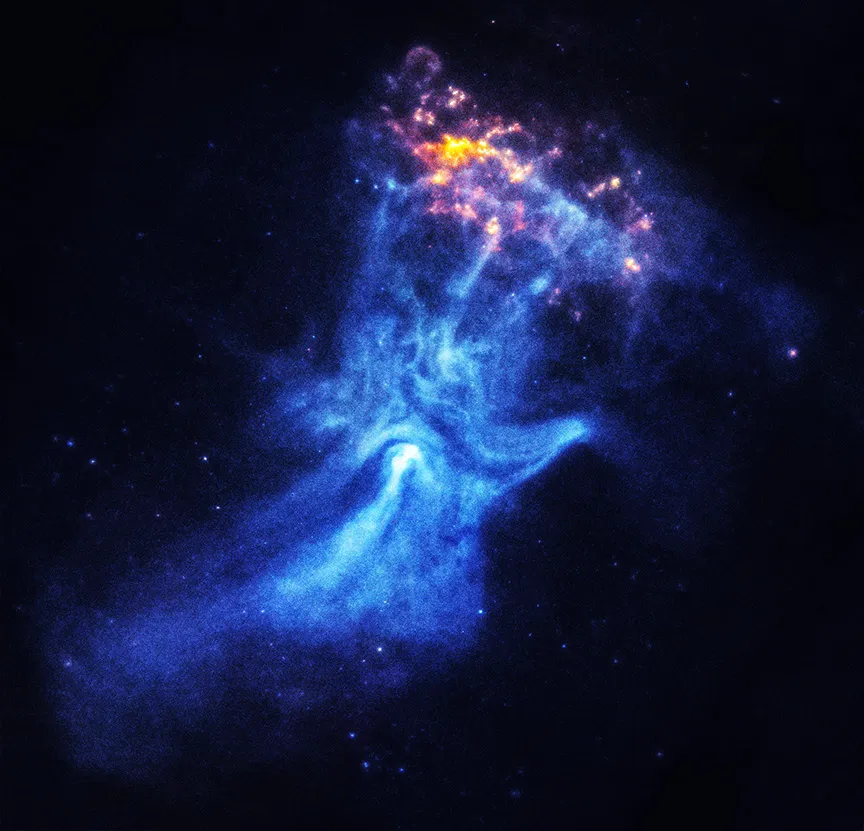
Notice that pulsars, along with the gases surrounding them, resemble the Heavenly Spirit in their shape.
In the previous fragment of the message, we spoke of the hand of God, which covers St. Peter's Basilica with its shadow—that is, the Holy Spirit. It turns out that there exists a hand-shaped pulsar, which has been called the Hand of God (photo 2).
Then I see the Pope seated before me. The Lady looks at me seriously, turns her head to the side, and says,
"Encourage your subjects. Not only encourage them, but they must work in a true Christian spirit. You think all this is good, but they must work with deeds. I understand enough. Demand even more social rights, justice, and love of neighbor. But... act not with words, but with deeds. Deeds can lead them to the light I have shown you."
Then I see Europe before me. The Lady says,
"Europe, be warned! Unite in good! This is not just an economic struggle; it is about the corruption of the spirit; it is a political-Christian struggle. This must come from above. They must set an example, but, unfortunately, so must the clergy. They must descend to the least of my number."
The quoted excerpt from the message calls for work in a true Christian spirit. But what characterizes this attitude? The answer is found in the Gospel. Christ, as the Living Word of God, through his own life and actions provided us with an excellent model for such activity. He spent most of his time among people, traveling through the cities and villages of ancient Israel. He carried out his mission outside the walls of the temple, traveling to Jerusalem primarily for the most important Jewish holidays, such as Passover, the Feast of Tabernacles, and the Feast of Weeks. This is clear proof that working in a Christian spirit has nothing to do with stagnation and passively waiting for people to come to the Church, which represents God on earth.
In the message of the Lady of All Nations, we hear a clear call to fight for humanity—for their social rights, justice, and authentic love of neighbor. It is precisely these specific actions that have the power to lead people to the Light, whose earthly representation is the Catholic Church. Anyone suffering from any kind of need in this world—whether hunger, thirst, poverty, or poor health—gains the opportunity for inner transformation when God's servants come to their aid. When this physical or existential hunger is satisfied, gratitude arises in the human heart, naturally drawing them toward God. It is important to emphasize here that experiencing human kindness is only the beginning of the journey toward the Creator—a journey whose ultimate goal is inner purification and holiness. The witness of mercy, therefore, becomes a key impulse. It awakens faith and leads one to begin to fulfill God's will in their lives with trust and love. It is worth noting that Christ, during his earthly mission, meticulously implemented this pattern of action. He healed the sick, fed the hungry, gave drink to the thirsty, freed the poor from the bonds of sin, and supported the poor, praising those who know how to share with those in need. He constantly called for love of neighbor, justice, and righteousness.
Therefore, if God's servants do not imitate their Master in this, man will not come to the Church on his own. Moreover, destructive ideologies immediately exploit this vacuum. Communism and modern humanism, reaching out to humanity with slogans of social rights, equality, and fraternity, cunningly seize human souls. People naturally follow those from whom they receive real support. The tragedy is that these secular systems use God's values in a perverse way—not to bring man closer to the Creator, but to lead him to sin and separation from God. In Christ's Church, these same acts of mercy are intended to lead to reconciliation with the Father and obedience to His will, which is expressed in His commandments. In totalitarian and atheistic systems, they become tools of division.
This situation faithfully reflects the events of Eden. It was then that Eve allowed herself to be seduced by the serpent, whose deception was cloaked in beautiful words and promises. The price for becoming entangled in this illusion, however, was Adam and Eve's turning away from God, breaking His holy will, and ultimately leading them to death. Contemporary ideologies operate in the same way—hiding their destructive intentions under the guise of charity and humanism. This is an extremely dangerous trap, which is why Our Lady of All Nations so clearly warns that this "other spirit" insidiously permeates both nations and the Church itself today, while the world often has no idea how deeply it is being manipulated.
The Gospel of Matthew (Mt 25:31–46) foretells the Last Judgment. All the nations of the earth will be judged precisely by their relationship with their neighbors. However, it is important to remember that we are talking about Christians from all nations—those who know and identify with God. It is difficult to judge those who have not been familiar with the writings of Holy Scripture. In biblical terms, these are pagans. That is why it is so important for God's servants to reach out to the various nations of the world and evangelize them. In this way, they gain the opportunity to live with God in the eternity to come.
Christ ruthlessly exposes the selfishness and indifference, especially of those Christians who failed to fight for the suffering, even though they were called to do so (Mt 25:41–45):
Mt 25:41-45
25:41 Then he will say to those on his left, "Depart from me, you cursed, into the eternal fire prepared for the devil and his angels.
25:42 For I was hungryand you gave me no food;
I was thirstyand you gave me no drink;
25:43 I was a strangerand you did not take me in;
nakedand you did not clothe me;
sick and in prisonand you did not visit me."
25:44 Then they also will ask, "Lord, when did we see you hungry or thirsty or a stranger or naked or sick or in prison, and did not minister to you?"
25:45 Then he will answer them, "Truly I say to you, just as you did not do it to one of the least of these, you did not do it to me."
25:46 And these will go away to eternal punishment, and the righteous to eternal life."
Through this parable, Christ unequivocally calls his disciples to active involvement in helping those in need. The experience of authentic love for neighbor becomes the key that opens the human heart to the Creator. In her messages, the Lady of All Nations clearly indicates that these "least of these" must be brought to the Light. Let us therefore look at them from a different perspective – one that refers to the parable of the host and the banquet.
The host prepared a great banquet to which he invited his chosen ones. However, they refused to participate because their hearts were too closely tied to the spirit of this world. We clearly see that they were not among the humble who – as we mentioned earlier – accept the Word of God. Those invited lived comfortably, so they saw neither the need for God nor the value of service, the purpose of which was to purify the world. When those invited excused themselves, the Lord commanded that those suffering from the spirit of this world and thus being alienated from it be brought to the banquet. Their condition causes them to live in enmity with the spirit of this world, thus fulfilling precisely the Book of Genesis, where God established enmity between the offspring of Eve and the serpent.
The Gospel of Luke specifies that these "least of these" include the poor, the crippled, the blind, and the lame, but also those who obey God's commandments. The essence of the biblical command to enter the feast is voluntary obedience to the Father's will, which is expressed in His commandments.
In the spiritual dimension, however, the Lord's Supper is the Eucharist celebrated in the community of the Church.
It is worth noting that the parable of the feast is also a profound image of paradise – the Garden of Eden, in whose center grew the Tree of Life, and God walked among his children. In the spiritual sense, the feast is Christ himself, nourishing us with his Word. In turn, the Lady of All Nations, as the One who bore this Fruit, becomes for us a spiritual Tree of Life.
Let us now return to the servants of God, whose task is to bring these suffering people to the Lord's Supper.
Mercy shown to a suffering person is the first, fundamental impulse—it awakens a desire for God and begins the process that leads one to holiness.
To better illustrate this truth, let us imagine a non-believer suffering from hunger. When a servant of God comes to their aid in God's name, feeding them and caring for them, they actually turn their face toward God. Through this experience, the poor person not only regains physical strength and comes to know God's mercy, but above all, they enter the path leading to salvation. They come to know God, His commandments, and justice, which ultimately reconcile them with the Father.
We see, therefore, that reconciliation between man and the Creator is achieved through a threefold foundation. First: love, that is, showing mercy to one's neighbor in God's name. Secondly, justice – the spirit of this world has already been judged, therefore those who follow it will end in a similar way. And thirdly, righteousness, which consists in faithfully and actively fulfilling the will of the Most High.
It is worth noting that in the parable of the banquet, the host's servants use precisely these three values to gather people around the Lord's table. However, God's justice also has a second, harsh face in this context. It directly affects those who rejected the invitation. Those who have come to know God and yet boldly refuse to obey Him – trampling on His covenants and rejecting the Father's love – will inevitably be visited by justice, which is death, as foretold in paradise.
The task of the Church – as God's faithful servant – is to continually reach out to these simple people and bring them into the community of the Lord's table. Those Christians who faithfully fulfill this duty will be called righteous by the Lord and enter into the joy of the Kingdom of Heaven.
In the message of the Lady of All Nations, we also hear a call for Europe to unite in goodness, which—as we have already clarified—is the Light that God created and called good before anything existed on earth. This Light is the Holy Spirit. On the one hand, He brings comfort to those who suffer, and on the other, He reveals to the world its sin and points to God's justice and judgment. We see, then, that this is the same Comforter about whom Christ spoke to his disciples before his Passion:
Jn 14:15-17
14:15 If you love me, you will keep my commandments. 14:16 And I will ask the Father, and he will give you another Advocate, to abide with you forever —
14:17 The Spirit of truth, whom the world cannot receive, because it neither sees him nor knows him. But you know him, for he abides with you and will be in you.
Jn 14:25-26
14:25 These things I spoke to you while I was with you.
14:26 Now the Advocate, the Holy Spirit, whom the Father will send in my name, will teach you all things and remind you of all that I have said to you.
Jn 16:7-11
16:7 But I tell you the truth: It is for your good that I go away. For if I do not go away, the Advocate will not come to you. But if I go away, I will send him to you.
16:8 And when he comes, he will convict the world concerning sin, and righteousness, and judgment:
16:9 concerning sin, because they do not believe in me;
16:10 concerning righteousness, because I am going to the Father, and you will see me no more; 16:11 concerning judgment, because the ruler of this world has been judged.
The call to Europe is meant to remind it of what it has already forgotten: sin, God's judgment, and justice. Today, we see a clear relativization of God's law and the erasure of the truth about the Last Judgment from human consciousness. Even within the Church itself, voices are emerging that marginalize the reality of hell—yet, rejecting this truth leads to a denial of God's justice. An illusion of no moral requirements is created, justified by the false belief that since all have been redeemed by Christ, God's law has ceased to apply. In this way, both Europe and the Church are being insidiously undermined by the same ancient spirit that once tempted Eve to eat the forbidden fruit. It operates today as well, but in a different way: through various ideologies that separate humanity from God. The principle remains unchanged: the evil spirit seeks to lead humanity into sin through apparent goodness, which in reality leads to death. This ancient spirit is insinuating itself into the Church in a remarkably insidious way: through priests who have not accepted their vocation to unite creation with the Creator, but to sow division.
Godless ideologies are increasingly permeating the Catholic Church. A prime example of this was the dramatic disputes surrounding the encyclical Humanae vitae, when two factions clashed within the Church, the progressive side clearly embracing human ideologies. This document essentially constituted a renewal of the covenant with God, as it unequivocally upheld God's order in the sphere of procreation, opposing contraception and abortion. Today, from behind the church walls, we hear voices that align with the demands of modern humanism, demanding acceptance of sexual freedom, universal access to contraception, and the sanctioning of same-sex unions. In this context, as mentioned earlier in the message, Germany is becoming a glaring example of the destructive influence of this "other spirit."
That's why working in the Christian spirit in Germany is so important—concrete actions are necessary. The Holy Spirit can inspire us, show us the way, and enlighten our consciences, but he will not force us to act. Good does not happen on its own—it depends on our decisions, will, and deeds. We can endlessly discuss problems, but their solution lies in our own hands. Without real action, nothing will change. By asking for the Holy Spirit, we receive strength and light for spiritual struggle—with Him, it is easier to discern what is good and what is evil in today's reality, which is attacked from all sides by the spirit of this world.
The Lady of All Nations addresses a dramatic warning to Europe, calling it to unite around good, thus becoming a model for the entire world. The lives of Europeans should be based on love of neighbor, justice, and truth—values that constitute the only foundation of true peace and unity. Israel was once chosen to be a light for the nations and a model of life in accordance with God's will. However, as we ourselves see, these values cannot be found there. Therefore, the call to be a beacon for others is directed at Europe – a continent with deep Christian roots, which must rediscover and undertake its historical, spiritual mission.
The Lady of All Nations points out that, in addition to wars of purely economic nature, far more dangerous spiritual wars are raging in the world: political-Christian ones. These two opposing spirits symbolize two clouds that should under no circumstances mix. The red spirit does not engage in open combat, but insidiously penetrates the white one. In this way, the values of godless ideologies creep into Christianity and the Church, as clearly seen in the examples already discussed: in the efforts to accept same-sex couples, contraception, and abortion. Therefore, the Lady of All Nations decisively separates these two clouds, thus separating good from evil.
This directly alludes to the beginning of creation described in the Book of Genesis, when God brought into being the Light to separate good from evil – and thus light from darkness. The Holy Spirit does exactly the same in our hearts today, pointing out the clear difference between good and evil. The Tree of Life of Paradise, which is Light, refers to this first, fundamental act of God's creation.
Then I see, above the Pope and St. Peter's Basilica, the words written in large letters: "LOVE OF NEIGHBOR, JUSTICE." The Lady says,
"This is the great mistake of our times. If we don't live by this, things will get worse and the world will fall apart. Everyone must take care of this and live by it."
Then it's as if the Lady were placing a cross in my hand and, as she points to herself, saying,
"Not me, but the Cross."
The above image directly alludes to the covenant God made with Noah and all humanity. According to the biblical message, when the Creator stretches his bow across the clouds, the flood will never again destroy all life on Earth. It's worth remembering, however, that the biblical flood was a direct consequence of human corruption and the moral decline of the world at that time. It's difficult, therefore, to assume that an atmospheric phenomenon alone would protect humanity from destruction, regardless of its spiritual condition. The rainbow must therefore symbolize specific values, the absolute opposite of sin.
Recall that his immediate family was saved along with Noah, and the covenant was made only after everyone had left the ark. The foundation of a healthy family is living according to universal principles: love, justice, and righteousness. It was these values that God saw in Noah's house. He based his covenant on them, and the stunning arc of the rainbow made them a visible, timeless symbol.
God desires for all humanity to become one great family – only then can true peace reign in the world. A perfect example of this is Europe, which the Lady of All Nations calls upon to unite in Goodness and Light. Such a community would shape relations between nations based on the model of a good family, in which God is the Father – just as in the days of Noah, when his loved ones emerged from the ark. The fact that the Lady of All Nations so strongly emphasizes the need to return to these values in the Old Continent clearly demonstrates their contemporary crisis. This message unequivocally condemns the current state as an error, sharply drawing the line between good and evil. Therefore, when the Lady of All Nations spreads the clouds, thus alluding to the ancient covenant, and these fundamental values are lacking in the world, dark clouds gather over St. Peter's Basilica, foreshadowing torrential rain.
The mission of Christ's Church is to build love of neighbor, justice, and righteousness in the world. If these values disappear, the Christian community will sooner or later feel the consequences itself, a direct consequence of the inaction and indifference of the clergy, who avoid working for good. The evil spreading throughout the world will ultimately strike at the Catholic Church and its hierarchs. This is the third part of the Secret of Fatima, which depicts the Pope, clergy, and faithful walking through a war-ravaged world, amid countless bodies and immense suffering. As they ascend the symbolic Golgotha, they are slaughtered by soldiers. This is a shocking image of the consequences of the Church's abandonment of its fundamental mission: to cleanse the world of iniquity and to make it just, righteous, and filled with love.
The contemporary world is becoming terrifyingly similar to that of before the flood. Dark clouds hanging over St. Peter's Basilica foreshadow the storm and the destructive element that washed all iniquity from the earth in the days of Noah. This image is a powerful warning and an urgent wake-up call for the people of the Church. If they fail to take action, everyone will suffer a similar fate.
Notice that the message mentions only two of the three values: love of neighbor and justice. Righteousness is lacking. So where has this third value disappeared? As mentioned earlier, these three values also symbolize Mounts Gerizim and Ebal, at the foot of which—in the temple city of Shechem—the covenant with God was renewed. Mount Gerizim is the mountain of blessings, from which blessings flow down to the people if the covenant with God is faithfully kept. The Lady of All Nations is the embodiment of the missing value—righteousness—and she personally symbolizes the mountain of blessings.
Mount Ebal, in turn, is the mountain of curses that befall the people when the covenant is broken. It is therefore the mountain of God's justice. The temple city, which in our case represents the Vatican, is meant to unite both realities, bringing peace and love between the spiritual and corporeal worlds.
We see, then, that in reality we possess all three values, for righteousness is associated with the Lady of All Nations. However, the matter is not so simple – we clearly hear that these values are lacking in the world, and the message calls upon the clergy to work to reverse this state. Therefore, the Lady of All Nations calls on Ida Peerdeman to direct people's gaze not to her, but to the cross. We live in times that require intensive work for good – everyone must take up their cross and crucify all that opposes God's will, and then undertake the mission of making this world good.
The Lady of All Nations commands the seer not to focus on her figure, because humanity in its current state does not deserve blessings. These can only be poured out upon a given community when it is good. The lack of these graces is the result of the breaking of the covenant with God. If humanity had honored the covenant commitments, the visionary's gaze would have rested on the Lady of All Nations, and the Cross itself would have remained invisible. However, if humanity rejects the covenant with the Creator, it automatically falls under the harsh curses of the Book of Mosaic Law. It is precisely these punishments that are to befall Europe, as the prophecy contained in the next fragment of the message warns. These prophecies will inevitably be fulfilled unless humanity comes to its senses and embarks on the path of authentic, brotherly love.
The Lady allows me to read from a tablet on which it says, "50-51-53," and says,
"In this period of time, fighting will break out and disasters will come."
Then She holds one hand over the dome, as if protecting it, and the other in front of my eyes. I feel a terrible, burning pain in my hand. "It is unbearable," I say. Then the Lady says emphatically,
"This spirit will constantly try to penetrate, in the most diverse forms; slowly and subtly. It will penetrate in such a subtle way that the nations will not recognize it. Once again, I admonish you to convey this."
The Lady of All Nations announces that in 1950, 1951, and 1953, there will be struggles and catastrophes. In the context of the Vatican, we are talking about a battle against "that other spirit" that permeates the world unnoticed and insidiously, so that nations will not even be able to recognize it. The serpent acted in exactly the same way when it seduced Eve, who remained completely unaware of the threat. It is the same mechanism, only times change. Let us also remember that after Adam and Eve broke God's commandment, God established enmity between the serpent and the woman and her offspring – therefore, this serpent spirit is constantly at work today. However, it has different faces, manifesting itself through various ideologies, such as the spirit of communism or modern humanism. It is present wherever there is a division between God and man. Thus, for centuries, a constant struggle between the good and the evil spirit has been waged.
When the disciples tell Jesus that they encountered a man casting out demons in His name, He replies, "Whoever is not against us is for us." These words clearly indicate that there are two opposing spirits engaged in constant battle. There is no middle ground here—there is an exclusive division between good and evil. There is no "third" spirit that, standing on the border between these two realities, could be described as "lukewarm." This state of spiritual polarization is perfectly illustrated by a game of chess, in which only the white and black pieces face each other. There is no room for a third side or alternative colors. Although the individual pieces belonging to one side differ in function, they represent the same camp—and in exactly the same way, both good and evil take on different faces in the world.
Anyone who fights the Light, which is Good, sides with God's adversary, namely evil. The latter will always oppose good, because that is how God established it in paradise. It's worth emphasizing that we're talking about active struggle here, not passive, indifferent observation of evil. Anyone who considers themselves a disciple of Christ is absolutely obligated to undertake this effort. This evil spirit will do everything, using every trick to ultimately suppress good.
Let us now turn to the indicated years in which the predicted catastrophes and wars are to occur. Note that these are three dates: 1950, 1951, and 1953. We can clearly see that they reflect the three values spoken of by the Lady of All Nations: Law, Love of Neighbor, and Justice. As it turns out, during these very years, a deep dispute raged within the Catholic Church over the redefinition of these concepts, dictated by external pressures. In 1950, the dispute raged over the definition of God's law, in 1951 over what love of neighbor is, and in 1953 over what justice is and how to understand it. So let's take a look at each of these values that were tried to be changed back then:
- Law – In 1950, a fierce dispute raged in the Holy See over whether God's law should be obeyed universally, or whether there were life situations that exempted one from its application. Thus, we see that attempts were not made to change the content of the Ten Commandments, but rather to deviously employ tricks designed to demonstrate when the commandments lose their validity. Progressive theologians, yielding to external pressure, began to proclaim that God's eternal commandments and dogmas were not absolute but subject to relativism – that is, their validity depended on a person's circumstances. In these circumstances, the evil one, using the so-called "new theology" emerging in Western Europe, attempted to redefine Catholic doctrine. The insistence was that the eternal principles and truths of faith should be adapted to modern philosophies and secular humanism. From this source, a dangerous illusion was derived: that human conscience can, in specific situations, make an exception to the commandments and suspend their application. Note that in this way, various ideologies, including modern humanism, are currently attempting to introduce the right to legal abortion, which, according to them, should be decided solely by a person's conscience—where the termination of an unborn child can be justified by career advancement or a more comfortable life. The Vatican's response to these actions was Pius XII's encyclical Humani generis of August 12, 1950, in which the Pope firmly condemned this destructive relativism. Rome then defended the truth that God's law is an unchanging rock that absolutely binds every person. This exposed the ruse of "another spirit," which, through so-called situational morality, attempted to reduce the Creator's commandments to meaningless, historical guidelines.
- Love of neighbor – Let us now move on to the year 1951, when a dramatic struggle for the proper understanding of love of neighbor erupted. In the Gospel, Christ showed us precisely what it is. It is helping the poor, feeding the hungry, giving drink to the thirsty, and supporting the sick – all done in the spirit of God. In the Gospel according to St. Luke, we read about a host who ordered his servants to bring such people to a great feast. When a needy person receives help in God's name, they come to know Him, and this becomes the first step in entering God's path of righteousness and justice, the ultimate goal of which is the person's sanctification. Such help is carried out in the Catholic Church through missions conducted in various countries around the world, especially in those places where the largest numbers of people whom the host ordered to be brought to the feast are present. We can therefore clearly see that when we help someone, for example, by giving alms, it should always be done in God's name. Such an act becomes a spiritual impulse that can awaken in the recipient a deep desire to know the Creator and follow His path. Every converted sinner makes the world a better place and brings greater peace. God alone is the giver of good, as we discussed earlier, when at the beginning of creation, before anything on earth existed, he first created the Light, which he called good. This Light has been passed down from generation to generation since the beginning of humanity, and over time it should shine with increasing intensity. However, we see that the opposite is currently happening. Humanists wrongly assume that good evolved from within humanity itself—a mechanism stemming from the need to live in a gregarious environment. This example clearly demonstrates how the spirit of this world, using human reason, can separate it from God, who builds this world according to its own eternal and good assumptions. In 1951, the Church experienced bloody communist persecution on the mission field. In response to these dramatic events, Pope Pius XII issued the encyclical Evangelii praecones. This document arose from the brutal persecution and suppression of Catholic missions in communist China by Mao Zedong's regime. The Holy Father wrote it in deep anguish, as the communists arrested the Apostolic Nuncio, imprisoned priests and nuns, and forcibly separated millions of Chinese Catholics from communion with the Vatican. The primary goal of this encyclical was to save and revitalize these missions in the face of the devastating onslaught of the Red regime. In it, the Pope called for the urgent creation of independent, indigenous local Churches with their own indigenous clergy, as the communists were insidiously spreading lies among the people that white missionaries were spies for the West. This tragic reality is reflected in the message, where the Lady of All Nations holds her hand over St. Peter's Basilica and with the other covers her eyes, while Ida feels an extraordinary pain in her hand. This moving image foreshadows the persecution of the Church by communism, which in 1951 particularly targeted missionary activity that promoted Christian love for one's neighbor. The communists did not tell the Chinese to "be bad people." They brought secular slogans about "brotherhood, popular love, and social rights," claiming that Christian mercy was a relic of capitalism, and that no one needed God to love one's neighbor. However, the Marxists' intention was not true goodness, but the desire to take possession of human souls. Communism, though often uttered with beautiful words, is an exploitative ideology and an exceptionally bloody regime. It is this "other spirit," operating through communist ideology and employing catchy slogans about human brotherhood, that leads to the blatant violation of God's law. Meanwhile, authentic love among neighbors aims at the complete opposite: to closely unite the Creator with humanity. This means that love of neighbor must always go hand in hand with God's law and justice. These are three inseparable values that bring peace between people and simultaneously unite them with God. True Christian mercy, therefore, cannot in any way oppose or suspend God's law. This is precisely the hidden trick of the "serpent," which tries to separate these values from one another—that is, to speak of love of neighbor while failing to uphold God's law or justice.
- Justice – Let us move on to the last of three key dates – 1953, which brought the apogee of the Vatican's suffering and forced the Church to finally define what true justice was. Outside, behind the Iron Curtain, godless communism pursued its own destructive concept of "people's justice," symbolized by the brutal, unlawful imprisonment of Polish Primate Stefan Wyszyński on September 25, 1953, and of numerous other hierarchs throughout the Eastern Bloc. The Vatican's direct response to this profound crisis and the emergence of a new political order after the war was the groundbreaking address " Ci riesce", addressed directly to the participants of the 5th National Congress of the Association of Italian Catholic Lawyers. The overarching goal of this document was to determine how Christian states should treat religious and moral error within the framework of emerging international law. In it, the Pope attempted to halt a dangerous redefinition of justice. Instead of traditional tolerance—that is, the painful enduring of falsehood in order to avoid greater evil, bloodshed, or war at the legislative level—the new international community began to demand that erroneous cults and doctrines be granted the full, natural right to operate on a par with revealed Truth. Note that ideologies such as communism and modern humanism create their own order, which has nothing to do with God's law. European governments therefore sought to define justice as the freedom of individuals to choose other religions and doctrines, which were to be legally protected by individual countries. Thus, national legislation would become dependent on a given, protected belief system or ideology. A good example of this paradox is the recent events in England, where Sikhism—as an exception to British knife laws—formally allows the possession and carrying of a ritual dagger called a kirpan in public places. Among Catholics and other citizens, however, carrying bladed weapons is strictly forbidden. This religious regulation led to the brutal murder of an eighteen-year-old student of Polish descent, Henry Nowak, with a large ceremonial knife that the perpetrator, a Sikh named Vickrum Digwa, carried publicly for religious reasons. This tragedy sparked a massive debate in Great Britain over the injustice of secular law, which, in the name of political correctness and the protection of foreign cults, creates dangerous privileges that cost innocent lives. This leads to a terrifying relativism, in which what for a Christian remains God's inviolable commandment "thou shalt not kill," in the eyes of modern humanism or other cults, is brazenly declared a "human right" to legal abortion. In response to this idea, Pope Pius XII formulated the inviolable principle of Catholic justice. He categorically declared that no human authority, no state government, or even a community of nations has the right to issue a positive command or authorization to do or teach anything that is contrary to religious truth and moral goodness. The Pope recalled the stark fact that whatever does not correspond to God's moral law objectively has no right to exist, propagate, or act. Although human governments ignore the Creator and pretend to have the power to establish justice independently, their laws have no binding force before God's court, because God's supreme justice and the Last Judgment still hang over the entire world.
In her message, the Lady of All Nations clearly states that a time of great struggles would come. This announcement was fulfilled with absolute precision. These struggles were primarily spiritual in nature, although in the case of communism, they also took the form of physical persecution. However, the message also speaks of the catastrophes that were to come. It turns out that in precisely those years, natural disasters befell the nations openly fighting against the Church of Christ to separate God from humanity—and this precisely in the context of the flood we mentioned earlier.
If we take a closer look at the hard historical facts, we see that God's justice responded to man's audacity with destructive elements that swept across Europe precisely within the timeframe indicated in the prophecy:
- 1950 – Towards the end of this period, when the Church attempted to relativize God's eternal law, the first severe weather anomalies descended upon Europe. Powerful, sustained downpours caused rivers to burst their banks and caused devastating floods in Central and Southern Europe – including Romania, the Balkans, and the Alps. In November 1950, a major weather anomaly, known historically as the Great Appalachian Storm, also struck the United States. This cataclysm brought torrential downpours, flooding on the East Coast, and massive snowfall, which reached record levels in states like Ohio and West Virginia. The storm completely paralyzed the region, collapsed hundreds of buildings, and claimed 383 lives, becoming one of the most devastating disasters of the period.
- 1951 – At the beginning of this period, a wave of extreme weather reached its tragic climax in the mountains, becoming known as the "Winter of Terror." In January and February 1951, on the border between Austria, Switzerland, and Italy, an unusual clash of fronts triggered sudden rainfall that locally dropped up to 4.5 meters of snow. This led to a gigantic, devastating series of 649 avalanches. The avalanche completely buried entire mountain villages, destroyed infrastructure, and isolated over 40,000 people. In Switzerland, the most devastating impact was on the towns of Andermatt, Vals, and Airolo, destroying 1,500 buildings. The total death toll from this snow disaster was over 265, with 135 in Austria and 98 in Switzerland. The next major blow came in November 1951, amidst a painful missionary crisis within the Church. It was then, in northern Italy, in the Po Valley itself, that powerful, continuous downpours caused a river to burst its banks. The floodwaters killed over 100 people, drowned 30,000 head of cattle, and destroyed vast swaths of farmland, completely ruining local crops.
- In 1953, as the period of struggle with the Holy See reached its peak, the foretold symbolic flood descended upon the countries that had most vociferously demanded a secular redefinition of justice and tolerance for error. On the night of January 31st to February 1st, 1953, a powerful, hurricane-like storm in the North Sea led to the most tragic flood of the century in Europe. The seawater burst its protective embankments with enormous force and surged 75 kilometers inland. This cataclysm affected the British Isles and Belgium, but its main epicenter was the Netherlands – the homeland of the apparitions of Our Lady of All Nations and the official birthplace of modern humanism in 1952. The flood claimed over 1,800 lives there, submerged hundreds of thousands of hectares of land, and reduced thousands of homes to ruins, revealing humanity's utter helplessness before the power of God's wrath.
Our reflections lead back to the moving image of the Lady of All Nations shielding the Catholic Church with her own hand. We previously spoke of the Old Testament story in which the Assyrian king, conquering one nation after another, stood with his army before Jerusalem. The invader destroyed local temples and idols, so his pride and self-righteousness prevented him from feeling any fear of God Yahweh. King Hezekiah of Jerusalem, seeing the impending threat, went to the Temple to ask God for help, and He answered his prayers. We are now witnessing a similar event in the case of the Catholic Church, which is being attacked from various sides by the same ancient spirit, taking on various guises. It operates through contemporary ideologies such as communism and modern humanism, and seeks to utterly destroy the Vatican, which we can witness firsthand today.
This story, which forms the core of the message of the Lady of All Nations, had its conclusion in the Old Testament, a point worth recounting now. The Lord God made a promise to King Hezekiah of Jerusalem that the ruler of Assyria would return the same way he came. So what happened then that forced the enemy forces to retreat? It turns out that God sent his Angel, who defeated 185,000 Assyrians in their own camp, prompting Sennacherib to return to Nineveh (Isaiah 37:36-37).
Is 37:36-37
37:36 [That same night] the angel of the LORD went out and struck down a hundred and eighty-five thousand in the Assyrian camp. And behold, in the morning, when it was time to rise, they were all dead.
37:37 Then Sennacherib king of Assyria broke camp and departed, and returned and abode at Nineveh.
We see, therefore, that in the case of God's Temple, the Catholic Church, we are currently facing a similar situation. Convinced of their own wisdom and strength, individual nations took up arms against God's Church, resulting in disasters caused by the elements of nature—against which, as we can see, they proved utterly powerless. In previous reflections, we mentioned that the four elements—fire, water, wind, and earth—are identified with God's angels.
Since these societies have rejected God and His order, defined by the three values inscribed in the divine arch—righteousness, love of neighbor, and justice—they are approaching the pre-flood state of humanity. Therefore, they were visited by floods, harkening back to the times of Noah and the expected cleansing of the earth from sin. Note that the countries that officially united under the umbrella of international humanism suffered the greatest loss of life in floods and avalanches. Recall that in 1952, a congress was held in Amsterdam, at which the decision was made to establish an international humanist movement. The organizations participating in this event included the following entities:
- American Humanist Association – from the United States.
- American Ethical Union – also from the United States.
- Dutch Humanist League (Humanistisch Verbond – Dutch Humanist Union) – from the Netherlands (main host of the congress).
- Vienna Ethical Society (Wiener Ethische Gemeinde – Vienna Ethical Society) – from Austria.
- British Ethical Union (later Humanists UK) – from Great Britain.
The Netherlands became the cradle of modern humanism. It was there, in Amsterdam, that the congress that launched this ungodly movement worldwide was held in 1952. Shortly thereafter, during a tragic flood, approximately 1,850 people—1,836 to be precise—perished in that country. Note that the Angel of the Lord once struck down 185,000 Assyrians attacking the Temple in Jerusalem. This convergence of numbers is movingly reminiscent of that Old Testament event. In the case of the Assyrians, we speak of hundreds of thousands of victims, but the symbolism of the numbers is intended to draw our attention to that event—its causes and consequences. As we can see, the element of water, identified with the Angel, brought death to the rebels—just as it did to the Assyrians.
It was in the countries that joined the organization of international humanism that the greatest number of people perished during the years described in the message. These events were the tragic consequence of the nations' rebellion against God. In Great Britain, the same flood in 1953 claimed 307 lives on land and 224 at sea. In Austria, in early 1951, catastrophic avalanches triggered by a massive rainfall anomaly claimed 135 lives. In November 1950, the Great Appalachian Storm in the United States , bringing coastal flooding and a massive snowstorm, claimed 383 lives. In the Netherlands, as mentioned, 1,836 people died.
Then I see Italy. I see a humble, ordinary man, some kind of priest. It's as if he's standing in the middle of a group of people, giving a speech. The Lady smiles and points at him. As I watch, She says,
"This Lombardi, this one is doing it well. This one is working in the direction We want."
Then I see two rows of different churches in front of me. It's as if the Lady were walking to the front row and very lightly running her hand over it. I see these churches all collapsing and disappearing together.
In 1948, Father Riccardo Lombardi began his "Crusade of Goodness." Traveling across Italy, he tirelessly and powerfully proclaimed the Gospel in simple words, always prioritizing the love of God. His humble yet deeply moving demeanor touched the hearts of his listeners and led many to conversion. His message was received with openness, gratitude, and interest.
Following Jesus and his first disciples, Father Lombardi reached out to people and courageously carried his cross. The arduous journey was inextricably linked to suffering, both physical and spiritual. This stems from the fact that the evil one always opposes good. Therefore, anyone who tries to introduce it into the world will encounter suffering, misunderstanding, and often persecution. This means that as long as evil exists on earth, the Cross remains an integral part of the Christian mission.
The Italian friar perfectly fulfilled the call of Christ, who asked his disciples to take up their cross and follow Him (Mt 16:24). The Lady of All Nations points to this humble priest as a model and emphasizes that this is precisely the attitude expected of all who live in the world for Christ.
Father Riccardo Lombardi did not isolate himself from the world with walls, but reached out to others and united them around him. This is precisely the model of priesthood that Christ left us, as he traveled through cities and villages, gathering crowds around him. He also reminded us that the true enemy of man is not another human being—capable only of killing the body—but the evil spirit, which can destroy both body and soul in hell (Mt 10:28). This attitude also stems from a fundamental principle of the Gospel: light should illuminate the path for others, not be burned under a bushel (Mt 5:15). The vocation of priests is therefore to bring God's Light directly to people. Closing ourselves within the walls of churches makes churches a barrier to this Light. They begin to act exactly as if they were a biblical bushel.
Father Riccardo Lombardi imitated Christ not only in his actions – his life unfolded in a similar manner. In 1961, the monk published the book "The Council: For a Reform in Love," in which he called for the abandonment of all careerism in the clergy and for the election of a pope, even from among those who were not cardinals. The book was not well-received by the Holy See, and as a result, the priest was sidelined at the end of his ministry. The rejection by his brethren caused a deep depression in him, which ultimately contributed to a serious illness. He struggled with it for the last three years of his life. This outstanding Jesuit died like Christ – rejected by his brethren and in immense suffering.
In the Book of Isaiah, we read that during the invasion of Jerusalem, the Israelites built stone barricades, which ultimately proved completely useless. God listened to King Hezekiah and, through His Angel, personally repelled the threat posed by the Assyrian ruler (Is 22:10-11). However, the Creator reproaches the people for instead of seeking support from Him and turning to Him in prayer, they completely forgot Him, placing their trust in man-made barricades. Their behavior was direct evidence of rebellion and a lack of faith. While awaiting the Assyrian assault, they carelessly indulged in feasting and merrymaking, saying, "Let us eat and drink, for tomorrow we die" (Is 22:13).
Modern priests can be compared to this event. Instead of reaching out to the people and carrying out God's mission, they retreat within the safe walls of churches, where they lead comfortable lives. They behave as if they see the Church beginning to crumble under the pressure of the modern world. Consequently, they act so as not to offend anyone and to preserve their own status and peace at all costs. Yet, the Christian life will always be a priceless suffering, because the world is still tainted by sin, and evil invariably opposes good.
God, outraged by the words of the priests, who call for an unthinking enjoyment of life before death, announces that this sin will never be forgiven—until their final days (Is 22:14).
Is 22:9-11
22:9 You saw that the walls of the City of David were breached in many places; you gathered the water of the Lower Pool;
22:10 you numbered the houses in Jerusalem and tore down the buildings to strengthen the city wall.
22:11 you made a reservoir for the Old Pool between the two walls; but you did not consider the Maker of these things , nor did you consider Him who formed them long ago.
22:12 But the LORD, the God of hosts, called [you] on that day to weeping and to mourning, to shave your hair and to put on sackcloth.
22:13 But in the meantime [nothing but] joy and merrymaking, slaughtering oxen and slaughtering rams, eating meat and drinking wine: "Let us eat and drink, for tomorrow we die!"
22:14 But the Lord of hosts declared in my ears, "Surely this iniquity shall not be forgiven you until you die,"
said the Lord of hosts.
God explicitly declares that this particular sin of pride and cynicism places a seal of condemnation upon them, a seal that will not be lifted until death. This means that they will die in sin, and their souls will be damned. As the spirit of this world attacks the Church with increasing intensity, priests and all people should work much more zealously to overcome it with God's help. As the example from the Book of Isaiah, to which the message of the Lady of All Nations refers, indicates, the Community of the Faithful should turn to God with greater intensity in prayer. It is worth noting that Fr. Lombardi, held up to us as a model by the Lady of All Nations, never walled himself off from others. He did this despite numerous threats from communists and other enemies of the Church.
The friar was distinguished by deep faith and relied entirely on God. He wanted to fulfill the Gospel mandate and, like the first disciples, reach out directly to everyone, without any barriers. However, due to the real threat of attack, state authorities and superiors decided that the priest must be accompanied by a police escort during mass gatherings. This was intended to prevent a potential tragedy, although it happened completely against the clergyman's own will.
During Christ's earthly ministry, when the disciples marveled at the magnificence of sacred buildings, Jesus foretold their destruction, warning that not one stone would be left upon another (Matthew 24:1-2). However, Christ revealed a completely new dimension of this reality when he spoke of the temple of his own Body (John 2:21). Since Christians are to imitate him, as his disciples they also become living temples on earth. Father Riccardo Lombardi, standing among the crowds and proclaiming the Word of God, was precisely such a shrine of God – a beacon showing the way to those lost in the darkness.
The monk walked the world on the way of the cross and evangelized it exactly as Christ commanded, calling his followers to take up their own crosses (Mt 16:24). This doesn't mean, however, that church buildings are useless. Living temples are meant to draw people into their midst—to the feast God has prepared for his children.
In the image of the message, Ida Peerdeman sees two rows of churches, over which the Lady of All Nations gently passes her hand, knocking down the first one. At this point, the symbolism begins to allude to a game of chess, with two rows of pieces set up. Those at the back are crucial, while the pawns advanced serve as a shield and a protective wall. Thus, the Lady of All Nations tears down this wall, revealing the noble pieces in the second row, which directly reflects the message of this part of the message. This image harmonizes perfectly with the Book of Isaiah – God's people are not to be protected by stone walls, but by unconditional reliance on the Creator (Isaiah 22:11). As we will see in the next fragment of the message, this support is to be provided by the Lady of All Nations, who surrounds the See of Peter with her protection.
Then the Lady says again,
"Child," and traces a kind of rhombus before me.
"Child, this is the Center Point."
I now see the dome and the wall around it, just as the Lady traced it. Suddenly I see that it is the dome of St. Peter's Basilica. Around it, on the outside, flows a small stream, separated by a thin black stripe. The Lady points to it and says again,
"This is the Center Point."
Then the Lady moves her finger back and forth, very slowly and firmly, and says,
"Let this remain the Center Point! The spirits of the world want to destroy this Point. I will help you."
Now I see the Lady once again holding her hand over the Pope and St. Peter's Basilica.
Then I suddenly see, to my left, a large black paw, with long, pointed talons. It is as if this paw were digging through everything in St. Peter's Basilica. Oh, what pain overwhelms me. Everything in front of my eyes turns pink and red. As this paw begins to rise above everything, I see a black eagle in flight. It flies to the left, beating its wings strongly.
In the message of the Lady of All Nations, a mysterious rhombus figure appears. Initially, it appears vertical, but then transforms into a horizontal plane, becoming the wall surrounding St. Peter's Basilica. The correct interpretation of this symbol is crucial – the actual fortifications surrounding the Vatican Basilica have a completely different outline.
The rhombus shape directly references the principles of ancient heraldic art. In this system, geometric forms and symbols were not merely decorative, but conveyed precise legal and social messages. In the classical Western European tradition – particularly the French, English, and Scottish – the vertical rhombus was the shape of a heraldic shield, indicating that it belonged to a maiden or widow. Because women did not participate directly in warfare, they did not use the classic knightly battle shield.
When a woman married, her family emblem was combined with her husband's coat of arms on a classic knightly shield. If, however, she became a widow, this combined symbol was once again placed on a diamond-shaped shield.
It is worth noting that in heraldic art, the diamond can serve two purposes: it can be either the outer contour of the shield itself, or merely a geometric pattern painted inside.
In our case, the diamond-shaped frame defines the outer shape of the shield. It delineates the limits of the spiritual protection that the Lady of All Nations extends over the Holy See. Therefore, the Church should not seek support in material, stone walls. In the image of the message of the Lady of All Nations, she herself knocks the first row of pawns off the chessboard with her own hand—those that formed the wall protecting the nobler pieces. The true protection of the Holy See is God, who speaks through her, just as he once spoke through Christ.
This protection is confirmed by subsequent passages in the text, in which the Lady of All Nations shields St. Peter's Basilica with her hand. However, this is not a shield of stone and concrete, but a spiritual barrier, erected in prayer to God through the intercession of the Lady of All Nations.
Let's now return to the diamond-shaped shield, which constitutes the spiritual shield of the Holy See. Notice that at its center, the seer sees the dome of St. Peter's Basilica, which is circular. These two elements create a specific geometric figure: a circle inscribed within a rhombus. In heraldic tradition, such a shield is called a rustic (photo 3). Due to its unique shape, in ancient military tradition, the rustic was often associated with a piece of armor. Before the era of full plate armor, knights wore so-called chainmail or scale armor, in which metal, rhombic plates with circular holes were sewn onto the skin or connected by rings. Symbolically, the rustic refers to a part of the armor that protects the wearer.
Ida Peerdeman then again sees the dome of St. Peter's Basilica, surrounded by a stream separated from the rest by a black line. However, the original text does not indicate whether this line is on the outside or inside of the dome. This demonstrates the ambiguity of the text in official publications of the messages of the Lady of All Nations. Much more detail is available from archival recordings, in which Ida Peerdeman describes these images in her own words. Let us therefore provide a transcript of this recording:
(15:12) And then at a certain point I see the Woman drawing a rhombus shape.
(15:19) It's a rhombus placed on its top.
(15:22) You know how it is, a rhombus on its top.
(15:25) Then I see a dome, and around it a wall in the shape She drew.
(15:31) That is, in that shape with a top.
(15:34) And I see this dome again later – that it belongs to St. Peter's Basilica.
(15:41) Then around it – I could have presented this a bit unclearly here. (15:46) Because for me it was all a bit strange too.
(15:49) So first I see this rhombus shape.
(15:51) Then I see the dome.
(15:52) I didn't know what it was yet.
(15:54) Around it, a wall in this rhombus shape.
(15:57) And I see this wall, simply made of stone, very clearly.
(16:01) And then suddenly I see the dome clearly and again recognize the dome of St. Peter's Basilica.
(16:07) And around this entire building I see a thin stream flowing. (16:12) It looked like water to me, and it was flowing too.
(16:15) And there, separated by a thin black line.
(16:18) What that black line was – I still don't know.
(16:20) And the Woman points to it and then says, "This is the focal point."
The text indicates that the seer first sees a diamond-shaped wall, from which the outline of a dome emerges. She assumes it is the dome of St. Peter's Basilica, but the massive walls obscure the clear view. A moment later, however, the image before her eyes suddenly changes. This time, St. Peter's Basilica appears in all its glory, with a stream of water flowing around it, separated by a thin, black line.
For the seer, all this is completely new and extraordinary, so she struggles to describe what she has seen in her own words. It is clear, however, that the seer is in a spiritual form: first she encounters the wall, then penetrates it to discover what lies within. At this point, she passes from darkness into light.
Let us consider the significance of the thin, black line. The text does not clearly indicate its precise location. It may run directly between the stream of water and St. Peter's Basilica, or it may be located on its outer edge. The solution to this riddle lies in the Old Testament, where a certain boundary existed, represented in the image of the message by a thin black line. As we pointed out in previous messages, St. Peter's Basilica reflects Mount Sinai – the place where God descended and from which he delivered his Word through Moses. It was around Mount Sinai that God commanded a strict boundary be established for the lay people, which they were not to cross under any circumstances. Note that no one except Moses was allowed to approach the mountain during God's presence. This situation clearly indicates that God will speak to the people only through his confidant.
In the Christian context, it is the pope through whom God speaks to us – for example, in papal encyclicals, which are based on the Word of God. However, this does not mean that he is free from human error. If Moses was able to rebel against God, which resulted in a ban on entering the Promised Land, then a pope can succumb to the same rebellion and cease fulfilling God's will. The Lady of All Nations points out that the Holy See should and must be saved, which does not mean it will be.
Since this boundary is specified in the image of the message, it is not a random act, but is meant to draw our attention to something. Let us therefore consider what this boundary was all about. This does not mean that a layperson cannot enter the temple, but that the pope is the sole custodian of the Word of God, just as Moses was. No other priest, bishop, or layperson has the right to question this fact.
A perfect example of this is the great crisis surrounding the encyclical Humanae vitae. When Pope Paul VI published this document, upholding the ban on contraception, the majority of bishops openly rebelled against his decision. They claimed that God speaks through the majority of the people, thus questioning the papal office as custodian of the Word of God. The main argument of the rebellious episcopates (including those from Germany, Canada, Belgium, and the Netherlands) and the theologians supporting them, such as Charles Curran and Karl Rahner, was the notion of the sensus fidelium—the "sense of faith" of the faithful. They maintained that since the vast majority of Catholic couples conscientiously opted for contraception and considered it good, this universal consensus was the voice of the Holy Spirit himself. They argued that the Pope could not ignore the voice and experience of the majority, because the Holy Spirit spoke through the entire people, not just one person.
They had then crossed the line beyond which they faced death. This example demonstrates that laypeople cannot influence God's law, as they are guided rather by the spirit of the world. For them, what is good before God is evil according to their own criteria. One of the bishops who proved lukewarm and opposed this encyclical at the time was the future Pope John Paul I (Albino Luciani), who subsequently sat on the Throne of Peter for only 33 days.
Let us now return to the diamond-shaped shield. In Western European heraldic art, a maiden or widow bears her family emblem on her diamond-shaped shield. From the image of the message, we see that this emblem is St. Peter's Basilica, located at the very center of the shield.
There are two conditions that make a woman a heraldic heir: she must have no brothers, and her father—as the owner of the coat of arms—must be deceased. Only then does a woman have full right to the coat of arms and become a trustee, passing on the family rights. We see, therefore, that the Lady of All Nations, who was once Mary, meets all these strict requirements. She had no brothers, and her spiritual Father, in the person of the Son, was crucified and died bodily on the cross. Thus, she gained the full right to be the heir to the coat of arms and to pass on her ancestral rights to her offspring. It is thanks to her that we can be called children of God. However, this can only happen when we are born of her.
And here we come to the deeper meaning of the rhombus. In ancient sacred geometry, the rhombus is one of the oldest archetypes of the female womb, fertility, and the gateway through which new life comes to the material world. In our case, however, this birth takes place in the opposite direction. Birth into the spiritual world comes from the material world, and the mystical womb of the Lady of All Nations, who was once Mary, becomes St. Peter's Basilica. In this context, she is the Temple of God, where the Holy Spirit resides. It is thanks to her that we are born into eternity. However, to be born from this womb, we must first enter it, purified by the water that, in the image of the message, flows around St. Peter's Basilica. Peter, and already within, we experience purification in the Holy Spirit. The Israelites approaching Mount Sinai also had to first wash their garments, signifying bodily purity. Only then did they listen to the Word of God delivered to them through Moses.
This truth is confirmed in the Gospel, showing Jesus' public journey. He was first baptized by John the Baptist in water, and only then did the Holy Spirit descend upon him, leading him into the desert. There, Christ was put to the test, based, among other things, on his knowledge of the Word of God.
In Christianity, the ritual of baptism is performed once in a lifetime. Later, the regular cleansing of the body from sin takes place in the confessional, while through the Word of God and His teachings, we are purified in the soul.
The Lady of All Nations indicates that the spirits of this world want to destroy this central point—the navel of the world—which is the Holy See. This threat is represented by a large black eagle flying over St. Peter's Basilica. Peter's Basilica, where we see the Pope, while the bird itself wreaks havoc with its long talons. The Lady of All Nations holds her hand over St. Peter's Basilica and the Pope, protecting him.
The seer feels pain, as if she were holding this hand over the Pope, and shades of red and pink appear before her eyes. This is meant to allude to the blood shed by the black talon. From a spiritual perspective, the evil spirit directly causes division among the cardinals and bishops, whose robes correspond to these bloody shades.
Cardinals, the highest in the hierarchy of the Pope's advisors, wear scarlet robes. Their striking, blood-red skullcaps, sashes, and cassocks symbolize their willingness to shed blood for the faith. Bishops and archbishops, on the other hand, are distinguished by their amaranth purple. In everyday language and in tailoring, this color is called the bishop's color and resembles a deep shade of fuchsia or saturated pink. This characteristic shade is used for their skullcaps, sashes, and trims of their daily robes. Amaranth also dominates their ceremonial choir robes.
The evil spirit's goal is to deprive the pope of his role as supreme vicar and to deprive him of his mediation in transmitting the Word of God. We see, therefore, that all disputes within the Church of Christ are the result of the work of this evil spirit, which will always oppose good.
In this image, the evil spirit does not attack the Church from without in a spectacular manner, but operates insidiously, sowing confusion directly within the hierarchy. His strategy is to shatter unity. He suggests to the clergy that the voice of the democratic majority of the people or modern humanist ideas are more important than the inviolable teachings of God. By creating internal factions, disputes, and factions among the pope's closest advisors, Satan seeks to paralyze his authority. When bishops and cardinals begin to succumb to the "spirit of this world" and publicly question the decisions of the Holy Father, they become the claws of the black eagle, sowing confusion in the heart of Christianity.
The Pope serves as the mediator of God's Word to the people, similar to Moses, who was also repeatedly deprived of this position. This is demonstrated by the story of Korah, which we described in previous messages. God transmits His Word in the See of Peter through a single person – this avoids confusion and disputes. The Pope is the highest clergyman in the Catholic Church and should exercise authority over all Christian churches.
However, we must always examine the fruit the Pope produces, for nowhere is it stated that he will not bow to the pressure of this evil spirit. God's teaching remains unchanging. Therefore, if we hear that it or God's Law is being changed, we have an obligation to respond. The Word of God is the primordial Light, which God called into existence long before the creation of man. Therefore, the sole giver of good is God, while man remains solely His recipient and imitator.
Modern humanism proclaims something entirely different. This godless ideology tells us that man himself is the creator of good, which was supposed to evolve solely from the pragmatic need to survive within the herd.
To my right, I see Germany lying. Then I hear the Lady say,
"Germany, be warned!"
Now, above Germany, I see a triangle drawn. The Lady says,
"The spirit of the triangle is trying to penetrate in another form. People are good, but pulled this way and that, they will find no way out. Poor Germany. They will become, and are, the victims of this other greatness."
Suddenly, I see a German bishop in full chasuble before me. He is an older man; a strong figure. To my right, a layman appears, also a strong male figure. I hear,
"The bishop is in his field, and there comes someone in another field. But that is for later. Germany will try to emerge, just like Italy."
Then I see that simple priest again, surrounded by people. The Lady says,
"He is trying to bring the Truth among the people."
Then she says to me,
"You must spread this. Say it!"
And suddenly the Lady disappears.
The above excerpt from the message directly follows the previous one, which outlined the general mechanism of the evil spirit's attack on the See of Peter: a direct attack on cardinals and bishops. This time, through a specific example, we can see this mechanism materialized in Germany just a few years after the message was delivered. The Lady of All Nations points to Germany as a battlefield where the battle for human souls is being waged.
After being previously enslaved by totalitarian Nazism, this country has become a field of activity for new ideological currents, among which the "spirit of the triangle"—the symbolic symbol of Freemasonry—is particularly clearly manifest today. Before Hitler's rise to power, German Freemasonry was one of the largest and most diverse movements of its kind in Europe, by the early 1930s boasting some 80,000 members in over 600 lodges. After January 1933, when Adolf Hitler assumed the office of Chancellor, the Nazis launched a massive campaign. Joseph Goebbels' propaganda apparatus accused the Freemasons of creating a "Jewish-Masonic conspiracy" that allegedly led to Germany's defeat in World War I. Although the Old Prussian lodges attempted to survive by separating themselves from international structures and changing their name to "Christian Orders," their fate was sealed. In 1935, by decrees of the Third Reich government, the movement was finally outlawed, the lodges were liquidated, and their vast assets and libraries were confiscated by the SD and the Gestapo. After World War II, in the newly established communist East Germany, another regime ruthlessly and systematically combated the Freemasons. Like the dictatorship before it, the Eastern Bloc deemed these structures hostile, illegal, and dangerous to the state.
The fate of Germany clearly demonstrates the workings of the evil spirit that has consistently destroyed the country in various guises—from the totalitarian systems of Nazism and Communism, through the secret structures of Freemasonry, to contemporary, godless ideologies such as modern humanism.
However, Germany will find no escape from this spiritual trap as long as it rejects the one true Light, which is Christ—for thus, it continues to walk in darkness. Faced with such a grave threat, the Lady of All Nations issues an urgent appeal to the Holy See. In it, she emphasizes the need for an awakening among German priests. The clergy must take immediate, concrete action, as their continued inaction will only deepen the crisis and lead the faithful to the ultimate downfall.
The image of the message depicts a German bishop in full chasuble—an elderly man with a strong personality. The prophecy conceals a mysterious foreshadowing: this hierarch stands in his own field, while a layman with an equally strong, masculine character enters another field. This symbolic image, foreshadowing future events, was precisely fulfilled several years later. The bishop in question turned out to be Johannes Joseph van der Velden, a Roman Catholic theologian and ordinary of the Aachen diocese, who led the local Church from September 1943 until his death in May 1954. Most strikingly, his surname—van der Velden—literally means "coming from the field." This creates a direct, almost tangible, bridge between the text of the message and the clergyman's profile.
This powerful layman, entering a different field, is Dr. Theodor Vogel, a figure considered the most important Grand Master of German Freemasonry in the 20th century. He earned the nickname "The Uniter" for achieving something that no one in Germany had managed for over a century: uniting the previously divided and quarreling factions of Freemasonry under one banner. Equally fascinating in the context of the message, his surname, Vogel, translates from German as "bird."
In an earlier fragment of the message, Ida Peerdeman spotted a huge, black bird, which she called an eagle. However, as she herself noted—and this is clearly confirmed by archival audio recordings—she knew only this species of predator at the time, hence the name. This black eagle was said to have sown chaos in St. Peter's Basilica itself, striking directly at bishops and cardinals. In her messages, the Lady of All Nations unequivocally denounces the spirit of Freemasonry as an evil and destructive force tearing Germany apart, just like Nazism or communism. Acting under the inspiration of the Holy Spirit, the Lady of All Nations clearly shows us in a simple way—referring to real-life examples—what is evil and what is good.
Let us now move on to a detailed analysis of the events that inextricably intertwined the fates of these two men in the postwar reality.
In May 1949, their first meeting took place in Aachen, marking the beginning of direct and official theological debates, known as the Aachen Conferences (Aachener Konferenzen). These discussions continued regularly until 1953. Bishop van der Velden was appointed by the German Episcopate as the official representative for these discussions, while Theodor Vogel represented the Masonic lodges he had consolidated. Although the meetings were conducted with a high level of civility, they eventually exposed the irreconcilable, relativistic foundations of Freemasonry and the dogmas of the Catholic faith.
These tensions reached a climax in the 1970s, when a serious informational chaos erupted within the Church. Under the influence of Theodor Vogel and German-speaking Masonic circles, an unofficial group of Catholic theologians signed the so-called Lichtenau Declaration in 1970, which accepted the Freemasons' demands and declared the historical condemnations obsolete. This led to the widespread misconception that the Episcopate and the Vatican had approved Catholic membership in Masonic organizations. However, the Holy See categorically rejected this document.
This process, initiated by Bishop van der Velden's debates, culminated in a final examination of Freemasonry rituals by an official commission of the German Episcopate, which in 1980 issued a ruling that the two worldviews were incompatible. This culminated in the publication of an official document by the Congregation for the Doctrine of the Faith on November 26, 1983, signed by Cardinal Joseph Ratzinger. This act irrevocably upheld the Church's negative stance and confirmed that the principles of Freemasonry were utterly contrary to the Christian faith.
In the painting, as a large bird of prey attacked St. Peter's Basilica, the Lady of All Nations held her hand over it, protecting it and promising aid to the faithful. Thanks to her protection, the predator flew away empty-handed. These events are perfectly reflected in the facts. The Holy See remained completely vigilant and did not bow to this current, despite strong pressure from some German-speaking clergy. Recall that the signatories of the Lichtenau Declaration approved Christian membership in a Masonic lodge under the pretext of "brotherly love." By opposing these aspirations, the Church protected itself from the profound crisis that this unholy current would have ruthlessly sown there sooner or later.
In the imagery of the message, the Lady of All Nations also points to Italy as a country that will make strenuous efforts to escape the shackles of this evil spirit. The Italian Masonic crisis of the late 1970s and early 1980s provides the final and most drastic proof of the destructive power of the Lady of All Nations. At that time, Italy became the arena of a ruthless struggle with the powerful, secret lodge Propaganda Due (P2), which had infiltrated the highest state, military, and financial structures, creating a dangerous "state within a state." This chaos ricocheted into the Holy See's immediate vicinity through the gigantic financial and criminal scandal surrounding the Banco Ambrosiano bank, linked to Vatican institutions. Most shockingly, these struggles also exposed clandestine infiltration within the ranks of the clergy themselves. In September 1978, Italian journalist Mino Pecorelli published the so-called "Vatican Grand Lodge List," which included as many as 121 high-ranking clergy secretly linked to Freemasonry. Among the accused were Cardinal Jean-Marie Villot, serving as Secretary of State of the Holy See; Archbishop Paul Marcinkus, head of the Vatican Bank; Archbishop Annibale Bugnini, chairman of the commission for liturgical reform; and Pasquale Macchi, personal secretary to Pope Paul VI. These events demonstrated that the evil spirit, in the form of a bird of prey, was not merely conducting academic debates but was striving for brutal and real destruction at the very heart of the Church. It was this tangible crisis at the gates of the Vatican that provided the direct impetus for Cardinal Joseph Ratzinger to issue the uncompromising Declaration on Masonic Associations in November 1983.
In the image of the message, the Italian priest, Father Riccardo Lombardi, once again appears, proclaiming the Word of God among the faithful. The Lady of All Nations identifies him as the one who brings the Truth to the world. This message places his zeal in stark contrast to the attitude of those bishops and cardinals who, instead of proclaiming the Gospel and leading people to God, profess Masonic values. They work not for the Spirit of God, but for that other spirit that ruthlessly opposes the Creator.
In the image of the message of the Lady of All Nations, we see the bishop in his own field, while another lay figure arrives in another field. We have already established that we are referring to Bishop Johannes Joseph van der Velden and the Master Mason Theodor Vogel. This image directly alludes to the parable of Christ in the Gospel of Matthew (Matthew 13:24-30; 36-43) and provides the key to understanding the entire message. The Gospel story tells of a man who sowed good seed in his field, but during the night an enemy sowed weeds there. When his servants attempt to uproot it, the owner forbids them, fearing they will destroy the good grain along with it. He orders that both grow together until the harvest, when the seed will be placed in the barn and the weeds will be burned. We clearly see that in the parable, the sowing of evil has already taken place, making the situation irreversible. Therefore, the Lady of All Nations emphasizes that the Holy See must be absolutely protected from this contamination. As the center of the Christian world, Rome must pay special attention to preventing the contamination of God's Word. It must remain pure and free from foreign impurities, otherwise it becomes deformed, corrupted, and loses its flavor and strength. A clear example of this reality is wine – a drink that, when diluted with water, inevitably loses its properties. The Gospel illustrates this remarkably well during the wedding at Cana in Galilee, where the wedding master was surprised that the groom had saved the best wine for last. He had noticed the common human custom of serving good wine at the beginning of the feast, and only later, when the guests were less careful, is inferior wine served, often diluted with water. At that wedding, the wine supply finally ran out. Christ then performed a miracle and transformed the pure water into a new wine, one that delights with its taste and possesses the fullness of its true power. The Word of God must remain equally pure and undiluted by human ideologies in the Catholic Church.
The visual complement to this appeal is one of the previous images of this message. In it, the Lady of All Nations separates the red clouds from the white ones, which had been mingling moments earlier. Below them, however, are various churches, of which the seer sees only dark silhouettes. This indicates that they lose their original light when they begin to mingle with alien spirits. This clearly indicates that the spirit of the Catholic Church cannot merge with other ideologies or absorb their doctrines. In the case of Freemasonry, its aspirations diverge completely from Christian principles, and thus the Word of God—when mixed with them—inevitably loses its luster.
Transferring this symbolic rivalry to a chessboard, it is worth noting that in international nomenclature, one of the pieces—in Poland called a bishop—is called a bishop. It remains in its initial position, but in the image of the message, an opposing piece enters a square nearby. The Masonic master acts like a player intent on capturing the bishop and ruthlessly taking his place, thereby sowing a destructive weed in St. Peter's Basilica.