
Message 19 of December 3, 1949
I see the Lady standing. She says,
"Child, I am giving you another message for Germany. It must be saved."
Then the Lady takes me with her above Germany. While I see it, I feel the situation prevailing there: the terrible decline of the country, the nation, and the youth, and the great apostasy from the faith. The Lady says,
"The bishops must finally work! They must order their priests to work primarily among the youth, against humanism, modern paganism."
I see many crosses standing before me. The Lady allows me to see these crosses being carried to various places. Now I see a large square in Berlin where the Reichstag building stands. It is as if the Lady were erecting a large cross there, and she says to me,
"People must be brought there. The youth must be prevented from modern paganism. Let them work hard for it!"
In her previous message, the Lady of All Nations called on the clergy to take up the decisive fight against communism. Today, however, she warns us of a new, much more subtle threat – humanism, which she uncompromisingly calls "modern paganism." So what distinguishes communism from modern humanism?
In everyday language, the word "humanism" is usually associated quite clearly with humanities such as history, linguistics, and cultural studies, which focus on the study of human nature, history, and culture.
However, the concept also refers to a worldview that emerged in the 19th century as a comprehensive ideology that placed humanity at the center of the world.
This form of humanism completely rejects the existence of God. It attributes the development of human morality to biological and social evolution, viewing it as a key mechanism developed out of the need to live in a community. In this view, goodness and the ethical values associated with it evolved solely because they ensured individual security and enabled survival within a group.
It is this godless ideology – modern humanism – that the Lady of All Nations warns us against that will be the subject of our reflections.
It is worth remembering that historically, humanism was born of Christian inspiration and continues to function in the world today as so-called Christian humanism. It rests on the foundation of faith in the Creator, who shapes human morality in accordance with revealed teachings leading to salvation.
The difference between atheistic communism and modern humanism, therefore, proves insignificant. Both trends categorically deny God, place humanity in His place, and – as we will demonstrate in the following analysis – both inevitably lead to the spiritual and existential death of the human being. While communism killed openly, modern humanism does so in an extremely sophisticated manner.
Let us begin our reflections with Germany, mentioned in the aforementioned fragment of the Lady of All Nations' message. It was in this country that the foundations for the contemporary worldview of modern humanism were laid.
At the beginning of the 19th century in Prussia, Wilhelm von Humboldt created a completely new academic model, modeled on the University of Berlin. Humboldt introduced the principle into the higher education system that science and research must be completely independent of political, economic, and, above all, religious influences.
It's worth noting the tragic paradox of this history. Although these reforms were introduced under the banner of freedom and the modernization of science, in reality they struck at the very foundations of faith. By removing God from the academic sphere in the name of supposed "neutrality," Humboldt set the stage for a mass apostasy. Time has shown that this exclusion of the Creator from education inevitably led successive generations of students to atheism.
The same mechanism is clearly visible in today's efforts to remove religion—and everything associated with it—from modern schools. When young people see crucifixes being removed from classrooms by authority figures like teachers, it triggers a dangerous thought process. Young people come to the conclusion that if God is officially erased from their surroundings, it means He simply doesn't exist. In this insidious way, the values of modern humanism are introduced into young people's consciousness, completely excluding the Creator from their lives.
This entire process is based on a ruthless mechanism: the creators behind this ideology first deliberately remove God from a person's life, and when that person becomes internally empty, they immediately pour their own thought system into that vacuum. This is the spirit of modern humanism, in which a person begins to place themselves in God's place. They, in their own minds, become the supreme judge, dictating moral principles, indicating how to live and what norms to follow. Since the creation of the world and humanity is attributed solely to the blind laws of nature and evolution, creation no longer needs a Creator. In this way, under the banner of modern humanism, a person imperceptibly becomes a pagan.
However, in the messages discussed earlier, we saw quite the opposite. It is God who has absolute power over the forces of nature, through which He shapes both this world and humanity—a process that is still ongoing.
In His Temple, God—the Lady of All Nations—reveals Himself to Ida Peerdeman as the One who stands at the center of the world. This is meant to remind us that He, not man, is at the very center of the world of humanity, whom He created and transforms in His own image.
It is He who defines morality and indicates to human beings what is good and what is evil. The goal of the messages of the Lady of All Nations is precisely to make people aware of where truth lies and where falsehood lies.
If modern humanism were good, the Germany of the future that You showed Ida Peerdeman would not be so utterly corrupted, as we see in the prophetic image of the message, which has been fulfilled before our eyes.
Since man has lost the ability to distinguish good from evil, the Lady of All Nations indicates that the Cross must be placed once again at the center of the world.
This call is a direct reference to the Book of Genesis, where we read about the tree of death standing in the middle of paradise, from which Eve plucked and tasted the fruit. In this context, the empty cross—an instrument of torture and death—is meant to remind us of the existence of God's justice. Placing this sign at the center of the human world is absolutely necessary today, as humanity has once again turned away from its Creator due to sin.
In the imagery of the message, Ida Peerdeman, looking at Germany, describes it with the word "regression." This denotes the country's decline caused by the deterioration of the moral state of the youth and the entire nation, as well as a great apostasy from faith. The visionary then sees a multitude of crosses being carried to various locations throughout the country, with the largest of them to be erected in Berlin, in the center of the square where the Reichstag building—today's seat of the Bundestag—rises. At this point, it is necessary to clarify a little what exactly Ida Peerdeman saw. In the official publications of the messages, the Lady of All Nations places a large cross on the site of the Reichstag building. However, in the archival recordings, when Ida describes this image in her own words, the Reichstag building is demolished after the war, and only its ruins stand in the Berlin square. This is crucial, because the cross—as the tree of knowledge of good and evil—is also associated with God's justice, which in this case was revealed through the destruction of the Reichstag. By revealing the corruption prevailing in Germany and the crosses that must be distributed among the people—and especially handed over to the local government—the Lady of All Nations indicates that the authorities of this country and its people must return to this "tree." Awareness of God's justice awakens in people a fear of God, which helps them make good choices.
Leading people to the cross is therefore directly linked to the renewal of the covenant with God, which took place at the foot of Mounts Ebal and Gerizim. It was there that the Book of the Law of Moses, containing God's law and justice, was read. It falls upon people for breaking God's commandments or becomes a reward for keeping them, which the biblical text describes as curses and blessings.
Governments are, after all, the guides of nations, and it is they who should care about their lives in peace, love, and righteousness. Therefore, their actions should be directed toward ensuring that faith in God remains alive in the hearts of citizens—that is, manifested in daily life. In today's world, however, we observe quite the opposite: it is the authorities of many countries today who strive to completely remove God from human hearts, placing themselves at the center of the world and preaching their own spiritual teachings in order to gain power over the human spirit.
When we speak of the paradisiacal Tree of Life standing in the center of the garden, its reflection is the Woman of All Nations, whom we see standing at the center of the world. Her Fruit of Life is Jesus, whom she gave birth to. In the image of the message, we often see her with the Child Jesus in her arms, which signifies life. In turn, Jesus hanging on the Cross—on which he died—signifies death. Yet He had no sin within Himself, but hung on the cross to remind us of the Covenant made with God. For such was the Father's will that His Son should be crucified, and in fulfillment of that will, He rose from the dead.
The conclusion from this image is this: God and His Law—as the Giver of eternal life—must once again stand at the center of the world, not mortal man, for whom what is evil in God's eyes is good in the eyes of man.
Looking at the history of Germany, one gets the impression that it was chosen by God so that the entire world could learn from their example, which ultimately leads to succumbing to the camouflaged influence of an evil spirit—a wolf in sheep's clothing. This image unmasks the tragic consequences that befall a nation that has repeatedly been seduced by insidious ideologies.
The greatest threat today remains modern humanism. We can already see its devastating effects with our own eyes—for example, in the dramatic demographic changes that are slowly making native Germans a minority in their own homeland. This national extinction is directly linked to the anti-values of modern humanism, which, under the guise of "human rights," sanction contraception and abortion, bringing death, not life, to individuals and society as a whole.
Let us now compare the spirit of communism with the spirit of modern humanism. The vast majority of contemporary humanist organizations and philosophers actively advocate for and support the right to abortion and universal access to contraception. From a humanist perspective, this support stems directly from the defense of fundamental human rights. For humanists, the right of every person to decide about their own body, health, and life plans is paramount. Forcing a woman to carry a pregnancy to term and give birth to a healthy child against her will is considered by mainstream humanism to be a violation of her personal freedom and dignity.
It is important to emphasize here that we are not talking about cases where the fetus is diseased or the mother's life is at risk. Leading organizations such as the American Humanist Association and Humanists UK openly define access to safe abortion and contraception as part of basic reproductive rights—as a sphere of freedom free from any religious pressure.
Here, however, a terrifying paradox emerges: the killing of unborn children is linked with human rights. This means that God's commandment "Thou shalt not kill" is completely inverted in the spirit of modern humanism. Humanist law openly calls for safe abortion, which is in fact killing.
Because in this system, people become their own judge and are responsible to themselves, they also grant themselves the right to decide the fate of a healthy, unborn child, thus depriving them of any agency. Similarly, communism treated people without dignity or agency.
In that system, the goal wasn't truly human equality, but rather domination over their souls. These two currents of thought differ little—both communism and modern humanism bring death with them.
Humanist manifestos advocate for full sexual freedom, acceptance of divorce, diverse gender identities, and same-sex relationships. This naturally drastically limits a country's demographics, leading in the long term to the inevitable demographic suicide of the nation.
The horrific consequences of this ideology are now striking the entire German nation, becoming tangible proof of what the Lady of All Nations allowed Ida Peerdeman to see in the image of her address.
Germany is currently one of the most secularized and morally liberal societies in Europe, a fact directly confirmed by official data. The German Federal Statistical Office (Destatis) and surveys by Eurobarometer and the Pew Research Center provide very precise figures in this area. As many as 94% of Germans believe that homosexuality is morally acceptable or poses no moral problem. Depending on the survey, between 75% and 89% of citizens support the right of same-sex couples to marry. Around 11% of the German population, or over 9 million people, officially identify as LGBT+, with this percentage even higher among young people. According to official data from the German Statistical Office (Statistisches Bundesamt), there are currently approximately 208,000 same-sex couples living together under the same roof in Germany. Moreover, in 2024 alone, over 8,800 new same-sex marriages were celebrated there.
The warnings of the Lady of All Nations about the spiritual regression of the German nation were therefore not unfounded, as confirmed by contemporary statistics. These data clearly demonstrate that the prophecies contained in the messages are being fulfilled before our eyes. Modern humanism, in its German version, is no longer merely an academic theory—it has become a social system that has replaced the Ten Commandments with absolute moral freedom. Currently, the number of native Germans is declining alarmingly, in favor of an immigrant population, which is beginning to dominate society demographically and culturally. Christianity is giving way to other religions that have nothing to do with the true God.
However, the messages deliver a clear message: all is not yet lost, and this country can still be saved. The Lady of All Nations directly points to the role of bishops, who must undertake a much greater effort in the fight against modern humanism, for it—like communism—wreaks havoc on the human heart. The clergy must work more with young people, as they form the foundation of the entire state, shaping its future. Therefore, if negligence is committed in this area, the entire nation will suffer painful consequences.
However, when we look at today's German bishops, the reality is alarming. Leading hierarchs, such as Bishop Georg Bätzing, Chairman of the Episcopate, Cardinal Reinhard Marx, and Bishop Franz-Josef Overbeck, instead of defending the deposit of faith, have become promoters of a new ideology. They are the ones officially pushing the program of the so-called Synodal Path, introducing liturgical blessings for same-sex couples in churches. The sight of German clergy waving rainbow flags inside churches and in plenary halls clearly shows that the last fuses of this country have ceased to exist.
Then I see Rome before me again. The Lady walks above Rome, wagging her finger in warning, and says,
"Ah, ah, why not start from there? It must be completely rebuilt."
And it is as if the Lady were running her hands around the Vatican, digging it out, and turning it upside down.
In previous messages, we mentioned that St. Peter's Basilica symbolizes Mount Sinai. It was above it that God hovered in his heavenly dwelling—a cloud in which he hid himself from human sight. The image of the fragment of the message under discussion directly alludes to those events. We see the Lady of All Nations striding above Rome, making warning gestures with her finger. God once spoke in a similar way to his people, calling them to fidelity and obedience to God's Law. Those biblical events were accompanied by thunder and lightning, symbolically reflected in the image of the Lady of All Nations waving her finger in warning at the priests. Let us remember, however, that the entire people of God is a priestly people. Within this universal priesthood, there are various ranks, and therefore all Christians are called to fulfill a specific divine mission. Nevertheless, it is those who work in the House of the Lord, drawing closer to God daily, who are directly obligated to observe the principles we will now discuss.
The main warning that God addressed to the priests from Mount Sinai was an absolute call to maintain purity, symbolically represented by the washing of one's garments. Recall that Holy Scripture should be interpreted from a spiritual perspective—what is invisible to human eyes, God revealed to us through matter. In this perspective, the command to wash one's garments refers to spiritual purity, which directly translates into the physical sphere. It is the body that, as a result of sin, becomes covered with symbolic stains.
Moreover, a priest approaching the Lord was obligated to maintain complete abstinence in his relationships with women. These challenges are especially relevant today, as the Church grapples with the problem of sins among the clergy and the violation of celibacy. However, according to God's command from Mount Sinai, priests stained with sin or those who have had sexual intercourse with a woman cannot approach God (Exodus 19:14-16).
Exodus 19:14-16
19:14 Then Moses came down from the mountain and commanded the people to get ready. And they washed their clothes.
19:15 Then he told the people, "Be ready in three days , and do not approach women."
19:16 On the third morning there were peals of thunder and lightning, a thick cloud spread over the mountain, and a loud trumpet sounded, so that all the people in the camp trembled with fear.
The Lady of All Nations emphasizes that the renewal of a world that has turned away from God must begin precisely in the Vatican. It is the clergy who should guard the purity of the people. However, for this to happen, they themselves must be pure and free from sin. Therefore, if the world is falling, it means that the Church has either turned away from God and is stuck in sin, or that profound structural changes are necessary to respond to the current spiritual threats.
In the image of the message, we see the Lady of All Nations turning the entire Vatican upside down, which has multiple meanings. Earlier, in the first fragment of the message, crosses were shown to which people were to be led. In the case of St. Peter's Basilica, its upside-down position directly alludes to the inverted cross on which St. Peter hung. It is worth recalling here that he himself desired to die this way, believing himself unworthy to die like his Master.
Moreover, the symbolic turning of the head downward compels one to view reality from a completely new perspective—from the position of a small person, often oppressed by this world, because everything small in this world is despised by it. Thanks to this perspective, one clearly perceives this world for what it truly is. Only those who suffer from this world see its decline and understand the great need to work on its reconstruction.
Many bishops do nothing to repair this reality—they view the world solely from the perspective of a great and significant person. It is their Lady of All Nations who calls for immediate action among young people to prevent the spirit of modern humanism from entering the human heart. The problem, however, is that, living in prosperity and comfort, they experience none of the hardships of earthly life. They look down on the world and fail to recognize the real threats posed by godless ideologies. This is precisely what the Creator desired to show his priests, lowering himself from the position of a God who looked down on everything to the earthly figure of Christ, whose primary goal is to do good to humanity, which is the essence of service to others.
It is bishops who set the path for the entire clergy, and it is up to them to determine the direction the Church will take. Therefore, if they remain passive and fail to develop to meet the threats of the temporal world, sooner or later insidious ideologies will infiltrate not only the laity but also themselves. Communism was openly bloody, so recognizing its evil was easy. Contemporary ideologies also carry blood, though they conceal it under the guise of good. Abortion is precisely such a bloody procedure, hidden behind a person's right to self-determination.
The inversion of St. Peter's Basilica, and thus the cross, is intended to remind the hierarchs that God's law applies to them as well. The clergy are in no way exempt from observing the covenant with God, and what's more, they should manifest it through their lives. Gathering at the cross, as requested by the Lady of All Nations, is a renewal of the covenant with the Creator. Its purpose is to uphold in people's memory the truth of God's justice, according to which sin brings the curse of the earth, while righteousness brings its blessing.
The cross is an altar. Simply looking at this instrument of torture and death means that when renewing the covenant with God, there is no need to reread the Book of the Law, which God gave to the people through Moses. The cross is an emanation of this Book, so simply looking at it is enough to remind ourselves of the principles that remain unchanging and eternal.
In the Book of Ezekiel, we read that if a sinner repents of his iniquities, he will not suffer punishment and will survive. However, when the righteous—who was to shine among the people with God's justice—turns away from goodness and sins, there will be no leniency for him; because of his sin he will die (Ezek 18:24-28). It is worth asking: who are the righteous? It is certainly someone who issues just judgments, and therefore must have authority over other people. In the context of the Vatican, this will therefore be all those who govern the Church – including bishops. It is to them that the Book of Ezekiel refers, and they are also mentioned by the Lady of All Nations in her message.
Ezekiel 18:24-28
18:24. But if a righteous man turns away from his righteousness and does evil, following all the abominations that the wicked do, shall he live? None of the righteous deeds he has done will be counted against him; he will die because of the wickedness he has committed and the sin he has committed.
18:25. You say, "The way of the LORD is not just." But listen, O house of Israel: Is my way unjust, or is it rather your way that is perverse?
18:26. If a righteous man turns away from his righteousness and commits sin and dies, he dies because of the sins he has committed.
18:27. But if the wicked turns away from the wickedness he has practiced and practices justice and righteousness, he will preserve his soul alive.
18:28. He considered and turned away from all his sins that he had committed, and therefore he will surely live and not die.
The Vatican's symbolic "reversal" also reveals a truth well-known from the Gospel: the least in this world, who humble themselves as God did, will be the greatest in the Kingdom of God. Christ clearly states: "If anyone desires to be first, he must be last of all and servant of all" (Mark 9:35). In the realities of the Kingdom of God, greatness does not depend on position or influence, but on a willingness to serve and humility. The Lady of All Nations reminds us that it is precisely the "least"—that is, the humble—who most fully realize the Church's mission. They are the ones who bring the Gospel to the world: simple priests, nuns, lay people, and people of prayer.
Meanwhile, those who occupy high positions in the hierarchy, as we hear in the messages, often remain passive in the face of the spiritual challenges of our times. They are often absent from where the real battle for souls is waged. Moreover, some decisions made by Church elites contradict the teachings of Christ and strike at the very heart of faith. The call to be "last," to become a servant, applies today in a special way to those who have the greatest influence on the fate of humanity: church hierarchs and political leaders. They are the ones who should humbly serve others for their good, for God makes this world good, and they are to be His arm on earth in this mission.
Then I see the Netherlands lying before me. The lady says,
"The Netherlands is also beginning to approach the abyss."
I see the youth of the Netherlands, young people and children, standing on the edge of the abyss. The lady says,
"They are standing on the edge of the abyss."
This message focuses on the Netherlands (the Netherlands). Before we analyze the imagery of the message of the Lady of All Nations, let's consider what truly connects this country to modern humanism. As we've probably already seen, these messages are not a collection of random images, but rather constitute coherent thematic blocks linked together into a single whole. The leading theme of the entire message under discussion will be rebellion against the Creator—for the ideology of new humanism is, in fact, man's rebellion against God. As it turns out, this trend has much in common with Amsterdam—the city where the apparitions of the Lady of All Nations took place. However, before we move on to a direct analysis of the message itself, a brief introduction to modern humanism is necessary.
Modern humanism as an organized ideology was born from the consolidation of five organizations developing independently in different corners of the world. These were:
- American Ethical Union,
- American Humanist Association,
- British Ethical Union (now Humanists UK),
- Vienna Ethical Society,
- Dutch Humanist League (Humanistisch Verbond).
It was under her aegis, in 1952, during the first World Humanist Congress in Amsterdam, that the Amsterdam Declaration was proclaimed. Because this movement, by definition, rejects rigid dogmas, this document is subject to regular revision and evolves with the times. As a result of this renewal, at the 2022 congress, it acquired its current official title: the Declaration of Modern Humanism. When the message of the Lady of All Nations refers to this movement as modern paganism, we see that these words were, in fact, a prophecy. This prophecy was fully fulfilled in 2022, when the official title of this manifesto began explicitly using the concept of Modern Humanism.
Let us now turn to the tenets of this ideology in the context of the relationship with God. The position of modern humanism is unequivocal in this regard. This movement is based on the removal of God from the public sphere, the belief that only material things exist, and a belief solely in what can be tested by reason and science. In practice, this means an absolute rejection of any form of belief in a Creator.
According to the Amsterdam Declaration, the truth about the world and morality was not communicated to humanity by God in any act of Revelation. Modern humanists treat Holy Scripture solely as a human creation—the fruit of the historical and cultural development of civilization, not the inspired Word of God. One of the most important tenets of modern humanism regarding morality indicates that humans do not need God to be good. This movement holds that moral principles, empathy, altruism, and a sense of justice evolved from human nature itself and the need to live in a group. Consequently, humanists completely reject the concepts of sin against God, the Last Judgment, and salvation after death. According to their doctrine, humans are responsible for their actions only to themselves and others.
All phenomena that humanity does not yet understand should be explained using the scientific method and reason, not attributed to God's action. Humanists do not believe in miracles, divine providence, or fate. They believe that humanity is solely responsible for its fate. In modern humanism, humanity (not God) is the center of attention. Humanity has the power and responsibility to give meaning to its own life. Since for humanists there is no afterlife, the only time we have to achieve happiness and do good is this earthly life.
We clearly see that the systematic displacement of God from human life leads to the loss of meaning in our existence, as the ideology in question offers humanity nothing in return. It leaves a vast existential void in its heart, into which values contrary to the teachings of Christ are immediately poured. Therefore, modern humanism has one fundamental goal: to drive God from human hearts and destroy the divine order. It is a doctrine openly directed against the Creator and ruthlessly aimed at fighting Him, ultimately seizing complete control over the human soul.
Interestingly, in the initial phase of this movement's development, its founders openly proclaimed that humanism was to become a "new religion" for the secularized world—a system that would take over the social functions of the Church, but without any supernatural element. We are thus dealing with a movement openly opposed to God and anti-Christ, rejecting all supernaturalism and disrupting the divine order.
This movement contains beautiful, seemingly noble formulations in its tenets, but its primary goal is to tempt man to "eat the forbidden fruit." This situation is reminiscent of the events in Eden, when the serpent, using exceptionally intricate and deceptive language, tempted Eve to eat the fruit from the tree of death. It should be noted here that this fruit seemed exceptionally beautiful and delicious to Eve. From this example, we see that the forbidden fruit was false teaching—for Eve sought it not from God, but from Satan.
Modern humanism is precisely such a forbidden fruit, one that appears exceptionally beautiful. It encompasses lofty slogans such as altruism, individual freedom, tolerance, universal goodness, critical thinking, empathy, environmental protection, ethical development, global awareness, humility, peace, social justice, responsibility, service, and participation. These concepts constitute the so-called "10 commitments of humanists," which clearly allude to the Ten Commandments, from which, however, as we see, God has been completely erased.
It is easy to see that the serpent in paradise called on Eve to rebel against the Creator, saying: "When you eat of this tree, your eyes will be opened, and you will be like gods, knowing good and evil" (Genesis 3:4-5). The assumptions of modern humanism suggest to humans that they stand at the center of the world, as if they were God themselves, which directly corresponds to the serpent's language.
Anyone who reaches for this fruit is cunningly tempted by the forces of darkness, which do everything to make man jump into the abyss. This principle is demonstrated in the biblical event of Christ freeing the demon-possessed Gadarene (Matthew 8:28–32). When Jesus, at the request of the demons, allowed them to enter the swine, the herd immediately rushed forward and threw themselves into the abyss.
From this man's example, we see that when God was absent, his heart was taken over by evil spirits. Therefore, the displacement of God by modern humanism aims to seize control of humanity, for where God is truly present, evil has no place. The Lady of All Nations shows us the tangible effect of the Creator's absence in human hearts. She shows us German and Dutch youth who, due to moral corruption, are on the verge of throwing themselves into the abyss, led by the evil spirits of this world.
Let us now examine what the Declaration of Modern Humanism says in the context of the youngest. Humanists believe that a child is born without a specific worldview, and ascribing their parents' faith to them before reaching adulthood is a form of imposing their identity. They believe that a young person has the right to grow up as a "blank slate" and only as an adult can consciously choose their beliefs. For this reason, public schools cannot promote any one religion as the sole truth. If religious issues are taught in educational institutions, they should do so exclusively from an academic, historical, and cultural perspective—on par with atheism and humanism. Furthermore, humanists advocate for the elimination of prayers and masses from schools, and for all religious symbols from public institutions.
Children should be raised in a spirit of critical thinking and skepticism—they should question dogmas, ask questions, and not accept anything "on faith." Their morality should stem from evolutionary empathy and an understanding of the consequences of their actions toward others, not from fear of divine punishment, hell, or sin. Humanist organizations are lobbying vigorously for the introduction of universal, evidence-based sexual and relationship education in schools. They reject Christian concepts of premarital chastity and traditional gender roles, arguing that young people have the right to full knowledge of their bodies and to absolute autonomy in making their own decisions.
We now clearly see one of the reasons for the apparition of the Lady of All Nations in Amsterdam: an attempt to save young people and children from the modern ideology of humanism, which was soon to be revealed to the entire world through this Dutch city.
It is worth noting that the messages of the Lady of All Nations completely contradict the assumptions of modern humanism.
While we hear from the lips of the Lady of All Nations a call to place God at the very center of the world, humanists place humanity there. While the Lady of All Nations asks that children be brought to her Son, they do everything to prevent this. All the spiritual teachings of humanists contradict the spirit of Christ, which allows us to unequivocally state that the spirit of modern humanism is the spirit of the Antichrist. This entire ideological machine is causing today's children to distance themselves from God and stand on the brink of an abyss. This young generation represents the future of every nation, so if there is neglect in this area, the entire state will sooner or later perish. In the previous section, we analyzed the consequences for the existence of the German nation of the introduction of contraception, legal abortion, and the sexual revolution, which are the direct fruit of the doctrine of modern humanism. This poisonous fruit is causing the slow death of an entire society, which—to survive at all—must now fill the demographic gap with citizens from poorer parts of the world. These communities have never been raised in the Spirit of God, which consequently leads to both economic and moral regression for the entire nation.
Official publications of the messages of the Lady of All Nations sometimes fail to convey the dramatic picture that unfolded before Ida Peerdeman's eyes. However, we do have archival recordings in which the visionary recounts her experiences in her own words. Let us quote the transcription of Ida Peerdeman's words relating to the fragment of the address in question:
8:18. Then suddenly I saw, I see the Netherlands lying there. And then the Lady says, "The Netherlands is also starting to go down a slippery slope."
8:26. And then I saw the youth of the Netherlands. A whole group of young people and children. And then...
8:35. She says, "They are standing on the edge of a precipice." And then I actually saw this slope, these children standing on...
8:41. this slope.
The message clearly warns that the Netherlands – and its children and youth in particular – have reached a critical juncture. This drastic moral regression is reminiscent of the earlier picture of Germany's decline, and the Netherlands should draw conclusions to avoid making the same mistakes. The main source of this threat is the postulates of radical humanism. Its architects reject the right of parents to raise their offspring in the faith, viewing it as a form of oppression. Consequently, institutions and ideologists assume the role of educators, proposing a model of life free from God's law. A practical dimension of this strategy is the enforcement of early sex education in preschools, often implemented through controversial meetings with freedom activists and drag queens.
For children, who, due to their age, uncritically absorb stimuli from their surroundings, this is an extremely dangerous process. From a psychological and neurobiological perspective, mirror neurons play a key role here, stimulating subconscious imitation of observed behaviors. The permanent ingraining of negative role models in a child's mind leads them to imitate them later in life, marginalizing God, and descending on a slippery slope directly into the abyss, a phenomenon reflected in the biblical image of hell.
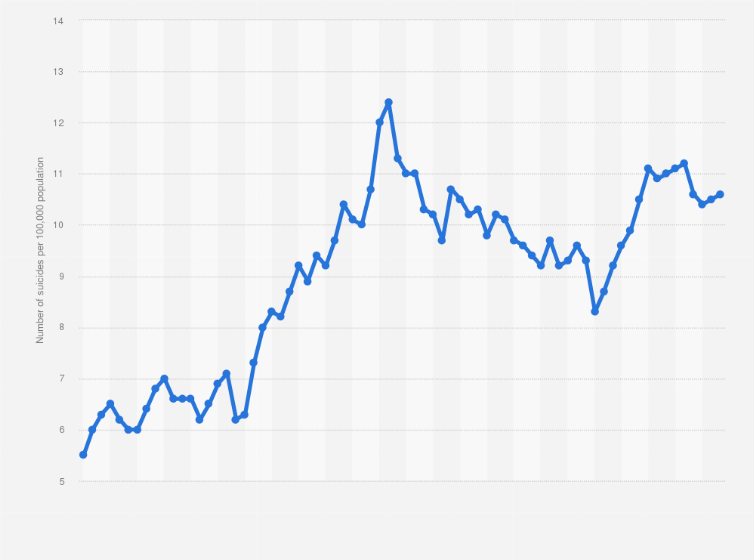
This metaphorical abyss is reflected in specific historical facts. Shocking evidence of this is provided by statistics dating back to the 1950s, when the Amsterdam Declaration was adopted in Amsterdam, laying the foundations for the international humanist movement. From that moment on, a drastic and unprecedented increase in suicide rates began in the country, reaching its historical peak in 1984.
Studies of this tragic trend have demonstrated a direct correlation with the increasing secularization of the Netherlands. Researchers who analyzed national statistics from 1936 to 1973 and regional data from the 1980s and 1990s demonstrated a clear correlation: the higher the level of secularization in a given region, the higher the suicide rate. At its peak in 1984, the rate in the Netherlands rose to 15 cases per 100,000 inhabitants, which translated into over two thousand victims per year (photo 1).
Traditional religious communities provided people with strong social integration, a sense of community, and real support in times of crisis—values that the secularized, secular state could not possibly replicate. Extensive analyses of Dutch society at the end of the 20th century ruthlessly exposed these effects, confirming that deep beliefs and a strong religious affiliation were the most effective protective factors against self-harm (pubmed.ncbi.nlm.nih.gov/9698137/).
Importantly, this dramatic process was not limited to the Netherlands. An identical relationship was observed in other Western societies that underwent rapid secularization. In neighboring West Germany, this wave reached its peak in 1981, when a record number of 18,825 suicides were recorded over a twelve-month period. During the same period, historic peaks in suicide rates were recorded in countries such as France and Denmark. Wherever modern humanism replaced God, a profound identity crisis arose. In secularized societies, suicide ceased to be perceived as a grave sin against the Creator and began to be treated as "an individual's right to decide one's own destiny." This dramatic mental shift directly translated into the tragic outcome of the 1980s. In the secularized world, success, work, and money were elevated to the status of new idols. When a deep economic crisis struck and people lost their jobs en masse, the worldview based solely on temporality and materialism crumbled. Believers possessed an unshakable spiritual foundation, allowing them to endure poverty, suffering, and social humiliation. Nonbelievers, on the other hand, cut off from God, found no support in the face of poverty, which, in conditions of existential emptiness, drove them en masse to the brink of despair.
However, a key question must be asked: since in the discussed message of the Lady of All Nations, we hear about the entire country's decline, why do children and young people, and not adults, stand on the brink of collapse in the message's image? Official statistics from the 1980s demonstrate that the dominant group among suicides at the time were adults and the elderly. This seemingly contradictory fact conceals the message's most profound warning. It is precisely adults who serve as role models for the younger generation. Children, observing the spiritual loss and tragedies of their own parents, adopt this destructive pattern from them.
Modern times show that this prophetic warning has begun to materialize in the most terrifying way. While at the end of the 20th century, the problem primarily affected older generations, in the 21st century, the vector of tragic statistics has shifted directly to the youngest. Official reports from the Dutch Central Bureau of Statistics (CBS) warn that in recent years, suicide has become the leading cause of death among people under 30 in the Netherlands – taking a particularly heavy toll on teenagers and young women.
Moreover, young people deprived of a solid Christian upbringing by non-believing adults may find themselves on the brink of a precipice in adulthood—faced with spiritual crises. Faith in God gives a person a clear purpose and gives profound meaning to every moment of existence, even the most difficult. The spiritual void instilled in the Netherlands and throughout Europe by modern humanism has irreversibly stripped this meaning away, pushing entire generations onto a slippery slope, at the bottom of which only a precipice awaits.
Then it's as if the Lady were leading me somewhere. I see two large mountains in front of me; between them is a very deep, black ravine or chasm. It seems as if I were suddenly transported to one of these mountains. The Lady says,
"Look!"
And I see an abyss in the middle of the world. Suddenly, it's as if the Lady were bringing the two mountains closer together. She says,
"This abyss must be closed."
The fragment of the message discussed here refers directly to the Book of Numbers (Numbers 16:1–35) and the story of Korah, who led the rebellion against Moses. Let us therefore examine the events that unfolded at that time.
Korah was a Levite, descended from the same tribe as Moses and Aaron. His primary motivation for instigating the rebellion was religious jealousy. Although he served in the Tabernacle as a Levite, he considered it unfair that the office of high priest was reserved exclusively for Aaron and his descendants. He demanded equal access to the highest priestly positions. Korah incited other members of the community to rebellion – among them Dathan and Abiram, along with two hundred and fifty prominent Israelites. It is worth noting, however, that Korah's three sons ultimately dissociated themselves from their father's actions.
Dathan and Abiram, on the other hand, were from the tribe of Reuben, Jacob's eldest son. Their motivation was political ambition. They believed that, as descendants of the firstborn son—who had lost his privileges because he had had intercourse with one of his father's wives—they, not Moses, should rule the nation.
They accused Moses of tyranny and of deliberately leading the people into the desert to their extinction. Korah himself, in turn, argued that the entire community was holy and that God was among all the Israelites, meaning Moses had no right to exalt himself above the people.
Faced with such grave accusations, Moses resigned himself to God's judgment. He ordered Korah and his 250 followers to take censers and offer incense to the Lord, which was the exclusive right of the high priest. This would reveal whom God would choose to lead the people. As they all stood before the Tent of Meeting, the glory of the Lord appeared before the entire assembly. Then the Lord spoke to Moses and Aaron, commanding them to separate themselves from the community, for He intended to destroy it in a moment. However, when they fell prostrate, begging Him not to be angry with the entire assembly because of one man's sin, God commanded the people to withdraw from the tents of Korah, Dathan, and Abiram.
Moses then commanded those present to withdraw from the tents of the rebels. Only Korah—without his sons—and Dathan and Abiram, along with their families, remained in front of their tents. Then the earth beneath them opened its mouth and swallowed them alive, along with all their possessions. Fire from the Lord, however, fell upon the remaining 250 rebels, consuming them for their unlawful offering of incense.
Crucial to our analysis is the fact that these rebels—along with their leaders—were prominent figures in the community of Israel. The Holy Scriptures describe them as princes of the community, representatives of the people, and respected figures. Thus, we are dealing with an elite that already possessed real power and authority but also desired to assume religious supremacy.
These "princes of the community" (Hebrew: nesi'ey edah) were the family leaders, chiefs of individual tribes or large clans. They exercised real administrative and military authority. "Representatives of the people" or "council members" (Hebrew: keri'ey mo'ed) were individuals appointed by the assembly—official delegates elected to the elite national council, which, together with Moses, made the most important decisions for the camp. The term "respected men" referred to "men of renown" (Hebrew: anshey shem). This phrase literally means "men of name." These were individuals with enormous personal authority, widely known, and exerting powerful influence on public opinion. The rebels, then, were not ordinary, simple people, but the elite of society at the time.
Let us now turn to the message of the Lady of All Nations. As mentioned earlier, the overarching theme of this entire message is rebellion against God. Let us therefore compare the history of the biblical rebellion with the ideology of modern humanism, which we discussed extensively earlier in this analysis.
Let us begin by examining the creators of the declaration of modern humanism. It turns out that its forerunners were a tight-knit, globally respected intellectual and political elite. This group included such influential figures as Harvard University professor Irving Babbitt, the eminent literary critic and essayist Paul Elmer More, and Matthew Arnold – the 19th-century English poet and critic who directly inspired the entire movement.
This trend also included the founders of its post-war, evolutionary incarnation: Julian Huxley (the eminent British evolutionary biologist and first Director-General of UNESCO), as well as John Boyd Orr and Brock Chisholm – the first heads of specialized UN organizations, namely the FAO and WHO. In turn, the Indian philosopher, yogi, and social reformer Prabhat Ranjan Sarkar (known as Shrii Shrii Ánandamúrti) aligned himself with spiritual neohumanism. In 1982, he published his programmatic work Neohumanism: The Liberation of Intellect, laying the foundations for the philosophical and educational system used today in many schools around the world.
This, of course, is only a fraction of the list of people who created and developed this current of thought. Nevertheless, their social profile clearly echoes the elite of the ancient Israelites, who also rebelled against God and His will. Like the biblical leaders, who, in addition to their existing political power and authority, sought to seize control of the sacred sphere, modern humanism makes no secret of its ambitions. It is intended to constitute a kind of "new religion" for humanity. Thus, the creators of this ideology strive to seize spiritual and moral power over people worldwide, rejecting God's sovereignty.
In the Book of Numbers, we read that the biblical rebels suffered a harsh punishment – they were swallowed by the earth and consumed by fire. Before we proceed with further analysis, let's take a closer look at the location where these dramatic events unfolded. It turns out that there is a unique area in Israel that matches the biblical descriptions. It strikingly corresponds not only to the location of the sinkhole that buried Korah's followers but also to specific words from the Book of Numbers describing those events. Moreover, the image of the message of the Lady of All Nations perfectly harmonizes with the unique topography of this very place.
The Holy Scriptures indicate that the rebellion occurred "in the wilderness." An analysis of the entire Israelite migration route indicates that the camp was then stationed near the oasis of Kadesh, also known as Kadesh-Barnea. In the Message of the Lady of All Nations, the seer was transported to a location overlooking two mountains, between which lay a deep ravine. The darkness below was clear, clearly alluding to the darkness of hell.
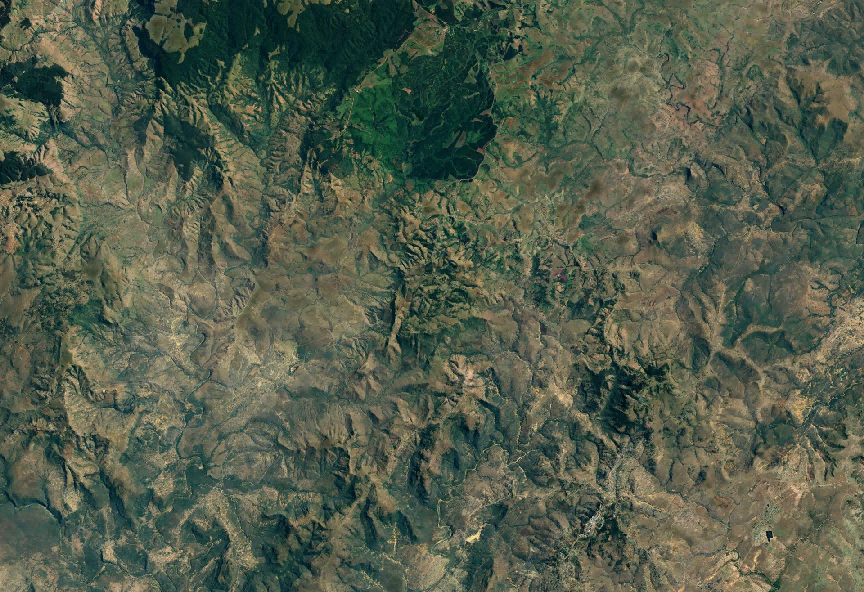
This location perfectly aligns with the biblical description. Let us therefore consider a modern map of this area and the Machtesh Ramon depression (photo 2), which is located in close proximity to the historical site of Kadesh-Barnea.

The Makhtesh Ramon Sinkhole was formed by a rare, millions-year-old geological process called a landform inversion. Although the term "crater" is commonly used here, this formation has nothing to do with a meteorite impact or a volcanic eruption—it is a unique erosion crater. Fascinatingly, it was formed by the literal collapse of a mountain, its interior being eroded away by underground waters over the centuries. The core of the mound was made of soft, eroding sandstone, while its outer crust was formed by a hard, limestone "cap." When the subsurface lost its stability, the peak collapsed inward. Today, the remains of this ancient mountain form the jagged, zigzagging rims of the crater, resembling a gigantic, toothed mouth. Let us recall the words of the Holy Bible: "The earth opened its mouth and swallowed them." The Makhtesh Ramon Gorge is thus a striking physical reflection of both the biblical descriptions and the image from the message of the Lady of All Nations.
For Ida Peerdeman to have witnessed such a monumental sight, her vantage point must have been Har Ramon (1,037 m above sea level)—the highest peak around the crater, which symbolically refers to the Mountain of God. Around the entire depression stretch the zigzagging remains of the mountain that once towered over the site, now resembling a large jaw with teeth (photo 3). From this perspective, the two opposing mountains, between which the deep gorge lies, are Har Gamal (Camel Mountain) and Shen Ramon (Ramon's Tooth).

Ida Peerdeman is then transported to one of two hills—Har Gamal or Shen Ramon—from where she sees the Lady of All Nations pushing these monumental mountains toward herself with her hands, thus closing the symbolic jaws of the earth that had once swallowed the rebels. This image deeply resonates with the Old Testament mountains of Ebal and Gerizim, between which lay the ancient temple city of Shechem—the place where Israel solemnly renewed its covenant with God. Comparing these two events, we see that this "temple city"—that is, the entire settlement of Korah, including its tents—was entirely swallowed by the earth because of its rebellion against the Creator.
By declaring that this chasm must be closed, the Lady of All Nations reveals her will to bring about final peace between man and God and to extinguish all rebellion that arose in human hearts. By transporting the seer to this symbolic place, she graphically shows the world that the fate that once befell Korah's followers can befall all those who rebel against God today, seduced by the rebellious ideology of modern humanism.
Here we come to a crucial point. Since the Korah event occurred some three and a half thousand years ago, it could not have physically occurred at the very site of the crater we have discussed, as it was formed millions of years ago.
The explanation for this lies in the nature of biblical and prophetic language. The Negev did not have to split open at this single, specific point on the map for the Ramon crater to be a clear sign for us. In biblical theology, God uses what is known as typology—creating monumental monuments in nature, which are a physical, tangible reflection of spiritual truths. Machtesh Ramon – located in the same geographical region where Israel wandered – was shaped by the Creator as an eternal trace, inscribed in the structure of the Earth, carrying a certain spiritual lesson for us. This means that these natural monuments were created first, and only then did the Creator guide the children of Israel around them. However, those who described the events occurring within the Israelite community, inspired by the Spirit of God, identified these formations with specific events that took place in reality.
There are many such testimonies carved into the structure of the Earth, created even before the appearance of man. This is in full accordance with the Book of Genesis, which states that God first created this world and only then fashioned man. We see, therefore, that the entire process of humanity's spiritual development was planned and encoded in stone long before its existence.
A perfect example of this are the apparitions of the Mother of God that occurred in various corners of the world. If we trace the locations of these supernatural events, we will discover natural monuments carved into the rock, precisely in line with the messages proclaimed there. For example, consider the apparitions of Our Lady in the African town of Ngome. A satellite image of the area surrounding this place of worship reveals a complete biblical scene depicting the story of Adam and Eve just after they ate the fruit of the tree of knowledge of good and evil. In the aerial image, a tree with a serpent beneath it is clearly visible, and just to the left, a horned creature can be seen. Furthermore, the outlines of Adam, Eve, and God himself can be seen. Photo 4 shows a raw satellite image downloaded from Google Earth, while Photo 5 shows the same area with graphically detailed figures and objects to better illustrate the whole. Spotting these "monuments" carved into the stone can be quite a challenge for the human eye.
We see, therefore, that just as in the Old Testament there are many monuments formed in nature for our learning, so in the case of the apparitions of Our Lady, we also find them near the locations of these events. They constitute, as it were, a visual representation of the word contained in Sacred Scripture. In a similar way, Christ is the living Word illustrating Scripture—as a living monument, through which we gain a full, tangible representation of the inspired text.

The image of the message, in which Ida Peerdeman stands above the Machtesh Ramon sinkhole, is not a history or archaeology lesson. The Lady of All Nations uses divine monuments carved in rock to convey to us the truths that guide God. The Creator once engraved similar truths on the stone tablets of the Ten Commandments.
It is therefore primarily a spiritual message, which in this case reads: all rebellion against God ends in the damnation of the human soul, and the earth will swallow up the human body. The human soul, which, while living in the body during its earthly journey, has acted in accordance with God's will, will gain its own body. However, this is not about the material body, but about its image, for all material things will ultimately pass away.
Thus, the creators of the ideology of modern humanism condemn themselves to damnation for their rebellion against the Creator. This does not mean that the physical earth will suddenly collapse beneath their feet, but that they will irrevocably lose their existence in the Kingdom of Heaven.
The story of Korah, however, shows that those who turn away from rebellion in time—as happened with his sons—are spared punishment. The biblical text tells us that the instigator of the rebellion was buried along with his tent, belongings, and loved ones, but his descendants were not among them. The crucial moment is when Moses commands the entire assembly to withdraw from the rebels' tents. It was then that Korah's sons had to make a personal decision and side with the obedient people. God, therefore, gives the man a chance to repent, reflect on his behavior, and turn from the path of apostasy until the very end.
Korah was a bad shepherd, and his irresponsible actions led not only to his own death but also to the death of many other Israelites. The Book of Numbers tells us that 250 of his followers and thousands of his people were killed.
Applying these events to today, we encounter a strikingly similar situation in the context of the ideology of new humanism. People from the upper classes are no longer satisfied with political power alone—they also desire to be spiritual guides. Convinced of their own holiness, they want to establish what is good and what is evil. This attitude brings ultimate ruin not only to themselves but also to those deceived by this group. The story of Korah did not appear in the Holy Scriptures by accident; it was recorded there precisely to provide us with an eternal lesson and a warning.
Let's return to the message of the Lady of All Nations. Official publications suggest that Ida Peerdeman spoke of only one location—a ravine stretching between two peaks. However, analysis of the archival transcription of the recording, in which the seer described these events in her own words, sheds a completely new light on the matter. It clearly shows that the Lady of All Nations takes her to two different locations, in both of which she reveals a dark abyss. Crucially, she identifies these two distinct spaces with the center of the world. Let's look at the transcription of the aforementioned account:
(8:41) And then she takes me to two high mountains. And between them is a very deep
(8:50) gorge. An abyss. I really see it too. It was really as if we were standing on a peak.
(8:56) And that then the whole depth was incredibly black. The woman then shows me that it is so,
(9:02) so dark and black there.
And then suddenly I also see an abyss in the middle of the world. So not
(9:10) by those high mountains. It was, yes, where it was supposed to be. I don't know if it was supposed to be for the Netherlands. But
(9:18) then I see the difference again. Where She is suddenly taking me now.
Then suddenly I see an abyss coming [appearing] in the middle (9:24) of the world. And then the Woman takes these two mountains. It's very peculiar, and it was as if She
(9:33) was bringing these two mountains closer together. And she said, "This gorge must be closed." While
(9:39) she moved the two mountains towards each other with her hands.
The text clearly shows that Ida Peerdeman saw two distinct centers of the world and two abysses. So what is this "center of the world"? Scripture leaves no doubt here – in the biblical perspective, the navel of the earth, its spiritual center, was all of Israel, as the territory inhabited by God's People.
The Book of Ezekiel directly confirms this. In chapter 38, the prophet describes the nation of Israel, returned from captivity, as a people who "think only of their flocks and possessions, and dwell in the center of the earth" (Ezekiel 38:12). Crucially, the original Hebrew text contains the unique phrase "tabor ha-aretz," which literally means "navel of the earth." From God's perspective, this entire land lay at the very heart of the world map, surrounded by other nations, a fact the prophet also confirms elsewhere, writing: "Behold, Jerusalem! I have set her among the nations, with countries all around her" (Ezekiel 5:5). Israel as a whole, therefore, constituted the broadly understood center of the world, yet possessed its precise, geometric center – Jerusalem with the Temple of God, the center of the action of the Spirit of God.
The site of Korah's rebellion was thus located in the center of the world, defined in this way, whose precise center moved with the Tabernacle of the Lord, carried by the children of Israel throughout their journey. Ultimately, this center later became Jerusalem with the Temple of God. This is an extremely important observation, because it reveals the profound message of this story: the revolt against God did not originate with pagan peoples, but was born in the center of the world – within the People of God. The rebels were not aliens, but belonged to this people and originated from it.
However, when we look at contemporary history, the Temple of God no longer exists in the former center of the world. The focus has shifted to Christians, who have become the new People of God. In the earlier fragment of the message under discussion, the Lady of All Nations performs a symbolic gesture: she kicks the Vatican around, turning it upside down. Besides recalling Christ's teaching that his disciples should become the little ones of this world—as we discussed earlier—this act brilliantly points to the navel, or the center of the world. The navel is, after all, anatomically concave, not convex. Jerusalem, as long as the Temple stood there, was the very center of the world, the center of the action of the Spirit of God. Today, this new "navel of the world" is the Vatican, with St. Peter's Basilica.
The Lady of All Nations brings this ancient analogy to our times, comparing the rebellion of the People of God to the birth of modern humanism. This modern rebellion also takes place within the boundaries of the Christian world. Crucially, its initiators—just like the rebels of old—come from within the People of God. All of them, like Wilhelm von Humboldt, the German creator of a modern education system that excluded God, were once Christians or at least came from Christian families. It was from this circle that the ideology of modern humanism emerged, which is, in reality, a new form of paganism, as the Lady of All Nations explicitly mentions.
We can see, then, why the Lady of All Nations showed Ida Peerdeman a black abyss located somewhere in the center of the world. Analyzing the entire message, one can conclude that this refers to Germany or the Netherlands, which she described as approaching the abyss. The Netherlands, once a deeply Christian country, is now one of the most turned away from God in Europe. It was in this country, in Amsterdam in 1952, that the first international congress of humanists was held. Ida Peerdeman herself—as seen in the transcript—wonders aloud whether this second abyss was meant to refer to her homeland.
In the visionary's statements, which were not included in official publications, the Lady of All Nations confessed to her that the Netherlands is like a withered branch hanging over an abyss. The entire tree is Christianity, while individual nations are its branches. The Netherlands appears here as a dead shoot—devoid of both leaves and fruit.
In the Gospel, we read of Christ comparing the Temple of God in Israel to a fruitless tree, with an axe already lying beneath its trunk. While that evangelical tree had leaves, symbolizing faith, it bore no fruit, rendering it useless. Trees that bear no fruit are ruthlessly cut down. While it looked impressive from the outside, it concealed a flaw within that prevented it from yielding fruit.
Then I see St. Peter's Basilica. The Lady says,
"Child, you see the Pope there, in full vestment, with two fingers raised. Listen carefully. The teaching is correct, but the Pope is authorized to change the regulations. Allow him to do so!"
I still see the Pope sitting before me, with two fingers raised.
Now I see the large council chamber where the Pope is.
"Child," the Lady says, "these regulations can be changed. This can be changed, this must be changed. The various estates must become closer together. They should carry this out in Rome and set an example for the whole world. Reflect and say this. And I repeat to you: Love is the first commandment, and beyond that, as if by an arch: Truth and Justice."
The words of the above message constitute a prophecy that was fulfilled almost sixteen years later, in 1965, and it speaks of the Second Vatican Council and its decrees. Years later, when Ida Peerdeman watched a television report from the room where the Pope, along with cardinals and bishops, were discussing the council, she immediately recognized in the message an image she had experienced during a previous apparition.
Since the convocation of the council was announced by Our Lady of All Nations as early as 1949 and actually came to pass, this fact alone provides a strong argument for the supernatural nature of these messages.
In the message, we see the Pope in full liturgical vestment, with two raised fingers, standing in the council chamber – the same one where heated discussions on the final shape of the council documents had been taking place since 1962. Through this message, the Lady of All Nations calls for peace while formulating new church regulations, thereby setting an example for the entire world. The community of believers is composed of many different factions and traditions, therefore, developing decrees concerning the entire Church of Christ required profound peace and mutual understanding between the synodal parties.
Although the image of the message itself does not specify the Pope's hand position, intuition suggests that it is two fingers joined. This position constitutes a traditional gesture of blessing and symbolizes the two natures of Christ – the divine and the fleshly. This interpretation is also suggested by the previous fragment of the message, in which the Lady of All Nations brings two mountains together with her hands to close the chasm that divides them.
This duality of Christ corresponds perfectly with the topography of the biblical mountains Ebal and Gerizim, between which stretches the space of the Church. The Church of Christ is a reality that unites the Spirit of God with the fleshly man – hence, these mountains must strive for unity. Mount Gerizim, signifying blessing, is spiritual in nature and represents the Tree of Life. Mount Ebal, the site of the curse, refers to the earthly realm and represents the tree of death, as every physical person will ultimately succumb to death. Just as the spiritual and physical elements coexisted in perfect harmony within the person of Christ himself, so too does the earthly Church have the task of uniting the supernatural with the temporal. The human soul comes from God, while the body belongs to this world.
It is worth noting that in the international community, two raised and parted fingers in the shape of the letter "V" originally signified victory, and in the 1960s, this sign was adopted by the hippie movement as a symbol of peace. However, in Christian and biblical contexts, the separated fingers forming the letter "V" paradoxically signify a lack of peace between the spiritual and physical realms, becoming synonymous with division and defeat.
In the context of Korah's rebellion—where two mountains stood separated by a dark abyss—the Lady of All Nations indicates that these heights must be united, which she does by drawing them together with her own hands. The Lady of All Nations also reminds us of love, the most important commandment. It is love that allows for the unification of the spiritual with the physical—exactly as the joined fingers express the union of the Spirit of God and the human body in Christ. This hand, positioned in this way, ultimately becomes a sign of blessing and peace born of obedience to God's will.
Here, the Lady of All Nations evokes the image of the Arch of God. Inscribed within its structure on the left is Truth, identified with the Kingdom of God, while on the right is Justice, as every human body will ultimately experience it. Between them, at the highest point of the arch, stands Love, which unites Truth with Justice, and thus God with humanity. Only when a person unites the divine and the temporal within themselves will they be able to clothe themselves in a spiritual body, a task in which the Church of Christ is constantly to assist them. Meanwhile, the story of Korah demonstrates that the community he and his followers built failed to connect the divine with the physical. For this reason, their community was ultimately swallowed up by the earth.
Let us now turn to the provisions of the Second Vatican Council. It brings reform to the Church, which must transform with the changing world. In her messages, the Lady of All Nations repeatedly reiterated that the Church must keep pace with the development of civilization to meet the threats facing modern man. It is worth emphasizing here that a fundamental change and reform of church law was one of the main topics of the Second Vatican Council's deliberations. In the age of the internet, the numerous ideologies emerging in the world exert a much greater influence on individuals because they easily reach a mass audience. Trends like modern humanism would not have spread around the world at such an alarming rate if it weren't for the global network. This doesn't mean, however, that the internet is evil—it should simply be used for good, such as the evangelization of the world. This is precisely why Christians should actively engage in the mass media, as the decrees of the Second Vatican Council directly emphasize. By pointing out the need for these changes, Our Lady of All Nations reminds the hierarchy and the faithful that a radical battle must be undertaken for human souls, which are tumbling on a terrifying scale into an abyss where nothing remains. The abyss that Our Lady of All Nations shows Ida Peerdeman is black and deep, for in reality, it constitutes nothingness.
Furthermore, Our Lady of All Nations emphasizes that the law must be changed so that it does not destroy man but gives him life.
This directly alludes to the teachings of Christ, who, through his actions and words, reminded us that the law was established for man and his salvation—not man for the law. This fundamental distinction should continually shape the Church's attitude toward current regulations. Where the letter of the law no longer serves love, mercy, and human good, it should be thoroughly reviewed and appropriately amended.
The Gospel repeatedly depicts situations in which the Pharisees and scribes placed formal regulations above human dignity. A prime example is the issue of the Sabbath, which, in their view, prevented helping one's neighbor. Yet, Jesus emphatically reminds us: "The Sabbath was made for man, not man for the Sabbath" (Mark 2:27). Law that ceases to serve life and love becomes a tool of spiritual enslavement. A good analogy from contemporary history is communism, where man was treated worse than doctrine itself—which was, after all, a purely human creation, a dead idol devoid of any life.
The Pope, as the Vicar of Christ, has the authority to introduce changes for the good of souls, but unity is essential to achieving this goal. It's no secret that many just and good reforms are blocked by internal fissures—both within the church hierarchy itself and between various branches of Christianity.
The Church should be a light to the world, a model of how to achieve harmony in the spirit of truth and love. Yet, it increasingly becomes an example of internal tensions, sterile disputes, and paralyzing lack of understanding. Yet it is precisely the Mystical Body of Christ that should most fully realize the commandment of love and constitute the living foundation of unity. Love is a spiritual principle that unites the supernatural with the corporeal. It operates similarly to gravity, which causes physical bodies to attract one another. In the material world, each person exerts a gravitational pull on another, but with such small masses, this force remains almost imperceptible. Love, however, is a much greater power—a metaphysical force capable of visibly and permanently drawing human hearts to itself.
The words of the Lady of All Nations about the need to bring the various orders of Christ's Church closer together were also directly reflected in the records of the Second Vatican Council. By these orders, we mean the three fundamental vocations that constitute the Mystical Body of Christ: the clergy (hierarchy), consecrated persons (religious men and women), and the lay faithful. Before the council, these orders were severely separated by a profound institutional distance. Meanwhile, the council's decrees brought about a true breakthrough in this regard. They indicated that, although each order fulfills a different function in the Church, all baptized persons possess absolutely equal dignity. The laity were no longer treated as merely passive subjects of the hierarchy, and the council called upon them to actively participate in deciding the fate of the Church and to build unity with their pastors. This synodal process of shortening the distance and bridging the old institutional divisions is a perfect realization of the gesture in which the Lady of All Nations, with her own hands, brings together what had previously been separated. The Lady of All Nations also points out that it is precisely love that is meant to bind these different states together. Since we are speaking of the Church of Christ, love constitutes its absolutely central and most important commandment.
Let us therefore summarize the decrees promulgated during the Second Vatican Council, which the Lady of All Nations speaks of in her prophetic messages. So far, the image of the message reflects three key documents, encompassing precisely those spheres of Christian life indicated by the Lady of All Nations:
- Decree on the Means of Social Communication (Inter Mirifica): The Lady of All Nations has repeatedly mentioned this request in previous messages. It constitutes a direct response to the need to utilize modern technologies in the work of evangelization. This document calls upon the Church to abandon its former distance from the press, radio, and the then-nascent television, and enjoins active engagement in the media sphere, so that through the mass media, truth may effectively reach human hearts worldwide.
- Dogmatic Constitution on the Church (Lumen Gentium): This key synodal document brought about a revolutionary rapprochement between the various orders of the Church. It redefined the community of believers not as a rigid bureaucratic institution but as the living People of God, in which clergy, consecrated persons, and lay faithful possess absolutely equal dignity. It was in this text that the former distance between the hierarchy and the laity was reduced, recalling that love is the binding force of all these orders.
- Apostolic Constitution Sacrae disciplinae leges (together with the reform of Canon Law): Although the new Code of Canon Law was not published pursuant to this document until 1983, the process of its creation was a direct consequence and one of the most important fruits of the council's work. This reform completely changed the nature of church regulations. It culminated in the inscription into the code of the fundamental principle that the salvation of souls must always be the supreme law, ultimately demonstrating that the letter of man-made church law must give way to love and the pastoral good of one's neighbor.
"Child," the Lady says again, "look!"
Now I see between the Lady and the Pope: "50." The Lady says:
"This year we will have to work very hard..., not only with words. Christ's teaching is correct. So why don't we live according to it and in its details?"
I now see small dots around me, and in the center – a large Red Dot. The Lady presses the Red Dot firmly with her hand and says:
"This is the most important thing. But according to it, we don't live. A complete transformation must take place there. If they don't heed the warnings, they will perish, and that is what they are getting closer to."
And now I see those mountains and the abyss again.
Then I see the Pope again, and the Lady says:
"He only has to order it, and it will be done."
Then I see Italy and the foreign, high clergy. I see the Pope sitting in the Vatican council chamber, surrounded by cardinals and bishops. The Lady tells me that the Pope is preparing a decree. Then I see an agreement between the high and low classes.
"It must go in this direction," the Lady says.
"Think of Love and Justice. Let all who believe work together for good."
In the image of the message, we see the Pope and the Lady of All Nations, between whom is the number 50, representing the year 1950. Let us recall here the story of Korah, who caused unrest and division among the People of God. At that moment, the earth opened its mouth, swallowing all those who were the instigators of this unrest. As we saw in previous fragments of the image of the message, the sinkhole into which the rebels and those spreading confusion were to fall was located precisely between two mountains. The Lady of All Nations desires to close this chasm, to make it disappear completely—this signifies that she strives for lasting peace to prevail in the Christian community.
In the context of the image of the message, we see that these mountains are the Lady of All Nations and St. Peter's Basilica, where the Pope exercises authority, and the chasm separating them is, as it were, bridged by this specific date. Let us consider what this date signifies. As it turns out, this is a time of fundamental significance – precisely in 1950, after profound theological debates, the dogma of the Assumption of the Blessed Virgin Mary was proclaimed. This dogma unites the aforementioned elevations and thus closes the gap that divided them.
Establishing this dogma was necessary because, since the Lady of All Nations, who was once Mary, was assumed into heaven, she can now help us from there. Pope Pius XII's proclamation of the dogma was merely a solemn confirmation of a fact that had existed in God's reality for almost two thousand years. What Mary had done by God's will from the moment of her actual Assumption simply had to wait for maturity and full understanding on the part of humanity until 1950. The dogma thus became the earthly fulfillment of her role, which is, among other things, to unite people with Christ and God.
In this way, she becomes the Advocate of Peace and Mediatrix of the Word of God. This is accomplished directly through messages, which are God's will communicated to humanity through the Lady of All Nations.
From the messages delivered to Ida Peerdeman, we learn that during this period, very intensive work will be necessary—not only in word, but above all in deed. This concerns the teachings of Christ, which the Lady of All Nations declares to be correct, while simultaneously asking why it is not lived in accordance with them, down to the smallest detail.
Let us therefore indicate what constitutes work in word and what in deed in the context of Christ's Church. The work itself around dogma is based on the analysis of God's Word, the study of prophecies, and the precise formulation of the dogmatic definition itself—and this is precisely what is work in word. Consultation within the Christian community and the very proclamation of dogma is work in deed, which becomes the peace of Christ. The greatest obstacle to the proclamation of dogmas and all papal decrees is disputes between Christian communities and denominations. All quarrels and divisions among the priests of the Christian Church constitute a counterexample to all believers, proving that Christ's teachings are being lived incorrectly.
Therefore, the proclamation of the dogma, which required consensus among the clergy, was a kind of test. It was intended to demonstrate the Church's capacity for achieving peace, which in subsequent years proved crucial during the profound reform of church structures during the Second Vatican Council. The Church must change with the changing world to adequately respond to the spiritual threats of this world. This is not about Christ's teachings themselves, which remain unchanging and valid regardless of time, but about the laws governing the functioning of the institution of the Church itself.
These regulations must serve man's reconciliation with God, rather than become a barrier separating him from Him. It was the teaching "growing" on the Tree of Life that united man with the Creator, while the teaching "growing" from the tree of death separated creation from Him. Therefore, all earthly ideologies that separate man from God—such as communism or the modern paganism known as humanism—are teachings from the tree of death. The ability to eat from the Tree of Life demonstrated that man was fulfilling God's will, which was an expression of reconciliation with God and living in peace with Him. Eating from the tree of death, on the other hand, was in direct contradiction to God's will, resulting in man's expulsion from paradise and separation from the Creator. For this reason, the key role of Christ's Church is to reconcile man with God. The foundation of this process remains the observance of His will by creation, expressed through observance of God's Covenant. However, no internal church regulations can cause separation of man from God, as the Church's mission is to reconnect creation with the Creator.
This is perfectly illustrated by the gradual, profound reform of the ancient, rigorous prohibition of eating from midnight before receiving the Eucharist, which for centuries could alienate the faithful from the sacrament due to simple hunger. This process, implementing the modification of church law announced in the messages, unfolded precisely in the following years and during the council's deliberations. First, on January 6, 1953, Pope Pius XII, in the apostolic constitution Christus Dominus, introduced the first exemptions for evening Masses. Then, on March 19, 1957, in the document Sacram communionem, the same pope definitively abolished the midnight fast in favor of a three-hour fast. The culmination of this reform occurred on November 21, 1964, during the third session of the Second Vatican Council, when Pope Paul VI, responding to pastoral needs, shortened the required Eucharistic fast to just one hour before receiving Holy Communion.
Nevertheless, it is precisely the conscious violation of God's will—not purely legal considerations—that remains the main barrier separating man from God. Therefore, in reconciling with the Creator, man should first and foremost cleanse himself of sin. Participating in the Eucharist in a state of sin simply prevents authentic reconciliation between God and humanity.
One of Christ's teachings directly addresses this internal Eucharistic law. In the Gospel, we read about Christ's disciples picking and eating grain on the Sabbath, which was forbidden according to the law of the time. Christ then points out to the Jews that the Sabbath was created for humanity, not humanity for the Sabbath. Therefore, the laws cannot kill, but must give life. Moreover, God himself instituted the Sabbath, and therefore, in the person of Christ, He is also its Lord. This is a profound image that directly alludes to the Book of Genesis, where, during God's presence, He allows Adam and Eve to eat fruit from other trees of paradise.
Reconciliation with the Creator and the law contained in the covenant together give humanity life, but God's law is essentially unchangeable. Therefore, anyone who observes God's covenant lacks only one thing: full reconciliation with God. This is precisely what the Jews lacked. Although many of them scrupulously observed the letter of the law, by rejecting God revealed in Christ, they were not reconciled with Him.
This is reflected in one of the moving stories in the Gospel, when two sisters in Bethany receive Christ in completely different ways. When Christ came to them, Martha was completely occupied with household chores, while Mary sat at His feet and listened intently to His words. Seeing this, Martha began to complain and indicated that her sister should help her. Then Christ told Martha that she was concerned and worried about many things, but in reality, she lacked only one thing: reconciliation with God, just as Mary was doing at this moment. Reconciliation with God, as we see in this biblical example, means above all knowing Christ, for everyone—just as Adam and Eve once did—must know their Father. Therefore, anyone who does not recognize God in Christ and is not reconciled with Him through the blood flowing in His Son remains cut off from God by a certain abyss. This chasm can be excessive devotion to worldly matters, sin, or a lack of peace and love.
Peace, synonymous with love, permanently binds God and humanity. In Martha's case, what separated her from Christ was an excessive focus on temporal matters and her anxiety, which appears in this scene on two levels. First, as an internal anxiety caused by worry about her earthly existence. Second, as an external anxiety, consisting of an attempt to create a "rift" between Christ and Mary by demanding that the Teacher order her sister to help with her work. With these words, Martha unconsciously attempted to draw Mary away from Christ, that is, to de facto separate creation from God. We see, therefore, that in this case, all earthly work stands between humanity and the Creator on the day designated for reconciliation.
It is precisely this nature of work that God has in mind when He establishes the Sabbath regulations. No human activity can separate us from God on the day of reconciliation unless it serves to help another person reach Him. Priests work on Sundays, but this work serves solely to reconcile man with God. The Jews did not understand their priestly role, so instead of uniting creation with God, they separated Him from humanity, imposing their own regulations, which they themselves did not actually observe.
Therefore, anything that serves this reunion remains fully permissible, as long as it does not involve consciously breaking God's law. Forcing a person not to eat before reconciling with God has the opposite effect, rather distancing them internally from God. The Crusades, misinterpreted throughout history, had the same destructive dimension. These Crusades forcibly forced people to accept the faith, which produced a completely opposite result. Outwardly, such a person – out of fear for their own life – manifested themselves as Christians, but inwardly they hated God. Anxiety for life, caused by external terror, is what ultimately separates a person from the Creator, and it cannot in any way be confused with the salutary fear of God. Only those who truly believe in God possess it, while those forced to embrace the faith felt only fear of the Crusaders themselves.
In the context of earlier messages, we have already recalled the Gospel parable of the host inviting his chosen ones to a great banquet, where reconciliation with God is achieved. For Christians, this banquet is the Eucharist. However, many of those invited rejected this invitation, as they were preoccupied with worldly matters and the work around them. Then the Lord commanded his servants to bring all the suffering and sick, and when there were still places left, he commanded: "force them to enter." The word anankazo (Latin translation: compelle) used in the original Greek text literally means "to compel," "to coerce," or "to command with unquestionable authority." However, evangelical coercion does not involve physically forcing a person into the Church.
Christ showed us what this "coercion" actually involves. This action is not based on the use of violence, but on helping others. As we read in the Gospel, the command to direct one's steps toward God's temple refers to those who lacked the strength to enter it themselves, or who, due to illnesses such as leprosy, were legally barred from even entering the holy city. For example, this command is manifested in the words: "Arise, take up your bed, and walk!" We see that these are words of command spoken with full authority, yet they do not carry with them violence, but rather healing accomplished by the power of God's commandment.
The response to this call becomes, on the part of the healed, a true fulfillment of God's will. Furthermore, note that in the Gospel no one forces anyone to believe or brings anyone within the temple walls against their will. God's pedagogy is based on the assumption that man must believe completely voluntarily, for only then can he be reconciled with his Creator in peace.
All of God's commandments are healing for man, and Christ demonstrated this directly by healing people through his commandments.
It should also be noted that when a sick person receives a commandment from Christ, which is His will, he fulfills this will and only then goes to the temple to be reconciled with God. We clearly see, then, that doing God's will is the foundation that allows one to subsequently know the Father, becoming reconciled with Him.
We see, therefore, that all the crusades that took place in ancient times were a complete misinterpretation of God's plan. Reconciliation with God must occur exclusively in peace and by one's own will, as perfectly illustrated by Mary's attitude in Bethany.
The Gospel "commandment" to enter God's temple has the character of a miracle, which becomes for man a gift of pure grace leading him to God. Christ also cast out evil spirits from people by means of a commandment, thus healing them, as happened in the case of the Gerasenes, who was possessed by a whole legion of demons. The man from whom Christ cast out these demons later desperately wanted to follow Jesus, but Jesus commanded him to return home. Christ desired that the healed man's loved ones and neighbors—seeing the great miracle he experienced—would also believe.
Many people come to God only after tangibly experiencing a supernatural sign in their lives. However, demanding a miracle can be an expression of the weakness of human faith, for it serves precisely to build it within a person. Christ clearly states in the Gospel that we should not come to Him for the signs He performs, but for the Word, in which the Spirit of God is present. This Word has the power to heal through the commandments, and it is in Him that a person can be reconciled with God, knowing Him deeply.
In many cases, however, even the Gospel miracle is not enough to awaken genuine faith in a person. Christ healed ten lepers, and only one of them returned to fall at His feet, offering Him praise and thanksgiving. The remaining nine, although they experienced physical healing, departed, not seeking spiritual reconciliation with their Liberator from the prison that was their body.
Let's return to the Sabbath. Although the Sabbath itself was established by God, over time human traditions became overgrown with a thicket of meticulous and rigorous regulations. Christ's disciples, who picked heads of grain, rubbed them in their hands, and ate the grain, were accused by the Jews of working on a holy day. The Pharisees associated picking heads of grain with harvesting, and rubbing them in their hands with threshing. We can see, then, the absurdities to which these conditions led. This interpretation of the regulations made them more important than human well-being. Yet God created the Sabbath for man—for his benefit, not the other way around.
It was precisely these human interpretations of the regulations, which no longer served man on his path to the Creator, that Christ drew attention to. God indicates that on the Sabbath, man is to detach himself from worldly matters and devote this time to his Creator. However, Christ clearly demonstrates that helping others is the purest form of devotion to God. Such acts make the world a good place—and that is precisely what God desires to make it.
The Gospels tell of examples of Christ healing people on the Sabbath. In these situations, too, the Jews expressed their deep dissatisfaction with the fact that He helped those in need on that day. According to their regulations, unless an illness threatened immediate death, administering medicine and even setting bones were considered ordinary work that could and had to wait until the end of the Sabbath. Thus, we see that someone experiencing severe pain from a broken bone, and who was denied help because of the Sabbath, could consequently come to hate God because of this law. Therefore, these internal regulations of the Jewish community did not connect people with God at all, but actually distanced them from Him.
For Christians, the day corresponding to the Sabbath is Sunday, when the faithful are reconciled with God in the Church of Christ. No human ecclesiastical regulation prohibiting the consumption of food before this sacramental union can become a barrier separating people from God. This is especially true since Christ came to sinners, that is, the spiritually weak, to nourish and strengthen their spirits.
The ancient prohibition against eating food before the Eucharist was in direct contradiction to God's words in paradise, where the Creator expressly permitted Adam and Eve to eat from all the trees of paradise, except for one forbidden one.
In the image of the message, the small dots surrounding Ida Peerdeman symbolize the paradise trees from which man could draw nourishment. Meanwhile, the large, red dot in the very center represents the Tree of Life, which remains the most important. However, it does not bear fruit intended for the body in a literal sense—it is food for the soul, which becomes God's teaching. It is the most important source of strength for man, because it reconciles creation with the Creator and ensures eternal life. Christ himself foretold that this world would pass away—and with it all bodily foods—but His words will never pass away, for they are the ones that give eternal life.
This Tree of Life, which gives birth to saving teaching, is found in the Church of Christ. And it is precisely to this place that the Lady of All Nations points, emphasizing that change must occur there, while simultaneously emphasizing that Christ's teaching itself is correct. This means modifying internal regulations that, instead of uniting man with God, create unnecessary divisions. These changes, as we have mentioned earlier, are related to the functioning of the Church. All of this was included in the resolutions of the Second Vatican Council, which constitutes an attempt at a profound reform of the Catholic Church.
For example, the Constitution on the Sacred Liturgy, Sacrosanctum Concilium, introduced key changes to the liturgy of the Holy Mass. The former Latin language was replaced by vernacular languages. At this point, powerful opposition was raised by so-called traditionalists, who strongly prefer pre-conciliar liturgical regulations. However, one fundamental question must be answered: does the Latin language during Holy Mass bring man closer to God? Certainly, for most of the faithful, it hinders their relationship with God. Not everyone knows Latin, after all, and to draw closer to God, one must first know Him. If someone hears teachings in a language they don't understand at all, can they truly know God? We also cannot force anyone to learn Latin. First, it would be coercion, and second, everyone has their own daily responsibilities and often lacks the time to learn a foreign language—especially since the older one gets, the more difficult it becomes to acquire knowledge. On the other hand, we cannot completely ban the celebration of the Tridentine Mass, which is celebrated in Latin. For many of the faithful who know the language, it can serve much better in personal reconciliation with God. Such Masses, however, should be celebrated according to a predetermined schedule, for example, once a week.
The Lady of All Nations clearly sees the threats the Church will have to face, but to overcome them, peace within the entire community is essential. Moreover, the Holy See was well aware of these dangers, as it was in 1950 that the papal encyclical Humani Generis was published, in which Pius XII condemned godless ideological currents threatening the foundations of Christianity, including modern relativism and the emerging secular humanism, which we discussed in the previous sections of the message. Thanks to the mutual agreement in the proclamation of the dogma, the Church gains a Mediatrix between the Spirit of God and humanity. We ourselves see that her messages precisely contain God's will. The Lady of All Nations conveys to us, a dozen or so years in advance, what actually happened in the Church in subsequent years, including the records of the decrees of the Second Vatican Council. This clearly proves that her words are the authentic Voice of the Spirit of God.
In the previous passage, we saw that the Lady of All Nations is the one who connects mountains with her own hands, becoming a lasting bridge between the invisible and the visible. A perfect example of this is provided by all the Marian apparitions that have taken place around the world. It is during these apparitions that Mary speaks to humanity through visionaries, who constitute, as it were, a bridge between the visible and spiritual worlds. However, the work of the Second Vatican Council cannot be solely a work of words, but above all, a work of deeds—building the peace and harmony for which Christ so ardently sought. The prophecy about the Messiah contained in the Book of Isaiah clearly indicates that He is to be the Prince of Peace.
It must be noted here that both during the proclamation of the dogma of the Assumption of the Blessed Virgin Mary and during the drafting of the Second Vatican Council, numerous disputes arose among the clergy. In the case of the Marian dogma, ecumenism became the axis of the conflict. Some Catholic priests argued that the proclamation of this dogma would hinder interfaith dialogue with Protestants, who do not recognize Mary's role in God's plan of salvation. However, in the case of the Second Vatican Council, the disputes were so deep that it was almost resolved during the first session. Reformist and traditionalist factions clashed in the council chamber.
The imagery of the message depicts the Pope surrounded by bishops and cardinals during consultations during which the provisions of Vatican documents are being finalized. The Lady of All Nations indicates in the message that the Pope has full authority and makes the final decisions. He only needs to command his clergy, and they should carry out this command. This indicates that ecumenism—understood as doctrinal concessions—is contrary to God's will, as clearly illustrated by the story of Korah. It is God who chooses the man who is to be the mediator between Him and the people, as we saw in the examples of Moses and Aaron. Meanwhile, Korach and his supporters sought to impose their own will on God, which ultimately led to their destruction. It's possible to listen to differing views within the Catholic Church, and even to dialogue with other denominations, but these voices cannot force the Pope's decisions—they can only influence them if he himself deems them just.
The Lady of All Nations warns that if there is no peace within the Temple of God, it will collapse—exactly as happened to Korach and his followers. The quarrel is an attempt to force one's opinion on others, which should never happen in the context of the papal office. Everyone has the right to express their opinion peacefully, but no one can impose it on the Pope, as he was chosen by God to head the Catholic Church. Similarly, it was with Moses, on whom Korach sought to force his opinion, for which he was justly punished.
Ecumenism between denominations also cannot influence doctrinal concessions within the Catholic Church. The main obstacle to the proclamation of the dogma of the Assumption of the Blessed Virgin Mary was the Protestant Church. Looking at this Christian denomination from today's German perspective, it turns out that a living faith in God is essentially nonexistent in the Evangelical community, as evidenced by the empty and closed churches. The same applies to the German Catholic Church, where the Word of God has been significantly distorted by the Synod. In the German Catholic Church, bishops and priests associated with the so-called Synodal Path (Synodaler Weg) have officially voted to introduce liturgical blessings for same-sex couples. Despite clear prohibitions and warnings from the Vatican, many German Catholic priests organize public services during which they bless such unions.
The Word of God – the grain of wheat – thus loses its flavor, as it is distorted on the one hand and unsalted on the other. Bread made from such grain proves unpalatable because those who knead it have lost their taste for salt. Therefore, people are reluctant to eat it. The Word of God, communicated to people, should have a distinctive flavor, spark interest, and arouse curiosity—and this is a fundamental duty of clergy.
In the Gospel, we hear that the Kingdom of God is like a woman kneading dough, adding leaven and all sorts of spices, allowing it to rise from a single measure of flour to a fully kneaded loaf. Similarly, the Word of God, seasoned with salt, must rise and be nourishing for the faithful. However, since the priests—the sowers of the Word and those who knead it—have lost the salt with which they should season God's Word, no one can eat it, because it simply does not taste good.
In this example, we see that the Lady of All Nations supports the Church of Christ by reminding us of the teachings of her Son and explaining what has been misinterpreted or completely omitted. The Word communicated to us through the Lady of All Nations has a profound flavor and arouses keen interest. She thus becomes the Co-redemptrix, because without her, His teaching would not have reached its ultimate destination and would not have been accepted by the faithful.
Further on in the image of the message, we again see the deliberations, in which foreign priests also participate. This image directly represents the deliberations of the Second Vatican Council, where the provisions of the decree were established, intended to bring the various orders of the Church closer together—the higher and the lower. This refers to the Dogmatic Constitution on the Church, Lumen Gentium (Light of the Nations), promulgated on November 21, 1964. This decree introduces a new definition, stating that the Church is not only the hierarchy (pope and bishops), but the entire People of God. In this document, the Council proclaimed a universal call to holiness. It explicitly states that every baptized person—regardless of whether pope, bishop, religious, husband, wife, or worker—is called to the same degree to perfect love and holiness.
This abolished the long-held belief that priests were "closer to God" or possessed a "higher spiritual state" than laypeople. This document opened the doors of the Church to laypeople, recognizing them as full-fledged collaborators in Christ's mission. Thanks to this, laypeople could begin to actively engage in the liturgy, parish councils, missions, and pastoral work in the broadest sense, connecting the spiritual sphere with daily life in the world.
Through this message, the Lady of All Nations foreshadows this groundbreaking document fifteen years before its creation, indicating that understanding between the clergy and the laity is good and necessary. She also emphasizes that all who believe should work together harmoniously for the highest good, which is God himself.
Then I ask, "But are you the Lady?" She looks at me, smiling, and says,
"Your spiritual guide should believe you. He has enough evidence. Tell him this: he has good intentions and love within himself, including for his work. And then..." The Lady then makes a friendly gesture with her head and hands, like a good mother, and says, "...he shouldn't have any worries. His life is simply being led this way. The proof is already provided for him. I can't say more yet. It will be revealed in time. Tell him this."
These last words frighten me greatly, and I think, "In time. How long will this last?"
And then the Lady leaves.
The spiritual guide has doubts about the authenticity of the messages, as he understands nothing. He ponders whether the Woman who appears to Ida Peerdeman is Mary or the Lady of All Nations, and what the title "Lady of All Nations, who once was Mary" actually means. Due to his misunderstanding of the messages, he begins to doubt whether Ida Peerdeman is deceiving him. The Lady of All Nations tells him to believe Ida Peerdeman, as he has already received ample evidence. As it soon becomes clear, this evidence is hidden in her words and prophecies. The Lady of All Nations indicates that in time he will understand everything and that he should not worry. The messages will only become fully understandable when the prophecies contained within them are fulfilled. This is the case, for example, with regard to the Second Vatican Council. For example, the Lady of All Nations indicates in the message that she desires to bridge the gap between the classes in the Church of Christ, so that all who believe may work together for God. These words are understandable in themselves, but when they are fulfilled fifteen years later during the Second Vatican Council in the decree Lumen Gentium, the messages become even clearer. This is precisely what the Lady of All Nations points out: if the priest does not understand now, he will understand when the prophecies are fulfilled.
It is also important to note that the Lady of All Nations subtly indicates the qualities a good priest should possess: he must have good intentions and love within himself, including for the work entrusted to him. Importantly, he must allow himself to be guided by God and be characterized by patience.
Since Ida Peerdeman's spiritual guide had a problem with the title "Lady of All Nations, who was once Mary," let us reflect more deeply on this formulation.
She was once the Mother of Jesus alone. However, when Christ on the cross addressed his disciple, saying, "Behold, your Mother," her motherhood extended to all of us. From that moment on, she became the Mother of all people who follow the Savior—after all, every Christian is His disciple.
Regardless of clerical or lay status, as the Second Vatican Council's dogmatic constitution, Lumen Gentium, proclaims, all Christians actively participate and collaborate in Christ's mission. Since this document demonstrates that the faithful share in the mission of Christ, who is the Redeemer, this means that we are all called to co-redemption in this dimension—provided we truly participate fully in His work. By the same token, the Lady of All Nations remains the Co-redemptrix. This is
precisely why she was once Mary—as the earthly Mother of Jesus Himself—and today she becomes the Lady and Mother of All Nations, for Christ's followers live throughout the globe.
Furthermore, the Mother of God has appeared in various corners of the globe, as clearly seen in one of the images in the message, where the globe revolves beneath her feet. This signifies that she has traveled the world, setting foot in individual countries. The culmination of this process is the title of Lady of All Nations, which serves as a kind of capital and a framework for all previous apparitions.
In ancient times, the Middle East held that setting foot on any land constituted a formal act of taking possession of it. Unique archaeological sites from that time have been preserved in Israel, the so-called gilgal —encampments and places of worship for God, purposely built in the shape of a gigantic human foot (photo 6). The shape of the foot in these gathering places for the entire people directly alluded to the biblical promise that the land on which Israel would set foot was a gift from the Creator. Because the kingdom belonged to God, this great stone structure "imprinted" in the ground symbolized that the Lord himself sets foot on this land and takes it under his sovereign rule and care. This land became a sacred space, belonging exclusively to the Lord. Because the revelations occurred in all the nations of the world, by setting foot upon them, the Lady of All Nations took spiritual possession of them—just as in ancient times, when the Lord himself held sovereign power over the earth.
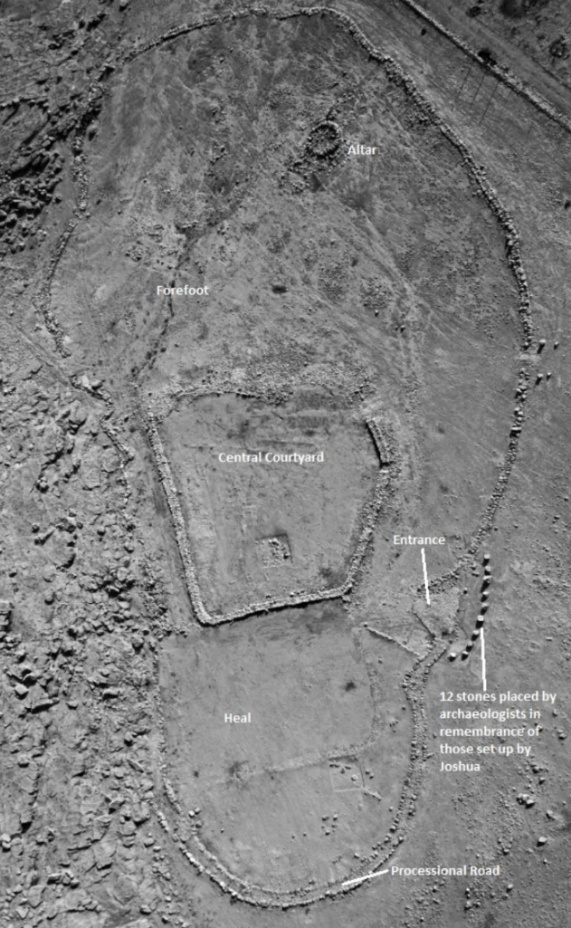
The title of Lady of All Nations also confirms a principle rooted in biblical tradition. In the Old Testament, God gave new names to those to whom He entrusted a groundbreaking mission and whom He specially chose. It is worth noting that in various countries she appeared under many local names, as in each of these places she carried out a specific divine task. She herself repeatedly reiterates that she acts by the will of God, who entrusted her with the mission of saving humanity. The name Mary is her earthly name, given by her parents at her birth, therefore her present, universal mission goes far beyond this single historical designation. This is perfectly illustrated by Old Testament examples of the changing of the names of chosen individuals: when God changed Abram's name to Abraham (making him "the father of many nations"), or when he gave Jacob the name Israel. The change of name to Lady and Mother of All Nations is therefore the seal of the new, universal mission entrusted to her by the Creator. Therefore, just as Abraham, by God's will, became the father of many nations, so the Lady of All Nations became the Mother of All Nations.
It is also worth noting the attitude of Ida Peerdeman's spiritual guide, the Dominican Father Joseph Frehe. Until the end of his life, this priest failed to grasp the depth of the words she had transmitted, never issuing a statement confirming their authenticity, nor did he privately declare them to be true. On the contrary, due to growing doubts, he held the exact opposite position, consistently reiterating that they should be approached with the utmost distance and caution. In his writings and opinions addressed to church authorities, Father Joseph Frehe openly claimed that the new terminology, particularly the title "Lady of All Nations, who was once Mary," aroused in him profound theological anxiety and could lead to dangerous confusion among the faithful. Following the official, negative Vatican decrees of 1957, this monk absolutely forbade the public dissemination of this devotion.
We see, therefore, that ultimately, Ida Peerdeman's spiritual guide failed and turned away from her and the Lady of All Nations. One could say that he thus abandoned his mission, assigned to him by God Himself. It's difficult to believe that his entire life up to that point had been guided by Providence toward becoming Ida Peerdeman's spiritual guide, and ultimately, to disbelieve her.
Satan, as the master of division and confusion, relentlessly strives to separate people from God. He seeks to destroy trust in those through whom God chooses to communicate with humanity. It should therefore be remembered that the direct cause of Father Frehe's disbelief may have been the intense efforts of the enemy of God's plan.
The reasons for this state of affairs could also have been linked to the actions of a specific group of people for whom the Amsterdam messages were highly inconvenient. It was in 1952 that the first World Humanist Congress took place in Amsterdam, during which the so-called Amsterdam Declaration was announced—a manifesto that for the first time officially presented secular postulates to the world in the very city where Ida Peerdeman lived. It's also no secret that within the Church, there are groups openly advocating for the tenets of this secularized ideology, demanding the right to abortion and contraception. Recall that when Pope Paul VI issued the encyclical Humanae vitae in 1968, upholding immutable moral principles, an influential faction of progressive clergy vehemently opposed the papal decisions, fighting to liberalize them and adapt them to the standards of the modern world.
The fact that this godless ideology of international humanism was organized in the very city where Ida Peerdeman received messages about the need to return to the Creator is no coincidence. This demonstrates that Amsterdam then became the central arena for the clash of two utterly polarized teachings: the Tree of Life and the Tree of Death. The current spiritual state of the inhabitants of the Netherlands demonstrates that most of them have plucked the fruit from the tree of death, which permanently separates man from God. We can see, therefore, that the Netherlands became a kind of imitation of paradise, where in the very center there were two trees: Life and Death, which were the teachings of distinguishing good from evil.