
Message 15 of March 28, 1948
I see the Lady. She says,
"It will be a matter of law. In a very short time, serious things will happen. They will be preceded by chaos, disorder, doubt, and despair. Heavy clouds will hang over St. Peter's Basilica, which will be dispersed through great struggle and effort... If not, there will be a fall.
All Christians must unite. This will be accompanied by great pain and misery. Unite all together, for the battle is beginning. The gates are opening. The peoples of the East in Jerusalem hold their faces in their hands. They will lament over their city.
There is a great spring in which you can all wash yourselves."
Then I see the inscription: "Righteousness, Love, and Justice." The Lady says,
"As long as these words do not appear above people's heads and live in their hearts, there is no chance for peace."
Then I see the Cross, embedded in the earth. A serpent coils around it. Everything around me becomes black and dark. Then I see a sword hanging over Europe and the East; from the West comes light. I hear the Lady say very seriously,
"Christian nations, the pagans will teach you this!"
Then I see the Pope surrounded by a reinforced bodyguard. Other people are also present around him. It seems to me as if they were all clergy – bishops and cardinals. Pointing to these clergy, the Lady says,
"Traps and snares."
After saying this, the Lady looks at me with a penetrating gaze. Heavy clouds hang over St. Peter's Basilica. Now the Lady says to all those seated around the Pope:
"Be righteous and follow your teaching. Cover your eyes with your hands and reflect on yourselves."
Now I feel as if the cross were in my hand again. It hurts. It is so heavy I can almost not hold it. The Lady says,
"Hold it tight!"
It is as if great rays were emanating from it.
Then suddenly the Lady disappears, and so does the light.
The messages of the Lady of All Nations reveal the future—and this time is no different. Each one carries a profound spiritual lesson, rooted in Sacred Scripture. This is precisely the pedagogy of Heaven: God reminds us of past events caused by human errors, and their long-term consequences. The fulfillment of all these prophecies so far proves that humanity still struggles to distinguish good from evil, since it is unable to prevent them. If we do not learn this lesson, the warnings contained in the Messages will continue to materialize in our reality.
The human heart learns most quickly through the senses—especially sight. Only by confronting the words contained in the Messages and Sacred Scripture with concrete realities does we fully grasp their meaning.
But why do these revelations contain so many motifs of war and catastrophe? The answer and key to understanding this issue can be found in the Gospel of John (John 16:5-15). There, Christ announces the coming of the Spirit of Truth. It is He who is to convince the world of sin, righteousness and judgment, shedding light on the course of future events.
Jn 16:5-15
16:5. But now I am going to Him who sent Me, and none of you asks Me, “Where are you going?”
16:6. But because I have told you this, sorrow has filled your hearts.
16:7. But I tell you the truth: It is expedient for you that I go away. For if I do not go away, the Helper will not come to you. But if I go, I will send Him to you.
16:8. And when He comes, He will convict the world concerning sin, righteousness, and judgment.
: Concerning sin, because they do not believe in Me;
9. 16:10. Concerning righteousness, because I am going to the Father and you will see Me no more;
16:11. Concerning judgment, because the ruler of this world has been judged.
16:12. I still have many things to say to you, but you cannot bear them now.
16:13. But when he, the Spirit of truth, comes, he will guide you into all truth . For he will not speak on his own initiative, but whatever he hears, he will speak, and he will announce to you the things that are coming .
16:14 He will glorify me, for he will take what is mine and declare it to you.
16:15 All that the Father has is mine. Therefore I said that he will take what is mine and declare it to you.
However, prophecies about armed conflicts should not alarm us – as Christ reminds us in the Gospel according to St. Matthew (Mt 24:6), these things simply must happen.
Mt 24:6 You will hear of wars and rumors of wars; be careful, do not be alarmed. This must happen, but the end is not yet.
The apparitions of the Lady of All Nations are a direct continuation of this Gospel announcement. It is through the Lady of All Nations – our Comforter and Advocate – that the Holy Spirit speaks, uncompromisingly exposing evil and pointing the way to good.
Analysis of the Message under discussion leads to a clear conclusion: all unrest in the world stems directly from the crisis of God's law. It results from its ignorance and from a severe deficit of love, justice, and righteousness. Until these foundations are rooted in human consciousness, authentic peace will remain unattainable.
God's law is truth, and its earthly emanation is a person living in righteousness. Although the law was given to us by God through Moses in the Ten Commandments, it was fully revealed in the Body of Christ. He completely surrendered his will to the Father by accepting the cross. In this way, humanity received spiritual nourishment that strengthens its soul on the journey to the Promised Land – Heaven. This is a clear analogy to the children of Israel, who journeyed for 40 years to the Promised Land. God then fed them manna from Heaven to give them the strength to reach it, and this manna foreshadows the spiritual Kingdom of Heaven.
Although it is commonly believed that Christ lived on earth for approximately 33 years, a more thorough analysis of the sources sheds entirely new light on this, correcting an ancient error in medieval calendars. Studies of Holy Scripture and historical records – including those of the Jewish chronicler Josephus – unequivocally indicate that Jesus must have been born before the death of King Herod the Great, who died in 4 BCE. Fascinatingly, modern cosmological and astronomical research pinpoints this date to around 6–7 BCE. It was then, as Johannes Kepler demonstrated, that a rare triple conjunction of Jupiter and Saturn occurred in the sky, creating the spectacular brilliance of the Star of Bethlehem.
It is worth emphasizing, however, that Heaven does not call us to a thoughtless ritual. Receiving the Eucharist—this manna for the soul—must be coupled with a genuine assimilation of Christ's teachings. Only it has the power to cleanse the human heart of corruption and give the soul the strength to journey through the world without constantly repeating the same mistakes. In this view, Christ becomes the temple of God, harboring within himself a source of living water.
This reality is the direct fulfillment of Zechariah's prophecy (Zechariah 13:1), which announced the coming of the Messiah, who would free people from sin and defilement. It was from Him—as the true temple of God—that the source of salvation symbolically flowed when a Roman soldier pierced His side on the cross.
Zec 13:1. In that day a fountain will break forth for the house of David and for the inhabitants of Jerusalem, to cleanse from sin and from uncleanness.
To fully understand this aspect, let us now turn to the Old Testament. It was at the foot of Mounts Gerizim and Ebal, in ancient Shechem (modern Nablus), that the children of Israel renewed their covenant with God, based on the foundation of God's Law, which the Lady of All Nations mentions at the beginning of the Message. In the context of our analysis, however, the local spring proves crucial. In the valley between these mountains lies a rock-hewn well, which, according to biblical tradition, was dug by the patriarch Jacob. Remarkably, this spring today flows within a Christian church – the Church of St. Photinus (the Samaritan), officially known as the Greek Orthodox Church of Jacob's Well. We discover a striking parallel: just as the water source from Jacob's well is located within the church, so Christ – as the Living Temple of God – harbors within himself the source of the water of life.
This is a crucial comparison, as it illustrates the role and mission of Christ, where—analogous to the ancient sanctuary—the renewal of the covenant with God takes place. By being in God's temple, we are in God, and by partaking of the Eucharist, we make Him live within us. This is precisely why the renewal of the covenant by the children of Israel occurred at the site of Jacob's well. For the same reason, the Ark of the Covenant, part of this ritual, must also have rested there.
In the context of the children of Israel, Jerusalem should be the most important point of reference for the events at Shechem and the symbolism of Mounts Gerizim and Ebal. It is generally accepted that the Temple of God—built by Solomon and later rebuilt by Herod—was located on Mount Moriah, the site where the Al-Aqsa Mosque and the distinctive, gold-topped Dome of the Rock stand today. The complex was surrounded by massive walls. It's worth remembering, however, that the famous Western Wall is not a physical remnant of the Temple itself or its walls, but rather a fragment of an impressive retaining wall dating back to the 1st century BCE. The purpose of this structure, built by order of Herod the Great, was to support a gigantic, artificial platform on which the sanctuary was situated. Jews pray at this wall because they believe that the Holy Place of God's Temple was located nearby.
However, an analysis of Sacred Scripture suggests something entirely different: God's Temple stood in a different location than the traditionally attributed Mount Moriah. The key to this mystery lies in Jerusalem's topography. Located right next to Mount Moriah is the Mount of Olives, and between these two hills, the Gihon Spring gushes from the rock. Translating this arrangement into the biblical topography of Shechem, we discover a striking parallelism: Mount Moriah (on which Islamic sanctuaries stand today) corresponds to the Mount of Beatitudes (Gerizim), while the Mount of Olives reflects the Mount of Curse (Ebal). This division is perfectly confirmed by the fact that for centuries the Mount of Olives has housed a Jewish cemetery. Both mountains represent the biblical Tree of Life and the Tree of Knowledge of Good and Evil, which is the zone of death.
This location also reflects the location indicated by Ida Peerdeman, showing the construction of the Temple of the Lady of All Nations, as described in the introduction to this study. The area indicated by the seer now houses a park and a domed swimming pool, while the area corresponding to Mount Ebal is occupied by a cemetery, with a flowing river separating the two points. This striking topographical identity is no coincidence; it constitutes a testimony rooted in Scripture, thus authenticating the revelations of the Lady of All Nations.
From this perspective, it becomes clear that the temple complex on Mount Moriah does not occupy the site where the covenant was renewed, but rather stands on the Mount of Beatitudes. This does not mean, however, that the temples of Solomon and Herod were not located on Mount Moriah at all. Their monumental splendor and opulence, which we read about in Holy Scripture, can logically be linked to the manifestation of God's blessing attributed to this particular mountain.
However, a true sanctuary—one serving directly to cleanse from sin and impurity—must have been built in the valley between the two hills, directly above the Gihon Spring, which flows from a rock. It was precisely above its waters that the true Temple of God must have stood. This location is not accidental; as we read at the very beginning of the Book of Genesis, the Spirit of God hovers over the waters (Genesis 1:2).
This location of holy places is confirmed by recent archaeological discoveries and reports from scientific research programs. A key clue is the research led by American antiquities expert Timothy P. Smith. Using advanced computer technology and mathematical algorithms, he discovered textual codes and linguistic structures encrypted in the oldest Hebrew manuscripts. These hidden codes indicate that the Temple of God was located directly above an underground water source.
The second, material clue comes directly from the earth. Years of archaeological excavations, led by Israeli archaeologist Eli Shukron in the City of David, led to the discovery of an ancient, rock-hewn sacred complex with a sacrificial altar and special channels. This structure is located a few meters above the Gihon Spring, where, in light of all these facts, the Ark of the Covenant must have originally rested.
From a Christian perspective, the Mount of Olives gains an additional dimension. Today, the Sanctuary of the Ascension of Jesus, concealing the traditional footprint of Christ, stands on its summit. It was on this hill that Jesus taught his disciples the words of the Lord's Prayer and there he prayed to God just before being captured by Roman soldiers. Referring to Message 14, in which we described the meaning of the Lord's Prayer, the connection between the Mount of Olives and Mount Ebal becomes the ultimate confirmation of the spiritual significance of the words of this prayer. It is a spiritual offering to God, both a burnt offering (an act of worship, adoration, and complete submission to the Father's will) and a peace offering (a peace offering).
Christ himself says in the Gospel that the time has come when people will offer sacrifice in Spirit and truth (John 4:23-24). This truth, as we have already mentioned, is manifest in the life of a righteous person. If a person has transformed their spirit into the likeness of God's Spirit, then as a righteous person they act in accordance with His plan. The point is to be good—just as God plans to make this world.
Standing at Jacob's well, Christ also confirms that Jerusalem is the place of worship for God—as it was for the Samaritans who lived around Mounts Ebal and Gerizim at that time. Furthermore, as the Living Temple of God, standing at this well shows us where the true Temple of God should actually stand—that is, at the Gihon Spring between Mount Moriah and the Mount of Olives.
Let us now take a closer look at the Message of the Lady of All Nations itself. It warns that heavy clouds are gathering over St. Peter—a direct reference to the Pope as the Successor of St. Peter. However, a correction is necessary at this point. Official book publications containing the content of these revelations have popularized the version that the clouds are gathering over St. Peter's Basilica. This minor change, unfortunately, completely distorts the meaning of the prophecy. It suggests a crisis of the entire institutional Church (which is generally true), while the original message focuses on a specific pope, who is to suffer at the hands of his own clergy.
This detail perfectly illustrates how a single word can transform the meaning of a prophetic message. Fortunately, thanks to the original audio recordings, we can now present a faithful and direct transcript of the words Ida Peerdeman spoke live during the recording of this Message. Importantly, at 0:16 and 2:02 of the recording, Ida describes directly what she sees before her eyes. Only at 3:44 does she begin to share her own personal feelings and reflections—which, by the way, is a regular part of the summary of each of her visions.
0:16 Chaos, disorder, doubt, and despair will precede them. Heavy clouds will hang over Saint Peter
2:02 I hear the Woman say again: Wolf pits and traps. Heavy clouds hang over Saint Peter .
3:44 And then I saw this Saint Peter with heavy clouds hanging, and that much struggle and toil would come, and that they would be dispersed, she said.
The message of the Lady of All Nations states that serious events will soon occur, preceded by chaos, disorder, doubt, and despair. Let's take a look at this fragment in the original audio recording:
0:00 I see a Woman and She says: It will be a matter of law, and in a very short time, serious things will begin to happen.
0:16 Chaos, disorder, doubt, and despair will precede them. Heavy clouds will hang over Saint Peter, which will be dispersed with great struggle and difficulty.
0:31 She says: "Otherwise, he will fall." All Christians must unite, which will involve great pain and misfortune.
Below is Ida Peerdeman's commentary on the above words of the message of the Lady of All Nations:
3:44 And then I saw this Saint Peter with heavy clouds hanging over him , and that much struggle and hardship would come, and that they would be dispersed, she said.
3:52 And then she said so very strangely, "If not, he will fall." Yes, it was so strange. I never found out what she actually meant by that, I'd pondered it so often, thinking, "What did she actually mean by that..."
4:07 But yet that sentence always stayed in my head: "If not, he will fall," didn't it?
Let's focus on the key phrase for understanding the entire message: "if not, then he will fall" (Dutch: zo niet ten ondergaan). The first words simply introduce the condition: "if not, then..." – and here the point is obvious. The real depth, however, lies in the verb itself. The Dutch word "ondergaan" (together with the noun "de ondergang" or the phrase "ten onder gaan") is an incredibly rich term. Depending on the context, it can mean: "to sink" or "to go to the bottom"; "to sink below the horizon"; "to perish" or " to cease to exist"; "to collapse"; "to fall" or "to be overthrown"; "to suffer defeat" or "to morally decline.
Considering the heavy, storm clouds gathering over St. Peter, this word should primarily be translated as "to sink." The entire phrase then takes on an evangelical dimension: "otherwise, he will sink." This image directly alludes to the Gospel of John (John 6:16-21). It speaks of a violent storm that Christ's disciples struggled with. They were sailing alone, and Jesus was not on board. When the terrified apostles believed they were perishing, Christ came to them, walking on the stormy waters, mystically guiding the boat to shore.
John 6:16-21
6:16. At dusk his disciples went down to the sea,
6:17. And getting into a boat, they crossed it to Capernaum. It was already dark, and Jesus had not yet come to them;
6:18. The sea was agitated with a strong wind.
6:19. When they had rowed about twenty-five or thirty stadia, they saw Jesus walking on the sea and drawing near to the boat. And they were terrified.
6:20. But he said to them, "It is I; do not be afraid!"
6:21. They tried to take him into the boat, but immediately the boat was at the shore toward which they were heading.
In biblical symbolism, a boat represents the Church. Thus, St. Peter—as pope and helmsman—is on the boat, and heavy clouds heralding a catastrophic storm gather overhead, casting a shadow over the entire community.
If these clouds are not dispersed, the boat, along with the Pope, the clergy, and the entire community, will simply sink to the bottom. The salvation of this ship—as we will later see—depends solely on the attitude of the Successor of St. Peter himself. We also see that Christ is missing from the ship to calm the storm. The image of the Message perfectly reveals the reason for this spiritual abandonment: priests gather around the Pope, trying to force him to make a specific decision. Where peace and unity are lacking, God is absent. The curse of Mount Ebal inevitably descends upon places gripped by chaos and disorder.
In a global perspective, this lack of peace always materializes in the form of wars and historical catastrophes. This is precisely why the Lady of All Nations is issuing a categorical appeal to us: all Christians must unite immediately so that the pressure on the Pope is lifted. Only by working together can we dispel the dark clouds and save the sinking ship of the entire community of believers.
Ultimately, the direction of the Church depends on the helmsman, the Pope. This is precisely why storm clouds are gathering above him, symbolizing the clergy eager to take the helm of the ship. Whether this darkness will spread over the entire Church as a consequence of the breach of the Covenant with God will depend on the Pope's determination and final step, aided by God. For now, these words may sound mysterious, but once we identify the Bishop of Rome and the situation in question, everything will become clear.
However, in the Message of the Lady of All Nations, we hear the assurance that the dark clouds will ultimately be dispersed from the See of Peter. This means that the time of unrest and storm will be interrupted at some point – for if it were not, the community of believers would face a final end. We intuitively see a parallel here between Christ's prophecy in the Gospel according to St. Matthew (Mt 24:15-22) and the image conveyed by the Lady of All Nations:
Mt 24:15. Therefore when you see the "abomination of desolation," spoken of by Daniel the prophet, standing in the holy place , let him who reads understand.
This is precisely the scenario that emerges from the Message. The Pope, surrounded by reinforced security, becomes the target of attacks from various clerical factions driven by their own particular interests and submissive to the spirit of this world. These disputes, waged within the Church hierarchy, prove brutal and insidious, which the Lady of All Nations uncompromisingly exposes, using the blunt term: "pits and traps." She also reminds us that until love, justice, and righteousness shine above people's heads, authentic peace will remain unattainable. In the imagery of the Message, the lack of peace among priests signifies a lack of these fundamental values in their relationships, above all, the righteousness mentioned at the beginning of the Message.
This is confirmed by the subsequent words of the Lady of All Nations, addressed directly to the clergy: "Be righteous and follow your teaching," and also: "Cover your eyes with your hands and examine yourselves." This is a call for priests, closing their bodily eyes, to look at reality from the perspective of the soul and the teachings of Christ, instead of viewing it through the prism of the spirit of this world. Jesus himself used a similar admonition when, in response to St. Peter's objection, he said that he thinks not with what comes from God, but with what comes from Satan—the spirit of this world.
The Spirit of God must take root in human consciousness, and the witness of life must follow. God's Church is, after all, the space in which, through Christ's teaching, the transformation of the human heart must take place. If the Church falls, the entire Christian community and humanity will fall, losing the only instrument capable of truly transforming this world.
So, what pope and what situation is the Message of the Lady of All Nations, delivered on March 28, 1948, about? The only such events, consistent with the prophetic image of the Message, occurred during the pontificate of Pope Paul VI. On July 25, 1968, he issued the encyclical Humanae Vitae, which ignited a massive conflict in clergy and laity worldwide. It addressed contraception as contributing to the depopulation of the Christian community. Through its use, a person becomes objectified, and the subsequent consequence of this approach is abortion, which is the sin of murder. Yet the Ten Commandments clearly state: "You shall not kill." It is precisely the spread of abortion across the globe, rooted in the contraceptive mentality, that is one of the reasons for the heavy clouds gathering over the Pope and the entire Church. Murder, a radical violation of God's Law, leads to a curse and punishment, and in the long run, to death.
Sometimes, contraception also contributes to the complete renunciation of offspring, which directly violates God's Commandment to Adam and Eve.
Before discussing this commandment, let us return for a moment to the Message of the Lady of All Nations, in which we hear that to dispel these heavy clouds, all Christians will have to unite—which will involve great pain and misery. In the light of the encyclical Humanae vitae, this call to unity takes on a very specific, fundamental dimension: it means creating families strengthened by God in sacramental marriages, which open themselves to the gift of new life and bear fruit in the form of offspring. Anyone raising children knows perfectly well the enormous effort, sacrifice, and dedication this task demands, which naturally influences daily choices and often lowers the material standard of living for the entire family. Just as a woman gives birth to offspring in the pain of childbirth, so a man labors in pain, struggling with the earth that produces thorns and thistles. This harsh daily life perfectly reflects the words of the Lady of All Nations about the pain and misery of parents. However, this is the path of Christian sacrifice. The eternal commandment and plan of God, recorded in the pages of Holy Scripture, is that man and woman should unite with each other:
Gen 2:24 Therefore a man leaves his father and mother and cleaves to his wife, and they become one flesh.
In this sense, the biblical "joining" refers to the marital act, while "one flesh" refers to offspring who become the physical, tangible fruit of this love, bearing within themselves a part of both father and mother.
Let's examine Ida Peerdeman's words in more detail. The Dutch word "aaneensluiten" is translated as "to join together," which precisely reflects the formulation used in Holy Scripture (Genesis 2:24) and in books conveying the content of the revelations of the Lady of All Nations. However, when we examine the depth of this word, it becomes clear that its literal meaning, depicting a physical embrace or formation, is: "to close into one," "to unite," "to adhere closely to one another." We see, therefore, that "to adhere closely to one another" more deeply reflects the meaning of this word, which is the act of intercourse between a man and a woman.
God's commandment, therefore, states that marital intercourse is to bring life, not death.
For violating this law, the Christian community brings death upon itself. Imagine a situation in which Christians widely practice contraception and allow abortion. By doing so, they find themselves on the verge of annihilation – especially since representatives of other cultures, which are themselves overpopulated, including the peoples of the East, begin to emigrate to Christian nations, eventually replacing them. In the Message, this process is symbolically presented as gates opening in Eastern countries, caused by flight from military operations. We will discuss this aspect in greater detail later in the message.
However, the education of people in those regions of the globe where the teachings of Christ are not rooted follows not only the spirit of this world but is also based on a strictly defined, strict law – which is often incomprehensible to Christians. Such a scenario will sooner or later dominate Christian countries, setting them back in both civilizational and moral development. Therefore, the Lady of All Nations calls on Christians to fight to preserve their own community by establishing large families. The point is to ensure they are not replaced by followers of other cultures, who might begin to dictate their own terms and legal principles, which the indigenous people will certainly not like. In those civilizations, breaking imposed rules involves radical measures.
Therefore, for these heavy clouds to be dispelled, Christians must absolutely abandon contraception and abortion. Imagine, however, a situation in which the official authority of the Church establishes a law permitting contraception or universal abortion. By accepting such guidelines—often even completely unconsciously—the faithful would be signing their own death warrants.
Let us now describe the events that took place in the Church when the Holy Father attempted to uphold the traditional teaching prohibiting contraception. It should be added that these regulations constituted the unchangeable law traditionally binding in the Catholic Church. Meanwhile, the clergy gathered around the Pope exerted powerful pressure, demanding that this divine law be changed to suit the dictates of the modern world.
The debates that unfolded behind closed doors at the Vatican during the work on the encyclical Humanae vitae between 1963 and 1968 were the most dramatic, insidious, and brutal theological clashes in the modern history of the Church. The topic of contraception had long been a hot topic of discussion, so Pope John XXIII established a special research committee called the Pontifical Commission for Population, Family, and Nativity. Initially composed of just six people, including lay experts, it was followed by John XXIII's death in June 1963, his successor, Paul VI, who took over and expanded the body to approximately sixty members: cardinals, bishops, theologians, as well as doctors, sociologists, and married couples.
It was under Paul VI that this initially peaceful research transformed into a veritable "storm." The commission split into warring factions, each attempting to force a change in the prevailing doctrine by advocating for contraception. Tremendous, organized media and financial pressure was exerted on the entire body (including from the Rockefeller Foundations, which were pushing for global depopulation) to force the Vatican to surrender unconditionally. An unprecedented rebellion occurred within the Commission, with two fierce camps forming:
- Majority Faction (Progressives): This constituted the overwhelming majority of the Commission's members. Led by influential figures like Belgian Cardinal Léon-Joseph Suenens, they produced a document known as the Majority Report. It argued that, in the face of world overpopulation and the demands of "modern humanism," the Church should recognize hormonal contraception as morally acceptable, abandoning its previous position.
- The Minority Faction (Traditionalists): Consisting of just a few theologians who categorically rejected these demands, they stood firm in upholding the immutability of the Ten Commandments and natural law. They warned that if the Church were to bow even once, it would open the gates to total moral destruction—the objectification of women, the degradation of families, and mass abortion.
In 1967, proponents of liberalization decided to employ a brutal and insidious political maneuver: they orchestrated a massive leak of secret documents to secular media. The Majority Faction Report was deliberately leaked to the press to suggest to world opinion that the Church had already decided to approve the pill, and that the Pope only needed to formally sign it. Had Paul VI rejected this document, he would have been seen by the masses as the sole author of these antiquated prohibitions. The intention of this ruse was to incite widespread popular anger against him. And that's precisely what happened. In the press, the Pope was systematically vilified, described as a backward, backward old man with anachronistic views. Everyone pointed fingers at him, and the atmosphere of hostility was so intense that shortly after the encyclical's publication—on November 27, 1970, at the Manila airport—the Holy Father was physically attacked and stabbed by an assassin.
When, before making his final decision, the Pope received the Commission's official report, he was deeply dismayed that almost his entire advisory circle had voted for capitulation. It must be clearly stated that many clergy were simply motivated by fear of the reaction of the laity, who did not wish the Church to interfere in their intimate spheres. A coordinated propaganda campaign was underway in the media, aimed at inciting the faithful against the hierarchy and the Successor of St. Peter himself.
However, while the Pope was still pondering his course of action, a helping hand was offered by the then-Archbishop of Kraków, Karol Wojtyła (the future John Paul II). The Polish prelate unerringly saw through the progressives' ruse. He appointed a secret group of distinguished experts in Kraków, which prepared an anthropological and theological memorandum, providing crucial support for Paul VI's decision. Wojtyła personally provided him with these analyses, proving beyond any doubt that the "contraceptive mentality" would lead human civilization to inevitable destruction.
Let us pause here for a moment. In the previously quoted passage from the Gospel of John, Christ walks on the water and extends a helping hand to his terrified disciples, immediately bringing the boat to shore. Note that in this case, Jesus does not calm the storm and waves, but merely safely guides the boat to shore, where it no longer has the chance to sink. In exactly the same way, Karol Wojtyła personally comes to the aid of Paul VI, who is struggling in a storm, and the crisis is averted.
The future Pope John Paul II was renowned for his extraordinary Marian spirituality. He referred to himself in this way, and his chasuble bore the embroidered letter "M," referring to the Lady of All Nations, who was once—during her earthly life—Mary. Many clergy reject the statement "who once was Mary," claiming that the Mother of God has always been and always will be simply Mary. However, when we refer to Holy Scripture, we notice that God repeatedly gives new names to his chosen ones—and this case is no exception. For example, the patriarch Jacob was named Israel by God, and Abram received the name Abraham. In turn, Jesus was given this name by the will of God the Father himself through an angel. We see, therefore, that every word spoken by the Lady of All Nations has its deep foundation in Holy Scripture.
Returning to the symbolism of the boat: it was the Lady of All Nations, in whom the Spirit of God dwells, who brought Karol Wojtyła, a Marian priest, to Pope Paul VI, thanks to which the ship of the Church reached shore in one piece. The times of the Catholic Church's decline were thus interrupted by God's work, but the storm did not end. The children of Israel did not recognize God who came in the flesh of Jesus. Similarly, contemporary Christians do not recognize God who spoke through the Lady of All Nations. We see, then, that this is not about the physical body, but about science. Not to know God means not to know His teachings, which are inextricably linked to Sacred Scripture.
As we have already mentioned, ultimately, on July 25, 1968, Paul VI demonstrated superhuman courage. He rejected the Majority Faction's opinion and, in the encyclical Humanae Vitae, upheld the inviolability of God's Law. It is worth adding here that this document was signed on the feast day of St. James the Apostle, which symbolically links it to the patriarch Jacob, who dug a well in the rock between Mount Ebal and Mount Gerizim. It was at this well that the covenant between the children of Israel and God was renewed. The encyclical Humanae Vitae, , is essentially a contemporary renewal of the covenant between the Creator and Christians, as the moral provisions contained therein, concerning the prohibition of contraception, have been consistently guarded by the Church for centuries. They therefore constitute nothing new, but simply a repetition of the eternally binding Law.
For Pope Paul VI, the price for this act of absolute fidelity to the Creator was an immediate, powerful storm: the episcopates of Germany, the Netherlands, the USA, and France openly disobeyed him.
Paul VI himself did not write a single encyclical for the rest of his pontificate—for the next ten years—becoming a suffering, lonely pastor betrayed by his own priests.
Progressive clergy, striving at all costs to please public opinion, considered the encyclical Humanae vitae a mistake. They claimed that the document irreparably damaged the image of the Church, and they also blamed Cardinal Karol Wojtyła, who had directly contributed to the Bishop of Rome's decision.
Paul VI's successor was John Paul I (Albino Luciani). His reign went down in history as one of the shortest – lasting only 33 days and abruptly cut short by the Pope's death from a heart attack. It's worth recalling that before the encyclical Humanae vitae , Albino Luciani sided with the majority faction, which sought to liberalize contraceptive laws. Interestingly, he was neither a conservative nor a progressive – he was widely considered a centrist. Instead, the Bible says: "I wish you were either cold or hot! But since you are lukewarm, and neither hot nor cold, I am about to spit you out of my mouth" (Revelation 3:15-16).
After his unexpected departure, Karol Wojtyła was appointed to the See of Peter – Pope John Paul II, whose ministry lasted over 26 years.
It's hard not to see Providence at work in this extraordinary confluence of events. God's hand ensured that Paul VI's ultimate successor was not a hierarch inclined to make concessions and dilute God's Covenant, but one who steadfastly upheld it. Wojtyła's path to the papal throne was a striking symbol of the triumph of a minority supported by God. During the first conclave after Paul VI's death, the Krakow cardinal received only four votes in the second, morning round out of a possible 111. Although a handful of electors supported him at the time, less than two months later he left the Sistine Chapel as Head of the Church. It is clear, then, that God's plan can completely reverse human proportions, provided they are aligned with His will.
This choice proved to be a true blessing. John Paul II went down in history as an outstanding Successor of St. Peter. With his extraordinary charisma and unique pastoral style, he won millions of lost hearts to God. He became the pilgrim pope who made the most apostolic journeys in the history of Christianity, tirelessly proclaiming to the entire world the teachings of the inviolability of the family, the dignity of every human being, and the beauty and value of motherhood.
In the image of the Message, we see a cross embedded in the earth, around which a serpent coils. This is a symbolic representation of the Tree of Knowledge of Good and Evil, which represents the realm of death. As the seer gazes upon it, a deep darkness falls around her, representing this state.
Then she sees a sword hanging over Europe and the East, while light comes from the west. Then the Lady of All Nations says solemnly: "Christian nations, the pagans will teach you this."
Ida always wondered what these words about pagans might actually mean. Let us, then, explain this entire prophetic image. The serpent coiling around the tree—exactly as it did in the time of Adam and Eve—tempted and continues to tempt God's people. The purpose of this insinuation is to instill in people a reluctance to have children, supposedly in the name of comfort and a peaceful life. Many succumb to this delusion, which, in the historical perspective, leads to inevitable death, as the lack of new generations erases the traces of a given civilization's existence. The sword hanging over Europe and the East heralds the punishment and curse resulting from the breaking of God's Covenant, which is irrevocably binding on every Christian.
Lev 26:25 I will send a sword against you, avenging your broken covenant. And if you flee into the cities, I will send a plague among you, and you will fall into the hands of your enemies.
It's important to note that, according to Holy Scripture, God's coming will come from the East, which metaphorically refers to the morning sunrise in the sky. It's worth remembering that, historically, God in the Person of Jesus Christ came into the world in the Middle East—it was from there that the Light for all humanity shone.
However, Ida sees the light coming from the West, which is a symbolic place of darkness, for it is there that the sun sets and night begins. It's important to emphasize here that we shouldn't attribute any privileged position to specific parts of the world, as this has only a symbolic meaning. This image is followed by words about pagans who have something to teach Christians, becoming for them a kind of light coming from darkness.
Since the Message of the Lady of All Nations speaks of abortion, contraception, and the related depopulation, the lesson given to Christians by pagans must be related to these very aspects. The peoples of the East are rapidly increasing their population, unlike the Christian community, whose numbers are drastically declining. For this reason, in the future—if nothing changes—these communities will sooner or later dominate and replace the former Christian world. This process will initially be associated with mass emigration to Europe, as a result of which the new arrivals will begin to visibly dominate the indigenous population.
Pagans, who do not practice contraception or abortion, will naturally—without open war—displace the former Christian nations. They will ruthlessly demonstrate to Europeans that true strength lies in numbers, ultimately imposing their laws on the minority. This bloodless demographic war was dubbed the Great Replacement theory in 2011. In it, French essayist Renaud Camus argues that it is precisely the indigenous Europeans, shaped by Christian culture, who are being systematically replaced by non-European populations, primarily of the Islamic faith. We see, therefore, that the former Christian world will be peacefully conquered through natural increase alone.
The prophetic dimension of this phenomenon becomes striking when we realize that Our Lady of All Nations described this process in her Message as early as 1949, anticipating the conclusions of contemporary geopolitics by more than six decades. Our Lady calls on Christians to reverse this course by courageously establishing large families, so that the community of believers will survive and not collapse.
Let us now consider the phrase "teaching from the pagans" in the context of abortion, which is becoming a common phenomenon in Europe. To fully understand this process, we must call things by their proper names: from the perspective of Christian morality, abortion is nothing less than a ruthless attack on defenseless, unborn life. It is, quite simply, murder.
Since contemporary Europeans are accepting this practice on a massive scale, the announced teaching from the pagans becomes retribution. A terrifying consequence of Christian errors will be a situation in which Christians themselves will fall victim to violence at the hands of immigrant peoples. Since Western civilization has lost its moral compass and ceased to understand the meaning of killing the innocent, it will experience this firsthand. These tragic events are destined to shake the consciences of Christian nations and become a bloody and painful lesson for future generations.
However, this topic requires a deeper introduction and an answer to a fundamental question: why did such a mass migration of non-Christian peoples to Europe occur in the context of the Message of the Lady of All Nations, and how is it linked to the demographic crisis in the West?
In the Message, we see a moving image of the peoples of the East burying their faces in their hands, mourning for their city – Jerusalem. Analyzing the events that took place in the Holy City immediately preceding the publication and signing by the Pope of the encyclical Humanae vitae on July 25, 1968, we can easily see their direct connection to the Arab-Israeli war, known as the Six-Day War. This lightning-fast armed conflict, also known as the June War, raged in the Middle East from June 5 to 10, 1967. Israel won a crushing victory over a coalition of Arab states – Egypt, Jordan, and Syria, supported by Iraq. On June 7, 1967, Israeli forces captured and completely subjugated all of Jerusalem in just a few hours.
It was during this war that Palestinians lost control of the eastern part of Jerusalem, which had previously been under Jordanian jurisdiction. After the Israeli army occupied the West Bank and Gaza Strip, unemployment in these territories soared, and hundreds of thousands became homeless. This situation, coupled with the opening of migration channels through Jordan, initiated a mass exodus of Palestinians in search of a safer life and work. Thousands of young Palestinians emigrated to Europe at that time – primarily to West Germany (FRG) and Sweden – giving rise to numerous contemporary Islamic communities in the West, of which Berlin remains a striking example to this day. Events after 1967 – both the blocking of Palestinians' ability to return to their homeland and the enormous demand for cheap labor in post-war Europe – finally opened the gates of the Old Continent to them.
The dispute between Israelis and Arabs had been simmering for many years, and one of the main triggers for the outbreak of war proved to be false intelligence information provided to Egypt by the USSR. The Soviets informed the Egyptians that Israel was amassing a massive military force on the border with Syria, a sign that a confrontation was imminent. Although Cairo later learned that this was disinformation, it did not halt the mobilization that had already begun. Moreover, Egyptian President Gamal Abdel Nasser took a step that Israel viewed as a direct act of war: he completely blocked the Straits of Tiran to Israeli shipping, cutting the country off from the Red Sea.
In response to this blockade and the tightening ring of Arab forces, Israel decided to launch a preemptive strike against the Egyptian air force, completely destroying it on the ground. The same fate befell the air forces on the other Israeli-Arab borders, resulting in the Arab states being crushed in just a few days.
The Palestinians blamed this state of affairs on the West, which was massively rearming Israeli forces. Furthermore, they deeply resented Western states for their lack of response to Israel's violations of international law, which were gradually annexing their territories. This sense of injustice and impunity sparked the tragic events that later unfolded on the Old Continent.
The Message of the Lady of All Nations states that the sword hung over both Europe and the East. The sword hanging over the East materialized in the form of the Six-Day War, while the sword hanging over Europe took the form of terrorism, which rapidly intensified after 1967. Palestinians took revenge on the West for its inaction towards Israel's actions and for its military support of the Jewish state, which was considered the direct cause of the Arabs' defeat in the war and the loss of Jerusalem, their long-standing home.
Let us examine the activities of Palestinian terrorist organizations in the West. The defeat of the regular Arab armies in 1967 made Palestinians realize they could not count on Egypt or Syria to win their independence. The Palestine Liberation Organization (PLO), led by Yasser Arafat, took control of the resistance movement. The fringe factions decided that, since they were unable to defeat their opponents on the traditional battlefield, they needed to take the fight to the international arena to force Western public opinion to pay attention to the Palestinian cause.
The Popular Front for the Liberation of Palestine (PFLP) became the primary perpetrator of these attacks, and Western airlines and aircraft flying to Israel became the primary target:
- July 22, 1968 (Hijacking of El Al Flight 426): First-ever hijacking of an Israeli passenger plane (Rome-Tel Aviv route) by the PFLP. Hostages were exchanged for Palestinian prisoners.
- December 26, 1968 (Athens Airport Attack): An Israeli airliner was shot down on the airport runway by PFLP fighters. One passenger was killed.
- August 29, 1969 (Hijacking of TWA Flight 840): Notorious terrorist Leila Khaled led the hijacking of a US airliner bound for Damascus.
- February 21, 1970 (Swissair Flight 330 Crash): A bomb planted by the PFLP High Command exploded on a plane bound for Tel Aviv. The plane crashed in Switzerland, killing 47 people.
- September 6, 1970 (Operation Dawson's Field): Simultaneous hijacking of four Western airliners (TWA, Swissair, BOAC, Pan Am). Three of them were forced to land in the Jordanian desert and blown up on camera. This event led to the Jordanian civil war (Black September).
- May 8, 1972 (Sabena Flight 571): Four Black September terrorists hijacked a Belgian airliner bound for Tel Aviv. Israeli commandos (including Benjamin Netanyahu) successfully stormed the plane.
- May 30, 1972 (Lod Airport Massacre): Palestinians hired the Japanese Red Army. Three attackers opened fire with machine guns at a terminal near Tel Aviv, killing 26 people and wounding 80.
The most famous international attacks were:
- September 5–6, 1972 (Munich Massacre): Members of the Black September group broke into the Olympic Village during the Olympic Games. They murdered 11 Israeli athletes and coaches and one German policeman.
- August 5, 1973 (Athens Airport Attack): Black September terrorists opened fire in a crowded terminal, killing three people and wounding 55.
- December 17, 1973 (Rome-Fiumicino Airport Attack): Palestinian gunmen threw phosphorus bombs at a Pan Am flight and fired on the terminal. 34 people died.
- December 21, 1975 (Attack on OPEC headquarters in Vienna): Notorious terrorist Carlos "the Jackal," acting in collaboration with the PFLP, took 63 ministers and officials from oil-producing countries hostage. Three people died.
- June 27, 1976 (Operation Entebbe / Hijacking of Air France Flight 139): A plane flying from Tel Aviv to Paris was hijacked by the PFLP and West German far-left fighters to Uganda.
- August 11, 1976 (Istanbul Airport Attack): PFLP bombers attacked passengers waiting for a flight to Israel, killing four people.
- October 7, 1985 (Achille Lauro Hijacking): Four members of the Palestine Liberation Front seized an Italian cruise ship and cold-bloodedly murdered a disabled American Jew, Leon Klinghoffer, by throwing him into the sea in his wheelchair.
- December 27, 1985 (Rome and Vienna Airport Bombings): Members of the Abu Nidal Organization (OAN) simultaneously attacked the check-in desks of the Israeli airline El Al at both airports. Nineteen people, including children, were killed and over 100 were injured.
In Israel itself, numerous other terrorist attacks occurred as a direct consequence of the lack of peaceful resolution of tensions between Israelis and Arabs. Their consequences were chaos, disorder, despair, and despair. Over time, numerous attacks by Islamic extremists also began to occur in Europe, sowing such deep fear in societies that many people became afraid to leave their homes. War always generates suffering on both sides of the conflict, so any disputes must be resolved peacefully.
Let us now analyze the course of the Six-Day War, as it provides an excellent point of comparison for the events that unfolded shortly thereafter in the Holy See. Although Israel possessed significantly fewer military resources than the Arab coalition, it won the conflict in spectacular fashion. The Arab states possessed a vast, ultramodern arsenal that drastically outnumbered Israel's defense forces. Egypt alone possessed hundreds of modern Soviet fighter jets (such as MiG-21s) and long-range bombers. What happened on June 5, 1967, wasn't due to a lack of weapons, but to unimaginable sluggishness and blatant errors on the part of the Arab command. Military historians to this day cite that day as a textbook example of how poor leadership can lead to the annihilation of a powerful army.
Israeli intelligence meticulously analyzed the daily habits of the Egyptian military. The attack was planned for 7:45 a.m. for very specific reasons. Primarily, at that time, pilots were finishing their morning patrols and disembarking for breakfast, leaving their planes unfueled. Meanwhile, base commanders, who were supposed to relieve their colleagues, were stuck in morning traffic jams on their way to headquarters in Cairo. Most astonishingly, the thick fog that had hovered over the Sinai bases at dawn suddenly cleared at 7:45 a.m., giving the Israelis perfect visibility.
The greatest absurdity of this war, however, turned out to be the fact that minutes before the attack, Egyptian Defense Minister Field Marshal Abdel Hakim Amer took off from Cairo to inspect bases in Sinai. Fearing that his own air defenses might mistakenly shoot him down, he issued a categorical order to disable all radars and missile systems throughout the peninsula. When the Israeli fighters arrived, Egyptian radars were blind, and Egyptian troops were forbidden to open fire.
The Egyptians also made a cardinal logistical error – their multimillion-dollar planes were parked side by side at the airports, completely exposed, without any concrete shelters. Israeli pilots, flying low above the ground, mow down entire lines of parked aircraft in rapid succession. Furthermore, Israel used special bombs to destroy the runways, preventing the surviving planes from taking off.
Analyzing these events, one might get the impression that the Egyptian pilots and commanders were paralyzed by an invisible force. Such an inexplicable defeat of military might finds its spiritual explanation in the pages of Holy Scripture. Israel's smaller army defeated a more numerous enemy because it was supported by God's promise recorded in Holy Scripture. We have already mentioned that Israel is the chosen people, through whose example God reveals spiritual reality to the entire world.
The fate of the Vatican commission that debated the encyclical Humanae vitae unfolded in precisely the same way. Although it was dramatically divided into a minority faction (comprising only 10% of the members) and a majority faction (comprising a staggering 90% of the members), the majority miserably lost this clash with the minority. This happened because God, who will never condone the destruction of unborn life, was with the minority, as is clear from the Law given to us.
Returning to the Six-Day War, it is worth quoting a key passage from the Book of Zechariah (Zechariah 12:1-6):
Zechariah 12:1-6
12:1. Judgment. The word of the LORD concerning Israel.
Declaration of the LORD, who stretched out the heavens and laid the foundations of the earth, who puts spirit within man.
12:2. Behold, I will make Jerusalem a drinking cup for all the nations that are abroad. I will also bring trial upon Judah when I lay siege to Jerusalem.
12:3. On that day I will make Jerusalem a heavy stone for all the nations; whoever lifts it up will be cut off severely. All the nations will be gathered against it.
12:4. On that day, declares the LORD, I will strike every horse with terror, and its rider with madness. But I will look upon the house of Judah with favor, and all the peoples
12:5 Then the leaders of Judah will say, " The inhabitants of Jerusalem have great help from their God, the LORD Almighty."
12:6On that day I will make the leaders of Judah like a pot on fire, like a burning torch among sheaves, and they will consume all the surrounding nations on the right and on the left. But Jerusalem will remain where she is.
The text above speaks of the riders' horses being struck blind and their riders insane, which surprisingly aligns with the absurd behavior of the Egyptian troops and the destruction of their aircraft.
Symbolically, these riders were Arab pilots, while their combat mounts were modern aircraft. The Six-Day War ended with the complete defeat of the coalition, and Jerusalem fell to the Israelis in mere hours.
This biblical analogy, however, goes much further. It is deeply reflected in the events that unfolded in the See of Peter – the spiritual Temple of God. There, too, God sided with the minority loyal to Pope Paul VI, helping them win this doctrinal battle. Were it not for Karol Wojtyła (later Pope John Paul II), who supported Pope Paul VI with his treatise, the regulations advocated by the progressive majority would likely have been implemented.
In this interpretation, the rider becomes the human soul, and its mount – the human body. Zechariah's prophecy clearly demonstrates that the hierarchs belonging to the Majority Faction have been afflicted by this condition. This is precisely why the Lady of All Nations calls upon the priests of the progressive camp to cover their eyes with their hands and reflect. In this way, she blinds their "mounts" so that their souls—through direct association with eternal darkness and the resulting fear of God—will finally see. In darkness, people lose their bearings and do not know where they are going unless they possess the Light, which is Christ and His teachings. By cutting off their senses and finding themselves in total darkness, they are meant to realize that they are in darkness without the Light, and this is meant to cause them to remember the saving teaching of Christ, which dispels this darkness.
In their case, it was not the soul possessing the Light that dominated the body, but the body that took complete control of the soul remaining in darkness. This call, then, becomes an appeal to look at reality not through the prism of earthly corporeality, but through the pure truth that comes from God. This is confirmed by the words of the Lady of All Nations: "Be righteous and follow your own teaching. Cover your eyes with your hands and examine yourselves."
Eve, finding herself at the Tree of Knowledge of Good and Evil, was also bodily blinded by her senses, further tempted by Satan, who extinguished the Light in her soul. Looking at the forbidden fruit, she decided it looked delicious, and she followed the voice of her bodily senses instead of the voice of the Spirit of God, whose teachings she should have preserved in her soul. Eve, therefore, lost the Light that comes from God. In exactly the same way, the clergy who advocated for a change in moral regulations—and today many of them advocate, for example, the abolition of celibacy—remain spiritually blinded by their own bodies, deprived of the Light of God within them. In the context of Pope Paul VI's encyclical, sexual intercourse between a man and a woman appears as a beautiful gift, yet the Creator's plan is that it should always be the fruit of life, not death.
In the Book of Zechariah (Zechariah 14:1-3), we read that it is God himself who allows the attack of other nations on Jerusalem—as a response to its sins and turning away from the Creator. This action is not accidental; first, it is intended to select the righteous from among them, and second, it fits into the logic of the Covenant God made with humanity. The punishment for sin becomes a direct consequence of infidelity, as we read in the Book of Leviticus (Leviticus 26:40-45). However, God announces that after some time he will return to Jerusalem, have mercy on it, and punish the nations that attacked it.
In the Old Testament, however, we read that if at least ten righteous people were found in Sodom, the Lord would refrain from inflicting punishment—which would apply to every corner of the earth (Genesis 18:22-33). In the context of the controversy over the encyclical Humanae vitae, this document identified the righteous who persevered to the end with God and His Law, which the Lady of All Nations mentions at the beginning of the Message, and it was thanks to them that the Catholic Church was saved.
Leviticus 26:40-45
26:40 Then they will acknowledge their transgression and the transgression of their ancestors, the treachery they committed against Me, and their transgression against Me.
26:41 Therefore I transgressed against them and brought them into an enemy land, that their uncircumcised hearts might be humbled, and that they might repent of their transgression . 26:42
Then I will remember My covenant with Jacob, My covenant with Isaac, and My covenant with Abraham. I will remember these things and remember the land.
26:43 But before that, the land will be desolate because of them, and it will pay for its sabbaths; it will be desolate because of their iniquity, and they will repent for their transgression, because they rejected My judgments and abhorred My statutes.
26:44 Yet even when I am in the land of my enemies, I will not reject them or abhor them so as to utterly destroy them and break my covenant with them, for I am the LORD their God.
26:45 I will remember for them the covenant with their ancestors, when I brought them out of the land of Egypt in the sight of the nations, that I might be their God. I am the LORD.
The nations attacking God's people were merely instruments in the Creator's hands, serving their spiritual purification. These invaders were in no way morally superior to the inhabitants of Jerusalem, and therefore, after fulfilling their designated role, they themselves experienced the final defeat. However, God did not descend from heaven in his full majesty to personally annihilate the enemies. Instead, he filled his people with the strength and strategic wisdom necessary for victory.
The same mechanism can be found in contemporary history. A prime example is the Six-Day War, during which Israel—with God's help—single-handedly defeated the advancing Arab armies. A similar situation arose with twentieth-century totalitarianisms: the criminal regimes of the Soviet Union and Nazi Germany first served as a scourge on Europe, only to later, by the Creator's will, be shattered by the Allied coalition, mystically supported by Providence. This action is fully consistent with the principles of the Covenant described in the Book of Deuteronomy: after a time of trial, God returns to discreetly interact with his people.
At the conclusion of the Book of Zechariah (Zechariah 14), a vision of a renewed, spiritual Jerusalem emerges. Only those who have uncompromisingly chosen good in their daily lives and confirmed their faithfulness in extreme circumstances will enter holy Zion. Crossing the thresholds of this Kingdom, however, requires a new birth of water and the Spirit, whose source is Jesus Christ – and it is to Him that the Lady of All Nations refers us in her message.
At the threshold of the end of time, material reality – including the human body – will irrevocably pass away. After all, Christ calls us not to fear those who kill only the body, but to fear Him who can destroy both soul and body in hell (Mt 10:28). This warning sheds light on Zechariah's prophecy about the salvation of only one-third of the people (Zechariah 13:8-9). The Old Testament should be read in a spiritual light: this third part represents the souls that will be washed in Christ, endure the final test, and be born of the Holy Spirit. This is not, therefore, about the physical destruction of the majority of humanity, but the spiritual death of those who have succumbed to sin.
Meanwhile, modern man focuses primarily on temporal matters, even though he will take nothing with him at the end of days. The only thing we can bring to Heaven is what we have voluntarily offered to God—our own will. The key to understanding the nature of this saved minority is the biblical metaphor referring to the smelting of precious metals, evoked by the prophet Zechariah:
Zec 13:9 And I will bring this third part through the fire, and purify it as silver is refined, and test it as gold is tested.
And it shall call upon my name, and I will answer,
In the spiritual dimension, these precious metals represent God's future, spiritual people. Silver souls will be those who, during their earthly lives, maintained their faith and did good deeds to the end, while gold souls are the previously mentioned, tested righteous. Significantly, gold is smelted at a much higher temperature than silver. This clearly indicates that gold souls are called to higher purposes – it will be their lot to judge the peoples of the world. At the end of history, this third of humanity will be transformed into a purely spiritual form. Their bodies will symbolically burn in the crucible, and their souls will be finally cleansed of earthly dust.
It is worth remembering that the process of purifying gold and silver ends when the craftsman sees his own reflection in the molten metal. Analogous to this image, God will purify the faithful so deeply that he will see himself reflected in them as in a mirror, thereby fully embodying His model of Holiness.
The comparison of souls to gold and silver also carries a profound cosmological context, relating to the Sun and Moon. Golden souls – like a lantern – illuminate the path to God for others. Silver souls, on the other hand, linked to the Silver Globe, merely reflect this light, not being its primary source. These are people who faithfully followed the light of God's Covenant, thus becoming a clear guidepost and teaching for others. This is precisely what God required of the children of Israel: they were to live according to His Law, so that, through the blessing from Mount Gerizim, they would become a clear sign for the world to follow and a testimony of God's presence.
Zechariah's prophecy (Zechariah 13:9) is also connected to the Gospel healing of the sick by Christ. It clearly demonstrates that suffering and the hardship of trials have a purifying power for humanity – they are like fire for the human soul. People afflicted with various illnesses came to Jesus, asking Him with faith for salvation and physical healing. Their struggle became the embodiment of Zechariah's prophecy: they passed through the crucible of suffering, and then called upon the name of the Lord in the person of Christ. And He always answered this prayer, bringing physical healing to humanity.
However, before the final purification at the end of time, this one-third of humanity would undergo a severe test of faith in extremely unfavorable conditions. Similarly, Christ himself was tested twice, to illustrate this process through his own example. The first time, he was led into the desert, where the climate was harsh and there was a complete lack of water and food. This was a state in which man becomes particularly susceptible to Satan's temptations. After this victorious experience, which was the silver test, Christ began his mission as the Light of the world. The second and final test, however, took place on the cross, where he completely fulfilled the will of the Heavenly Father, revealing the full nature of the golden soul.
At the hour of his death, the phenomena described in the Gospel according to St. Matthew (Matthew 24) occurred. From a global perspective, these events herald the end of the world, while locally, they marked the end of previous times. In the case of Christ, these signs heralded the destruction of the Temple in Jerusalem—which brought an end to its era—and the birth of the Christian community. These phenomena therefore heralded the beginning of a new era, in which Christians become the new people of God.
We must therefore clearly distinguish between the end of time and the end of the world, after which all will see the One whom they pierced with their sin. This will be the moment of final judgment for all nations.
Let us now discuss the signs in the heavens that accompanied Jesus' death. It is important to emphasize that they are both earthly and deeply spiritual in nature. We will examine both dimensions, beginning with the phenomena directly visible to humans.
The individual evangelists present them in slightly different, yet internally consistent, ways. According to the accounts of St. Matthew and St. Mark, a deep darkness fell over Golgotha for three hours, which can be explained by the arrival of black clouds that suddenly obscured the sun and moon. Additionally, St. Matthew notes that at that very moment the earth shook and the rocks began to split. This finds its prophetic counterpart in the account of the opening of the sixth seal in the Apocalypse of St. John:
Rev 6:12And I looked, and when he had opened the sixth seal, there was a great earthquake, and the sun became black as sackcloth made of hair, and the whole moon became as blood.
Saint Luke, in turn, writes that the sun was darkened. This could have been a direct result of the aforementioned dense clouds, which caused the daylight to suddenly fade, or it could have referred to a real astronomical phenomenon. However, if we relate this image to the message of the Lady of All Nations—in which heavy clouds hung over the Pope and the See of Peter—it becomes clear that these very clouds may have contributed to the obscuration of the heavenly bodies. In it, the Lady of All Nations calls on Christians to dispel these darknesses, warning that otherwise a profound decline will follow. If these clouds were not dispelled by the community faithful to Christ, stars would fall first on the Vatican and then on the entire earth, completing the end of the Christian era and the ultimate end of the world. For Christ is the First and the Last, which means that after Him no new Church of God will arise. This ultimate reality will be revealed in the fact that, with the fall of the Christian community, ever-increasing chaos and disorder will reign on earth. The spread of sin will cause the spiritually weakest to despair. And in the end, when the foretold signs of the end appear in the heavens, many will despair, and only then will they call upon the name of God in Christ.
On the other hand, if we look at these events through the lens of modern science, a classic solar eclipse during Passover was astronomically impossible. However, advanced models and research by scientists at the University of Oxford prove that on April 3, 33 CE, a unique lunar eclipse occurred over Jerusalem. It caused the Moon to lose its natural brilliance and become blood-red. These cosmic anomalies, combining tectonic shocks with the image of a darkened Sun and a blood-drenched Moon, constitute a direct realization of the apocalyptic vision (Revelation 6:12). We see, therefore, that at the hour of Jesus' crucifixion, there could have been simultaneously an astronomical lunar eclipse and the sudden arrival of thick clouds that completely obscured the sky and the Sun.
Let us now return to the motif of stars in the context of Calvary. Historically, their image refers to the Romans, who bore star symbols on their military standards, and the lead balls of their whips, striking Jesus' body, became an earthly figure of these falling celestial bodies. It was they who ultimately brought about the death of the Living Word of God.
These events also have a powerful symbolic dimension: Christ, as the true Light of the world, "went out" for three days—from the moment of his death until his glorious resurrection on the third day. The symbolic Moon, which are His disciples, did not shine then, because the Master and original Source of light were absent from among them. In turn, the stars are the angels who, after the Lord's resurrection, appeared in His empty tomb. The Apocalypse according to St. John describes these very end times and the two trials to which God's people will be subjected. In this vision, the angels bringing purifying suffering are the very stars mentioned in Christ's eschatological prophecy.
Moreover, in these three hours of darkness, prophetic tradition sees a mystical repetition of the three-day plague of darkness that once enveloped Egypt, which here foreshadowed the three-day repose of God's Light in the tomb. It should be noted here that the ninth Egyptian plague of darkness was followed by the last, tenth, plague, which resulted in the death of all the firstborn in Egypt. Applying this image to Christ: He was the Firstborn of God who suffered death to bring liberation to the world.
Similarly, the tenth plague brought liberation to the children of Israel from Pharaoh's rule. However, the path to the Heavenly Homeland is long and fraught with suffering, as perfectly illustrated by the history of the Chosen People of that time, who wandered for forty years to the Promised Land.
All of this is connected with deep work on ourselves, in which the Holy Spirit guides us, just as it did in the desert. Back then, the Shekhinah—a vertical, luminous cloud that guided their journey—preceded the children of Israel. And just as God sent them manna from heaven along the way, so today our spiritual nourishment is the Eucharist, giving us strength on the march to the eternal Kingdom. In turn, the aforementioned Shekhinah becomes the Lady of All Nations, who, like a luminous cloud, leads us safely to Christ enthroned in heaven.
In the context of the Message of the Lady of All Nations, Pope Paul VI and a handful of priests faithful to him are subjected to precisely such a spiritual test. They did not bow under the pressure of attacks coming from both outside and within the Church, maintaining absolute fidelity to God. However, members of the Majority Faction, who advocated breaking God's commandment and bowed to the pressure of public opinion, automatically lose the Light, remaining completely in darkness. The darkness that envelops them, of which the Lady of All Nations speaks, is meant to clearly show them that they have lost the Spirit of God, without whom they cannot be born into the Kingdom of Heaven. His teaching cleanses the human heart like symbolic water, and human actions reveal whether this teaching has been understood. Christ himself clearly reveals this truth in the Gospel of John, when he tells the Pharisees and scribes that unless one is born of water and the Spirit, he cannot enter the Kingdom of God (Jn 3:5).
In this light, the message of the Lady of All Nations becomes a profound, spiritual development of Zechariah's Old Testament prophecy. Contemporary attacks on the Church and the person of Christ—though they sometimes take physical form, they primarily attack the doctrinal and spiritual spheres—ultimately prove to be a space of historical testing. Christians faced precisely the same confrontation when Pope Paul VI defended traditional moral teaching on contraception and the protection of the unborn. A handful of true believers in God likely survived that doctrinal battle among the priests. It's important to remember that after the encyclical Humanae vitae was published, a wave of rebellion swept through the Church: multitudes of clergy abandoned the priesthood, and this crisis also affected a huge number of nuns, which drastically translated into a lack of vocations. Mass apostasy also affected the lay faithful. These people left the Church in protest, even though in reality they were never united with it on a spiritual level.
It's worth noting that in the history of salvation, God used the Jewish people to reveal spiritual truths materially—and it is precisely in this dimension that the Jews remain the chosen people. However, while in the case of the Jews, the biblical selection concerned one-third of human bodies, for Christians, the battle is waged for one-third of souls. As the Messages of the Lady of All Nations demonstrate, today not only the history of Israel, but the history of all the nations of the world, carry within them a hidden divine message connected to Holy Scripture.
The media aggression that poured out from the press and television had one purpose: to sow chaos and disorder, breeding deep doubt in human hearts. In today's language, this contemporary battle against Christ and the Church is based on the spread of disinformation. Its goal is to shake human faith, which ultimately leads to ultimate despair related to the logic of God's Covenant.
However, God does not leave humanity without salvation, which is why he sent us first his Son, and now his Daughter, who leads us back to Christ. The path to purification does not have to lead through suffering—as God foretold in the Book of Genesis—but true salvation lies in following the teachings of Christ, who leads humanity toward love, justice, and righteousness, the fruit of true peace. This source, foretold by Zechariah, materialized in the person of Jesus. In Him all can be washed from sin and stain – both Christians and those who struggle with them today.
Zec 13:1. In that day a fountainfor the house of David and for the inhabitants of Jerusalem, to cleanse from sin and from uncleanness.
Let us recall that Christ—according to the Gospels—descended from the house of David, thus becoming the foretold source of salvation.
Meanwhile, the messages of the Lady of All Nations starkly expose the fact that both the Church and the entire contemporary world are systematically turning away from God and His eternal Law. This kind of spiritual apostasy could ultimately plunge humanity into global chaos, eerily reminiscent of the biblical times of Noah. Hence, a pressing warning emerges: if we do not open ourselves in time to the action of God's grace—the source in which everyone can experience purification—the tragic pages of history may repeat themselves.
God's overriding desire remains the salvation of absolutely every person. His mercy is not limited solely to this faithful, surviving minority, but also encompasses those who have not yet come to know the Creator. However, the burden and responsibility for bringing the world closer to God rests squarely on the shoulders of the Church, whose fundamental mission is evangelization. Unfortunately, in our current reality, we are observing a completely opposite process. The contemporary community of believers seems to be losing its missionary dynamism—the Church not only ceases to win new souls but is irrevocably losing those it once possessed.
This is precisely why God the Father and the Son send us, as a last resort, the Lady of All Nations. Through her maternal mediation comes the Holy Spirit—the Spirit of Truth, who is to reveal to people their sin and the course of future events. If a person trusts the Holy Spirit speaking through these messages and perceives the signs of the coming times, they will change their behavior. If, however, they do not believe, the announced prophecies will inevitably be fulfilled.
The purpose of the Lady of All Nations' apparitions is to awaken Christians to a radical fight for good. This struggle, by its very nature, must be fraught with difficulties, for the present world is immersed in sin. The evil spirit always reacts with rage to manifestations of goodness, because then it loses its power on earth. Therefore, this fight inevitably requires carrying one's own cross, experiencing suffering, and often also experiencing acute misery.
In the prayer dictated by the Lady of All Nations, we ask that Christ, the Son of God, send his Spirit to the earth. He is to show humanity the clear boundary between good and evil, thus contributing to the renewal of the face of the earth—if man believes and follows this call.
Truly chosen in God's eyes are those who have proven themselves righteous—like Noah, the only righteous man whom the Creator saved from the waters of the flood. It is important to emphasize that God allowed Noah to take his entire family on board, even though he himself remained alone in his righteousness. Because of this, the corrupt world of that time was destined for total destruction. From the pages of the Old Testament, we learn that God, in His mercy, was willing to spare Sodom, and in later centuries also Jerusalem, if only at least ten righteous men could be found there. However, because Jesus Christ proved to be the only perfectly Righteous One in the face of the Jews who rejected Him, He uttered a harsh prophecy over Jerusalem about the coming judgment, later faithfully recorded by St. Matthew.
In 70 CE, approximately forty years after Christ's crucifixion, historic Jerusalem and its temple were razed to the ground, and its inhabitants were tragically dispersed. For that generation, this catastrophe signified the real, tangible end of the world. These events clearly demonstrate that Christ's prophetic words do not refer solely to the global end of history, but also to specific nations, civilizations, and cities. After all, Sodom burned to the ground, and Jerusalem was reduced to ruins, while other centers survived.
In this context, God, relying on Christ as the only Righteous One, erected a new spiritual Ark—His Church. Within it, His entire family was to find refuge, just as it did in the days of Noah. Jesus constantly taught that we are all His brothers and sisters. Only those who love their Father, revealed to us in Christ, and the Lady of All Nations, who during her earthly life was Mary, may enter this new Ark of Salvation. By listening to Their voice and fulfilling the principles of the Covenant, the faithful become Their true children. The same applies to the relationship with Christ Himself, for whom true siblings are those who love Him with pure brotherly and sisterly love.
For unless a person builds a deep, intimate bond with the Divine Persons, they will remain deaf to the call to leave the sinking world and enter the safety of the Ark.
Sacred Scripture clearly shows that God gives a new name to those who actively participate in His plan of salvation. The same happened with Mary, who in this earthly reality reveals herself as the Lady of All Nations. Many people consider this new title controversial, arguing that Mary has always been, is, and will always be Mary alone. Such reasoning, however, contradicts God's plan – the Creator has repeatedly given new names to His chosen ones. If we look at the Marian apparitions that have occurred around the world in recent centuries, we see that the Mother of God has always appeared under various invocations, such as the Immaculate Conception or Gospa. Her name always remains identical to the specific mission entrusted to her by God at a given time.
Today, one of the most powerful threats to the Christian faith is the creeping reinterpretation of God's Law. When the highest authorities of the Church relativize truth, the faithful – often acting in good faith and completely unconsciously – accept these innovations as the binding norm, even if they are in open contradiction with Revelation. God's Law constitutes the inviolable foundation of the entire spiritual order and is strictly communal in nature, therefore any violation thereof impacts the entire Body of the Church, causing profound destabilization.
A direct consequence of these destructive processes are the heavy clouds gathering over the community of believers. In recent years, a clear manifestation of this tendency has been the disturbing attempts to redefine Catholic ethics, as exemplified by efforts to sanction blessings for same-sex unions. At this point, it is necessary to recall a fundamental truth: God's blessing is and always will be the fruit of a life of fidelity to the Covenant made with the Creator. Spending it without regard to a person's moral condition finds no justification in the pages of Holy Scripture.
The messages of the Lady of All Nations warn that the fabric of the Church is being systematically undermined, while multitudes of Christians remain blissfully unaware. This is a dramatic appeal to conscience—a call for holy courage and uncompromising opposition to all changes dictated by the spirit of this world. Every decision of the hierarchy should be deeply analyzed and confronted with Revealed Truth. For everything that does not stem from it has its source in the spirit of this world. The Church must be purified, following the example of Christ, who zealously entered the courtyard of the Temple in Jerusalem and overturned the tables of the merchants who were desecrating the Father's house, or following the example of the children of Israel led by Joshua, who resolutely removed every trace of idolatry from the Promised Land.
Today, this Holy Land, chosen by God, is the innermost being of man and the community of the faithful itself. The task of every baptized person is to ensure that sin does not take root either in their own heart or within the walls of the Church. This is why the Lady of All Nations continually points to the only safe path: a return to Christ. He is the foretold Source in which man can be cleansed of his sin and stain.
In the Book of Zechariah, God announces that he will pour out upon the inhabitants of Jerusalem the Spirit of grace and atonement. Under his influence, the people are to recognize and understand their sin against the Creator, experiencing deep repentance and conversion. In light of the apparitions of the Lady of All Nations, she herself becomes this herald – as the one through whose maternal mediation the Holy Spirit comes to us. In the image of the Lady of All Nations (photo 1), He manifests His presence within Her through rays of Light emanating from Her hands. The brightness behind the cross, on the other hand, is a radiance heralding the global or local end of the world for a nation that lacks a sufficient number of righteous. In an earthly sense, this symbol is a meteor burning as it passes through the Earth's atmosphere. At the end of the message, the Lady of All Nations disappears first, and only then does the light shining behind the cross. The message of this image clearly indicates that Her presence in people's hearts protects the world from a cosmic catastrophe. It is no coincidence that this scene was shown at the very end of the message, which directly refers us to the final events and to Her being the last chance for salvation for a world mired in sin.
Through the apparitions and prayers of the Lady of All Nations, the Holy Spirit pours into human hearts, leading to an inner transformation. He helps us see the clear line between good and evil, revealing human sins, God's justice, and the course of future events. All of this constitutes a final attempt to influence humanity's behavior. If people do not change their minds, the prophecies contained in the messages will inevitably be fulfilled, which has been the case so far. However, the foundation remains a living faith, which the contemporary Church lacks. This community often opposes the apparitions of Our Lady of All Nations, while treating previous interventions of Our Lady as purely commercial. If clergy and laity truly believed in these messages, today's world would be completely different, and humanity would be spared much suffering.
The apparitions of Our Lady of All Nations are a grace offered by God to the modern world to awaken a living faith in human hearts, encourage recognition of one's sins, and inspire deep repentance. This is Heaven's dramatic call for immediate repentance, before the time of mercy is finally exhausted and humanity is left with only purifying suffering, which will become salvation and a wake-up call for some, and the ultimate downfall for others.
At the end of the message, Ida Peerdeman receives a call to lift a heavy cross, from which rays of light radiate. This sign of Christ foretells the coming experiences, which, because of human rebellion against the Creator, will become a painful light of instruction for humanity. Therefore, if a luminous cross appears in the sky, visible to every inhabitant of the globe, it will herald the end of the world foretold by Christ.
Let us look again at the painting of the Lady of All Nations (photo 1), painted by Heinrich Repke, reproducing how she appeared to Ida Peerdeman. It depicts the Lady of All Nations standing on the globe against the background of an illuminated cross. This Luminous Sign, as previously discussed, foretells impending suffering and a global cataclysm that will bring an end to the present world. However, before this symbol of suffering stands the Lady of All Nations, shielding humanity with Her Person. She thus becomes the last refuge – provided that humanity believes and trusts. The outstretched arms of the Lady of All Nations are a gesture of invitation addressed to every inhabitant of the earth. She desires that all who recognize Her as their Mother come to Her as to an Ark in which they will safely experience the end times.
It is worth noting here that, depending on the subject matter of a specific message, this image takes on new meanings, closely linked to the content of the revelations themselves, giving the whole a unique and deeply moving character.
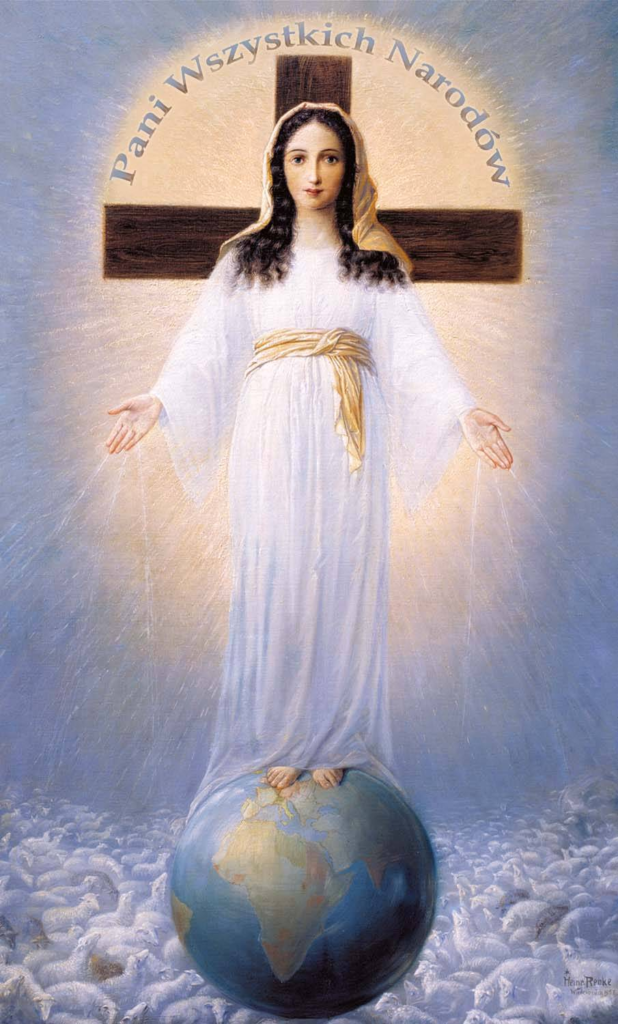
Many people, during a spiritual experience, experience this luminous Sign of the Cross as a personal warning. This state of the human spirit has been called the enlightenment of conscience. During this spiritual experience, their entire lives, including the mistakes they have made, are revealed to them. This is an urgent call, calling upon the soul to immediately change their behavior. Those who have experienced this state report that, in the face of their own sin, they gained a full understanding of the evil they had committed, which resulted in immense despair and spiritual suffering. This Sign can be given to individuals, entire communities, and at the end of time, it will appear to absolutely all inhabitants of the Earth.
Many contemporary commentators attempt to interpret the Sign of Christ from a material perspective, seeking in it, for example, extraterrestrial ships supposedly serving as an ark, which constitutes a fundamental error and a complete misunderstanding of the essence of things. To cross the threshold of the Kingdom of Heaven, a person must leave behind everything earthly—including their own body. The cosmic catastrophe will, in essence, become a global crucible of fire, ultimately separating human souls from the dust of the earth. Only after this cosmic upheaval, liberated from the bonds of matter, will humanity see Christ in His full majesty. Then, in a purely spiritual form, will man fully understand whom he has wounded and pierced with his sins.
Before this happens, however, this Gospel must first be proclaimed throughout the world—so that people, seeing the signs of the end times foretold in prophecy, may come to their senses and not be able to hide behind ignorance. When man sees Christ coming on a cloud, accompanied by angels, the moment of the Last Judgment will come—the moment when every soul will receive the eternal reward it has earned during its earthly journey.