
Message 16 of May 7, 1949
I have to raise two fingers, and then I see a bishop in full vestments. Then I see a stone catafalque on which a cleric lies. This, too, is made of stone. At the head of this catafalque lies a cardinal's hat, and above it a sword and crown. This sword lies diagonally next to the hat, and because the catafalque is also diagonally positioned, the sword points diagonally downward.
The fragment of the message of the Lady of All Nations discussed here depicts the pontificates of two popes, simultaneously foreshadowing their course. With the death of the first, the Catholic Church is said to begin returning to its Gospel prototype. This pope is said to take certain non-Gospel symbols with him to the grave, thus turning the entire community towards Christ, while the second is said to be a continuator of this mission. The accompanying symbols leave no doubt as to who is meant.
As we will see later, the entire message of the Lady of All Nations is based largely on the Book of Isaiah. This framework is therefore firmly grounded in the Word of God, preventing misinterpretation. Let us therefore move on to an analysis of the image of this apparition.
The key to understanding the first part of the vision is the stone image of the pope reclining on a catafalque. The details placed above his head unmistakably point to Paul VI, who ruled the Church from June 21, 1963, to August 6, 1978. The fact that all these attributes are made of stone carries a powerful message: the Holy Father symbolically "took them with him to the grave." This isn't about physical burial, but rather a spiritual dimension – it turns out that this pope has withdrawn from official use elements long associated with the Petrine office.
The first of these, located above the deceased's head, is the cardinal's hat (galero). Recall that Paul VI's pontificate began on June 21, 1963 (when he succeeded John XXIII) and ended with his death on August 6, 1978, in Castel Gandolfo. This pope abolished the traditional galero on March 31, 1969, pursuant to the instruction of the Secretariat of State, Ut sive sollicite. This document radically simplified the vestments, titles, and coats of arms of cardinals, bishops, and senior clergy. The main reason for this decision was the implementation of the resolutions of the Second Vatican Council. The Holy Father desired the Church to reject its former baroque splendor in favor of humility and evangelical simplicity.
Another element above the Pope's head is a sword, symbolizing the armed forces. Paul VI disbanded them on September 14, 1970. Before this reform, the Vatican had four independent uniformed forces, three of which were abolished:
- Noble Guard: The most prestigious, elite corps, created in 1801. Composed exclusively of Roman aristocrats, it served as the Pope's honorary and personal escort.
- Palatine Guard: A citizen militia established in 1850. Composed of volunteers – primarily Roman officials and craftsmen – it performed ceremonial and guard duties.
- Pontifical Gendarmerie: A classic military-police formation responsible for internal security and patrolling the Vatican area.
The only unit the Pope spared was the Swiss Guard – its centuries-long fidelity and usefulness in daily protection were appreciated. The Gendarmerie, in turn, was transformed into the civilian Central Security Office, which over time evolved into the present-day Gendarmerie Corps of the Vatican City State. The abolition of the Vatican's armed forces was a carefully considered theological and public relations move, stemming directly from the spirit of the Second Vatican Council. Paul VI wanted to demonstrate to the world that the mission of the Bishop of Rome is exclusively spiritual and pastoral. Maintaining court armies was at odds with the Gospel image of a Church close to the poor. As a result, the modern Vatican is a state without a national armed force, and the only formation ensuring the security of the Roman Pontiff remains the elite, small Swiss Guard.
Another symbolic piece of this puzzle is the crown. Paul VI was the last pope to wear the tiara. On November 13, 1964, he solemnly removed the triple crown and placed it on the altar. Moved by reports of dramatic famine in Third World countries, he ordered it sold and donated the proceeds to the poorest. None of his successors revived the coronation rite.
The image from the message—depicting a lavish tomb with a reclining sculpture of the pope—paradoxically contrasts with reality, and therefore is merely symbolic. It should be emphasized here that earlier bishops of Rome erected their funerary monuments according to the model presented to Ida Peerdeman. We see, therefore, that even the form of Paul VI's burial is an element of the old world, which he symbolically "took to the grave"—right alongside his cardinal's hat, crown, and sword.
Paul VI abandoned the construction of lavish, baroque monuments, and all subsequent popes faithfully adhered to this model. In his will, he categorically requested burial in the ground. His coffin rested in a grave dug into the floor of the Vatican Grottoes, covered with a raw slab of light travertine. We see, then, that the Pope desired not only to live but also to die in an evangelical manner.
The tombstone bears no gold or family coats of arms; only the name PAVLVS PP. VI and the ancient Chi-Rho (☧) Christogram—the symbol of Christ—are inscribed.
Paul VI redefined the image of the Church, turning the gaze of the hierarchy away from wealth and toward the common people. It is they whom the Lady of All Nations calls "the least of these." These are the faithful who are guided in their lives not by the "spirit of realism"—that is, by a blind attitude recognizing only the material and visible—but by pure, evangelical trust. They are distinguished by profound humility and diligently listen to and fulfill the Word of God.
As we have already mentioned, the message of the Lady of All Nations directly refers to the Book of Isaiah. Let us quote a fragment referring to Pope Paul VI's actions aimed at finally breaking with the image of the Church as wealthy and luxurious (Is 66:1-2):
Is 66:1-2
66:1. Thus says the LORD: "Heaven is my throne, and the earth is my footstool. What house can you build for me, or what place can you give me to dwell in?
66:2. My hand has made all these things, and all these things are mine, declares the LORD. But I will look on him who is poor and contrite in spirit, who trembles at my word.
This biblical truth that God looks to the poor and oppressed constitutes the absolute foundation of the community of believers. God is not concerned with earthly riches, for He alone is the Creator of all that exists. The Lord seeks a contrite human heart—a heart that makes one humble and obedient to the Word of God.
This image perfectly reinforces the concept of a Church in harmony with the Spirit of God, to which Pope Paul VI so consistently strove. With his radical reforms, he demonstrated that the true mission of the successor of St. Peter is authentic service to others, not the maintenance of structures fueled by the spirit of this world.
Christ himself, contrasting the steadfastness of John the Baptist with the attitude of the Pharisees and scribes, referred to the image of a reed swaying in the wind and people wearing soft garments. It's a perfect portrait of people lacking stability, who proclaim only what suits them at the moment and unscrupulously adapt to prevailing trends. This is how they gain honor, influence, and luxurious attire. However, they stand before God empty-handed – their only real legacy is greed. This truth is ruthlessly exposed in the Gospel of Matthew (Matthew 11:7-8):
Mt 11:7-8
11:7 As they were leaving, Jesus began to speak to the crowds about John: "What did you go out into the wilderness to see? A reed swaying in the wind?
11:8 But what did you go out to see? A man dressed in soft garments? Behold, those who wear soft garments are in kings' houses.
In the message of the Lady of All Nations, the same Gospel motif returns in a new guise – in the form of grain waving in the wind. However, there is a key symbolic difference. While the Pharisees and scribes, as the complete opposite of the steadfast John the Baptist, personified the image of a wavering reed in Christ's words, contemporary priests of the Catholic Church become ears of grain in the message. This symbol, deeply rooted in the Gospel, constitutes an uncompromising attack on that part of the hierarchy that cares more about worldly wealth and consumerism than about the salvation of those entrusted to them, turning to wherever the wind blows.
It was precisely this un-evangelical image of the institution that Pope Paul VI sought to demolish. By deciding to drastically simplify liturgical vestments and dismantle courtly ceremonial, the Holy Father symbolically reconciled himself with the humble and contrite in spirit. He showed the world unequivocally: a priest of Christ is not called to accumulate earthly wealth, but to lead human souls to salvation.
Let us now turn to the stone statue of Paul VI, presented in the message, on which the fruits of his reforms symbolically rest. To fully understand why this monument looks so different from the Pope's humble, actual tomb in the Vatican, we must turn to the Book of Isaiah in Isaac Cylkow's unique translation. The true meaning of the monument presented in the message is revealed in the words recorded in Isaiah 56:1-7:
Is 56:1-7
56:1. Thus says the Lord: Keep judgment and do righteousness, for My salvation is near to come, and My favor is revealed.
56:2. Blessed is the man who does this, and the son of Adam who holds fast to it—who keeps the Sabbath from profaning it, and keeps his hand from doing evil.
56:3. And let not the foreigner who looks to the Lord say, 'The Lord will surely cut me off from among His people,' and let not the eunuch say, 'Behold, I am a dry tree.'
56:4. For thus says the Lord concerning the eunuchs who keep My Sabbaths, and choose what pleases Me, and hold fast to My covenant:
5. I will establish for them in my house, within my walls, a monument and a namebetter than for sons and daughters; I will establish for them an everlasting name, which shall not be cut off.
56:6 And the strangers also, that shall join themselves to the Lord, to minister unto him, to love the name of the Lord, and be his servants, every one that keepeth the sabbath, and profane it not, but hold fast my covenant:
56:7 And I will bring them to my holy mountain, and make them joyful in my house of prayer: their burnt offerings and their sacrifices shall be accepted upon my altar: for my house shall be called a house of prayer for all nations.
In Judaism, having children is fundamental. Already in the Book of Genesis, God commands humanity to transmit life, at the same time indicating to Eve that she would give birth in pain. This is expressed in the words about the unity of husband and wife, who become one flesh. In the physical dimension, this truth is realized in a child, a living union of father and mother.
However, the situation was completely different for those who had no children. The biblical Jewish mentality, which persists to this day, deeply rooted in the belief that a person lives as long as the memory of their name endures on earth. The absence of a child meant the complete death of memory and "cutting off" from Israel's history. Therefore, for the Judeans, having children was the absolute fulfillment of God's commandment: "Be fruitful and multiply, and fill the earth" (Genesis 1:28). Deliberate childlessness or an unwillingness to start a family was therefore viewed as open rebellion against the Creator's will and a destruction of God's plan.
In this context, however, the Book of Isaiah offers a surprising alternative:
Is 56:5. I will establish for them in my house and within my walls a memorial and a namebetter than for sons and daughters: I will establish for them an everlasting name, which shall not be cut off.
These words hold a promise for those who, for various reasons, will not leave offspring—whether due to biological barriers or through voluntary dedication of their will to God and unmarried service. Such faithful ones—in light of the profound message of the Book of Isaiah—should shape others, spiritually giving birth "with their own hands," just as a potter shapes clay. This alludes to the Book of Genesis, in which God formed the first man from clay. The priest of God is called to imitate the Creator himself in this work of shaping human hearts. However, this requires personal holiness, for God is Holy, and complete obedience to God.
To understand the essence of the image of the Lady of All Nations' message, let us turn to the ancient Hebrew language, where the word for monument—yad (יָד)—means primarily "hand." The primary function of the ancient funerary monument was to point. The stone monument functioned precisely like an outstretched human hand, directing the gaze of passersby to a momentous event or a specific figure and their virtues.
It is worth mentioning here the Yad Vashem Institute in Jerusalem, whose name refers directly to the quoted passage from the Book of Isaiah and means "Monument and Name." This institution was established by the Israeli parliament in 1953. Its primary goal is to preserve from oblivion the identities of the six million Jews murdered during the Holocaust and to honor those who helped them.
The heart of the modern Holocaust History Museum is the Hall of Names. This monumental, circular room, under a cone-shaped roof, hangs thousands of photographs of victims, reflected in the water at the bottom of a deep, rock-hewn well. Around it are shelves with binders, where the "Pages of Testimony" containing the names and surnames of identified individuals are meticulously collected. In this way, God's promise that their memory will be eternal is fulfilled.
Surrounding the entire Hill of Remembrance is a green complex, where thousands of trees, primarily olive and carob, have been planted. These trees, however, do not symbolize the victims themselves, but commemorate the Righteous Among the Nations – heroes who selflessly saved Jews from the Holocaust. Each plant bears a plaque with their name, becoming a living monument to human deeds.
Returning to the image of the message of the Lady of All Nations, the stone monument of Pope Paul VI appears as a literal fulfillment of the promise from the Book of Isaiah. This monument inextricably links the image of the deceased Bishop of Rome with the works he accomplished with his own hands during his pontificate, fulfilling the will of the Most High. We thus see a profound connection between the monument and the Pope's hand, which, in reality, becomes an extension of God's arm in all his actions – including the spiritual birth of people by shaping them in the image of God.
Although families raising children fulfill God's plan, their memory does not surpass the name of those who fulfill the Lord's will with their own hands. The latter, by virtue of their mission, become closer to God. A person dedicated to celibate service centers their heart solely on the Creator, while parents naturally focus on the earthly upbringing of their children. Moreover, since God formed us with His own hands, the faithful who work with their hands for God reflect God's likeness in a special way.
Comparing the verses from the Book of Isaiah (Is 56:1-7) with Christ's discourse in the Gospel of Matthew (Mt 19:11-12), we see a striking similarity. In both texts, God calls individuals to become part of His people and precisely defines their role in this holy community.
Mt 19:11-12
19:11 But He answered them, "Not everyone can accept this, but only those to whom it has been granted.
19:12 For there are eunuchs who were born that way from their mother's womb, and there are eunuchs who were made that way by men, and there are eunuchs who have made themselves eunuchs for the sake of the kingdom of heaven. Whoever can accept it, let him accept it."
In both of these texts, marriage, whose natural fruit is offspring, appears as one of the fundamental vocations. In this perspective, however, simply bearing a child is not enough; the key task lies in raising them in the Spirit of God, who shapes us to be good people. Offspring—in light of God's commandment given to our first parents—are ultimately meant to crush the head of the serpent, that is, to defeat the spirit of this world. It is worth noting that, in Christ's view, marriage and parenthood are inextricably linked—the husband unites with his wife to transmit life. Thus, when Christ speaks of continence, he simultaneously refers to childlessness.
However, there are exceptions to this universal rule, as we clearly see in the world around us. There are infertile people who were born with biological defects or were physically mutilated, preventing them from having biological children. Such couples, however, can adopt, thus making the world a better place by raising their adopted child in faith and love. However, even without offspring, they will not be excluded from God's people. This also applies to single people, provided they keep the Covenant with the Lord, honor the holy day, and stand for what pleases God. Their state then becomes a distinct vocation, the purpose of which is to reveal God's face to those who have not yet come to know Him. This is accomplished through a daily life in accordance with God's law, which is the image of a good person.
Let us clarify a key issue here: why does God promise to erect a monument in His house specifically for eunuchs and castrati? Analyzing the Hebrew word for eunuch proves key to understanding the depth of this message. The original text uses the term saris (סָרִיס). This word is not native Hebrew; the ancient Israelites borrowed it from the Akkadian language spoken in Assyria and Babylon, where it sounded ša rēši. The literal, original meaning of this Akkadian phrase is "one who stands at the head" or "one at the king's head." It simply meant a trusted court official, dignitary, minister, or close servant of the ruler.
In the ancient courts of the Near East—in Babylon, Persia, and Egypt—there was a strict custom of physically castrating men who were expected to serve closest to the ruler's chambers and harem. This was done to ensure they did not pose a threat to the dynastic line and to avoid the temptation to start their own families, which guaranteed their absolute, unconditional loyalty to the king. For this reason, in Hebrew, the word saris began to carry a dual meaning. In its official sense, it denoted a royal servant—which in our case directly refers to a priest—while in its physical sense, it defined a castrato, a man deprived of the ability to have children.
By using this term, God refers to his trusted servant who has completely devoted himself to Him, renouncing childbearing. This is precisely why he desires to erect a monument to such a person and give him an eternal name in the Kingdom of Heaven. However, the Jews refused to understand the true, profound meaning of the word saris. They looked so as not to see and listened so as not to hear. The priests, Pharisees, and scribes of that time had wives and children and were unwilling to relinquish these privileges for God's sake. For this reason, voluntary celibacy in favor of exclusive service to the Kingdom of Heaven was utterly rejected by them.
One of Christ's parables, recorded in the Gospel of Luke (Luke 14:16-24), directly addresses their attitude. In it, Jesus tells the story of a man who gave a great banquet and sent out his servants to summon the invited guests. However, one by one, they began to cite worldly matters as an excuse. The key argument in this context, aimed at the mentality of the religious elites of the time, is contained in verse twenty, which reads:
Lk 14:20. And the third one said, "I am married to a wife, and therefore I cannot come."
We see, therefore, that the earthly marital obligations of the religious leaders of the time hindered their undertaking God's mission.
In the context of the Catholic Church, these "sacrifices" are the Lord's servants – the priests, while nuns, living in God's spiritual court, metaphorically become His "harem." Unfortunately, in recent years, numerous cases have come to light in which relationships contrary to the spirit of Holy Scripture occurred between nuns and clergy.
It is worth recalling here the story of the patriarch Jacob, whose firstborn son, Reuben, had sexual intercourse with Bilhah, one of his father's wives. This transgression led to tragic consequences – on the verge of death, Jacob stripped Reuben of his birthright, deprived him of his father's blessing, and resolutely condemned his transgression.
Returning to the analysis of the word "saris," it is worth noting the striking phonetic similarity that occurs both in Polish and in the original Hebrew sound of the terms "saris" (translated as "tuffnut") and "Sarah." This sound similarity creates a brilliant, symbolic play on words in the Bible. For decades, "Sarah" remained a symbol of absolute barrenness, and her body, at the age of ninety, became an obvious image of Isaiah's "withered tree" (Is 56:3).
Is 56:3 And let not the stranger that cometh to the LORD say, Surely the LORD will cut me off from among his people: and let not the eunuch say, Behold, I am a withered tree.
Phonetically, the term "saris" immediately evoked the painful childlessness of the ancestral mother. Ultimately, however, the dead womb of the aged woman was miraculously revived, a fact directly linked to God's promise—the assurance that Abraham's descendants would become as numerous as the sand on the seashore.
We see, then, that for God, there is no "dry tree"; this biblical phrase was used as a metaphor generally referring to those who, for various reasons, cannot transmit life. Each of us is called by the Creator in our own way. For the Hebrews, someone afflicted with childlessness resembled a dry stump, a direct reference to the family tree, which, for lack of successors, withers like a plant deprived of water. When a family tree dies, a person's name disappears with it irrevocably. This is precisely why the Scriptures place such great importance on genealogy, as best demonstrated by the passages of the Gospels devoted entirely to the genealogy of Christ.
In this context, Pope Paul VI, by choosing celibacy, symbolically loses his earthly family tree, but at the same time—in accordance with God's promise—gains an eternal place in the Kingdom of Heaven. This is a reward far more significant than having earthly sons or daughters, for it expresses man's ultimate salvation. Such a priest is spiritually grafted onto the tree of Christ, like a branch onto the true vine, drawing from Him the sap that ensures it never withers.
It should also be emphasized here that everyone has the right to become part of God's people if they faithfully adhere to His Covenant. Even an elderly person who desires to enter the Christian community, but due to the passage of time is already barren and resembles a "dry tree," can fulfill their vocation in a different way. Let us recall that there are three basic paths: priestly, marital, and the vocation of lay people, who, living according to the principles of God's law, become a living witness to His presence in the world.
We see, therefore, that Christ, in the Gospel according to St. Matthew, not only evokes the very same issues addressed by the prophet Isaiah, but also expands and clarifies concepts that have remained misunderstood for centuries.
In these verses, we read about foreigners who can also become God's people if they obey His words—and this, after all, is precisely Christ's mission: to proclaim the true God among all nations. All God's people, regardless of their social standing, are called to choose one of the vocations mentioned above.
All are awaited in the house of God, of which the Lord himself announces that His temple is to be called the House of Prayer for all nations. We see, therefore, clearly that it is the Lady of All Nations who personifies this Divine Sanctuary and Mystical Temple, where the inhabitants of the entire world can find salvation and ultimate deliverance. When we consider the Marian apparitions that have occurred throughout the earth, these words are completely fulfilled in Her. Moreover, the spiritual capital of all these revelations remains the Lady of All Nations—analogous to the See of Peter, to which, by Christ's will, all ecclesial communities on earth should be subject. When we look at the image of the Lady of All Nations, painted by Heinrich Repke, we see that she stands on a globe, which is the footstool of her feet.
Is 66:1. Thus says the Lord: Heaven is My throne, and the earth is My footstool: where will be the house that you will build for Me, and where will be My resting place?
In the pages of the Gospel, we also find the motif of the tree and the axe laid to its root, mentioned by John the Baptist. Christ himself, when he searched in vain for fruit on the fig tree, warned uncompromisingly that the useless plant would be cut down. In this profound understanding, the tree symbolizes all three vocations discussed earlier. If it bears no fruit—neither on the priestly path, which bears fruit in human hearts born in the Spirit of God, nor on the marital path, which produces offspring, nor in the secular vocation, which consists in bearing witness to a righteous life—it becomes utterly useless. Such a dry trunk yields no physical fruit, and therefore cannot even quench hunger, which directly refers to the obligation to help those suffering from poverty.
Let us now return to the image of the message of the Lady of All Nations, in which the seer Ida Peerdeman raises two fingers and then sees a priest in full chasuble, heading to the tomb of Pope Paul VI. This scene and Ida Peerdeman's gesture allow us to identify this hierarch with Pope John Paul II, which is fully consistent with the message of the previous message.
Karol Wojtyła's immediate predecessor was John Paul I, the shortest-serving pope in modern history, who died suddenly of a heart attack after thirty-three days of his pontificate, but he did not continue Paul VI's mission. Even before he ascended the throne, Albino Luciani openly supported the Majority Faction, which sought to abolish the ban on contraception. He personally urged Paul VI to abolish the existing law and allow the use of artificial methods of birth control. John Paul II adopted a completely different stance, uncompromisingly advocating for the absolute retention of the existing law, directly contributing to the consolidation of the encyclical Humanae vitae. We are thus dealing with three pontificates, the middle of which—marked by an attempt to change God's order—was abruptly interrupted by death. A similar situation occurred in Paradise, when Adam and Eve, breaking God's law, were subject to the death sentence. Therefore, Karol Wojtyła appears as the proper successor and the second pope after Paul VI.
While still Archbishop of Kraków, Karol Wojtyła played a fundamental role in the creation and defense of the encyclical Humanae vitae (1968), which upheld the Catholic Church's existing teaching on the indissolubility of the marital act and motherhood. This document reminded us that marriage must be inextricably linked with the fruition of offspring and the transmission of new life, not its abandonment. He upheld the ban on artificial contraception, which, in reality, did not constitute the introduction of a new law but rather a profound renewal and confirmation of the eternal Covenant between man and God. Paul VI therefore became the target of ruthless attacks and condemnation from atheist circles, lay faithful, and even opposition within the Church itself.
The committee appointed to decide whether to maintain this ban split into two conflicting groups. The Majority Faction, constituting approximately 90% of the commission, voted in favor of allowing contraception. Were it not for the decisive stance and doctrinal contribution of the future Polish pope, this principle would likely have been rejected. As successor to St. Peter, John Paul II determinedly continued this work, treating Paul VI as his highest authority.
This brings us to a key point in the analysis. During his annual Lenten retreat, the pope completely cut himself off from the outside world for several days. This tradition of solitary prayer and suspension of official matters was characterized by strict rules:
- Complete isolation from worldly affairs: During the entire week of retreat, the Pope did not receive any delegations, politicians, bishops, or pilgrims; both private audiences and the weekly general audience were canceled. The Bishop of Rome then withdrew from the day-to-day governance of the Church, devoting these days exclusively to silence, fasting, and personal reflection.
- The retreat leader's exclusive voice: The only person the Pope and the assembled cardinals met with during this period was the designated retreat leader. Traditionally, the Holy Father invited a distinguished theologian, bishop, or cardinal from anywhere in the world, who was the sole speaker, delivering teachings for the Pope and his closest associates in the Vatican chapel.
It was during his first Lenten retreat that John Paul II, in deep contemplation, descended into the Vatican Grottoes to pray at the tomb of Paul VI. It was then, while re-examining his predecessor's moving testament, that he experienced a personal epiphany, which led him to begin writing his own will—an act that the Holy Father continued and expanded upon throughout the next twenty-five years of his pontificate. We see, then, that the deceased Pope became almost a personal preacher for his Polish successor, one whom he longed to listen to in silence, retreating to his tomb for solitary prayer.
Paul VI's testament contained a personal testimony to what he had continually strived for throughout his pontificate, ultimately bringing his message of modesty to life. At the same time, this document remained a passionate call to return to the evangelical image of the Catholic Church – a community clearly distancing itself from worldly luxury and centered around those biblical “least of these,” who are characterized by humility and true fear of God.
Then I'm transported to a large gate. It opens, and I have to go inside. Someone in a long robe stands in front of the gate. I shudder to step over the threshold. Suddenly, I see it's the Lady. She says,
"Take that step!"
Then we enter a large, circular space. In this space is endless depth and darkness. The Lady says,
"This is a dark spot. You must go there, very deep. This is the depth and darkness of the times."
The fragment of the message under analysis, on the one hand, illustrates the moral condition of the contemporary world, and on the other, it constitutes an extraordinary prophecy. It refers to a scientific discovery that was to occur many years after the apparitions of the Lady of All Nations concluded. The black hole and the force of gravity were used by the Lady of All Nations as metaphors for humanity's spiritual state. This surprising comparison gives the entire message an exceptionally fascinating character.
Let us begin our considerations by citing Ida Peerdeman's words, recorded on audio tape, which much more clearly describe the image she saw:
9:31 (…) And then I was again placed before a large gate
, 9:40 and there stood someone in a long robe. At first I didn't see who it was, but when
9:46 I saw the Lady standing there and she said to me, "Take that step." And then,
9:53 we went inside, and then I saw a large circular space, a very dark, dark spot, it was very strange,
10:04 infinite darkness and depth. And there the Lady said, "You must go very deep into it, and this
10:11 is the depth and darkness of the times." And I felt it too, as something very heavy,
10:21 and... Yes, it was as if it were falling on me, right? As if I felt this weight and this entire darkness
, 10:27 And then, later, She speaks of the word "corruption" in humanity. Yes, I thought, what is
10:34 corruption, right? Back then, in '48 [the year given colloquially from memory by Ida], we didn't know what the word "corruption" was.
Let's begin with the black hole phenomenon, then compare it with events unfolding in the modern world. Research on these enigmatic objects has evolved over the centuries. Initially based on purely theoretical considerations in the eighteenth century, mathematical calculations in 1916 led scientists to the physical discovery of the first such point in space in 1971.
At the heart of this search was a simple question, rooted in the classical physics of Isaac Newton: can gravity trap light? At the time, it was widely believed that light consisted of material particles with mass, and if so, it must be subject to gravitational attraction. In 1783, the English clergyman and scientist John Michell conducted a groundbreaking thought experiment. Knowing that every celestial body has a so-called escape velocity, which for Earth is approximately 11.2 km/s, and that this velocity increases with the object's density, Michell made some surprising calculations. He demonstrated that if a star with the density of the Sun were five hundred times greater, the escape velocity from its surface would exceed the speed of light. Consequently, light would be unable to escape such a celestial body, rendering it completely invisible to an outside observer.
In the context of the Lady of All Nations' message, we clearly see that, standing near the described black spot, Ida Peerdeman physically felt its enormous weight. In the light of modern science, this was a palpable experience of the powerful force of gravity. The seer devotes considerable attention to this experience, describing it as a state in which mass and overwhelming darkness practically descended upon her, overwhelming her senses.
Before John Archibald Wheeler popularized the term "black hole" in 1967, these objects were known in scientific literature as "dark stars," "frozen stars," "collapsed stars," or "Schwarzschild singularities." It's worth noting that the official name wasn't coined until the late 1960s, while the Lady of All Nations' message was delivered as early as 1949.
In this context, the singularity theory is indispensable. It describes the point within a black hole where all mass is compressed to infinitely small dimensions, and density and gravity reach infinite values. For decades, physicists dismissed this concept, viewing it solely as a mathematical error in Einstein's equations.
The breakthrough came in 1965, when British mathematician and physicist Roger Penrose formulated the groundbreaking singularity theorem.
He proved that if a dying star crosses the event horizon, no known force in the universe can stop its gravitational collapse. Matter inevitably collides at a single, central point. Thus, the singularity proved to be a physical reality, and Penrose himself was awarded the Nobel Prize in 2020 for this groundbreaking discovery.
Let us now turn to the Lady of All Nations' message. In it, Ida Peerdeman is transported before a large, opening gate. The Lady of All Nations, dressed in a white robe, leads her into a circular object, encompassing endless depth and darkness. The Lady of All Nations calls this space a "dark spot," into which the seer must immerse herself profoundly. This abyss is directly compared to the "darkness of time."
To fully understand this message, we must compare this mystical space with the physical structure of a black hole. Ida enters its depths, reaching the cave containing the Infant Jesus at her destination (read the next excerpt from the message). At this point, the message remarkably confirms the scientific theory of singularities. This spiritual singularity at the heart of darkness turns out to be the Infant Jesus, the source of Light for a world plunged into darkness. The Lady of All Nations is also a source of Light for a world plunged into darkness, as evidenced by her white robe.
Thus, we are presented with an image of the black hole as a circular space of infinite depth, at the center of which lies a luminous singularity. When we peer into the depths of the universe with specialized equipment, a black hole also appears as a round, black spot in the starry sky. Due to its enormous gravity, the light emitted there cannot escape; instead, it constantly returns to its source. This is a direct, structural reference to the Book of Isaiah, which forms the foundation of the entire message (Isaiah 55:10-11):
Is 55:10-11
55:10 For as the rain and the snow come down from heaven and do not return there until they have watered the earth, making it fertile and fruitful, so that it yields seed for the sower and bread for the eater, 55:11 so the word that goes out from my mouth will not return to me empty, but will accomplish what I desire and succeed in accomplishing what I sent it for.
As Ida Peerdeman recoils at the prospect of entering the endless darkness, the Lady of All Nations addresses her with a categorical appeal: "Take that step." In this interpretation, the biblical threshold becomes the equivalent of the event horizon—the irreversible boundary of a black hole. It was a small step for the seer herself, but in fact a milestone for all of humanity.
This formulation surprisingly anticipates the words of Neil Armstrong in 1969, who, standing on the moon, uttered the famous declaration: "That's one small step for man, one giant leap for mankind." If we, as humanity, had subjected this message to a thorough analysis in the year it was announced (1949), our knowledge of the cosmos would have been ahead of its time. After all, the first empirical evidence for the existence of black holes did not appear until the late 1960s.
The Word of God is purely spiritual in nature, therefore, it has no material substance—unlike the Living Word, which took on a real, corporeal form. Although for decades traditional astrophysicists considered the singularity to be an immaterial, infinitesimal point of zero volume, recent discoveries in loop quantum gravity completely shatter this old paradigm. Modern science proves that at the very center of a black hole there must be a material, superdense object with a specific physical form, called a Planck star.
This object is unimaginably small at the moment of its formation, known in physics as the Planck length. However, it is not nothing; the gigantic mass of the collapsed star is packed into this microscopic point, reaching extreme density. Most fascinatingly, under the influence of the enormous gravity that drastically slows the passage of time there, this quantum structure within the black hole begins to grow and expand immediately after the collapse, finally manifesting its presence with a powerful explosion.
This scientific reality phenomenally confirms the logic of the message and behaves exactly like a human being. Human existence begins from an almost imperceptible point – an embryo – and then develops into a fully formed, real body, which, within the dark abyss – its mother's womb – continually grows and then comes into the world. In the context of the message, it is crucial that the Lady of All Nations first finds herself in this darkness, and only later, upon entering the cave, is the Infant Jesus placed on the hay, which directly reflects the moment of birth. The light was thus located within a black hole, as if protected by the mother's womb while the child was still unborn. Recall that the Lady of All Nations wears a white robe, which alludes to the biblical Tent of Knowledge, and within her womb lies the divine embryo.
The process of the Incarnation of the Word of God appears as if the infinite Light of God were compressed from unimaginable size into a microscopic point, which precisely reflects the mechanism of black hole formation. The message flowing from this image of the message directly alludes to the contraceptive pill, which we have already discussed, which strikes the unborn human embryo, causing its death.
Returning to the black hole, at its center undoubtedly exists a dense, material foundation that generates powerful energy and emits light. In the context of the message of the Lady of All Nations, this light, developing from the smallest point of matter, that is, from the level of the embryo, is Jesus growing in her womb. After nine months, he is born as a Child, only to become an adult over the years, and at the end of his earthly life, he explodes in immense light, as happened in the grotto of the resurrection. This truth is materially confirmed by the Shroud of Turin. Modern science indicates that the body of Christ wrapped in it must have emitted a powerful pulse of light energy, thanks to which a permanent image was inscribed on the cloth – captured in negative, exactly as happens in the process of creating a classic photograph. We see, then, that the cosmic life cycle of a black hole—from its collapse to its final evaporation in a flash of energy—perfectly mirrors the earthly mystery of the Incarnation of the Word of God: from the microscopic embryo, through growth, to the triumphant explosion of resurrection.
The metaphor of the "darkness of the times" refers us back to Isaiah's prophecy (Is 60:1-2):
Is 60:1-2
60:1. Arise! Shine, for your light has come, and the glory of the LORD rises upon you.
60:2. For behold, darkness covers the earth, and thick darkness covers the peoples; but the LORD rises upon you, and his glory appears upon you.
Both in the Book of Isaiah and in the messages of the Lady of All Nations, cosmic darkness signifies a moral crisis in the world. Ida Peerdeman descends into the very center of this spiritual abyss to redirect the world's attention to the Light that can dispel this darkness.
Then I see the Lady sitting in mourning robes, with a white veil on her head. She has very old features on her face and is leaning forward. She says,
"We are here in Darkness; this is the fall of humanity."
Then I see the Cross before me. The image of Christ slides down, leaving the Cross empty. The Lady says with great sadness,
"The path of martyrdom begins anew."
I see deep furrows and large tears on the Lady's face. Now I go deeper into the darkness with Her. We continue onward, and I see nothing but darkness. "Stand, what is this?" I ask. We enter the grotto. The Lady makes me feel as if it were a stone; it is a grotto made of natural stone. Then suddenly a little straw appears in it, and a child is placed on it. A multitude of people, quite ordinary people, enter from all sides. The Lady says,
"Simple people. My little ones. There is no room for them. Whole crowds."
Then she adds,
"My little ones."
Now suddenly the grotto transforms before my eyes into a church. Immediately after this, I see endless rows of churches, and then that one church again. Just like in a cave, there lies straw, and a child is placed on it. And again, it is not just any ordinary child, but a heavenly, radiant, spiritual Child.
Now the Lady takes me with her and leads me through all the churches. Pointing to the completely empty pews, she says,
"Do you see the error? Emptiness."
And now white plaques appear on those pews, as if with names. The Lady says again,
"Do you see the error?"
Now the Lady runs her hand along the rows of pews, and then I see those pews without names; all the plaques have disappeared.
"My little ones," says that Voice again. And now it is as if the Lady wants to fill those pews with people.
Then I see the bishop. The Lady says,
"Say it, say it!"—and points to those churches. Then she says,
"The world must be free from everything, and above all, the Church."
The fragment of the message discussed here carries a powerful emotional charge, deeply rooted in the texts of the Old and New Testaments. The backdrop for the entire message is the image of Our Lady of Sorrows, from which a clear message flows for us. Since the Lady of All Nations is the Mother of God's people—as she herself announces with the words: "They will call me Lady and Mother"—then the seven sorrows she once experienced, worrying for her Son and observing His Passion, apply directly to every member of the Christian community today. And it is precisely this maternal concern for her children that radiates from all the messages she conveys.
The Lady of All Nations desires to embrace every person with her motherhood, which requires effective and efficient evangelization. It is this universal mission that God announces in the Book of Isaiah (Is 56:7-8), announcing that he will bring all the nations of the earth to his Temple. In this context, Mary, as the Lady of All Nations, becomes the living, spiritual Temple of God. Within its walls, everyone is a disciple of the Lord, and those who belong to it are destined to become righteous in the future—provided they fulfill the Lord's will.
However, this is not about a relationship between master and slave, but rather an obedience rooted in concern for our well-being, for God makes the earth good. His rule has nothing to do with power understood according to the spirit of this world, which ruthlessly exploits its servants. We see, then, that it is essentially about the relationship between the Father and the son of man.
Beyond the people God has already gathered in the Temple, He also desires to bring others: those who have not yet come to know Him.
Is 56:7-8
56:7. I will bring them to my holy mountain , and make them joyful in my house of prayer. Their burnt offerings and sacrifices will be accepted on my altar, for my house will be called a house of prayer for all nations.
56:8. Declares the Lord God, who gathers the outcasts of Israel: I will gather them yet others besides those who have already been gathered.
The historical devotion to Our Lady of the Seven Sorrows arose in medieval Western Europe and developed in two stages. The first phase took place in the late 11th century in Benedictine and Cistercian monasteries in present-day Germany and France. Monks—including St. Bernard of Clairvaux and St. Anselm—began to focus on the earthly life of Jesus and the reality of his suffering, which gave rise to a natural need to empathize with Mary at the foot of the Cross. At that time, however, the devotion encompassed only the Five Sorrows, a direct counterpart of the five wounds of Christ.
The second phase began on August 15, 1233, in Florence. Seven wealthy Florentine merchants (later canonized as the Seven Founding Saints) abandoned their former lives and earthly riches. They established a devout religious community, which eventually moved to the nearby hill of Monte Senario, giving rise to a new order – the Servites (Servants of Mary). According to tradition, Our Lady appeared to the men in black mourning robes, giving them the Rule of St. Augustine and commanding them to expand their meditation on suffering to the number seven – the biblical symbol of fullness. Significantly, in the same mystical way – also in black mourning robes – the Lady of All Nations appears in the message under discussion.
It was the Servites who became the main propagators of this devotion in Europe, creating, among other things, a special Chaplet of the Seven Sorrows.
Each of the seven sorrows of the Lady of All Nations is reflected in the imagery of the message. We will discuss them gradually, as we consider individual fragments of the text. First, let us recall which sorrows we are referring to:
- The First Sorrow – The Prophecy of Simeon
- Second Sorrow – The Flight into Egypt
- The Third Sorrow – The Loss of Jesus in Jerusalem
- The Fourth Sorrow – Meeting the Lord Jesus on the Way of the Cross
- The Fifth Sorrow – The Crucifixion and Death of the Lord Jesus
- The Sixth Sorrow – The Deposition of the Body of Jesus from the Cross
- The Seventh Sorrow – The Laying of the Body of the Lord Jesus into the Tomb
Let's look at this fragment of the message through the lens of Mary's new mission, in which she becomes a Mother to all Christians from all nations of the world.
The vision described in this section of the text directly alludes to Mary's fifth sorrow, the Crucifixion and death of her Son. Ida Peerdeman sees the Lady of All Nations dressed in black mourning and a white veil. She sits bowed, and the wrinkles on her face indicate maturity. This scene indicates mourning after her Son's death on the cross. However, in the context of the Lady of All Nations as our Mother, the darkness surrounding her symbolizes a fallen world mired in sin. The message emerging from this image is that it is sin that brings death to humanity. This is entirely consistent with the Book of Genesis, where God warns Adam and Eve that they will die if they break His commandment and eat the forbidden fruit. Christ also died bodily, even though there was no sin in Him. Every earthly body will return to dust, but not every soul will be resurrected to eternal life.
At this point, we reach the heart of the entire argument. The earthly Mary's mourning garment was associated with the bodily death of Christ. However, the Lady of All Nations, in her mourning garment, is already a spiritual figure, and therefore her attire reflects the spiritual death of contemporary people. This is where her tears come from – the Mother's weeping over the spiritual death of her children. Each of her tears represents a condemned soul.
Another of Mary's sorrows, captured in this revelation, is the descent of Jesus from the Cross – depicted in the message as the moment when His limp body slides from the arms of the Cross. In the context of the Lady of All Nations as our Mother, her words at this very moment become crucial. She says that the path of martyrdom begins anew, and the cross remains empty. Since humanity turns away from Christ and His teachings, each person will have to walk this path of suffering in their own way. There is no longer One to bear the burden of our iniquities—those that constitute a curse and punishment for human sins. Each person will have to atone for their own sins.
For this reason, humanity faces a series of torments, foretold in the prophetic images of the Lady of All Nations. These are punishments for breaking God's covenant, of which God's people should be fully aware, for all of this is recorded in Holy Scripture, specifically in the Book of the Law of Moses and the Gospel of Christ. We find these consequences in dramatic prophecies heralding downfalls, catastrophes, and wars.
All of this causes the soul of the Lady of All Nations to be once again pierced by the sword of sorrow as she watches the suffering of her children. In this way, the text alludes to the four last sorrows of Our Lady of All Nations. The Lady of All Nations encounters contemporary humanity on their own way of the cross: she sees the suffering and death of her children, all the way to the dramatic image of a man sliding into the grave.
At the moment when Christ's body falls from the Cross, the light of the world fades, and man returns to experiencing the consequences of sin in his own flesh. We have already mentioned the covenant God made with his people. It was written down in the Book of the Law of Moses and then renewed at the foot of Mount Gerizim and Mount Ebal in Shechem.
For contemporary Christians, this central point has become the Vatican, with St. Peter's Basilica, located between two Roman hills: the Janiculum and Monte Mario. However, if we consider the entirety of Marian apparitions over the centuries, we notice a fascinating pattern: they almost always occur in the vicinity of two hills, between which lies a town dedicated to renewing one's bond with God. This is clearly illustrated by the example of Medjugorje. Between the Mount of Apparitions (corresponding to ancient Mount Gerizim) and Mount Cross (a reflection of Mount Ebal), stands the parish church. This entire town constitutes a modern-day Shechem, and its temple becomes a space for the renewal of the Covenant with God.
This is clear proof that the Covenant with God extends to all Christians—it encompasses all nations and specific cities, reaching far beyond the borders of Israel. By accepting the burden of our sins, Jesus took upon himself the curse of sin that weighed upon humanity. However, he did not save us automatically and unconditionally through the act of martyrdom. Instead, he gave us time and the opportunity for inner purification, which ultimately leads to salvation. The condition remains that we listen to His words and faithfully follow Him. In the Gospel, we find a reference to this principle in the words of the high priest: "It is better for you that one man die for the people than for the whole nation to perish." However, when Christ is absent from the Cross, the One who shielded us from God's justice and the harsh judgments written in the Law disappears. Jesus descends from the Cross because no one wants to listen to Him anymore, and humanity has turned away from His voice – a fact clearly demonstrated by the darkness of the times, which the Lady of All Nations presents to Ida Peerdeman.
Then, as a result of human errors, the path back to the Creator becomes strewn with thorns and weeds that bring pain. The painful path of martyrdom, which God marked for Adam back in Eden, reopens before man. This foreshadows that humanity will cultivate the earth, which produces thistles and thorns, until the moment of death, when the earthly shell returns to dust and the soul returns to God. The key, however, is whether this soul, while residing in the body, has learned to distinguish good from evil and whether it has been guided by love, justice, and righteousness in its earthly life. Let us not forget that after death, all of God's people await a final, just judgment.
Jesus came into the world in a cave and left it from a cave. The symbolism of this place unites both His birth and His resurrection, which is also a birth in the Spirit of God. It is worth noting that the question of the location of Christ's birth still raises certain misunderstandings. In early Christian tradition, it was commonly assumed that it was a rock grotto, not a wooden stable – such freestanding buildings were not typical of that region. The Gospels also do not specify this matter, mentioning only a manger, which later Western tradition identified with a stable.
A manger is, by definition, an element from which animals consume food. However, this function could have been performed by the grotto itself or a recess carved within it. This is confirmed by the events of Lourdes, where the Virgin Mary appeared to Bernadette Soubirous in a grotto that served local shepherds as a place of refuge and feeding. Ida Peerdeman sees exactly the same image: in a stone grotto, on straw spread directly on the ground, rests the Infant Jesus. In Bethlehem itself, the Grotto of the Nativity is venerated to this day, located beneath the Basilica of the Nativity, built in the 4th century by order of Emperor Constantine.
The symbolism of the grotto has not only a historical dimension but, above all, a deeply spiritual one. It sheds new light on the Gospel texts: the dark grotto represents a world engulfed in darkness—and it is in this darkness that the light, the nascent Savior, shines forth. The grotto is also the place Christ leaves after the Resurrection, leaving us his Gospel as a clear guide and light.
In the image of the message, we see tears on the face of the Lady of All Nations. They are an expression of her deep, spiritual pain, caused by the wounds inflicted on her by humanity through sin. Mary's direct suffering at the hands of humanity was already foretold by the elder Simeon, who addressed the memorable words to her in the temple: "Behold, this man is destined for the fall and the rising of many in Israel, and for a sign that will be opposed. And a sword will pierce your own soul, that the thoughts of many hearts may be revealed." These tears, however, carry something more. They reveal the anguish that her children will experience, for whom the Way of the Cross is just beginning, and the pain of losing those sons and daughters who, persevering in chaos and sin, are heading towards spiritual death.
It is worth considering the very fact of her weeping here. Many believe that Mary did not shed tears while her Son suffered on the Cross. However, since she wept as the Lady of All Nations—and thus the Mother of every person belonging to the Christian community—she must have wept also when Jesus experienced his Passion. The spiritual person is, after all, a reflection of the physical person and possesses his full sensitivity. If, therefore, a person never cried in their earthly existence, their spiritual form would not either, for the gift of tears would remain completely alien to it.
Ida Peerdeman draws attention to another detail: the face of the Lady of All Nations is covered with deep wrinkles. The word she uses to describe these wrinkles is "groeven,"which literally means grooves, wounds, or cuts. If these were simply wrinkles associated with age, the author would use the term "rimpels"—as she did a moment earlier when describing the general appearance of the Lady of All Nations. These deep wounds reflect the suffering foretold by the prophet Simeon. He foretold to Mary that a sword would pierce her soul, so that the thoughts of many hearts would be revealed. This event constitutes the first of the Seven Sorrows of the Mother of God.
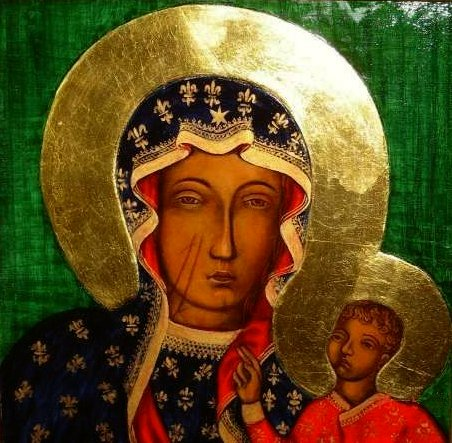
One of the visible signs of the fulfillment of this prophecy is the image of the Black Madonna from the sanctuary of Jasna Góra in Poland. The characteristic cuts are clearly visible on the cheek of the icon (photo 1). However, they are not the painter's artistic vision – the original work was cut with a saber. However, these wounds, as inflicted on the Mother of God, should not be limited to this single point on the map – Simeon's prophecy is fulfilled every day in all nations, in a more or less noticeable way.
The marks on the face of the Black Madonna are testimony to the brutal and sacrilegious attack of April 14, 1430, which took place on Easter Sunday itself.
For centuries, blame for this event was placed solely on the Czech Hussites. However, the historical truth, described by chronicler Jan Długosz, among others, indicates that the main instigators of the attack were bankrupt Polish noblemen. Hearing legends of supposed riches hidden in the Pauline monastery at Jasna Góra, they gathered mercenaries to plunder the sanctuary. The attack was therefore purely robbery-related, and the band consisted of robber knights of various nationalities: Poles, Silesians, Czechs, and Moravians.
When the attackers broke into the monastery, they were met with a great disappointment – the Pauline monks possessed no great treasures. The furious robbers rushed to the altar to strip the icon of precious votive offerings, crowns, and jewels. One of the bandits, enraged by the lack of expected loot, drew a sword or saber and began cutting into the board bearing the image of Mary and the Infant Jesus. He inflicted two deep cuts along the cheek, and a third, shorter one, intersected them at the nose. The vision of Ida Peerdeman, in which deep furrows appear on the face of the Lady of All Nations, strikingly resembles the visage of the Black Madonna.
Below Her head, the icon also contains several further, smaller cuts – marks left by the blade used to brutally rip the necklace from Her breast. In light of Simeon's prophecy about a sword piercing the soul of the Mother of God, the fact that she was stabbed several times is a moving fulfillment of this prophecy.
It should be added that today's image of the Black Madonna is, in fact, a new painting on an old, original panel. After the attack, at the request of King Władysław Jagiełło, an attempt was made to restore the icon in Krakow. However, the conservators at the time lacked the wax techniques used by the ancient Byzantine artists, causing the applied paints to run off the base. Ultimately, the decision was made to scrape off the damaged layer and recreate the image from scratch, deliberately carving commemorative marks of the old cuts into the new painting.
Simeon's prophecy also clearly indicates the reason why the sword was to pierce Mary's soul: "so that the thoughts of many hearts might be revealed." In this context, the attack on the sanctuary exposed a painful truth about the Polish nobles. As Christians, part of the Polish Catholic elite of the time, they should have been guardians of the faith, yet in reality, they were not interested in spiritual matters, but solely in mundane gains and the desire to quickly enrich themselves. This attack is a painful fulfillment of Simeon's prophecy. Mary's soul was pierced by the sword precisely so that the intentions and true thoughts of these people would be revealed. This brutal act became an outward manifestation of their inner corruption. It is for them that the Lady of All Nations weeps—for her own offspring, living in darkness, heading towards eternal destruction.
In the context of the earlier fragment of the message, depicting Pope Paul VI, the matter is no longer so obvious. Let us recall that he sought to change the image of the Church – he wanted to reject luxury in favor of serving the poor. In her message, the Lady of All Nations describes them as "the least of her little ones," and Ida Peerdeman sees them as modest and ordinary people. However, to serve them, both priests and the entire Church must first become small themselves. The aforementioned noblemen did not treat the temple as a place of prayer, but saw it merely as a space of opulence. It is worth noting that during apparitions around the world, Mary appears in modest robes. This reveals a profound truth: since she is the Living Temple, this House remains by nature simple and free from opulence. The image of a building dripping with gold displeases God and in no way serves humanity. In many cases, it even becomes a cause for stumbling and provokes sin. This divine opposition is expressed in the Gospel events, in which Christ himself overturns the tables of the bankers and merchants trading in the temple. The icon of the Black Madonna was brutally stripped of the gold and ornaments with which people had actually clothed her. Were it not for these valuables, the image would have remained modest, and such a dramatic act of vandalism would likely never have occurred. The pomp and circumstance of money within church structures contribute to the departure of the faithful, a visible consequence of which is the empty pews in churches today. Since the Lady of All Nations invites the least of us—the humble and contrite—the Church cannot build an image that contradicts this. The entire community should focus its activities on the inner good of humanity, not on material gain. A similar problem affected the ancient Temple in Jerusalem, which at that time was closer to a banking institution and a marketplace than to a house of prayer. The priests of that time—unlike the steadfast prophets—behaved like reeds swaying in the wind. Instead of serving the people entrusted to them, they ruthlessly exploited them. Their stances vacillated from right to left, revealing their profound instability. They expressed their views according to the wind blowing at the moment, merely to maintain their status and comfortable lives. Instead of sharing with the needy, they themselves indulged in luxury. God does not want to see such attitudes, as His prophets have loudly proclaimed for centuries.
In the message, the austere, impoverished grotto of Christ's birth is starkly contrasted with contemporary religious buildings. In this humble place, a multitude of simple people gather—those "least of all." Meanwhile, churches, spaces of opulence, are increasingly empty. Moreover, the Lady of All Nations is present in the grotto of Jesus' birth, along with her children from all over the world. Meanwhile, in the churches, not only are the faithful lacking, but it is in vain to look for Herself there, as the Church institution opposes and rejects Her revelations and messages. This resounding call is intended to recall the tenets of the Second Vatican Council: the Lady of All Nations calls for sharing one's wealth with the needy instead of squandering it on a comfortable life. It is also an appeal to heed her words as coming from God Himself. Contemporary churches are emptying because the faithful—scandalized by wealth and the mistakes of those called to serve—are turning away from the Church. Instead of bringing the Gospel message to people, many clergy today simply follow the spirit of this world.
As the Lady of All Nations leads Ida Peerdeman through deserted churches, white nameplates appear next to empty pews. This is a telling sign: the community not only fails to attract new believers but also loses those who already belonged. Places once assigned to specific individuals now lie empty. The names of those who were inscribed in the Book of Life but ultimately rejected God's call are being erased. This is a direct reference to God's words in the Book of Exodus: "Whoever sins against me, I will blot out of my book" (Exodus 32:33). This mystical chronicle contains the names of those for whom a place has been prepared in heaven, and removing an entry from it means that the gates of the Kingdom of Heaven are closed to such a person. This perspective allows us to better understand Christ's words about the sin against the Holy Spirit, which will not be forgiven (Matthew 12:31).
What is this transgression? It is a conscious rejection of God's invitation to a life-giving banquet—which is, in essence, His teaching—due to excessive attachment to the things of this world (Luke 14:15-24). During this banquet, a person receives the teaching and the Fruit of Life. Whoever rejects this invitation acts not only against the Holy Spirit but also destructively against themselves. Such a person forgoes the possibility of cleansing from sin and ultimate salvation, which directly undermines God's plan of redemption.
Luke 14:15-24
14:15. On hearing this, one of the guests said to Him, "Blessed is the one who will feast in the kingdom of God ."
14:16. Jesus answered him, "A certain man gave a great feast and invited many.
14:17. When the time for the feast came, he sent his servant to tell those who had been invited, 'Come, for everything is now ready .
' 14:18. Then they all began to make excuses with one accord . One told him to say, ' I have bought a field; I must go out and see it. Please, consider me excused.'
14:19. Another said, 'I have bought five yoke of oxen and I am going to try them out . Please, consider me excused.'
14:20. Still another said, 'I have married a wife, and therefore I cannot come .
14:21. The servant returned and reported this to his master. Then the master of the house, enraged, ordered his servant, "Go out quickly into the streets and alleys of the city and bring in the poor, the crippled, the blind, and the lame!"
14:22 The servant replied, "Sir, it has been done as you commanded, and there is still room."
14:23 Then the master said to the servant, "Go out into the highways and hedges and compel people to come in, that my house may be filled.
14:24 For I tell you, none of those men who were invited will taste my banquet."
In Jesus' parable, those who ignored the invitation to the feast are erased from the Book of Life. The same fate befalls those absent from the deserted churches that the Lady of All Nations shows to Ida Peerdeman – there, too, those who rejected the call lose their place in eternity. The situation is different in the image of the message, which depicts the Lady of All Nations surrounded by a crowd of ordinary people. There are so many that they cannot fit in the cave. The Lady of All Nations calls them her "least of all," which in the context of the Gospel according to St. Luke refers to the poor, the crippled, the blind, and the lame, whom God commands to be brought to his House for the feast. When there is still plenty of room, the Lord commands his servants to go out into the streets and hedges and compel them to enter, so that his house may be completely filled with people (Luke 14:23).
Many myths and controversies have arisen throughout history around the word "compel." The literal, distorted meaning of this command brought tragic consequences. As early as the fifth century, St. Augustine used this verse from the Gospel of Luke to justify the use of state force against Christians who disagreed on legal and theological matters. Although the saint himself categorically opposed torture and the death penalty, his doctrine of "salvific coercion" opened a dangerous door. In later centuries, the Inquisition and the Spanish conquistadors invoked his authority, thus legitimizing forced conversions carried out by sword and torture. However
, let us consider what this phrase truly means in light of the entire Gospel. The key to understanding this "coercion" lies in the actions of Christ himself. It has nothing to do with forcibly driving people into the Church. Christ is God's Bread and, at the same time, the banquet to which the Father invites humanity. Ritually and sacramentally, He is present in the Eucharist, but in this context, it is primarily His Word, which is a command and a teaching.
The Evangelists indicate that Christ healed over thirty sick people, each time by His command. In the same way—through His authoritative word—He cast out unclean spirits from people.
Let us consider the specific case of healing at the Pool of Bethesda (John 5:1-9). A man had been suffering there for 38 years. He had no one to guide him into the water when the angel of the Lord descended stirred it—a fact that guaranteed healing for the first person to immerse himself. When Christ stood before this helpless paralytic, He did not use violence but addressed a firm command: "Arise, take up your mat, and walk!" (John 5:8). Although the sick man had previously been unable to reach the place of worship for decades, after these words he appeared in the Temple in Jerusalem. Christ thus "forced" him to enter—not by physical force, but by His command. Jesus applies a similar, authoritative tone to other sick people.
The Greek text of the Gospel according to Luke (Luke 14:23) uses the word "ἀνάγκασον" (anánkason) here, the imperative form of the verb "ἀναγκάζω" (anankázo). It means "to command," "to urge," or "to summon with authority." In Polish, it is rendered "zmuszać," which, in the context of God, becomes synonymous with an overarching command. Because Christ is the Living Word, we see this metaphor realized in His earthly life. To "force" those stuck on the roads and between fences means, therefore, to bestow upon them grace and strength so that they may regain the use of their feet and enter the temple under their own power.
Those outside the city walls symbolized those excluded from society due to their disabilities. Often, these were lepers, who were forbidden from entering the city. In Christ's time, it was widely believed that illness was a visible sign of punishment for sin, which led to the ruthless condemnation of these individuals by the religious elites of the time. However, Holy Scripture teaches something entirely different – sin itself is, in the eyes of heaven, a disease from which God desires to heal us. We can read about this truth in the Book of Isaiah, where God says of his people: "I have seen his ways, but I will heal him" (Isaiah 57:18). This is also confirmed in the Book of Exodus, where the Lord addresses his people directly, proclaiming: "I, the Lord, will be your healer" (Exodus 15:26).
God's commandments and commandments are therefore nothing less than a saving medicine, a perfect example of which is the Ten Commandments. Following them makes a person healthy and cleansed from sin. Jesus commands the sick to rise, thereby healing them from paralysis and spiritual weakness. Therefore, the second group the Lord commands to bring to His feast from the highways and hedges includes sinners who must submit to God's commandments. And here we come to the heart of the expression "compel to enter." This is not about forcibly entering the House of God and imposing faith through bloody crusades or conquests, but rather a saving command based on God's commandments. God's servants are to "compel" people to enter not by sword, but by giving them God's commandments, which are the medicine. This medicine heals sin and gives man the strength to enter God's banquet on his own, taste the Fruit of Life, and thus enter the Kingdom of Heaven.
It is worth remembering that after healing the paralytic, Jesus commanded him, "Sin no more" (John 5:14). Whoever obeys God's commands and commandments fulfills His will, and for anyone who does the Father's will, the gates of heaven remain open. The sick man obeyed Christ's command and rose – thus, we see that he fulfilled His will. God transforms this world with His Word, not the sword.
In the case of the cave, God's command to fill His Temple is fulfilled, while the churches remain empty. The main culprits for this state are God's servants – the priests, who, instead of bringing people to the temple, prefer to mind their own business.
The part of the message that speaks of empty pews strikingly parallels the accounts in the Book of Isaiah (Isaiah 59:15-16). God also sees no people in the Jerusalem Temple at that time, nor any intercessor inviting them inside. Moreover, he sees no Law there, which is, after all, a cure. The spiritual leaders of that time devoted themselves solely to pleasure and a comfortable life, completely ignoring God and the souls entrusted to them. For this reason, the Jerusalem Temple, as having failed in its mission, met with divine justice. A similar phenomenon is occurring today in the Catholic Church, where the proclamation from the pulpits that the Law has been abolished is increasingly common. Furthermore, the intercession of the Mother of God is being rejected, and the church pews are beginning to be empty. Clergy do not learn from the mistakes of their predecessors, so if nothing changes, they will suffer the same fate.
Is 59:15-16
59:15 And so faithfulness was lacking, and few people avoid evil. The Lord saw, and it was evil in his sight that there was no justice.
59:16 And he saw that there was no people, and he was amazed that there was no intercessor. Then his arm brought him victory, and his righteousness was his support.
In the Book of Isaiah, we read that God notices the lack of people in the Temple in Jerusalem and its square and is surprised that no intercessor is present. There is no one to invite people in, speaking on behalf of the Creator, and also to speak for the Temple itself, thus defending it. In a general sense, an intercessor is a spokesman, promoter, defender, or propagator of a specific value—someone who loudly supports a given cause and encourages others to do the same. Spiritually, it is a person who proclaims God's words and invites people to join the community, undertaking the effort of evangelization. It is also a mediator, intermediary, or helper who intercedes with God on behalf of others, acting as their voice before the Creator. Therefore, the absence of an intercessor in this context signifies the complete absence of someone to invite people into God's house—the absence of a righteous person who, through their actions, would restrain the punishing arm of the Almighty. This is precisely what affects the Temple in Jerusalem and God's people themselves because, during their service, they abandoned their calling for earthly matters.
The prophet Isaiah, speaking of Jerusalem and the House of God, uses the feminine gender to describe them. In the case of cities and lands, this is natural, as in Hebrew they are feminine by nature. The House of God itself, on the other hand, is grammatically masculine, but in an extremely deliberate way, it is identified with the feminine gender by Isaiah. This is no accident. The Temple is, after all, the place where a person is born by the Spirit of God into eternal life. Since in the earthly world it is the woman who gives birth, this feminine element takes on key significance here. When God sees that the Temple in Jerusalem no longer bears any fruit and lacks the righteous, it becomes useless to humanity. It no longer serves only unbridled wolves in sheep's clothing. This is precisely why the Lady of All Nations is the new spiritual Temple of God. Just as she gave birth to Jesus himself, so today she gives birth to each of us to new, eternal life.
Let us return once again to the image of the empty church pews from the message of the Lady of All Nations. They bear the names of those invited to the feast, who ultimately declined due to earthly matters. Then, in the absence of an intercessor, the Lady of All Nations gestures with her arm over these tablets, as if to strike down or erase them—thus indicating what might soon happen. Let us recall that the Temple in Jerusalem also lacked an intercessor, and there was no one to restrain the righteous arm of God, as we read in the Book of Isaiah. Today, churches are increasingly empty, and the Lady of All Nations is rejected by the church hierarchy, leaving no intercessor there. This image conceals a prophecy of the crisis and decline of the Catholic Church, towards which we are heading at an ever-increasing pace. The priests do not even attempt to heed the words of the Lady of All Nations contained in her messages. Failing to recognize the Spirit of God within them, they reject Her as Co-Redemptrix, Mediatrix, and Advocate, leaving them utterly defenseless in the face of God's coming justice.
It is in the prayer given by the Lady of All Nations that we ask Her to become our Advocate—the One who can stay the Creator's just arm, if only man begins to listen to what She says.
Let us now turn to the figure of the Lady of All Nations, who appears as the Living, Spiritual Temple of God. The prophet Isaiah announces that at the end of time, the mountain of the Lord's temple will rise above the hills:
Is 2:2-3
2 : 2 It will come to pass in the last days that the mountain of the LORD's house will stand firm on the top of the mountains and will rise above the hills. All nations will stream to it;
2:3 many peoples will go and say , "Come, let us go up to the mountain of the LORD, to the house of the God of Jacob. He will teach us of His ways, and we will walk in His paths. For out of Zion will go forth the law, and the word of the LORD from Jerusalem."
Mary, who has appeared under various titles during apparitions around the world—including as the Lady of All Nations—comes to us primarily on high hills, rising high above them at the end of each encounter. The events in Medjugorje are a perfect example of this. Our Lady appeared there on Podbrdo, known as Apparition Hill, and then finally ascended to heaven, soaring high into the heavens. Here we see a striking fulfillment of Isaiah's words in the person of Mary. She herself is the Living Temple of God, to whom—in Medjugorje and many other places—people from all nations of the world come. As
we have already shown, the message of the Lady of All Nations stems directly from the Book of Isaiah. The crisis of ancient Jerusalem and the righteous arm of God striking it are a mirror image of today's Christianity, which is rapidly losing its faithful. The Church ceases to bear fruit pleasing to God and thus becomes useless. However, at this difficult moment, Mary, known by many different names, comes to the rescue. Thanks to her work, churches—especially those built at apparition sites—are once again filling with people. This must be stated bluntly: without her, the fate of today's community would be utterly uncertain. Mary, as our Advocate, communicates God's wisdom to people in a way that attracts attention and arouses genuine interest. It is precisely through this that she revives and renews faith in God in the world, providing the impetus for a return to community. This mission is expressed in the scene from the message, when the Lady of All Nations intimately conveys to Ida Peerdeman her desire to fill all those church pews again at all costs. And this desire is being realized before our eyes today, thanks to her revelations and intercession.
The prophet Isaiah foretold that the Temple in Jerusalem would be despised and rejected. Yet God promises that it will be repopulated and regain its former splendor. God himself will accomplish this. His servants will bring to her people from all nations, for this place is to be open to all without exception. These words are being fulfilled before our eyes in Marian shrines. Because of the immense crowds, it's almost impossible to squeeze through the threshold. Anyone who has ever been there has witnessed with their own eyes the multinational crowds making pilgrimages to Our Lady. The very image of the Lady of All Nations, showing open and outstretched hands, perfectly expresses her mission. It's a gesture of invitation intended to refill the deserted churches. The Lady of All Nations calls us to a life-giving feast. She desires that every person may receive the Fruit of Life and enjoy eternity. This is a direct fulfillment of Isaiah's prophecy (Is 60:1-22). God keeps his word: countless crowds from every nation of the world are flocking to the Living Temple – Mary – venerated under many names.
At the end of the fragment of the message under discussion, Ida Peerdeman sees the bishop-pope. The Lady of All Nations calls on him, as head of the Catholic Church, to proclaim to his subordinates in all churches a fundamental truth: "The world must be free from everything, and above all, the Church." This is a direct reference to the parable of the great banquet from which the invited guests excused themselves in favor of earthly matters. The community of believers must cut itself off from the influence of the spirit of this world and begin to live fully in the Spirit of God. Today, many priests are more interested in wealth than in the things of God. As a result, the sheep are left without a shepherd and go their own way—wherever the wind blows. This is the source of the empty churches. However, the problem affects both sides. The faithful equally excuse themselves from attending church, allowing themselves to be carried away by the spirit of this world. Meanwhile, lay people and priests must cast off the burdens that pull them toward the earth, preventing them from rising to God. After all, it is the spiritual, not the carnal, person who enters the Kingdom of God. This is not about completely abandoning daily duties, but about the absolute primacy of the Spirit of God in our lives. Only those who learn to distinguish good from evil and begin to be guided by God's wisdom in daily life will gain their own body—or more precisely, its image.
A Church entangled in politics, power, wealth, or human ambitions irrevocably loses its identity. Its strength never lies in human structure, but in unity with God.
In proclaiming the Good News, Jesus' disciples were to take nothing with them—a clear call to complete freedom from the spirit of this world. Any attachment to the comforts of this world becomes a barrier to following Christ: it acts like an invisible chain that chains a person to the earth. The message of the Lady of All Nations is addressed to everyone. Only a completely free heart can authentically respond to God's invitation.
Every person must consistently break the bonds that bind them to the earth. Sin, the pursuit of money, or blind comfort block the soul and prevent it from soaring. Pride, addictions, the lust for power—all of these inevitably drag us down. In the parable of the rich young man (Matthew 19:16-22), Jesus makes it clear: a person who is completely attached to material things will not choose God, because there is simply no room left in him. Paradoxically, a public sinner, aware of his poverty, will sooner turn to the Creator after throwing off his chains than a supposedly righteous person. The rich man is held to the earth by his vast wealth, while the sinner is held only by his sin. Therefore, when the latter throws off the yoke of sin, he regains complete freedom. Meanwhile, the wealthy man remains bound by the strongest possible chains – his material possessions.
This is why exposing sin is so fundamental. Without it, we will never realize how tightly the spirit of this world has imprisoned us. Those who do not see their own chains will never try to break them. Those who do not see their own sin will not even begin the fight for salvation. Therefore, proclaiming that everyone is automatically saved and need do nothing more is extremely harmful. It causes a person to stop seeing the need to fight against his own sin.
Now I see St. Peter's Basilica and the Pope, who sits with his head bowed. He is surrounded by his bodyguard. All this is also placed in this grotto. The Lady writes a capital letter P and through it, an X. This she places at the Pope's feet, and in front of it is a cross, the longer beam upwards, so in reverse. The Lady says,
"Where are your soldiers?"
The Pope sits with his fingers raised, and above his head is the inscription: "Fight." I see more and more fighting. Then suddenly I see soldiers in high caps standing behind the Pope. They raise two fingers.
The above fragment, though short, is characterized by an extremely high degree of complexity. It is rich in symbolism and contains several prophetic predictions that have been fully fulfilled. Let us therefore proceed to an analysis of the text.
Ida Peerdeman sees St. Peter's Basilica and the Pope with his head bowed, surrounded by his bodyguard. In the fifteenth address, we saw John Paul II standing before the tomb of Paul VI. The address under discussion is a continuation of the previous one, which is why the Pope depicted in this image of the address is John Paul II. The first scene depicts the moment immediately after the assassination attempt on the Holy Father, which took place in the Vatican's St. Peter's Square on May 13, 1981. The Pope, standing in the popemobile, was shot twice and then slumped in his seat with his head bowed. Security immediately gathered around him, as shown in photo 2. The location and dynamics of this tragic event accurately reflect the image from Ida Peerdeman's perspective.
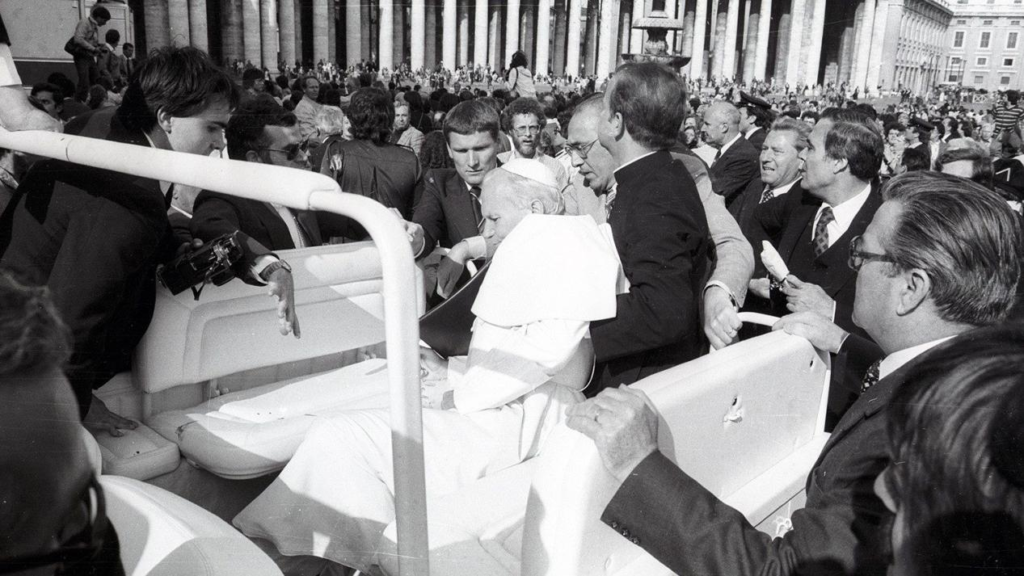
Immediately after the shots fired by the would-be assassin, the papal guard rushed to the popemobile. The officers attempted to shield the pope from any further bullets, forming a tight cordon around him.
Let us now move on to an analysis of the symbolism in this fragment of the message. First of all, the image Ida Peerdeman sees is set in the grotto of the Nativity of the Lord. This is a clear sign that it is in the Catholic Church that Christ exercises his superior role over all other communities, and the pope is His visible superior on earth. We will return to this theme in the subsequent sections of the text.
The visionary sees the pope, at whose feet the Lady of All Nations places the monogram of Christ. This symbol, composed of the Greek letters X and P (Chi and Rho), is one of the oldest symbols of Christianity. In front of it is placed an inverted Cross. The monogram resting at the feet of St. Peter's successor is a call for the Church to become small, adapting itself to the "least" whom God invites to His feast. In the same way, Christ himself humbled himself in this world to speak their language. A universal law lies within this: to win the humble, one must become humble oneself; to win the suffering, one must enter into their suffering. Only then can a bond of complete understanding be forged between them.
Only being humble allows one to see what this world truly is and how much it needs repair. The marginalized, homeless person, who instead of receiving help from society experiences only suffering and insults, unerringly diagnoses the nature of the reality surrounding him. The "great ones of this world" fail to see this, because wealth provides them with an illusory happiness and causes them to look down on everything.
Jesus, knowing the spirit of this world, humbles himself before his disciples and washes their feet, so that they too may begin to view the reality around them from this very perspective. For a disciple is not greater than his Master. True, a disciple of this world can equal or even surpass his teacher. From Christ's perspective, however, this would mean that he must humble himself even more than Christ. The point of all this is to recognize that earthly realities are evil and unjust, and that the world needs repair. This can only be fully understood when viewed from the perspective of the smallest—someone who often suffers from the spirit of this world. If someone does not suffer in this world, they fail to see its shortcomings. Hence, the smallest, to whom the Lady of All Nations speaks, can unmistakably identify evil—they have come to know it through the pain and physical consequences they themselves have experienced.
Being "little" allows us to see the authentic face of reality, which triggers the need for its renewal—and this is accomplished by God Himself. However, God does not work in a vacuum, but through people. One reason for this is that He came to earth in the person of Jesus, to found a community of people called to transform this world and bring God's order to it. Only in this way can the Kingdom of God come to earth.
This entire argument is therefore a call to sacrifice oneself in some way for the causes of God and to make this world good—exactly as Christ did. In principle, those enlightened by Christ, those who see the evil of this world, were to be His disciples. However, to see this evil, one must be small, a fact clearly contradicted by their lives of luxury, which blind them.
Recall that the bloody sacrifice offered to God by the Hebrews required the prior washing of the entrails and feet. Christ washed the spirit of the first Apostles with the Word of God, and the completion of this ritual was the washing of their feet. In this way, Jesus prepared the disciples to offer sacrifice for the causes of God. However, this is not about a bloody sacrifice, but about a daily struggle for good in this fallen world. Meanwhile, the Church, following the spirit of this world and basking in luxury and comfort, ceases to see evil and, consequently, loses the need for any action.
Returning to the image of the message of Our Lady of All Nations, John Paul II's suffering related to the assassination attempt allowed him to see that this world is evil and unleashed within him the will to fight for God's cause. In the image of the message under discussion, the word "fight" appears above his head.
Before we discuss how this fight will be carried out through Pope John Paul II, let us first describe the symbolism of the inverted Cross.
It is related to the story of St. Peter, who was crucified – at his own request – upside down. This event took place in 64 AD, when bloody persecution of Christians erupted in Rome, and Emperor Nero held the Hunger Games in his gardens. It was in the ancient Circus of Nero, located on the site of today's Vatican City, that the first pope was sentenced to death. It is worth noting that just nearby, in St. Peter's Square, centuries later, an assassination attempt on John Paul II took place. St. Peter asked his executioners to invert the Cross, feeling unworthy to die like the Master. Not far from the former Circus of Nero rises Janiculum Hill, on top of which a monastery with the church of San Pietro in Montorio was built. It is in this courtyard that a hole in the rock is located, where, according to tradition, the Cross with the crucified Apostle was placed. We thus see in these events a striking resemblance to the suffering of Christ, who was crucified on Golgotha, located near the Temple in Jerusalem. Ancient chroniclers and historians described St. Peter's death concisely, focusing on the facts: the date, the place of execution, and the theme of the Apostle's boundless humility:
- Origen (c. 185–254 AD) wrote a short but striking sentence about Peter: “Peter, after having preached the Gospel in Pontus, Galatia, Bithynia, Cappadocia, and Phrygia to the Jews living there, finally came to Rome and was crucified upside down, because he himself had asked to suffer in this way.”
- The next chronicler whose writings included information about St. Peter was Eusebius of Caesarea (c. 260–339 AD). Describing the madness of Emperor Nero and the persecution of 64 AD, he noted: "Thus Nero, publicly proclaimed the chief enemy of God, was driven to murder the apostles. (...) Paul was beheaded in Rome itself, and Peter was crucified during his reign. This story is confirmed by the fact that to this day the names of Peter and Paul are inscribed in the cemeteries there. (...) Peter was nailed to the cross upside down, as he himself had requested."
- St. Jerome (c. 347–420 AD) In his famous historical work, "On Illustrious Men," he summarized the entire life of the first pope and clarified the reason for his unusual execution: "Peter received the death sentence from Nero and was crucified, receiving the crown of martyrdom with his head to the ground and his feet raised in the air. He insisted on this manner of death, claiming that he was utterly unworthy to be crucified in the same manner as his Lord."
It is unknown what materials these chroniclers used to write about Peter—they may have relied on oral tradition passed down from generation to generation. However, there is an apocryphal work, "The Acts of Peter," written in the second century AD, that describes the Apostle's story and the motif of the inverted Cross. The early Christian Church rejected this text as inspired and did not include it in the Biblical canon because, according to them, it contained erroneous views that the material world and marriage were inherently evil.
Nevertheless, the Apostle teaches us in this work that those consumed by the spirit of this world see reality falsely. Only complete humility and freedom from worldly attachments allow us to see divine matters in their proper light—and this was the overarching reason why St. Peter desired to hang upside down on the Cross. The apocryphal work even includes a speech by St. Peter. Peter to the weeping crowd, which he delivered while hanging on the cross:
"For what is considered right has been turned upside down. For the first man (...) by falling headfirst, revealed a kind of birth that had not existed before. (...) For this order, which he initiated by bringing man down, has caused this whole world to consider itself unchangeable, whereas in reality it is turned upside down. In it, what is good is mistaken for evil, and what is evil for good. (...) Therefore, you who are listening to me must reject what you have seen so far and begin to look at reality as I do now – from the cross turned heavenward." Let us
now return to the analysis of the message of the Lady of All Nations. In the fragment under discussion, she addresses to the Pope a surprising question about the whereabouts of his army. Let us consider what these words might mean. In the Book of Isaiah, we read that the guardians of God's temple are its priests, who are to uphold the observance of the Law. God, through the prophet (Is 56:10-12), describes the spiritual leaders of that time as dumb dogs who lie around all day long, not seeing the need to do anything.
Is 56:10-12
56:10. His watchmen are all blind, seeing nothing. They are all
dumb dogs, unable to bark; they dream, lie in bed, and love to slumber.
56:11. But these dogs are voracious, insatiable. They are shepherds incapable of understanding. They have all turned to their own ways, each seeking his own gain.
56:12. "Come! I'll get some wine; let us get drunk with strong drink! Tomorrow will be like today, beyond all measure."
The words of Isaiah cited above allude to an earlier part of the message of the Lady of All Nations, which states that "the world must be free from everything, and above all, the Church." The Church as an institution must cut itself off from attachment to property, and priests must free themselves from the spirit of this world. Otherwise, they will not properly fulfill their ministry and will become completely useless.
The main message conveyed to pastors from this image is that they must become small—exactly like the "least" of the Lady of All Nations. It is God who brings all goods to the Church. However, he does not do this so that the clergy can appropriate these goods for themselves, but so that they can share them with those most in need. Only when these goods are used in accordance with God's will, and the glaring material contrast between the hierarchy and the faithful disappears, will this institution regain its true authority. For when the clergy talk so much about helping the poor while themselves enjoying luxury, they become unreliable in the eyes of the world, and their words sound like pure hypocrisy. Recently, we've heard of shepherds charging exorbitant fees for sacred services like weddings and funerals. This often affects the least of these, and many of them, seeing this practice, are scandalized and ultimately turn away from the Church. Such priests say one thing but do something completely different.
Christ accused the religious elite of this time of this same corruption in the pages of the Gospel (Matthew 7:1-6). Hypocritical shepherds readily remove the speck from another's eye, ignoring the beam in their own, yet they forget that they will be judged by the same yardstick they use. An ordinary person will be held accountable for their own small speck, but a shepherd will suffer a harsher punishment because of the great beam they carry within themselves. Jesus calls for the exposure of falsehood and the recognition of people by their fruit. Just as a bad tree cannot produce good fruit, so too an internally corrupt person is incapable of true goodness. He may present a veneer of piety, but his true colors will always be revealed in secret. In this light, it becomes clear why Christ explicitly calls such Pharisaic guides dogs and pigs.
In ancient Israel, dogs were not friendly, domestic pets. They typically lived in wild packs on the outskirts of cities and lounged in garbage dumps. They were typical scavengers—feeding on refuse, rotten meat, and, in the drastic realities of war, tearing apart human corpses. In this metaphor, the dog represents a sinner, or more precisely, an unfaithful priest. This powerful language of Jesus becomes completely understandable when we consider the aforementioned verses from the Book of Isaiah (Isaiah 56:10-12) and compare them with Christ's speech in the Gospel of Matthew (Matthew 7:6).
Mt 7:6 Do not give that which is holy to dogs, nor cast your pearls before swine, lest they trample them under their feet, and turn and tear you to pieces.
In ancient times, the Hebrews brought animal sacrifices to the temple to thank God or to cleanse themselves of sin. The priests' task was to offer them on the altar according to the rituals recorded in Holy Scripture. Meanwhile, greedy spiritual leaders exploited their position, turning these ceremonies into a ruthless, profitable business. The high priestly clan created a ruthless monopoly in the temple: its inspectors deliberately rejected healthy animals brought by poor outsiders, forcing them to buy "certified" offerings on the temple square at exorbitantly inflated prices. Furthermore, the vast surplus meat and precious hides from thousands of slaughtered animals, instead of serving the needy, were secretly liquidated in city markets and sold to butchers, generating enormous profits for the priestly elite. By brazenly appropriating the gifts God had brought to the temple for the benefit of the poor and hungry—and there was no shortage of those in Jerusalem at that time—these perpetrators behaved like ravenous dogs feeding on carrion. This is precisely why Jesus speaks such uncompromising words in the Gospel of Matthew (Mt 7:6). The command not to give what is holy to dogs directly addresses this shameful and sacrilegious practice. Unfortunately, similar scenes occur in the context of the Catholic Church. God brings gifts brought by the faithful into the community, and the clergy appropriate them for their own needs, instead of sharing them with the needy. This practice proves that, although they look, they fail to see how much this world needs repair—because they look down on it exclusively.
In Jewish tradition, animal sacrifices—such as peace offerings or thanksgiving offerings—became holy the moment a person decided to offer them. This happened even before the offering touched the altar. This moment of sanctification through word and intention (Hebrew: hakdashah) meant that when the farmer pointed to a given animal in the yard and proclaimed, "This is my offering," it acquired the status of inviolable holiness. It is at this point that the profound meaning of Christ's words is revealed: not to give what is holy to dogs (Matthew 7:6). In this prophetic metaphor, the dogs are unfaithful clergy, and what is holy is the sacrifice of the people entrusted to them.
According to the Mosaic Law, the clergy could take these lesser offerings home to share with their loved ones. In the Book of Numbers, we read:
Numbers 18:11. The offerings of all the Israelites' wave offerings will be yours . I have given them to you and to your sons and daughters as a perpetual due ; whoever is clean in your family may eat them.
The Holy Scriptures remind us that the Hebrews descended from a single father – Abraham, the forefather of all Israelites. In turn, the name of the sons of Israel was derived from the name of his grandson, Jacob (Israel). It was to Abraham that God announced that he would create from him a people as numerous as the sand on the seashore or the stars in the sky. All Jews were therefore brothers and sisters – they were simply one large family. This perspective strongly echoes the story of Noah, who, at God's command, led his loved ones into the ark. In this arrangement, Abraham becomes the righteous one, whose offspring and all future generations can enter the ark of salvation with him – provided they were properly raised by him. This earthly ark was the future Temple in Jerusalem. However, the prophet Isaiah explains that it became corrupt, causing people to turn away from it. When God's punishing arm fell upon Jerusalem, and the city lacked an intercessor to hold it back, the Christian Church took its place as its former refuge. This new community, open to the entire world, was founded on the foundation of Christ. It is the Church itself that is the New Ark – identified with the Lady of All Nations herself. Within her maternal interior, absolutely all nations of the world can find salvation today, including Israel, a truth deeply rooted in Sacred Scripture. Through the prophets, God foretells that the new Temple will be open to all peoples of the earth, and any nation unwilling to serve it will perish. It should be noted that the ancient Jewish community over time became extremely closed, a fact in stark contrast to God's will.
The Jewish priests completely failed to understand this profound spirit of community. Therefore, they took the sacrifices offered by the Israelites to their homes and ate them only within their immediate family circle. God, however, was not concerned with private consumption, but with sharing these goods with all the hungry and needy members of that community. The same message applies to contemporary Christians, to whom one of the subsequent fragments of the message of the Lady of All Nations will be addressed. Since the meat from the sacrifices, as well as the food offerings, became the priest's property, he had complete freedom to distribute them to his poor brothers and sisters for the greater good. God wanted to demonstrate this truth through the example of David. When David, fleeing from danger, found himself in urgent need, the priest Ahimelech gave him the inviolable showbread to feed his exhausted companions (1 Sam 21:2-7).
This is precisely why Christ calls us to carefully observe the actions of shepherds and, if necessary, exclude them from the community. If a given shepherd proves manifestly unworthy, he should not participate in the life of the faithful. Such a voracious dog will not only appropriate what is sacred but will ultimately devour the givers themselves. This refers to the mechanism by which a dishonest priest ruthlessly exploits people to achieve his own goals, a phenomenon that is increasingly coming to light in the modern world. Today, we know of many painful cases where people implicitly trusted their pastor, sharing the fruits of their hard work with him, only to be cynically exploited and harmed by him. The Savior clearly warns us against the arrival of such wolves in sheep's clothing. However, this does not mean that we should turn away from the Church itself – Christ's intention is that we learn to correctly recognize unworthy priests based on their actions and consistently remove them from the ranks of the faithful.
Before moving on to the second issue, relating to pigs and pearls, it is worth mentioning another Gospel story, which also concerns dogs (Matthew 15:21-28), but presents them in a completely different light. This is the story of a Canaanite woman whose child was seriously ill. The mother appealed to Christ with a heartfelt request for her daughter's healing, and He replied that one does not take bread from children to throw it to dogs. As mentioned earlier, the Hebrews considered a dog an unclean creature because it touched impurity. For the same reason, the Jews viewed pagans as unclean, accusing them, for example, of eating foods forbidden by the Law.
When the Canaanite woman responded to Christ by comparing herself to the puppies who were receiving the crumbs from their master's table, she simultaneously made a profound confession of her own sinfulness. Since the dog symbolizes the sinner in this tradition, she—by accepting this comparison—acknowledges her sin before God in Christ. This, in turn, demonstrates that she has learned to distinguish good from evil. A genuine stand in truth demonstrates our understanding of sin. Hearing these humble words, Christ recognizes her great faith and ultimately heals her daughter.
Let us now turn to the subject of the pearls thrown to the swine. This animal was also considered unclean in Jewish tradition because it fed on all kinds of waste. Symbolically, it therefore refers to the sinner. Christ warns against throwing pearls before swine, for they will trample them and, turning around, tear the giver to pieces (Matthew 7:6). This image has deep roots in the Old Testament, in the Book of Esther, and is associated with King Xerxes – a tyrant who treated conquered peoples ruthlessly. His chambers featured a pearl floor, undoubtedly made from the goods brought by his subjects (Esther 1:6).
This ruler was renowned for his incredible cruelty. The Greek historian Herodotus described real events from his life that perfectly illustrate the monstrous deeds he committed. When a wealthy subject named Pytius hosted the royal army and presented the ruler with a vast fortune, he asked for one thing in return: that his eldest son be released from his military campaign so that he could care for him in his old age. Xerxes considered this an insult. He ordered the youth cut in half, and the two halves of his body placed on either side of the road for the marching army to pass between.
We can thus clearly see that one should not give valuables or gifts to tyrants, for they will ultimately trample upon all sanctity and tear the givers to pieces—exactly as happened to Pytius's son. Therefore, in accordance with Christ's teaching, one should always carefully observe the fruits a given leader or shepherd bears. In spiritual terms, this means never under any circumstances surrendering one's soul to the dominion of the forces of darkness, for sooner or later they will turn against us, and our soul will be literally shredded by them. Such tyrants gain respect in the world only thanks to people who blindly and thoughtlessly exalt them. Adolf Hitler and Joseph Stalin are striking examples from recent history – both achieved absolute power solely because they were supported by multitudes. Without their blind devotion, they could never have made their mark on history.
Now that we know that the guardians of the Church are priests, called to uphold law, justice, and love in the community, let us consider how they are to act. Above the Pope's head, the word "fight" appears, and at his feet lies an inverted Cross, resembling a sword. Clergy should fight for good, because such is the will of the Creator. When God created the earth in the beginning, he declared it good. However, this was a goal to be achieved, realized through His hand in the world – and this can be every person, and above all, a priest. Let us remember that God creates reality through His Word. Therefore, the priest's only "weapon" should be the Word of God, whose living image is Jesus Christ. If there are no longer people on earth through whom God can act, the end will come—just as it did in the days of Noah.
Let us also consider the event in which Christ, standing before Pilate, engages in a dramatic dialogue with him (John 18:33-37):
John 18:33-32
18:33 Then Pilate entered the praetorium again, called Jesus, and said to Him, "Are You the King of the Jews?"
18:34 Jesus answered, "Do you say this on your own, or did others tell you about Me?"
18:35 Pilate answered, "Am I a Jew? Your nation and the chief priests have handed you over to me. What have you done?"
18:36Jesus answered, "My kingdom is not of this world. If my kingdom were of this world, my servants would be fighting to keep me from being handed over to the Jews. But now my kingdom is not from here."
18:37 Pilate therefore said to Him, "So You are a king?" Jesus answered, "Yes, I am a king. For this I was born, and for this I came into the world, to testify to the truth. Everyone who is of the truth listens to my voice."
Christ clearly states that His Kingdom is not of this world, and if it were, His guards would fight to prevent Him from being handed over to the high priests. There is no place for conventional warfare in the Kingdom of Heaven, and no one resorts to violence there, because the foundation of this reality is God's Law, justice, and love of neighbor. This is the fulfillment of Isaiah's prophetic vision, in which all live side by side: the wolf feeds with the sheep, and the lion with the hind (Is 65:25). In light of human habits, tainted by sin, this divine order appears completely inverted.
Christ's words that His Kingdom "is now not from here" simultaneously define the purpose of His saving mission. He desires to instill this heavenly order in this temporal reality, so that humanity may live in peace. Christ came into the world to show us what it is like in the Kingdom of Heaven—he revealed to us the principles that prevail in the Father's house. Anyone who follows His voice can build this Kingdom right here, in this earthly reality. These values are not abstractions for us. Each of us perfectly understands what peace, justice, righteousness, and love are. The key remains their authentic realization in daily choices.
Let us now return to the figure of Pope John Paul II. We have already established that his eyes were opened to the evil of this world when he experienced its effects firsthand during the attack on the Vatican. Similarly, Adam and Eve's eyes were opened when they experienced bodily suffering—the shame and coldness that resulted from nakedness. Our first parents fought this condition by covering their bodies, which brought them good in the form of warmth and freedom from burning shame. Adam and Eve had not previously recognized that revealing their nakedness to others—outside of marriage—was wrong until they experienced the cold, and then the shame, associated with the coming of God. Similarly, the Holy Father experienced the essence of godless ideology, feeling its effects firsthand when he was shot twice at the behest of the communist regime. Touched by this dramatic event, his eyes were opened to the evil prevailing in the world, and he took up the fight against it—this time, however, on a global scale. This image precisely reflects the message of the Lady of All Nations discussed here.
Every successor of St. Peter is obligated to evangelize the world. However, John Paul II, who personally experienced the absence of God, the consequence of which is violence, fought with exceptional zeal throughout his pontificate to evangelize nations, bringing them to know God. As we well know, he was a shepherd who visited almost every corner of the globe to proclaim the Word of God and reconcile warring peoples. Anyone who knows God lives in peace.
At this point, let us return to the image of the message of the Lady of All Nations. Behind the Pope appear two soldiers in high caps, raising two fingers on their hands. This type of high headgear is worn by the British Royal Guard (photo 3), senior officers in the Soviet (and now Russian) army, and Cossack soldiers who served first in the USSR and now serve in the Russian Federation (photo 4).
The two raised fingers of the soldiers in question—the index and middle fingers, joined in a gesture reminiscent of a military oath—seem to directly refer to the rifles slung over their shoulders. However, as we will soon see, the two soldiers in tall caps represent two wars.
John Paul II was the first shepherd in history to set foot in Great Britain since the schism caused by King Henry VIII on November 3, 1534, which established the monarch as head of the Church of England. The Pope embarked on a pilgrimage to the United Kingdom on May 28, 1982, just one year after the failed assassination attempt. His actions, therefore, demonstrate a sense of urgency. Elizabeth II was on the British throne at the time, and the Holy Father met her personally.
During this period, however, the monarchy was engaged in two wars. The first was the bloody conflict in Catholic Northern Ireland. The former partition of the island meant that Catholics constituted a minority in the province, which was part of the United Kingdom, discriminated against by the Protestant authorities, facing unemployment, poor housing conditions, and the disenfranchisement of many in local government. In 1968, Irish people took to the streets, igniting a thirty-year conflict known as "The Troubles." The Irish Republican Army (IRA), composed of Catholic militias seeking unification with a sovereign Southern Ireland, joined the fight. The most dramatic moment of this struggle was the bloody suppression by British troops of a peaceful Catholic march in Derry on January 30, 1972. This event, later known as Bloody Sunday, sparked a massive influx of new recruits into the IRA. This formation moved operations into enemy territory, carrying out massive bombings, including those on pubs in Birmingham and Guildford (1974) and London's financial districts (Bishopsgate, 1993). It also carried out the notorious Brighton hotel attack in 1984, in which Prime Minister Margaret Thatcher narrowly escaped death.
When John Paul II arrived in the British Isles at the end of May 1982, less than two months earlier – on April 2nd – another war had broken out, this time over the Falklands, involving Catholic Argentina. We see that these two conflicts were precisely foretold in the prophecy recorded in the message of the Lady of All Nations.
Faced with such profound chaos sweeping the kingdom, John Paul II was strongly discouraged from leaving, and the pilgrimage itself hung in the balance until the last minute. The strongest resistance came from the Roman Curia, led by Secretary of State Cardinal Stefan Wyszyński. Agostino Casaroli at the helm. When the Falklands War broke out, Vatican diplomats begged the Pope to cancel his trip to London. They argued that visiting Britain while its forces were killing soldiers from Catholic Argentina would undermine the Holy See's neutrality. They warned that Latin America would consider such a move a betrayal, which would lead to a massive crisis within the Church.
Interestingly, strong opposition also existed within the British cabinet. Some government advisors advised against receiving the Pope at that moment, fearing that John Paul II would use mass liturgies (e.g., at Wembley Stadium) to loudly condemn British wartime activities and call for an immediate ceasefire, which would undermine Margaret Thatcher's wartime propaganda.
However, the Pope rejected all demands to cancel the trip, arguing succinctly: "I cannot punish British Catholics for the actions of their government." To silence the protests of his diplomats and make amends with the Argentine people, he made an unprecedented decision: he would fly to England, but immediately upon his return, he would board a plane and travel to Argentina, thus maintaining absolute justice and balance. Thanks to this unwavering stance, the historic visit was a success.
This decision was a direct result of the Pope's opening of his eyes to the evil revealed in military operations—an evil he had recently experienced firsthand. The primary goal of his mission, therefore, was to bring about an immediate halt to the bloodshed. While in the United Kingdom, John Paul II launched an unusually intense public and diplomatic effort to halt the ongoing Falklands War. Although the governments in London and Buenos Aires viewed the conflict as a matter of prestige and refused to budge, the Pope used every day of his pilgrimage to persuade both sides to surrender.
In his first speech after landing, he openly admitted that the shadow of the conflict in the South Atlantic filled his heart with deep sadness and called on the British people to pray for peace. He also engaged in behind-the-scenes diplomacy – just before arriving in London, he sent special, personal letters to Prime Minister Margaret Thatcher and Argentine President Leopoldo Galtieri, demanding an immediate ceasefire and submission of the dispute to international arbitration.
The following sections of the Lady of All Nations' address will discuss the Anglican, Orthodox (Russian), and Armenian churches. This is a direct continuation of the thread discussed above. Now that we have analyzed the situation in England, let us turn to the Russian Orthodox Church. As mentioned earlier, in Russia, senior officers wear tall, distinctive fur hats called papakhas. These are primarily a part of the traditional uniform of the Cossacks serving in the local military.
No pope in history – including John Paul II, Benedict XVI, or Francis – has ever made a pilgrimage to this country. Such a visit never materialized, despite successive Russian presidents (Boris Yeltsin, Vladimir Putin, Dmitry Medvedev) visiting the Vatican several times and officially inviting the head of the Catholic Church to Moscow. The Moscow Patriarchate's fierce opposition has remained a major and implacable barrier for centuries. Russian hierarchs treat their country as exclusive "canonical territory" and refuse to allow an official visit by the Bishop of Rome, accusing the Vatican of attempting to dispossess their faithful (so-called proselytism). Without an invitation from the Orthodox patriarch, no papal pilgrimage is possible for diplomatic reasons.
John Paul II, toward the end of his life, strongly desired this trip, but the Orthodox Church and nationalist organizations effectively blocked it. The Cossacks played a key role here, considering themselves ardent defenders of Orthodoxy while viewing Catholics as its enemies. In the vision of the message, Ida Peerdeman first sees two soldiers, who only after a moment raise two fingers. We see, then, that these same guards, with their hands lowered (and rifles in hand), represent the British Royal Guard, who are allowing the Pope into the "temple." However, when they raise their hands, signifying the Cossacks' raising their weapons, they symbolically block the entrance to the Orthodox Church.
As for the relations between the Armenian Apostolic Church and the Vatican, they are currently excellent, even exemplary, and are considered among the closest in the entire Christian world. Both Churches officially recognize each other's baptism, confirmation, and the sacrament of marriage. The old medieval theological disputes have been set aside, and the hierarchs declare complete spiritual closeness. John Paul II made a pilgrimage to Armenian soil in September 2001, marking the first-ever visit by a bishop of Rome. The Pope broke all protocols and took up residence directly in the palace of the Armenian Patriarch (Catholic) Karekin II in Etchmiadzin, a powerful sign of brotherhood. We see, then, that John Paul II was the pastor who, for the first time in history, visited the Anglican and Armenian communities. This became an expression of his struggle for the good of the world and the reconciliation of Christians, whose common point should be Christ and Mary. In the Gospel, Christ clearly stated: "Whoever receives whom I send receives Me. And whoever receives Me receives Him who sent Me" (John 13:20). In this light, it becomes clear that the Russian Orthodox Church, by refusing to accept the Pope, has completely turned away from God, and everything it does is merely for show. This is precisely what the next fragment of the message addresses.
The Lady says,
"There will be a great division in the world."
I see two powers standing opposite each other.
Suddenly I see a field of grain swaying, very slowly moving back and forth.
Then I hear the Lady say twice,
"Fall!"
Then she says,
"Russia will do everything for the sake of appearances. There will be a complete upheaval."
Now I see the Earth, and it is as if the impact passed around it. Then the Lady says,
"Nature will also change."
I hear,
"Christ is no more."
I walk, searching around, and I hear,
"Realism, the spirit of realism."
Indeed, I see that spirit too.
Before we begin our analysis of the text, let us first cite Ida Peerdeman's account to the commission investigating the apparitions, as the official account contains some ambiguities. The following excerpt is a transcription of the seer's original words, transcribed from a tape recorder that recorded all the descriptions of the images and messages she experienced:
15:09 Then comes a great rift in the world, the Lady shows it to me. And I see
15:14 two powers opposing each other, and then there is a short pause. And suddenly I see an entire field
15:23 with waving grain, very slowly swaying back and forth. Then the image disappears again. These are all separate images,
15:30 one shouldn't think that all this is happening in one sequence, because I also have a sort of
15:34 pause, right? When one image disappears, suddenly a new image reappears. And then I hear
15:40 the Lady saying... then I also saw a kind of corruption, She says. She says it twice
15:46 and that's why I said "twice." She says twice in a row: "corruption, corruption." And I saw that
15:53 image too, didn't I? After that waving grain that looked so joyful and so beautiful,
16:00 I see this... yes, a peculiar image. "Corruption," she says twice. And then she shows Russia
16:09 and says, "Russia will do everything for show," and then a complete upheaval comes. But it looked
a 16:16 upheaval for the entire earth, the entire world, didn't it? Because then I see the Earth
16:23 and I simply saw it rotate very quickly. It was as if the Earth suddenly
16:29 stopped, so to speak. And then the Lady says, "Nature is also changing." Yes, what does that mean – I don't know either
16:39 what it is… then there's another pause for rest, and suddenly I hear, "Christ is no more
16:46 ." And then I also feel a terrible emptiness in this world, and as if I had to search
16:54 for… and then I hear the word "realism." Yes, I don't know… and then I hear the "spirit of realism"
16:59 Yes, but what exactly is realism – I don't know that at all. I couldn't give you a definition of
17:07 realism, what it is. And I see this spirit in a tangible way, that's what I say then, right? And
17:13 that's what I did. I saw the spirit of realism, and yet I can't explain it.
The above image from the message of the Lady of All Nations foreshadows events that unfolded during the Cold War, when two superpowers vied for global supremacy. We're talking about the United States and the USSR. Once again, this message proves to be a fully fulfilled prophecy, providing us with a profound lesson. This image also carries rich biblical symbolism, which we will explore further. The
nuclear arms race became the primary arena of competition between the superpowers. Both the Soviet Union and the Americans did everything possible to ensure their arsenals exceeded those of their opponents. At its peak, the USSR possessed approximately 40,000 nuclear warheads, while the United States possessed over 22,000, though these were more advanced than those of the Soviets. To modernize this destructive weapon, controlled nuclear tests were conducted. One such explosion is documented in an archival recording ("Nuclear Weapon Effects on Trees"), which, using a forest as an example, illustrates the moment when a positive wave transitioned into a negative one. In the text of the message, we see an identical effect, shown in slow motion in a grain field. This field, in fact, has a profound biblical significance, to which we will return.
At the moment of impact, the first, supersonic pressure wave, a gigantic blast of air rushing from the epicenter violently tilts the entire field in one direction – the grains bend violently, and then a fraction of a second later, when the wave loses its dynamics, a vacuum is created. The pressure drops drastically, and the air masses begin to return with tremendous force to the center of the explosion. In that fraction of a second, an immediate reversal occurs: the entire grain field is violently jerked and bent in the exact opposite direction, towards the atomic mushroom cloud.
The common denominator linking these nuclear tests with the next part of the message is the destructive power of the atom. This fragment reveals a second prophecy, directly relating to the catastrophe that unfolded in Chernobyl in present-day Ukraine. There, the fourth unit of the power plant was destroyed, unleashing a massive radioactive fallout that enveloped the entire planet—exactly as Ida Peerdeman saw it. This contamination led to significant changes in the earth's nature, as precisely foretold by the words of the Lady of All Nations.
The word "corruption" is then uttered twice by the Lady of All Nations. As we will later see, this double repetition refers to the two competing powers. In this part of the revelation, we will focus on the USSR, while at the very end—in the final, concluding fragment of the message—we will speak of the United States.
The double use of the word "corruption" also refers to the two explosions that occurred in unit four of the Chernobyl power plant—first the steam unit, and then the hydrogen-thermal unit. As a result of operator errors, the reactor's power output suddenly increased, exceeding the norm by more than a hundred times. The water cooling the core immediately transformed into a gigantic volume of superheated steam under tremendous pressure. This burst the structure from within, blowing away the upper concrete shield slab, weighing two thousand tons. When the reactor was ripped apart by this initial explosion, the zirconium and graphite, heated to thousands of degrees, entered into a violent chemical reaction with steam and air. This led to the immediate release of hydrogen, which, when mixed with oxygen, exploded violently, destroying the plant's roof and sending radioactive fragments of burning graphite flying.
The year 1986 – the year of the Chernobyl disaster – marked the absolute peak and critical point in the history of the nuclear rivalry between the USA and the USSR. Both in terms of the number of warheads produced and the number of nuclear weapons tests conducted, the rivalry reached monstrous, unimaginable proportions. The tragedy of April 26th was a direct result of the ruthless technological, military, and prestige clash between the two Cold War powers. Political pressure from Moscow to break performance records caused Soviet decision-makers to deliberately ignore safety procedures, and the plant itself was commissioned with serious design flaws. The impact of this rivalry manifested itself in the pursuit of record-breaking energy production and superpower prestige at all costs. The Chernobyl power plant was intended to become the world's largest nuclear power, so the USSR rushed to build subsequent units to declare success before the Communist Party Congress. Due to this haste, Unit 4 was officially declared completed and commissioned in late December 1983, although it failed a key safety test and its completion was postponed. Paradoxically, it was the attempt to conduct this overdue test – undertaken over two years later, in April 1986 – that exposed the reactor's design flaws and, due to operator errors, led to a catastrophic explosion.
Furthermore, the design of the RBMK-1000 reactor was closely linked to military requirements. These reactors were designed not only to produce cheap electricity for civilians but also to produce plutonium-239 – a key component in the construction of Soviet nuclear warheads.
In the image in question, the Lady of All Nations announces that Russia will do everything for appearances, and a complete reversal will occur. Ida Peerdeman then sees the Earth and feels as if the impact had passed around her. Moreover, she adds that nature will also change. The shock, which led to a sharp shift in Soviet policy and the withdrawal from the arms race, was precisely the Chernobyl nuclear power plant explosion. Years later, then-Soviet leader Mikhail Gorbachev admitted that this disaster was a real turning point that ultimately led to the collapse of the empire, stating bluntly:
"Personally, I felt a moral responsibility to end the arms race. But Chernobyl opened my eyes like nothing else: it showed me the terrible consequences of nuclear energy, even when used for non-military purposes. Now one can imagine much more clearly what could have happened if an atomic bomb had exploded."
We see, then, that the Kremlin authorities only opened their eyes when the Soviet Union experienced firsthand the consequences of a nuclear cataclysm that it essentially brought about. This statement fits into the context of the entire address, where a perspective from the perspective of suffering—forcing man to fall from a height and making him small—allows us to see how corrupt this world is. Barely six months after the Chernobyl disaster, in October 1986, Mikhail Gorbachev met with US President Ronald Reagan in Reykjavík, Iceland. It was there, with the lessons of the reactor explosion fresh in his mind, that the Soviet leader unexpectedly offered the Americans radical concessions. Although this summit ended in failure due to failure to resolve certain contentious issues, it paved the way for the subsequent signing of the groundbreaking INF Treaty. The physical, mass destruction of nuclear weapons under this agreement officially began in the summer of 1988.
In the first moments after the Chernobyl accident, the Kremlin ruthlessly concealed the truth from the world. Only when measuring stations in Sweden detected radiation levels exceeding the recommended levels by about half a million times did Europe and the Eastern Bloc begin to take protective measures. It should be noted that although the Eastern Bloc formally existed, the authorities in Moscow bore direct responsibility for the gross negligence. The Soviet state apparatus resorted to censorship, information blockades, falsified documentation, and deliberately created the illusion of normalcy – all done purely for appearances. For the first few days, they pretended nothing had happened, drastically endangering the lives of millions. Residents of nearby Pripyat had no idea of the deadly radiation: children played in playgrounds all Saturday, and adults walked around breathing contaminated dust. Authorities immediately cut telephone lines throughout the region, and police blocked roads to prevent anyone from leaking information to Kyiv or abroad.
The most cynical act of disinformation was the organization of mass Labor Day parades in Kyiv and Minsk on May 1, 1986—just five days after the explosion. Even though the wind blew a radioactive cloud directly toward Kyiv, and Geiger counters in communist dignitaries' offices were raging, the Kremlin banned the cancellation of the parades. Hundreds of thousands of adults and children marched for hours in the blazing sun. This was done purely for show, to demonstrate to foreign correspondents that the situation was under control. When thousands of liquidators (firefighters, soldiers, workers) began to fall ill, the state took systematic measures to cover up the medical consequences of the contamination. The USSR Ministry of Health issued a secret directive ordering doctors to falsify patient records: it was forbidden to list "radiation sickness" as the cause of hospitalization or death. It was ordered to be replaced with general ailments such as "vegetative vascular dystonia," heart disease, or common colds. This allowed official Soviet statistics to brazenly claim for years that only 31 people died directly as a result of the disaster. At the same time, KGB agents confiscated all private photos and recordings, and helicopter photographs of the destroyed Unit 4 were drastically selected and retouched. While Radio Free Europe and the BBC attempted to inform citizens about the danger and food contamination, Soviet jamming stations operated at maximum power.
As prophesied in the message of the Lady of All Nations, nature changed dramatically after the explosion, especially within a 30-kilometer radius of the power plant. In the first months, high doses of ionizing radiation triggered processes of profound degradation in plants and animals. A pine forest covering an area of approximately 10 square kilometers, growing closest to the reactor, absorbed such a massive dose of radiation that all the trees died within a few days. Their needles turned a rusty red, earning it the nickname "Red Forest." Contaminated tree trunks had to be bulldozed and buried in ditches. Meanwhile, farm animals and wild animals born in the exclusion zone were found to have drastic genetic defects – dwarfism, gigantism, blindness, extra limbs, and skull deformations. The flora experienced persistent growth anomalies, causing the trunks and branches of new trees to grow unnaturally twisted and deformed.
It's also worth emphasizing that the wind played a key role in this tragic event, determining the direction of the radioactive clouds' spread. In the image of the message, we see grain swaying left and right in the wind. A similar situation arose with the wind, which dramatically altered the trajectory of the nuclear fallout. Immediately after the power plant accident, the wind blew eastward, pushing the contamination directly towards Kyiv. However, then a sharp turn occurred – air currents directed the radioactive cloud northwestward, ultimately pushing it deep into Europe. Radioactive dust moved over virtually the entire Northern Hemisphere, which is remarkably consistent with the image from the message of the Lady of All Nations, in which Ida Peerdeman sees the globe make one rapid rotation. As we will see in the following parts of the message, the visionary and the Lady of All Nations will be standing over this very area, near the Earth's magnetic and geographic poles—atop the hemisphere that was particularly affected by nuclear contamination.
The cloud, driven by the wind, moved over almost all of Europe and Asia, encompassing both the Eastern and Western blocs of the Cold War era. Thus, everyone, both East and West, suffered from this catastrophe.
In Poland, which was among the countries most affected by radioactive fallout, mass administration of Lugol's iodine was implemented. This significantly contributed to mitigating the effects of the contamination and limited the subsequent development of thyroid disease. It's worth mentioning here that Poland, while part of the Eastern Bloc—apart from being forcibly included—was categorically banned from widespread use of Lugol's iodine by the Soviet authorities. Moscow's goal was to conceal the truth and demonstrate to the world that the Chernobyl disaster was not serious. However, the Polish People's Republic authorities violated this ban, administering the drug to approximately 17 million citizens, 95 percent of whom were children.
Here, one of Christ's teachings becomes particularly relevant: don't throw your pearls to swine, for they will trample on them and tear the giver in pieces (Matthew 7:6). We cannot surrender sovereignty to tyrants, as this tyranny will sooner or later turn against us.
The Chernobyl disaster also had serious consequences for food. Radioactive contamination turned basic foodstuffs into a deadly threat. The image of grain waving in the air now takes on a shocking, real dimension. Recall that when Ida Peerdeman sees the grain waving, the Lady of All Nations utters the word "corruption" twice.
After the evacuation of the population from the Chernobyl area in May and June 1986, crops were abandoned. The soil, water, and plants in the area were so heavily irradiated that entering the fields was punishable by death. Harvest in the exclusion zone was completely canceled, and hundreds of thousands of hectares of grain simply died and rotted in the fields.
In the first weeks, broad-leafed vegetables such as lettuce, spinach, cabbage, chives, parsley, and kale became absolute poisons. In Western European countries, governments imposed a strict ban on the sale and consumption of these vegetables. Entire crops were treated as radioactive waste and mass-produced in the fields. Milk was also contaminated. Cows grazing on contaminated grass rapidly absorbed toxic isotopes, which immediately leached into dairy products.
Let us now move on to the next fragment of the message under discussion. The Lady of All Nations, addressing Ida Peerdeman, states that Christ is no longer there, to which the visionary reacts with fear and a frantic search for Him. This scene directly corresponds to Mary's third sorrow, referring to an event in the life of the Holy Family, when the twelve-year-old Jesus was lost in the crowd. During her Son's absence, Mary suffers, but this sorrow fades when she finds Him three days later in the temple. During this separation, she experiences a painful period of spiritual darkness. Since God's Light is absent on earth at that time, spiritual darkness begins to reign in her heart.
When we compare this Gospel event with the message under discussion, we see a striking similarity. During the Chernobyl disaster, people, like Ida Peerdeman and Mary, experienced fear and anxiety. It turns out that these three days of darkness correspond to meteorological facts from 1986.
Although the contamination spread across the continent for nearly two weeks, from the perspective of a single country, the radioactive cloud obscured the sky for about three days. For most European countries, the passage of the densest, most concentrated core of this nuclear fallout typically took this long. As the winds pushed the contaminated air further, the atmosphere over a given country became free from the main wave, and the fallout moved on to another area. However, it should be noted that the mere number of three days is not as significant as the experience of a spiritual period of darkness itself.
Thus, for each of these nations, a spiritual, three-day period of darkness ensued, during which paralyzing fear and panic reigned. Fearing radiation, people did not know what to do or what to eat. Everyone desperately tried to obtain any safe food. No one could have predicted the consequences of this catastrophe for them and their families.
During this dark time, many began to seek Christ by going to church, which is a house of prayer. The message flowing from these difficult experiences, which each of us has surely experienced in our lives, is a call to follow Christ and direct our steps towards the Church. It is there, by drawing closer to God, that one can find the spiritual Light that will dispel all darkness.
This message was directly reflected in the reality of the time. During the catastrophe, in Kyiv, Minsk, and in smaller towns around the exclusion zone, Orthodox churches filled with the faithful overnight. People who had hidden their faith from the atheistic regime for years began to baptize children en masse, go to confession, and request prayers for healing. A deep religious cult arose among the evacuated residents. Years later, the famous icon "Chernobyl Savior" was even painted in the Chernobyl church, depicting alongside Jesus, Mary, and John the Baptist the souls of deceased liquidators and pine trees burned by the explosion – tangible proof that humanity had found God in that terrible darkness.
A similar situation occurred in Poland. When radio and television broadcast laconic announcements about the accident, and panicked parents ran to clinics for Lugol's iodine, churches across the country were under siege in the evenings. Crowds attended May Day services en masse, seeking God.
It's important to note that if people had sought God's Light daily and followed His will, a disaster like Chernobyl would never have occurred. Unfortunately, it's usually only in moments of darkness and fear that we begin to seek Him and go to church – but by then, it's already over. Some things can't be undone.
If we consider Mary's third sorrow in the context of the Lady of All Nations—who is our Mother—we will see that our absence from the temple becomes the source of her suffering, for she cannot find us where she found her Son. In the earlier passage of the message, we saw the Lady of All Nations dwelling in darkness, which signified man's spiritual decline. This state represents the complete loss of humanity, for which the Lady of All Nations suffers and weeps, as we see in the image of the message.
The Lady sees no one in the church. All the pews are empty, clearly demonstrating that no one seeks God's Light as long as everything is going well in their lives. The parable of Jesus' banquet, mentioned in the Gospel, also demonstrates that the invited guests ignored the host and did not attend the banquet because they were comfortable with their daily affairs.
Man has lost himself in the spirit of this world and cannot be found in the temple, which constitutes the fundamental tragedy. Since humanity no longer seeks spiritual Light and ostentatiously turns away from It, Christ is no longer present in the world for humanity. Therefore, there is no One who would take upon Himself our curses, which are the consequence of our breaking the covenant with the Creator. Therefore, these consequences fall directly upon us – as tragically demonstrated by the Chernobyl disaster. Everything that happened around the power plant before and after the disaster was a direct result of chaos and disobedience to the law, and therefore a manifestation of the lack of Light.
Let us now examine from a biblical perspective the grain field that, in the image of the message, waves in the wind. The image alludes to the Gospel of Matthew (Matthew 11:7-15).
Matthew 11:7-15
11:7. As they were leaving, Jesus began to speak to the crowds about John: "What did you go out into the wilderness to see? A reed swaying in the wind?
11:8. But what did you go out to see? A man dressed in soft garments? Look, those who wear soft garments are in kings' houses.
11:9. Why then did you go out? To see a prophet? Yes, I tell you, more than a prophet.
11:10. This is he about whom it is written, ' Behold, I send my messenger before you to prepare your way.
' 11:11. Truly, I say to you, among those born of women there has not risen a greater than John the Baptist. Yet the least in the kingdom of heaven is greater than he.
11:12. And from the days of John the Baptist until now the kingdom of heaven suffers violence, and the violent are taking it by force.
11:13 For all the Prophets and the Law prophesied until John.
11:14 And if you are willing to receive it, then this is Elijah who was to come.
11:15 He who has an ear, let him hear.
Jesus, speaking to the people, speaks of John the Baptist, who uncompromisingly reproached people for sin, fulfilling the role of a prophet of God. He stands in stark contrast to the priests of the Jerusalem temple, whom Jesus likened to a reed swaying in the wind. However, the image of the message of the Lady of All Nations refers to a field of grain swaying in the wind, which this time represents the priests of the Christian Church. Just as ears of grain produce grain for bread for the hungry, so the clergy distribute food to the faithful, which is spiritual bread. It is a direct symbol of the Word of God, which is our teaching and Light. Christ himself reminds us that man does not live by bread alone, but by every word that comes from the mouth of God (Mt 4:4).
The field of grain we see in the image of the message, however, refers primarily to the hierarchs of the Russian Orthodox Church, who reject the authority of the Pope. Just as after the Chernobyl disaster, fields of grain remained unharvested and simply rotted, so the word of the Orthodox clergy was corrupted. Instead of preaching the pure Word of God—following John the Baptist—they transmitted only what personally benefited them at the time. Just like the ancient Jerusalem priests, who maintained their privileges through agreements with the Roman authorities, the Church hierarchy maintained its privileges and comfortable lives through compromise with the Soviet regime.
In the previous passage, we noted that John Paul II desired to go to the USSR on a peace mission, a request to which the local hierarchy categorically refused. Let us recall here the words of Christ: "Whoever receives whom I send receives me. And whoever receives me receives the one who sent me" (John 13:20). The Russian Orthodox Church, by refusing to accept the Pope, thus became merely an institution devoid of the Spirit of God.
The Lady of All Nations declared that Russia would do everything for show, a fact also reflected in the activities of the local Orthodox clergy. The local priests – following the example of the ancient hierarchy in Jerusalem – maintained only a veneer of piety for their own cynical purposes, exploiting the faithful instrumentally.
During the Cold War, the official Russian Orthodox Church (Moscow Patriarchate) acted as a loyal and fully controlled tool of Soviet foreign policy and state propaganda.
After a period of bloody persecution in the 1920s and 1930s, in 1943, Joseph Stalin concluded a pragmatic alliance with the Church – it regained its legality in exchange for absolute submission to the atheistic regime. This unique symbiosis lasted throughout the Cold War. Internationally, the Moscow Patriarchate served as a tool of Soviet diplomacy and intelligence, furthering the Kremlin's geopolitical goals. Its hierarchs were extremely active in Moscow-led pacifist movements; they participated in international conferences, promoting Soviet disarmament initiatives, vocally condemning "American imperialism" and NATO's nuclear doctrine, while remaining silent on Soviet invasions.
In 1961, with the Kremlin's consent and support, the Moscow Patriarchate joined the World Council of Churches (WCC). The primary goal of the clerical delegates was to block any resolutions condemning violations of human rights and religious freedom in the Eastern Bloc. Every bishop or senior hierarch was required to undergo state vetting, and many of them became direct collaborators with the KGB. Archives contain reports proving that the metropolitan curia forced priests to break the seal of confession and report on the faithful for anti-Soviet attitudes.
However, this official hierarchy, loyal to the Kremlin, did not represent all of Christianity in the East. During the Cold War, the USSR witnessed a powerful underground movement, the so-called Catacomb Church. These were Orthodox Christians who refused to compromise with the communists, viewing the official patriarchate as a treacherous institution. They held secret services in private homes, forests, and basements, for which they faced long prison sentences.
The prophet Isaiah speaks of a great trial (Isaiah 17:5-6) to which the People of God would be subjected. These words resonate remarkably with the fate of these Orthodox priests, who, even in the face of the most severe suffering, did not stray from the Path of God. The prophet announces that few such steadfast ones will remain, comparing them to single ears of corn left in the field after the harvest, or to a few olives after the harvest that have survived at the very top of the tree.
Is 17:5-6
17:5. And it shall be as when the reaper takes hold of the standing grain, and his arm cuts off the heads, and as when they gather the ears of corn in the Valley of Rephaim,
17:6. So that the gleaning remains therein; or as when an olive tree is beaten, and two or three grapes remain in the topmost part, and four or five in the branches of the fruitful tree, declares the LORD God of Israel.
In the context of the priests of the Russian Orthodox Church, these harvested ears of corn will be priests who do everything for show. Those who did not betray God, in turn, refer to the so-called Catacomb Church.
The priests of the ancient Temple in Jerusalem are a faithful reflection of today's Moscow hierarchs, but not only that. There are many similar shepherds in the Catholic Church, a fact that Pope Paul VI and later John Paul II vehemently attempted to change. The priestly elite in Jerusalem during the time of Christ acted in precisely the same way: adapting to the pagan system and collaborating with it to the absolute extent. In the first century CE, the office of high priest ceased to be a sacred, lifelong religious position and became the most profitable and corrupt political position in Judea. According to Mosaic Law, this position was held for life by virtue of descent from the line of Aaron. The Romans and their vassal king, Herod the Great, completely changed this. Roman governors—such as Pontius Pilate—appointed and dismissed high priests at their discretion, ensuring no one gained too much power over the people. This position went to the largest bribe-offerer, causing many high priests to last only a year.
Whether during Christ's earthly mission (the Sanhedrin's pact with Rome), during the Cold War (the symbiosis between the Church and the KGB), or in contemporary Russia, the religious elite's behavior remains the same: a superficial religiosity focused on profit and the protection of their position through absolute loyalty to the stronger political power. In Soviet times, the authorities ensured that bishops loyal to the KGB lived the highest standards of living. They were granted state limousines, palatial residences, the right to shop in closed shops reserved for communist dignitaries, and exclusive trips to foreign resorts.
Today, this opulence has exploded with redoubled force. The current Patriarch Kirill, a secret collaborator with the KGB under the codename "Mikhailov" during the Soviet era, has become a symbol of unimaginable wealth. There have been widespread scandals over the erasure of a luxury watch worth $30,000 from his official photos, and the patriarchate itself boasts luxurious yachts, private jets, and residences dripping with gold.
We see, then, that the Russian Orthodox Church, in its official guise, is not a House of God but merely a sham temple. Statistics show that fewer and fewer Russians attend services, and the pews in local churches are empty. People living in extreme poverty refuse to witness such opulence or listen to the propaganda spouted by these priests. The Spirit of God has been replaced in Russia by the spirit of realism, a spirit that is increasingly infecting the West as well. People are beginning to believe only what they see with their physical eyes. This is not solely their fault, but primarily the fault of the pastors, who abandoned their evangelical mission and treated the Church as a space for a comfortable and prosperous life.
There are many spirits in the world—every thought, every word is a spirit. A great struggle rages over which one we will choose: the one who gives eternal life, or the one who leads to transience, decay, and death—a spirit made by human hands.
Christ said of John the Baptist that he was a prophet, and even more—the foretold Elijah, who directly heralds the coming of the Messiah. Although the biblical texts do not provide abundant details about him, they paint a picture of a figure with an exceptionally sharp, burning tongue. John uncompromisingly exposed the sins of God's people, not sparing the religious elites of his day. In vehement words, he compared the Sadducees and Pharisees to a "brood of vipers" (Matthew 3:7-10). It was this uncompromising nature and his firm words that earned him immense respect among the people.
In his mission, John the Baptist remained completely independent of any human being. Both his clothing and his daily food were provided by nature—a world created directly by God. There is a striking analogy here to the Book of Genesis, where God brought all the animals to Adam. Similarly, the Creator brought creatures to John in the desert, thanks to which the prophet received clothing made of camel hair and food in the form of wild honey and locusts. Living outside human civilization, fed and clothed directly by God, John became His authentic prophet and stern voice.
By baptizing people in the waters of the Jordan, John sought to instill in them a deep fear of God. This act was a clear allusion to the flood of Noah's time, which had once washed away all wickedness from the face of the earth. In this view, baptism took on the character of a warning against catastrophe and the wrath of God that could descend upon rebellious sinners. At the same time – analogous to the waters of the flood – the river had the power to wash away iniquity, becoming a means of purification from sin.
It is worth noting here that modern baptism differs significantly from that of biblical times. Originally, it involved complete immersion in water. The accompanying physical sensation of drowning and a brush with death was intended to shock the baptized, instill in them a saving fear of God, and ultimately prompt a radical change in their previous behavior.
John the Baptist tirelessly proclaimed the nearness of God's coming Kingdom and called people to repentance. Through his mission, he wanted to make people aware that God could come at any moment. If, however, moral decay had prevailed in the world at the time of His coming, humanity would have suffered a tragic fate, similar to that which befell the generation of the flood in the days of Noah.
Mt 3:7-10
3:7 Now when he saw many of the Pharisees and Sadducees coming for baptism, he said to them, "You brood of vipers, who has warned you to flee from the wrath to come?
3:8 Therefore produce fruit worthy of repentance,
3:9 and do not presume to say to yourselves, 'We have Abraham for our father,' for I tell you, God is able from these stones to raise up children to Abraham.
3:10 Even now the axe is laid to the root of the trees. Every tree therefore that does not bear good fruit will be cut down and thrown into the fire.
Let us consider the words of Christ which he spoke in reference to John the Baptist during his address to the people:
Mt 11:11 Truly, I say to you, among those born of women there has not arisen anyone greater than John the Baptist. Yet he who is least in the kingdom of heaven is greater than he.
These words remain highly controversial to this day, and around them many myths have grown up. However, we will see that they perfectly fit into the mission and overall teaching of Jesus.
Common translations of the above verse from the original Greek are similar. However, they contain certain distortions that, at first glance, are subtle, but as we will see, dramatically affect the understanding of the text.
Let us first examine the original verb "ἐγήγερται" (egēgertai), traditionally translated as "rose." This word is a form of the verb "egeirō," which means "was raised," "was resurrected," or "raised." In the Old Testament, God always raises prophets. Since Christ himself speaks of John the Baptist as a prophet, it is logical that he must have been raised by the Father. The first part of the verse in question should therefore read:
"Truly I say to you, among those born of women there has not been raised by God a greater than John the Baptist (...)."
Before we move on to the analysis of the second part of this statement, it is necessary to emphasize a key historical fact: in ancient Greek, the Gospel texts were written without punctuation marks and without distinction between uppercase and lowercase letters. The oldest and most important biblical codices (from the 4th and 5th centuries, e.g., Codex Sinaiticus and Codex Vaticanus) were written entirely in the uncial script—that is, a continuous text composed exclusively of capital letters, without spaces between words. Lowercase letters (minuscule) were not introduced into Greek until the 9th century CE, several hundred years after the New Testament was written.
From the perspective of modern orthography, which expresses respect for God through capital letters (so-called maiestaticum), such a distinction is natural for us. However, if we uncritically accept later editors' decisions, errors can creep in, obscuring the true message of Christ. Therefore, when translating, we must always pay close attention to the context of the entire Gospel. Let us now transcribe this verse in a way that captures its true meaning, and then we will reveal its message:
"Truly I say to you, among those born of women there has not been raised by God anyone greater than John the Baptist. But he who is little, is greater than he in the kingdom of heaven."
Most official translations completely omit the article present in the Greek text, which we have capitalized above as "He." In the original, this sentence begins with the words: "ὁ δὲ μικρότερος..." (ho de mikroteros...).
The word "ὁ" (ho) is an article in Greek grammar. However, in many places in the Gospels—and especially in the specific style of the evangelist Matthew—when the article is followed by the conjunction "δὲ" (de – whereas/whereas), the entire conjunction doesn't simply mean "and this one," but functions as a demonstrative pronoun with a strong personal overtone. The proper translation is "This one...", "This one...", or "He, however...". Jesus uses a construction here that points to a specific, close person—Himself.
In the Gospels, Christ frequently refers to Himself in the third person. The most common example is the title "Son of Man,"which appears over 80 times in the inspired text. In almost every case, Jesus uses it to describe from a distance his future suffering, earthly mission, or heavenly glory. For example, he explains the essence of his mission of being small on earth in the same way:
"...just as the Son of Man did not come to be served, but to serve, and to give his life as a ransom for many" (Mt 20:28).
In the reconstructed verse (Mt 11:11), we deliberately inserted a comma after the word "least ." Although it is not necessary, in Polish it gives Christ's words their proper clarity, isolating and protecting the true meaning of the statement.
With this translation of His words prepared, we can fully explore their meaning. Christ indicates that among the prophets, no one greater has been raised by God than John the Baptist, additionally calling him Elijah, who announces the coming of the Savior. John the Baptist thus received a mission more powerful than the prophets of the Old Covenant – in addition to being a prophet, he became the direct forerunner of Christ, indicating that He is the Savior.
Some might object: isn't Christ himself greater than John? Of course, he is, but Jesus is God incarnate. As the One who raises others to life, he cannot claim to have been "raised by God" in the same way that the prophets were raised by Him.
Furthermore, the Father's eternal plan was for Christ to become the least in this world—which is the foundation of His later mission. Jesus repeatedly reiterates that those who become little on earth will be great in the Kingdom of Heaven. He calls us to imitate Him in this.
The key here is humility. It is humility that enables one to listen and accept God's teachings. The opposite of this attitude is the proud "spirit of realism." A person possessed by this spirit becomes a god unto himself. He believes that everything depends solely on him, thus closing himself off from the voice of Truth, convinced of his own infallibility.
This image is found in the messages of the Lady of All Nations, delivered to the visionary Ida Peerdeman. In the grotto, she sees crowds of people whom the Lady of All Nations calls her "least of all." These are authentic followers of Christ. Their humility allows them to acknowledge their own sin, desire improvement, and accept God's teachings with submission. Outside the grotto, however, Ida Peerdeman encounters a spirit of realism that is tangible and perceptible.
We thus see a striking coherence: the words of Matthew 11:11 resonate perfectly with the entire Gospel message and the message of the Lady of All Nations. Jesus—being the greatest in Heaven—had to become the least on earth for humanity and its salvation. Only such people, as the content of the message demonstrates, are capable of listening to and properly seeing both Jesus and the Lady of All Nations. Proud people always know better, which is why they not only reject them but actually fight them.
In light of these reflections, the Lady of All Nations appears as a figure whose mission is analogous to the calling of John the Baptist. In her messages, she uncompromisingly points out the world's errors and calls upon humanity to repent. She thus fulfills the role of a prophet, and the prophecies contained in her messages are systematically fulfilled. The image accompanying the apparitions depicts the Lady of All Nations in a dark circle, which illustrates the spiritual state of humanity. This clearly indicates that our times are reminiscent of the era of John the Baptist. To avoid total catastrophe, God's intervention is necessary – the coming of the Liberator from sin, who is to be the Light of the world.
However, for Jesus to accomplish the work of human salvation, he first had to undertake the path of overcoming evil – the same path that each of us must follow. This is confirmed by the moment of his baptism in the Jordan, when the Holy Spirit descends upon him. Only from that moment, after passing the test of temptation in the desert, could Christ begin to fulfill his mission in the world. It is therefore not surprising that when he approaches John to be baptized, the prophet initially resists, recognizing his own need for purification. Jesus explains, however, that walking this path is necessary to fulfill all that pertains to justice—so as to leave us a perfect example to follow. Through this, each of us can become like Him.
Christ also proclaims that since the time of John the Baptist, the Kingdom of Heaven has been conquered by violent people—that is, courageous people who have decisively fought against their own weaknesses. Only such violent people, who systematically combat evil in their own hearts, can enter it. The Church was founded precisely for this purpose, so that we might continually purify our inner selves. This is the fundamental role of this community: throughout the entire process, time seems to stand still for us, as any transgression would bring immediate suffering and death. During this period, as long as we actively work on our sins, God's justice does not fall upon us—we are given time to amend, and Christ, by exception, takes upon himself our curses. This truth has its roots in the Old Testament, in the event when God stopped the course of the sun and moon so that Joshua and the children of Israel could remove sin from the Holy Land (Joshua 10:12-14).
Another important fact should be noted here. In Christ's prophecy about the end of the world and His Second Coming, the harbinger preceding these events is said to be fire falling from heaven. This element directly refers to the figure of Elijah, who, as a prophet, had power over this element. Elijah was able to bring down flames by the power of his word, as evidenced by the account in 2 Kings, when, at his command, fire consumed the troops sent against him (2 Kings 1:9-12). The Old Testament explicitly defines him as the one who wielded this power – the Book of Sirach summarizes his mission with the words: "Elijah the prophet arose like fire, and his word burned like a torch (...)."
This fire symbolizes God's justice and His punishing arm, which, thanks to the intercession of the Lady of All Nations, is stayed. In this way, her mission gives humanity time for conversion. Were it not for her intercession, God's just wrath would have long ago struck humanity. It is she, imploring the Creator for the grace of time when humanity turned away from Christ, who appears as the "Lady of Time." Similarly, at Cana of Galilee, it was Mary who indicated the moment when Christ's public ministry was to begin, sealed by the first miracle. Symbolically, the unpalatable wine, and then its complete absence, represent the darkness of times deprived of the Word of God. In this spiritual night, it is Mary who marks the time for the revelation of Christ's mission, whose Word becomes wine of the finest quality for humanity.
When we speak of the Lady of All Nations as a herald announcing the coming of Jesus, we mean His second coming—not in a physical body, but in a spiritual dimension. In the context of fire symbolism, it's worth noting her garments: a golden loincloth, a golden head scarf, and the light radiating behind her, resembling a ball of fire. In biblical tradition, the prophet Elijah was constantly identified with this element, and at the end of his earthly journey, he was taken to heaven in a fiery chariot (2 Kings 2:11).
The Second Coming of Christ is irrevocably linked to judgment, and consequently, to the end of earthly time. In this perspective, however, it is not only about the spectacular, material destruction of the earth, but above all, about the moment of death of a specific person, which marks the beginning of their existence in the spiritual realm. It is then, after leaving the body, that a detailed judgment takes place upon the soul, at which the final decision regarding its fate is made. This perspective, however, does not in any way deny the truth about the final end of the world, when all humanity, after bodily death, will simultaneously see Him coming in the clouds surrounded by angels, and history will be completed by universal judgment.
Then I see a very beautiful image. We enter the cave again, and I see as if all the fruits and riches of the earth were placed there. Now the Lady has a very joyful expression on her face and says to me,
"We will share."
But then suddenly the Lady becomes very serious and says,
"Such was the Spirit that they did not understand."
And yet it seems as if she were sharing.
Now the Lady allows me to see the empty cross and places it flat on the floor of the cave.
The message of the Lady of All Nations' message directly alludes to the biblical story of the Mount of Beatitudes. It was from its summit that streams of God's blessing flowed down upon the community of the children of Israel—provided the people remained faithful to the Covenant. This Old Testament principle remains unchanged: God's prosperity always accompanies God's people who choose good in their daily lives. However, if a significant portion of the community of believers or society violates God's law, the consequences of this sin affect everyone. These examples demonstrate the crucial importance of spiritual vigilance and nipping evil in the bud before it spreads throughout the community. As God's people, each of us participates in God's plan of salvation, and each becomes His prophet, and therefore has the duty to protect our brothers and sisters. In the Book of Ezekiel, we read that silence in the face of another's sin makes us co-responsible for it. Meanwhile, in the Gospel according to John, In Matthew, Christ clearly outlines the procedure: Church members should admonish one another, and if a stray person stubbornly rejects the community's voice, they should be excluded. The contemporary Catholic Church should be guided by a similar principle of radical combat against evil. When, instead of eradicating sin from its ranks, it begins to be hidden, evil infects the entire organism, and God's justice ultimately affects the entire community.
It is important to remember that temporal blessings do not come from nowhere. The prophet Isaiah foretold that, through God's grace, wealth and gifts from other peoples would begin to flow into the renovated Temple in Jerusalem (Is 60:1-22). This image is complemented by the New Testament. In the Gospel of Matthew, we read about the Magi who, guided by the brightness of the Star of Bethlehem, arrived at the site of the Lord's birth. There, in the presence of Mary, who as Mother watched over the Child, they laid costly gifts at Christ's feet. It was God himself who brought these strangers from foreign nations so that their gifts might support the renewed community, led by the Holy Family.
Through various nations, God pours out blessings or—in moments of crisis and turning away from the Creator—deserved justice upon the community of the faithful. Today, numerous Marian shrines around the world have become living spaces for the encounter of nations. However, the apparitions of Our Lady were not an attempt to create a new, competitive institution, but a powerful tool for the renewal and strengthening of the Catholic Church. It was thanks to these spiritual interventions of Mary that the community of the faithful repeatedly awoke from its slumber. These apparitions remind us that Mary is the renewed Temple of God, whose seat is the Lady of All Nations. Her Son, Jesus Christ, remains the sole High Priest of all humanity.
To this Temple belongs the people of God, which began to form from the moment Jesus began his public mission. He himself, as the Firstborn of the New Temple, became the first and at the same time the Head of this new community, of which we, as His brothers, are members. This is a direct fulfillment of God's Law, which commands that every firstborn son be dedicated to God.
The key to fully understanding the principle of God's blessing is the Book of the Prophet Isaiah. In it, the prophet foretells the day when God will completely renovate his Temple and give it a completely new, holy Name (Is 62:1-4). It will be noticed by other peoples because of the glory and happiness bestowed upon it by the Creator Himself.
Is 62:1-4
62:1. For Zion's sake I will not keep silent, for Jerusalem's sake I will not rest, until her prosperity comes like the dawn, and her salvation like a burning torch.
62:2. Then the nations shall see your prosperity, and all kings your glory; and you shall be called by a new name, which the mouth of the Lord shall appoint.
62:3. And you shall be a crown of glory by the power of the Lord, and a royal turban by the hand of your God.
62:4. You shall no longer be called desolate, nor shall your land be called desolate; but you shall be called My favored, and your land my vow; for the Lord delights in you, and your land shall be my vow.
It is important to remember that the just punishment for breaking the Covenant always has an end. The prophet Isaiah describes in detail the moment when the time of repentance ends and God shows mercy to his people. It is then that all nations begin to serve the reborn place and rebuild its walls (cf. Is 60:10).
This prophecy shows that on the ruins of the old Temple of God, a new one is rising, erected on the holy Mount Zion. In light of Marian apparitions, this mystical hill today takes on many different faces around the world. For example, in Medjugorje, the Mother of God appeared on the hill where her monument now stands. Similar signs of her presence can be found across the globe – each such statue reflects the New Temple of the Body of Mary.
Within the community of God, based more closely on the Old Testament tradition, many of its members object that the Old Testament, on the Tablets of God's Commandments, contains a commandment prohibiting the worship of statues and images:
"You shall not make for yourself a carved image, or any likeness of anything that is in heaven above, or that is in the earth beneath, or that is in the water under the earth. You shall not bow down to them or serve them; for I, the Lord your God, am a jealous God..." (Exodus 20:4-5).
Besides the fact that this prohibition applies exclusively to foreign deities, in the Book of Leviticus we also find a clear command to worship God's Temple. Therefore, since the Body of Christ and Mary are the living temples of God, giving them honor and praise is a direct fulfillment of this Old Testament law:
"Keep my Sabbaths, and revere my temple: I am the Eternal." (Lev 19:30 and Lev 26:2).
God directs all nations to this renewed Temple of God, as we clearly see in the examples of the places where Our Lady appeared. Along with them come temporal graces – not, however, so that only a few may benefit from them, but so that God's blessing may rest on all people fulfilling His will.
In the spiritual dimension, this new Sanctuary is Mary – the one who gave birth to Christ. In this way, the Lady of All Nations, whose new name God Himself gave, gives birth to us anew for the Kingdom of Heaven. However, this only happens when we allow ourselves to be led by Christ and cleanse ourselves of sins. After all, every person must be born to eternal life of the Spirit and of water (Jn 3:5). This prophecy is complemented by Isaiah's words about the motherly care and comfort that God reserves for the reborn community:
Is 60:10. Foreigners shall rebuild your walls, and their kings shall serve you. For I struck you in my anger, but in my favor I have shown you mercy.
Is 66:10-13
66:10. Rejoice with Jerusalem, and be glad with her, all you who love her; rejoice with her in her joy, all you who mourn over her.
66:11. Feed and be satisfied with her breasts, suck and delight in the fullness of her glory.
66:12. For thus says the LORD: Behold, I will bring prosperity upon her like a stream, and the wealth of nations like an overflowing torrent; and you shall be satisfied; you shall be carried there as in the arms, and held there as on the knees.
66:13. As one whom his mother comforts, I will comfort you; yes, in Jerusalem itself you will be comforted.
This entire holy hill, together with the Temple that crowns it, appears as God's Mount of Beatitudes—a new Zion. The prophet Isaiah, in a remarkably literary manner, compares this space to a breast. If we imagine the shape of the mountain with the sanctuary at its summit, this image naturally brings to mind a mother's breast from which her children draw nourishment. In the Book of Isaiah, we read of God's people, who in the renovated Temple are to be satisfied and nourished from the abundance of this place. God directly calls his people to suckle and delight in the fullness of her glory (Isaiah 66:11). This refers to the spiritual and material riches that the Creator will bring to the Temple through all the nations of the earth.
Is 66:11. Be nourished and satisfied at the breasts of her consolations, suck and delight in the fullness of her glory.
The text clearly states that these gifts are to be enjoyed by all of God's people, not just temple dignitaries or priests. This is precisely the profound meaning of the Mount of Beatitudes: the goods brought by the faithful are to benefit the entire congregation, especially those most in need. Looking at the contemporary world, we find this idea reflected in the activities of organizations such as the Red Cross and the numerous charitable works conducted by clergy and nuns. These institutions, in accordance with their principles, should equitably divide and distribute the goods coming from people, bringing salvation to the poorest among the Christian community. Therefore, the Church's wealth, accumulated through the generosity of the faithful, can never be used by a closed group of individuals who would use it for their own private purposes. Any such misuse is a clear violation of God's law.
Another profound metaphor used by the prophet Isaiah to describe the new Tabernacle is the comparison of the temple mount to a garment (Isaiah 49:18). In this image, the sanctuary itself, perched on the summit, becomes its head. It should be emphasized here that in biblical texts, the Temple of God is, at the deepest level of meaning, associated with the feminine gender. It delivers human souls to the Kingdom of Heaven—just as a woman gives birth to children in this world. Therefore, its robe, or holy garment, becomes the garment worn by all the faithful ascending the hill, on their way to the Temple of God. The purity of this garment is directly linked to the principle of the Mount of Beatitudes, where God bestows His graces upon humanity for personal holiness. Therefore, only those who have purified themselves of sins should ascend this mountain—otherwise, the garment will become stained.
Is 49:18 Lift up your eyes all around and see; they all gather and come to you. As I live, says the Lord, you will clothe them all like a garment, and you will crown yourself with them like a bride.
The metaphor of grass, to which God's people are compared, has a similar meaning. It is watered by God, thus maintaining its vibrant, green color. This life-giving water is the Holy Spirit, poured out on all who faithfully fulfill the Creator's will and thus become His people. The Word of the Lord causes this grass to become lush, as if growing on the very bank of a river (Is 44:3-4). Looking at the Gospel, we find the same profound image: Christ, teaching the crowds and then multiplying the loaves and fish, commands everyone to sit among the grass. In this way, he nourishes them, making their souls as lush as the lush greenery and as beautiful as the flowers of the field.
It is worth recalling that Mount Gerizim, in the biblical tradition, symbolized such a verdant harvest. Unlike Mount Ebal, which remained barren and dry, Mount Gerizim teemed with lush vegetation. This image directly refers to God's blessing and abundance that flows to the people who obediently listen to and accept the words of the Heavenly Father.
Is 44:3-4
44:3 For I will pour water on the thirsty ground, and springs on the parched ground.
I will pour my Spirit on your offspring, and my blessing on your descendants.
44:4 They shall spring up like grass in the midst of the waters, like poplars beside the flowing waters.
Let us now turn to the message of the Lady of All Nations itself. In it, we see a grotto symbolizing the Temple of God on the Mount of Beatitudes, filled with an abundance of fruits and all the riches of the earth. At one point, the Lady of All Nations beams and—desiring to comfort God's people—announces that we will share these goods. She then gestures as if she were making this sharing at that moment. The word "as if" is fundamental here. It draws attention to the overwhelming emptiness in the sanctuary, revealing a world shrouded in darkness. For some reason, there is no one at the grotto to respond to this invitation. Equally important, there is a lack of people faithfully observing God's Covenant, because the Church lacks the Law. One reason why the faithful turn away from the Church is its splendor and wealth, which should be distributed among poor Christians—for such is the Spirit of the Mount of Beatitudes.
This scene also serves as a dramatic call to the clergy to imitate the attitude of the Lady of All Nations, who desires to share with the people of God. The current behavior of the priests is quite the opposite – instead of sharing goods with the faithful, they keep them for themselves. This attitude deeply offends not only the poor but also the donors themselves. Yet this is not how stewardship of God's wealth should be. The Lady of All Nations, becoming very serious, indicates a misunderstanding of this Spirit, which applies both to the clergy and the entire community. The goods brought by God to the Temple were not intended solely for the benefit of the hierarchy, but were to be distributed equitably among the faithful as a blessing for those who keep the Covenant. In this way, God's glory was to be revealed, and the people were to experience true consolation.
Furthermore, there are no faithful in the grotto to whom the Lady of All Nations could bestow these graces. Sadly, it must be said that the clergy also bears blame for this state of affairs. We see how much skepticism grows around Marian apparitions, which are primarily denied by priests. Often, they do not bother to analyze the words of the Lady of All Nations in the light of Holy Scripture, which is, after all, inspired by the Spirit of God. Similarly, just as the priests of the Jerusalem Temple once failed to recognize God in Christ and His words, so now the priests of the Christian Church fail to recognize God in the words and gestures of the Lady of All Nations.
Lacking a deep understanding and knowledge of God's Word, these pastors lack the knowledge of God and His Spirit. For if it is God's will that the wealth He Himself has brought to the Church should reach the most needy of God's people, and they fail to do so, does God's Spirit truly dwell within them? The consequence of this blindness is the clergy's open warfare against Mary and their rejection of her apparitions. This closes the path for the faithful to being filled with God's Spirit, whose image in today's world has been distorted – much like at Cana in Galilee, when the guests ran out of wine, and the wine they had previously been served tasted significantly worse. One of the most irresponsible actions of the hierarchy is to shelve Marian apparitions for decades. According to them, if they are true, their memory will not fade even in a hundred years.
In this way, entire generations of people who, thanks to these apparitions of Our Lady, could have found their way to God are lightly condemned to spiritual loss. In this light, the words of Christ come to life with full force, as he rebuked the scribes for not entering the Kingdom themselves and not allowing others to do so (Matthew 23:13).
Mt 23:13 Woe to you, scribes and Pharisees, hypocrites! For you shut the kingdom of heaven against men. You yourselves do not enter , nor do you allow those who are entering to enter.
For years, fierce debates have raged within the contemporary Church over whether Mary has the right to distribute graces among the faithful, given that God Himself remains their sole Giver. This theoretical debate recently took on a dramatic institutional dimension when the Vatican's Dicastery for the Doctrine of the Faith issued the doctrinal note "Mater Populi Fidelis." This document officially banned the use of the title "Mediatrix of All Graces" in reference to Mary, arguing that the biblical statement about Christ's exclusive mediation is definitive, and that excessive emphasis on Mary's role risks obscuring the worship of God himself.
However, this decision provoked immediate and vocal opposition from many bishops and the International Theological Commission of the Marian Society. Prominent Mariologists accused Roman officials of error and of succumbing to Protestant trends, recalling that twelve previous popes—including John Paul II and Pius XI—had taught the exact opposite: that, by God's will, Mary is the dispenser of divine graces. This truth, deeply rooted in the tradition of the Church in Poland and Spain, proclaims that gifts from heaven descend upon people precisely through her maternal hands.
The image of the message of the Lady of All Nations, authenticated by the fulfillment of prophecies, puts an end to the Vatican's doubts and presents reality unequivocally. Since the Lady of All Nations is the living Temple of God – the new Mount of Beatitudes – it is through this holy tabernacle that fruits and graces can be poured out upon the faithful. It is within her that all the sacraments and riches that the faithful bring to the Lord as gifts and sacrifices are hidden.
At the end of the discussed fragment of the message, Ida Peerdeman sees an empty Cross, which the Lady of All Nations places flat on the ground. The empty Cross, a symbol of suffering, foreshadows the fulfillment of the Book of Mosaic Law. It is in this Book that both the punishments befalling man for breaking the Covenant with God and the blessings for keeping it are recorded. The spirit of this Law, contained in Holy Scripture, binds every Christian, and therefore the records of these books should be known to all of God's people. Since there is no Christ on the Cross to willingly take these curses upon Himself, the judgments of justice are carried out directly upon humanity. The absence of the Savior signifies a return to the harsh Mosaic law. Only when a person is aware of their sin and desires to cleanse themselves of it are the consequences of this Law removed from them.
Through her messages, the Lady of All Nations demonstrates that humanity has turned away from Christ, and that moral corruption reigns in the world—and precisely because of this, the Cross remains empty. The gesture of placing it flat on the ground clearly announces that suffering will descend upon the corrupted world from nature and its powerful forces, which are discussed in the next section of the message.
It is important to note an important principle: when only individual cases of violations of God's law exist within a given community, the entire community does not feel the broader effects of justice, and the consequences primarily affect individuals. However, when a significant portion of the Christian community succumbs to corruption, God's judgment begins to be felt by everyone—both the good and the bad. Therefore, it is crucial that spiritual vigilance prevail among the faithful, and that all members of the Church treat one another as one family. In this life, we have no problem saving those closest to us, but we treat those outside this circle as strangers. The consequence of this approach is that, in the end, we all suffer the consequences of the sin of the entire community. The good were guilty of remaining passive in the face of sin, while the bad are guilty of their own behavior.
Referring to our earlier reflections on the message of the Lady of All Nations, it is worth remembering that Pope Paul VI's pontificate was marked by the implementation of the reforms of the Second Vatican Council. It was this council that issued an urgent call to priests to give up their wealth for the benefit of the least. It is worth recalling here the council's teaching on the purpose of the goods that flow into the Church through the generosity of the faithful. The Council Fathers' voice was exceptionally firm and uncompromising on this matter: the Church was called to radical poverty, the rejection of luxury, and a complete liberation from the spirit of this world. The Council struck directly at the scandalous alliance between the altar, money, and political influence, issuing a bold warning: the Church must immediately renounce all material privileges if they undermine the credibility of its witness:
"The Church (…) does not place any hope in privileges granted to it by public authority; indeed, it will renounce the exercise of certain rights legally acquired when it becomes clear that their exercise undermines the sincerity of its witness, or that new conditions of life require a different arrangement of relationships."
The Council Fathers recalled that this institution was founded by Christ, who chose extreme poverty. Therefore, pastors do not have the right to enjoy abundance:
"Just as Christ accomplished the work of redemption in poverty and amidst persecution, so the Church is called to follow the same path, to offer people the fruits of salvation. (...) The Church embraces with love all those touched by human weakness; what is more, in the poor and suffering she recognizes the image of her Founder, the poor and suffering one, she strives to alleviate their misery and in them she wants to serve Christ."
In the Decree on the Ministry and Life of Priests, the Council referred directly to the earnings and property collected by pastors:
"Material goods (...) should be managed by priests in such a way that they are in conformity with the norm of the Gospel. (...) Church goods, in the stricter sense, should be administered by priests according to ecclesiastical laws (...) and whatever they accumulate in the exercise of some ecclesiastical service they should use for the support of the poor or for the benefit of the Church."
The humility of St. Peter's elevation to the position of "least of all"—expressed in his request to be crucified upside down—is deeply consistent with the message of the Lady of All Nations. She calls upon priests to become as little as "her least," for only such an attitude allows us to perceive the true state of the contemporary world. Looking from the perspective of the suffering that man experiences from this earthly reality, he begins to recognize its sin and gains knowledge on how to act to make this world a better place. Someone living in complete comfort and luxury often fails to notice the evil around them, because they look down on the world. One manifestation of this understanding of good is precisely the sharing of the Church's wealth with the faithful in need.
This conclusion is completely consistent with the resolutions of the Second Vatican Council. However, does it have any real impact on reality? Or are these merely empty declarations? In one of her earlier messages, the Lady of All Nations explicitly calls on clergy to adhere to what they themselves have previously written and established. In this area, a painful discrepancy is evident today: priests say one thing and do something entirely different. This is a striking resemblance to the attitude that Christ so harshly condemned among the scribes and the hierarchs of the Jerusalem Temple.
Suddenly, I'm lifted above the Earth. The globe is beneath us. I see something very strange now, something we don't recognize. Inside is a surface, all blue and of infinite depth. Rings appear around me, circles of beautiful colors that interpenetrate one another. These are colors we don't know.
As I float in space, I'm suddenly pulled downward, as if by a magnet. The Lady says,
"These are the forces of nature. You'll hear about them again."
I think this will happen later. Then we go further and enter above these rings, or circles, into an endless light, a very strange and distinctive light. Then we reach another circle, which seems very heavy. My arms and my whole body become numb. It's as if I were floating or falling. Then I have pain, terrible pain. I don't know how it all relates.
The image disappears, and now I see the Lady pointing at something. She says,
"This is the Bright Circle."
God shaped the reality around us so that humans, by contemplating its profound order, could find Him. A perfect example of this is the cosmological laws that regulate the earth's seasons and the rhythm of day and night. If this cosmic order were to be disrupted in Earth's immediate vicinity, our planet and human life would immediately cease to exist. The same applies to God's laws addressed to humanity – breaking them will sooner or later lead to death.
A perfect example of seeking God in the world around us are the words of the Lady of All Nations, who compared the moral condition of the contemporary world to the phenomenon of a black hole. This profound metaphor remarkably accurately captures the sin into which humanity has immersed itself. By turning away from God, humans cut themselves off from the source of light and inevitably descend into ever-deepening darkness. Interestingly, from this comparison we can discern certain laws governing the black hole, which humans were not yet aware of at the time of this message.
Until 1949, when we received the message of the Lady of All Nations through Ida Peerdeman, knowledge of black holes was merely a purely mathematical abstraction. Moreover, Albert Einstein himself considered these objects a radical error in equations, dismissing the possibility of their real existence in the universe. At that time, science lacked the technology to detect them, nor did the term "black hole" even exist, which was coined only eighteen years later. We can thus see that the content of the revelation preceded humanity's general awareness of this gravitational abyss by decades.
The fragment of the message under analysis is no different. The image of the universe that Ida Peerdeman saw will not only reveal scientific facts unknown at the time but, above all, reveal the profound secrets of the heavens. Let us, therefore, take a closer look at her account of the moment when she was lifted into space by the Lady of All Nations.
Because Ida Peerdeman found it difficult to describe in her own words the cosmic image she saw, the official books containing the messages are not so easy to recreate. Above all, they lack details that—as we will later see—are crucial. However, we do have audio recordings in which Ida Peerdeman describes the visions she experienced in greater detail. Let us therefore provide a transcript of Ida Peerdeman's recording, specifically relating to the fragment of the message in question:
18:11 Then I see something we don't know, I say that because it was something very peculiar.
18:17 Suddenly I stand on top of the Earth, so to speak, right? On the globe, or on Earth,
18:26 and I see a central space, very blue, of infinite depth. But it's not the blue we know.
18:32 You know, the most beautiful and deepest blue. It can't be compared. It's a completely different shade of blue,
18:40 very deep, infinitely deep. And around it first appeared circles of beautiful colors, but there were also colors that
18:51 we don't know – colors merging into each other, of which I couldn't explain,
18:58 that color. And these rings shouldn't be imagined as some solid... what would you call it
19:04 substance, right? Yes, what was it... they were very peculiar circles. As you have to explain it...
19:15 a rainbow, but it's vertical, and this... what can I call it, it was a plane, right? These rings
19:21 were flat. And then I was drawn. When I stood on these rings—standing or floating, you could actually
19:30 because we weren't standing, we were just floating in the air (in space). And then it was exactly as if
19:37 I was being pulled like a magnet, right? That you had this kind of magnetic feeling back towards this Earth, right?
19:44 And then the Lady said, "These are the forces of nature." But it was all so strange to me that I just
stood there looking in great surprise. And then she also said, "You'll hear about this later." And it also seemed to me
19:58 that this was for later, wasn't it? That it wasn't for now, for '48, was it?
20:05 And then we kept walking and suddenly we entered the light again. Above these circles, we suddenly entered
20:14 an infinite light, and this characteristic, strange light, right? And then we would come to
20:21 another circle. I just call them different circles; I don't know how else to explain it.
20:26 There were also, indeed, circles with colors again. And I came to a circle that was very heavy, and then
20:34 I got numbness (a lack of feeling) in my hands, but also in my whole body. It was exactly like floating or
20:41 whatever it was—just no feeling, like going up and down, right? And then I felt like
20:48 pain, terrible pain. What that meant, what it had to do with—I don't know.
20:54 And that's that bright circle. And then I suddenly see… because it was over… I was no longer standing
on this earth, and then I suddenly saw the Lady pointing at something. And then She said,
9:08 : "This is the bright circle." (...)
Looking at Earth from above, Ida describes it as possessing a blue plane of incredible depth. Around the globe, she sees beautiful, multicolored rings in hues she had never seen before. She unequivocally describes this entire phenomenon as a structure completely alien to human experience. Because exploration of near-Earth space began only in later years, people at the time had no idea what our globe actually looked like from space.
To fully understand this, let's look at the origins of space photography and how we gradually discovered the true appearance of our planet. The Lady of All Nations' message was delivered on May 7, 1949. Meanwhile, humanity had to wait until October 5, 1954, for the first color photograph of Earth. That's when the American Aerobee-Hi research rocket reached suborbital altitude, and the camera mounted on it captured the first color image. However, this photograph—due to its proximity to the surface—showed only a fraction of the Earth's surface. Although satellite technology provided increasingly accurate data in subsequent years, we didn't see the full and most iconic portrait of the blue planet until December 1972, thanks to the Apollo 17 crew, who captured the famous photograph of The Blue Marble (photo 5). The Lady of All Nations' message preceded this historic image by over 23 years.

It's worth noting that the first-ever photograph of Earth from space, taken on October 24, 1946, from aboard an American V-2 rocket, was recorded on black-and-white film. These images were characterized by high contrast—they perfectly showed white cloud bands against the pitch-black backdrop of space, but they offered no clue as to the planet's actual colors.
However, the world had to wait until April 12, 1961, for the moment when human eyes first saw the Earth from orbit. That's when Soviet cosmonaut Yuri Gagarin launched from the Baikonur Cosmodrome aboard Vostok 1, becoming the first human in space. Here's how he first-hand accounted for this breathtaking sight:
"I see the Earth! I see the clouds, they're magnificent! What a beautiful sight... The image is incredibly clear. (...) The transition from the bright surface to the pitch-black sky is incredibly beautiful. The Earth is simply blue!"
In the image of the message, Ida Peerdeman describes this very same blue. It's worth remembering that in 1949, humanity was still unsure about the color of its own planet. Although some scientists suspected that our planet might have a blue hue, this was merely a theoretical hypothesis, confirmed only years later by color photographs taken from space.
Ida Peerdeman describes this blue as a color of extraordinary depth. When we look at contemporary photographs from Earth's orbit, the seer's delight in this color becomes fully understandable (Photo 6).
Let us now consider the nature of the colorful rings, which Ida Peerdeman described as extremely peculiar. According to her account, they were not solid but appeared suspended in space, and their colors smoothly intertwined, devoid of clear and permanent contours. With modern knowledge, we know that such phenomena in near-Earth space or in the atmosphere itself can be caused by light dispersion or the solar wind, whose charged particles—moving along the Earth's magnetic field—collide with gases in our gaseous envelope, causing them to glow. Perhaps the seer witnessed a spectrum of such natural phenomena. Let's examine the phenomena she may have witnessed.

The rings Ida Peerdeman saw may have actually been gaseous rings. Earth is constantly surrounded by such colorful structures visible from space, although on the day the message was delivered, humans had no idea of their actual geometric shape or cosmic appearance. Today, astronauts in orbit regularly observe and photograph these spectacular optical phenomena, forming perfect, colorful circles that encircle our planet or glow in its uppermost layers. A prime example of this is the airglow layers that form permanent, luminous rings around the globe (photo 7, photo 8).

From the perspective of modern physics, we know that these luminous rings visible in the upper atmosphere are shaped by powerful natural forces. The colorful airglow is created by a fascinating interaction between the Sun and the Earth's atmosphere. While solar radiation breaks down gas molecules in the mesosphere and ionosphere during the day, at night they recombine. It is during these natural chemical reactions that flashes of colored light are released. Depending on the altitude and the type of elements present, these cosmic rings glow with unique colors. Reactions occurring in oxygen molecules generate intense green and deep red glows, while the presence of sodium atoms is responsible for yellow and orange hues. These constant processes cause regular, colorful rings to form around the globe.
From space, the so-called "glory effect," which appears on clouds or fog, can also be seen. These are multicolored, rainbow-like rings created by the deflection of light in water droplets (photo 9, photo 10, photo 11). This effect becomes visible when the Sun shines directly behind the observer and a cloud or fog composed of tiny, symmetrical droplets is in front of them. The sun's rays strike these round particles, which bend the light 180 degrees and direct it directly towards the viewer. As a result, the returning waves overlap and split, creating rainbow formations in the observer's eye around their own shadow.
Another extraordinary phenomenon is the aurora borealis, visible both from orbit and from specific regions of our planet (Photo 12). This fascinating light phenomenon occurs at the very edge of space when charged particles from the solar wind collide with gases in the Earth's atmosphere. From the perspective of Earth's surface, it is primarily associated with undulating "curtains" in the night sky of the polar regions. Only entering orbit allows us to discern its true, global structure – from space, the auroras can be seen forming giant, magnetic ovals surrounding our planet's polar regions.

Let's examine the subsequent sequences of the message. The Lady of All Nations leads Ida Peerdeman further toward a light, leaving the colored hoops behind. Ida describes this light as distinctive and strange. Eventually, they reach another circle, which the seer describes as "heavy." The Lady of All Nations calls this object the "Bright Circle," and Ida notices that other colored circles also surround it.
It's worth noting the linguistic and spatial aspects of this vision. In the original Dutch records, the word "kring" (circle) appears. Although it suggests a flat geometric shape, from an astrophysical perspective, the structure described is actually a three-dimensional solid—a sphere. When we look at the Sun or Moon from Earth, they also appear to us as flat discs.
As Ida approaches the "Bright Circle," she begins to experience a profound numbness. This state robs her of feeling, first in her hands, and then throughout her entire body, while she moves inertly up and down. This is how the seer describes the state of levitation. Looking at this description from the perspective of our solar system, the characteristic light turns out to be the Sun. As Ida levitates toward this star, she experiences excruciating pain, which, from a material perspective, can be identified with powerful thermal emission or a violent solar flare.
Furthermore, modern research confirms that enormous rings composed of cosmic dust and ionized atoms extend around our star. Science is currently studying two such regions: the so-called dust corona (F corona) and the electron corona (K corona). The F corona consists of dusty material (rock fragments from comets and asteroids) orbiting the Sun. When sunlight strikes these particles, it scatters, creating a giant, illuminated ring in space. The inner K corona, in turn, is an extremely hot ring surrounding the Sun, composed of the lightest gas in the universe—hydrogen—which, under the influence of temperatures reaching millions of degrees Celsius, has been completely broken down (ionized).
The Lady of All Nations describes this object as the "Bright Ring." In space, the Sun appears pure, crystalline white (Photo 13). On Earth, it appears yellow or orange because the rays passing through the atmosphere are filtered, inevitably changing their original hue. Ida Peerdeman discusses this phenomenon, stating that these are colors we don't normally see.
We see, therefore, that Ida Peerdeman's vision is precisely reflected in our material reality, describing scientific facts of which humanity at that time had no clue. The image conveyed in the message also conceals a profound spiritual message, closely resonating with Holy Scripture and rooted in the material world. The Creator always reveals supernatural matters through visible, tangible things. This cosmic image also carries a prophecy that was fulfilled more than a decade after its announcement. And it is with this extraordinary prophecy that we will begin our further reflections.
On March 13, 1989, one of the largest solar storms in modern history occurred, leading to the complete paralysis of the power grid in Canada, known as the Quebec blackout. In just 90 seconds, six million people were left without electricity, heating, and running water for over nine hours, paralyzing schools, airports, and the subway. The outage began at precisely 2:44 a.m. local time.
The X15-class solar flare itself occurred a few days earlier – on March 10th. The accompanying powerful pulse of radiation reached Earth at the speed of light in just eight minutes, causing instantaneous but invisible radio interference. However, the key event turned out to be a gigantic cloud of charged particles (a coronal mass ejection), which raced through space for approximately 54 hours. This magnetic wave struck our planet on the night of March 12th to 13th.
While the inhabitants of Quebec slept, powerful currents induced by the storm began flowing deep underground. Because the local rocks are poor conductors of electricity, the destructive energy accumulated in high-voltage power lines, instantly overloading and disabling the entire power grid.
That same night, one of the most spectacular and gigantic auroras in modern history illuminated the world. This phenomenon was so powerful that it transcended its natural, subpolar boundaries, illuminating the sky far to the south – witnessed by residents of Cuba, Jamaica, the Bahamas, Mexico, and Florida. The intense, blood-red glow was also clearly visible throughout Europe. As the aurora took on a rare, deep crimson hue, panic gripped millions. Convinced that a nuclear war or a catastrophic fire had broken out, terrified residents of many cities in the United States and Europe massively alerted police and fire departments.
Let us now look at the structure of the message itself, which strikingly foretells the coming catastrophe. The Lady of All Nations repeatedly appears on a globe rotating beneath her feet. This indicates that she stands on the Earth's axis of rotation – at the North Pole. When we look at the image painted according to Ida Peerdeman's precise instructions, this fact is fully confirmed.
In Sacred Scripture, this location is no coincidence, for it is from the north that God's glory and power come, and the Lady of All Nations appears here as the Temple where God's Spirit manifests and works. As Ida Peerdeman hovers above the edge of the Earth's atmosphere, she gazes at the mid-plane of the Earth. The seer is therefore not directly at the geographic pole, but near it. At this point, she begins to feel a force pulling her toward the surface of the globe, which she describes as if a powerful magnet were drawing her. Ida Peerdeman's physical sensations always play a key role in analyzing the messages, as they are meant to guide us to their deeper meaning. In this case, these sensations indicate that the seer is located directly above the magnetic north pole. It is worth emphasizing that, unlike the geographic pole, our planet's magnetic poles constantly shift each year. If we analyze the map of this journey (Figure 14), we discover a key fact: in 1948 and 1949, when this message was transmitted, the Earth's magnetic pole was located precisely in Canadian territory. This remarkable correlation becomes a precise guidepost pointing to Canada, where years later the memorable, sun-induced energy catastrophe occurred.
If we could look at Earth from space on the night of March 13, 1989, we would see a spectacle never before captured by humankind in satellite imagery. The Earth's atmosphere looked like a burning structure. Significantly, the American space shuttle Discovery (STS-29 mission) was orbiting Earth at the time. Although the astronauts, due to their low orbit, observed this play of colors up close as massive, crimson walls of light, the full architecture of this phenomenon was recorded by measuring instruments. Military and weather satellites revealed that instead of the standard, narrow green ring around the pole itself, the auroral oval had expanded and distorted dramatically. From above, a gigantic, blazing circle of deep crimson was visible, shifting unnaturally far south, encompassing all of Canada and the United States, and descending as far as the Caribbean. This dominance of red, caused by the excitation of oxygen atoms at altitudes above 200 kilometers, made the planet appear from a cosmic perspective as if enveloped in a bloody halo. Furthermore, the influx of enormous energy from the Sun caused the normally subtle rings of atmospheric airglow to become extremely bright and striking.
We see, then, how strikingly this historical event coincides with Ida Peerdeman's vision, which she described in precisely the same, incredibly vivid way, of colored circles.
As the seer calmly levitates near the sun, she suddenly experiences terrible pain. This experience is directly related to the solar flare and the powerful burst of particles and plasma that initiated the catastrophe described above. The effects of this cosmic impact are revealed at the very beginning of the message. When the Lady of All Nations and Ida Peerdeman find themselves in complete darkness, the scene strikingly evokes the great blackout in Quebec. The power outage lasted over nine hours. Although power gradually began to return, the cleanup and repair of the infrastructure continued for many weeks.
Let us now turn our attention to purely spiritual matters. Like every message of the Lady of All Nations, this one also clearly alludes to Holy Scripture—specifically, the Book of Ezekiel (Ezekiel 1:1-28). While in exile in Babylon, on the Chebar River, the prophet describes God's chariot, which heralds the coming of God and the entrusting of his prophetic mission. Similarly to Ida Peerdeman, he attempts to convey in his own words what he sees, recording these images in the pages of his Book. Because these images are completely new to the human mind, they are not always clear and unambiguous. Contemporary commentaries offer many speculations about what this heavenly procession actually looked like and what exactly it signified. However, what matters most is not its external form, but the profound meaning hidden within its individual elements. Through her message, the Lady of All Nations wishes to bring us closer not only to the course of Ezekiel's vision, but above all to its profound symbolism and spiritual message. Let us therefore take a closer look at the description found in the Book of Ezekiel, beginning from the very beginning (Ezekiel 1:4):
Ez 1:4. I looked, and behold, a violent wind came from the north, a great cloud, and a burning fire. <oraz blask dokoła niego>, a z jego środka [promieniowało coś] jakby połysk stopu złota ze srebrem, <ze środka ognia>.
Many researchers and scientists have been analyzing the symbolism of God's procession and the accompanying celestial phenomena for years. American geophysicist Professor George Siscoe and his team conducted research to prove that the description in Ezekiel 1:4 photographically matches a low-latitude aurora borealis, triggered by a powerful geomagnetic superstorm. The researchers' greatest challenge was explaining how this phenomenon could have been visible in Babylon (present-day Iraq). Analyzing samples of ancient rocks and baked clay from the Middle East, the scientists examined iron particles "frozen" in the direction of the contemporary magnetic field. They discovered that around 593 BC, the Earth's magnetic axis was significantly shifted toward the Babylonian meridian. This means that the magnetic north pole was much closer to Babylon than the geographic north pole, creating ideal conditions for the aurora to form.
Additionally, scientists analyzed the rings of ancient trees and ice cores from Greenland for concentrations of carbon-14 and beryllium-10 isotopes. These indicators confirmed that the turn of the 6th and 7th centuries BC was the period of the so-called "Babylonian Maximum"—an era of extreme solar activity. The conclusion became clear to the researchers: Ezekiel was not fabricating or hallucinating. Analysis of contemporary revelations leads to similar conclusions. The Message of the Lady of All Nations sheds new light on the prophet's ancient vision and the arrival of God's chariot. We know that during extreme magnetic storms, the so-called coronal aurora forms in the sky, its light forming radiant structures. A similar phenomenon occurred in 1989, when a powerful magnetic storm hit Canada. It was accompanied by a crimson glow, which the Lady of All Nations had shown to Ida Peerdeman forty years earlier. It's worth recalling that a few months before the outbreak of World War II, a blood-red aurora also flashed in the sky, heralding the coming suffering. The arrival of God's chariot, therefore, had a profound purpose – it was a call to repentance for God's people, whose mediator was the prophet Ezekiel. It is therefore clear that the scarlet aurora symbolizes the coming of God's punishment, while the appearance of the rainbow heralds His blessing. We will discuss the symbolism of the rainbow in greater detail later in this text.
The prophet Ezekiel describes God as present in a luminous sphere, resembling an alloy of silver and gold, from which fire constantly erupted. The sun – as we have already mentioned – is a symbol of the Creator. However, He is not a light visible to the eyes, but a spiritual light meant to guide the human soul. The earthly sun illuminates the path only for the human body, yet it is not the body but the soul that should guide it. This mystical image perfectly reflects what happened on the Sun in 1989. As a result of a gigantic solar flare, the Canadian province of Quebec experienced a massive power outage, cutting off electricity and plunging the region into darkness. Massive amounts of plasma and charged particles were ejected from the Sun (photo 15), resembling living fire—exactly the kind the prophet Ezekiel saw in his vision.

The solar flare, therefore, reveals not so much God's wrath as God's justice, as recorded in the pages of the Mosaic Law. Recall that God's people voluntarily agreed to its terms. This meant accepting both the promised blessings for keeping the Covenant and the curses resulting from human sin, for breaking God's covenant.
There is also a dispute over the color used by the prophet Ezekiel to describe the fiery circle surrounding God. The difference in translations of this passage stems from attempts to translate a single, unique Hebrew term – chashmal (חַשְׁמַל). Its precise meaning became blurred in antiquity. In Jewish tradition, this term was believed to describe an unnaturally shiny, even burning, golden metal – hence the powerful, bright "spectre of shining gold" in classical rabbinic translations. Christian translators, in turn, followed the lead of the ancient Greek translation, the Septuagint. The sages there translated the Hebrew chashmal into the term elektron (ἤλεκτρον). In ancient times, it referred to a naturally occurring, bright alloy of gold and silver, or amber. Modern translations, such as the Millennium Bible, wishing to remain faithful to this Greco-Latin tradition, replace the archaic term "elektrum" with its simple definition: "the luster of an alloy of gold and silver."
In the 19th century, with the discovery of electricity, the Jewish poet Yehuda Leib Gordon sought a new name for this incredible energy. He noted that the Greek electron gave rise to the English word electricity. He therefore performed a linguistic backtranslation and concluded that the biblical chashmal perfectly suited the description of this newly discovered, powerful force of nature. As a result, in modern Hebrew, the word chashmal (חשמל) simply means electricity.
So what colors did the prophet Ezekiel actually see? It was, in fact, one vast spectacle of color. The prophet describes a crystalline expanse, forming a vast vault, beneath a fire gleaming like an alloy of gold and silver. Surrounding this fiery glow was a stunning rainbow-like halo (Ezekiel 1:28).
Ezekiel 1:28. Like the appearance of a rainbow in the clouds on a rainy day, so was the appearance of the surrounding splendor. It was like the appearance of the glory of the LORD; and I beheld it. Then I fell on my face, and I heard the voice of one speaking.
It's worth remembering that the crystal is completely transparent – the Hebrew word used here is kerach (קֶרַח), which literally means ice, suggesting the structure of pure rock crystal. When the white light emitted by God's fire (called the "Bright Circle" in the message of the Lady of All Nations) strikes this crystal surface, it is split. This creates all the colors of the rainbow, from which the entire divine retinue emanates. This vision is complemented by a throne standing on the crystal, resembling a sapphire stone (Hebrew: sappir). In ancient times, this term referred to lapis lazuli – an intensely blue mineral speckled with shimmering gold particles of pyrite, which creates a natural image of the night, starry sky, as if reflecting the entire universe (photo 16).
The procession's wheels also fit perfectly into this spectacle of color, their appearance being compared by Ezekiel to the luster of chrysolite (Hebrew: tarshish). In ancient times, this term referred to precious, golden-green minerals with an intense, almost fiery glow. Green, associated with fertility, symbolizes holiness here.
Returning to the message of the Lady of All Nations, we notice that Ida Peerdeman describes spherical shapes as circles—as if she had lost the ability to see in three dimensions. Similarly, the prophet Ezekiel depicts the wheels as two-dimensional circles, although in their actual structure they are spheres, albeit luminous ones. God's procession is spiritual in nature, and its edges are revealed only by light. This can be compared to the situation in which a transparent object, invisible to the human eye, is sprinkled with sand or surrounded by smoke—its outlines become visible, but the center remains transparent.

That these circles must have been, in fact, a globe is evidenced by the profound symbolism of the entire structure. The cherubim personify the forces of nature, which the Lady of All Nations mentions in the message under discussion, directly pointing to earthly magnetism. The four spheres under their feet, in turn, are actually a single globe—a green one at that, to reflect its fertility and abundance. If continents were visible on these interlocking structures, forming a single solid, each of the four spheres would appear to be shifted by exactly 90 degrees. If we were to represent these four cardinal directions on a single, traditional globe, only one of the cherubim would be vertical, which would not look very impressive. This is why the identical sphere is depicted in four projections—so that each being standing on it remains vertical.
The Lady of All Nations wishes to demonstrate this by standing precisely at the North Pole, with the globe beneath her feet. She is not a Cherub, but she desires to bring us closer to the profound meaning hidden within these elements. Recall that one of the Cherub's four faces was, after all, human. We can thus clearly see that what Ida Peerdeman saw in space opposite Earth was the same divine procession that the prophet Ezekiel contemplated centuries ago, except that in our case, only the globe, upon which the Lady of All Nations stood, was visible.

Speaking of the rainbow (Photo 17), it's worth taking a closer look at its symbolic meaning. From space, Ida Peerdeman observes colorful circles visible on the globe, which, from a scientific perspective, could be the phenomenon of the glory or rings formed around the Earth as a result of gaseous chemical reactions. A glory can be observed in space if there's an observer between the Sun and the clouds—which in this case is Ida Peerdeman. Everyone is familiar with the classic rainbow phenomenon, which results from the dispersion of light in raindrops. Therefore, when we talk about observing phenomena manifested in rainbow colors, regardless of their method of formation—whether due to a halo, a glory, or the dispersion of light by water molecules or ice crystals floating in the air—we are dealing with natural processes occurring on our planet. A rainbow, according to the laws of nature, will always appear in the sky under certain atmospheric conditions. If these natural phenomena were to suddenly cease, it would mean that the fundamental laws of physics governing the universe have been disrupted.
Spiritually speaking, this refers to God's Law. Breaking the covenant with the Creator results in the fundamental spiritual principles of the world being disrupted. This order must then be restored, as its absence inevitably leads to catastrophe. If natural laws were to cease to function, the outcome would be exactly the same.
Earlier, we discussed disruptions to the natural law of Earth's magnetism. The disappearance of this field or a reversal of the poles would lead to powerful anomalies that could lead to humanity's destruction. Throughout our planet's history, the magnetic pole has reversed its direction many times. However, it is not the field reversal itself that is dangerous, but the processes that accompany it. The Earth's polarity reversal takes years – it is not an instantaneous phenomenon – and in the process, the magnetic field weakens by up to 95 percent. This leaves our planet completely defenseless against deadly solar and cosmic radiation. This loss of the natural shield leads to atmospheric destruction and a dramatic increase in UV radiation. It causes the gradual extinction of flora, as experienced in prehistoric times by the aboriginal peoples of Australia and the European Neanderthals.
It is now believed that people of that time had to shelter in caves from the devastating solar radiation that drastically heated the surface of the globe. At this point, we must return to the message of the Lady of All Nations. At the very beginning of this image of the message, Ida Peerdeman found herself, together with the Lady of All Nations, in a space illustrating the dramatic moral state of the contemporary world. This space was completely devoid of light. They then proceeded to a cave where the Infant Jesus was placed on hay – an image that later became the Church. In this cave, a symbol of the Church, many ordinary people gathered, finding a safe haven there. This image carries an incredibly profound message. Just as prehistoric people once found salvation in caves from the catastrophic consequences of the Earth's natural protective barrier, so in the spiritual dimension the Church becomes such a place – a true Ark of salvation for the human soul. This points directly to the Lady of All Nations herself. It is Mary herself who is the mystical space from which the first Son of Man emerged, who never followed the will of the serpent, but fully and unconditionally fulfilled the will of God. All who are born in this spiritual Temple will be born into eternal life in the same way.
If, hypothetically, such a magnetic cataclysm were to occur today over the frigid Antarctica – where in 1949 the Earth's south magnetic pole was still located, and today a gigantic ozone hole extends, exacerbated by the lack of Earth's magnetic field – the consequences would be apocalyptic. An unimaginable wave of cosmic radiation would completely shatter the polar wind barrier, opening the way for a massive influx of hot air masses. The unprotected Antarctic ice sheet (South Pole), which, unlike the floating ice of the Arctic (North Pole), rests on the mainland and encloses nearly ninety percent of our planet's ice, would begin to melt rapidly. The gigantic water element thus released would crash into the ocean, raising sea levels by several dozen meters and triggering a global flood. It is estimated that ocean waters would then rise by as much as 58 meters. However, if all the Arctic ice melted, along with the Greenland glacier on land, sea levels would rise by an additional 7 meters. In this way, nature itself would mete out justice to the corrupted world.
This topic will be discussed in greater detail in the description of the final fragment of the message.
In spiritual terms, this multicolored arch also becomes a herald of God, immediately preceding His coming. When God looked upon Noah and his family, he saw love, righteousness, and justice—and these are His fundamental principles regarding human spirituality. The Creator desires peace among humanity, a natural consequence of these values in relationships between fellow humans. If these principles were to be disrupted, like the laws of nature, it would mean chaos and the end of humanity.
In any case, the sign of the rainbow always appears as a foreshadowing of God's coming, and the Prophet Isaiah describes this coming in a very interesting way (Isaiah 52:7-10).
Is 52:7-10
52:7. How lovely are the footsteps of the messenger, who announces peace, who brings good news, who proclaims help, who proclaims to Zion, "Your God reigns!"
52:8. The voice of your watchmen—how they lift up their voices, how they shout together! For eye to eye they see the Lord returning to Zion.
52:9. Break out, sing together, you ruins of Jerusalem! For the Lord comforts His people; He redeems Jerusalem.
52:10. The Lord has revealed His holy arm in the sight of all peoples; all the ends of the earth have seen the salvation of our God.
The above verses from the Book of Isaiah were given in the translation by Isaac Cylkow, who used the phrase "the lovely steps of the herald" to describe the messenger. Popular Polish translations, on the other hand, use the term "beautiful feet." Let's examine the etymology of the Hebrew word regel (רֶגֶל). It derives from an ancient Semitic root, whose original meaning was "to tread," "to walk," or "to tread the ground." In the literal and anatomical sense, it denotes both the leg and the foot, as the ancient Hebrews treated the entire lower limb as a single, coherent organ of movement. We see, therefore, that, in essence, all these translations remain correct.
Let us now return to the verses from the Book of Isaiah under discussion. The herald, who walks across mountaintops or stands on their summits, is described by the guards of the Temple in Jerusalem as having beautiful feet and legs, as well as graceful strides. The appearance of this messenger heralds the arrival of God, who brings peace and help. Returning to the rainbow—as mentioned earlier—it is precisely this rainbow that heralds the coming of the Creator. In this view, these beautiful legs, feet, or steps are in reality nothing other than the majestic appearance of the rainbow in the sky.
Let us now return to the message of the Lady of All Nations. She is the Herald of God's arrival, for it was she who gave birth to God in Christ. When we look at the image of the Lady of All Nations, we see that she stands on a globe with both feet clearly visible, which are like a rainbow announcing the coming of the Lord. If we go back to the Marian apparitions that have occurred around the world, we notice that she most often appeared standing on a cloud or—as happened in Lourdes—with roses on her feet, a direct reference to the beautiful feet of the biblical herald. In this way, she announces the arrival of God, who brings peace and help to his people. Mary also often appeared among multicolored flowers, which also allude to the beautiful colors of the rainbow.
The rainbow is, above all, a sign of peace between God and humanity. It therefore heralds the end of God's justice, the terms of which God's people had freely agreed. Such a rainbow was seen by Noah after the flood, which was God's justice. God's people knew that for breaking the Covenant they would be cursed and punished, and for keeping it, blessed. God's justice is not, therefore, a manifestation of God's wrath, but simply the fulfillment of Holy Scripture. God's presence confirms that righteousness, justice, and love are once again beginning to prevail among people.
The fragment of the message discussed here has a multi-layered structure. It also alludes to Dante Alighieri's poem "The Divine Comedy," making the message of the Lady of All Nations absolutely unique.
As we can see, God speaks to us in every conceivable way—through the architecture of the solar system and the works of great literary masters, not to mention the Church itself. "The Divine Comedy" is a monumental epic poem, written entirely in verse, strongly based on Holy Scripture.
The work is built on a complex rhyme scheme, invented by the author himself, making it a demanding and at times difficult text to read. In this respect, it is written in a manner remarkably similar to the Book of Isaiah, in which the prophet also used a lofty, intricate poetic language full of profound metaphors—as if Dante were Isaiah reincarnated.
It should be clarified at this point that, according to medieval rules, this work was classified as a comedy, which is why its vivid depiction of the afterlife is at times greatly exaggerated. Let us now summarize the plot of this poem in a few sentences, and then move on to a fragment that directly alludes to Ida Peerdeman's cosmic vision.
The poem describes Dante's extraordinary journey through three spiritual realms, which he embarks on on Good Friday in the year 1300. Through an extraordinary miracle, God allows Dante to descend into Hell and traverse the afterlife in a physical body, so that upon his return he may immortalize everything in writing as a warning to others.
Lost in a dark forest, deprived of God's light, the hero is rescued by the spirit of Virgil. Virgil was a famous Roman poet who lived before the birth of Christ. Because he died a pagan and could not be baptized, his soul was barred from Christian Heaven. Dante placed him in the First Circle of Hell, called Limbo—a unique place where the souls of righteous people do not suffer physical torment but experience eternal sadness due to their distance from the Creator.
Remarkably, this fragment of the poem is directly reflected in the message of the Lady of All Nations. In Ida Peerdeman's vision, the interior of a black hole becomes the equivalent of the dark forest. It is through this cosmic void and darkness, symbolizing the corruption of the modern world, that the Lady of All Nations leads the seer to the cave where the light of the Infant Jesus himself shines. In this context, Ida plays the role of a modern-day Dante, led through the afterlife towards Christ, the living beacon of God. The Lady of All Nations takes on the role of Virgil.
Later in the poem, Dante and his guide descend into the depths of the funnel-shaped Hell, divided into nine concentric circles, where they witness the horrific punishments of damned sinners. From there, the travelers reach the oceanic hill of Purgatory. They climb seven successive terraces, where repentant souls voluntarily perform penance to cleanse themselves of the stigma of their cardinal sins. At the very top of the mountain, in the Earthly Paradise, Beatrice—his idealized love from his youth—takes over the poet. This time, the Lady of All Nations takes on the role of Beatrice. Under her guidance, Dante leaves the earthly sphere and begins his ascent to the Creator through a luminous Paradise, divided into nine moving celestial spheres.
To reach God's presence, Dante's soul must ascend a total of twenty-seven steps of the spiritual structure, stretched between the deepest abyss and the highest heaven. The entire journey culminates in the Empyrean, where the purified traveler experiences a direct encounter with God's glory in three Persons, manifested in the form of three geometric, luminous circles.
Let us now turn to the part of Dante's poem that demonstrates a direct connection to the analyzed fragment of the image of the message of the Lady of All Nations. Specifically, it concerns the moment when Dante climbs above the last circle of Purgatory to stand on the mountaintop—in the Earthly Paradise, the vestibule to the heavenly spheres.
From this moment on, Dante's and Ida Peerdeman's experiences unfold in almost identical fashion. As Dante gazes from the summit of the Earthly Paradise, he notices God's procession approaching from afar. This vision is strikingly similar to the images Ida Peerdeman experienced while atop the Earth. The heavenly procession is surrounded by four winged beings, and the approaching procession is preceded by a massive, seven-branched candlestick, whose flames leave behind multicolored, shimmering streaks like a rainbow. Beatrice is present in the procession, destined to lead Dante through the heavenly spheres, and the entire experience is accompanied by the unimaginable splendor of God's glory.
As Dante and Beatrice levitate in space, Dante wonders how this is possible, given that he still possesses a material body. At this point, Beatrice harshly rebukes him for his purely earthly thinking. She explains that the spiritual law of gravity operates in the universe: just as gravity pulls heavy objects down on Earth, a pure soul, cleansed of sin, naturally rises toward God—like a flame of fire shooting into the sky. Ida Peerdeman also experienced these twin physical states. Approaching this spherical light, she levitated right next to it, completely losing all feeling in her body. It seemed to Idzie Peerdeman that she was moving up and down completely helplessly, suspended in cosmic space and stripped of all corporeality. The pain that immediately followed her, however, refers to the solar flare we discussed earlier.
The Lady of All Nations shows us Hell, Earth, and Paradise in a slightly different way. Hell is compared to a black hole, from which escape is impossible once entered. This object bends space-time in such a way that even light cannot escape its interior. This makes profound sense if we remember that Dante's poem compares the human soul to a flame, which is light. While it is true that in Dante's case, God gave special permission for him to enter Hell for a moment and return, the very structure of Dante's poem also holds true for the principle of the complete irreversibility of damnation and the impossibility of escape. In the case of Ida Peerdeman, she too can enter and exit Hell, for God is present with her in the Person of the Lady of All Nations, who is His Temple.
Earth, on the other hand, corresponds to Purgatory from Dante's poem. In that poem, it is situated on a lonely island surrounded by vast oceans. A similar image emerges from the message of the Lady of All Nations, who hovers over the North Pole – an ice-covered place between oceans, strikingly resembling an icy island. Purgatory, in this case, represents this harsh, polar landscape. Recall that when Adam and Eve broke God's commandment, they became cold. Therefore, Purgatory is actually a person's earthly life, seen by Dante from the perspective of the soul, during which it must overcome evil and rid itself of attachment to matter.
To reach the mountaintop and gain access to the heavenly spheres through the Temple of the Lady of All Nations, one must constantly climb upwards towards God. There is no way to reach a higher level without effort. Climbing to God is not an abstract concept in the biblical context. In the Old Testament, Jacob's ladder appears, by which angels ascend to Heaven and descend to earth, connecting the material and spiritual worlds. Furthermore, God always sits on the Mountain, and entering His presence requires effort. However, this is not about classic mountain climbing, but about perfecting the strength of the spirit by fulfilling the will of the Creator, that is, cultivating peace, law, justice, and love in the good sense of the word.
In writing his poem, Dante views humanity from the perspective of the soul, yet this soul struggles not in a vacuum, but within the body. Therefore, Purgatory is life on earth, during which one must rid oneself of sin and attachment to matter. Earth is a battlefield where the soul, while in the body, undergoes a test. Only a successful test opens the gates to the heavenly realms.
The bridge leading to God's Paradise is the Lady of All Nations, and only through Her can man pass into the Kingdom of Heaven, being, as it were, born into Him. It is She, as in the account of Dante and Beatrice, who leads humanity from the final earthly stage to the heavenly sphere – the Bright Circle. She is the Mother of those who truly develop a sincere and filial love for Her.
Christ, in turn, is the Light who leads people to the highest level, located at the summit of earthly Purgatory, so that there – through His Mother – they may be introduced to the heavenly spheres. Christ appears as the Shepherd leading the sheep to the Lady of All Nations. She, in turn, directs those who have come to Her but are not yet fully cleansed of sin back to the Son, so that He may subject them to final purification. For only pure souls – that is, those who have overcome evil – can be led by the Lady of All Nations into the presence of God's glory. We see, therefore, how closely and inextricably linked the roles of Christ and the Lady of All Nations are here. Both are Redeemers of people, who must both receive the Spirit of God through Christ and be born in the Spirit through the Lady of All Nations.
In the image of the message, we see Ida Peerdeman levitating near the "Bright Circle," but she does not enter it because she still possesses a body. A natural force of attraction operates near such powerful structures, which should cause Ida Peerdeman to be drawn into Heavenly Paradise. However, she floats inertly, moving sometimes up, sometimes down. Earth's gravity pulls her toward Earth, while spiritual gravity draws her toward the Light. A clear message emerges from this image: only that which is spiritualized is permitted access to Heaven. Moreover, the force that draws the soul to God—unlike earthly gravity—is love. It is through love that we are able to seek the Creator, and it is love that draws us to Him.
Now I suddenly see St. Peter's Basilica again and the Churches next to it: Anglican, Armenian, and Orthodox. I understand this internally. A rope appears around all of this. Then I see the Pope, sitting at the front. He holds tightly the two ends of the rope. At the back, behind the Pope and these Churches, I hear very faintly the word
"Atheists."
They form a semicircle around it all. Then a new arch appears around it. The church is, as it were, being closed. I hear the Lady say, very sadly and emphatically,
"We won't save it this way."
Then I see a donkey with people fleeing. A woman with a small child sits on the donkey. They are both luminous Figures. This is an Eastern scene.
Before we analyze this message, let's hear from Ida Peerdeman herself. The following text is a line-by-line transcript of the visionary's statement to the commission investigating the apparitions of the Lady of All Nations. The visionary first read the official document and then attempted to clarify in her own words what it failed to fully express. Although the approved messages are generally consistent with her personal experiences, there are occasional minor gaps—and that is the situation we are dealing with this time:
20:54 And this is that bright circle. And then I suddenly see... because it was over... I was no longer standing
21:03 on this earth, and then I suddenly saw the Lady pointing at something. And then she said
21:08 : "This is that bright circle." And suddenly I saw St. Peter's Basilica, and next to it the English church, and
21:18 the Armenian church, and the Russian church. And yes, I say "Armenian" and "Russian" again, because it was
21:25 inspired (given to me in my mind), right? And around all of this a line appears - I can't explain it any other way - a kind of line
21:32. And I saw the Pope sitting at the head, and he was holding the two ends of this line
21:32 holding them tightly, and there in the back I heard the word... it was coming very far back, very vaguely, I sort of heard
21:49 "Atheists." And they formed a semicircle around the whole situation I saw there with the Pope.
9:49 PM And then a new arc appeared around it, right? And the Church was... for me... it looked as if
Church was being closed (encircled). And then I hear the Lady saying – and she did it very sadly and very emphatically.
10:05 PM and then she said: "We won't save this like this," right? And it was peculiar, then the image disappeared and I suddenly saw
donkey with people fleeing. And on that donkey sat a woman with a child, but it was
a 10:22 luminous figure and a luminous child sitting on it, right? And a kind of Eastern scene – I added that to
it ). Well, then I saw those Eastern peoples again, towards North America, that was also very characteristic.
There is a discrepancy between the official text of the message and Ida Peerdeman's tape-recorded account regarding the "Bright Circle," which the Lady of All Nations uses to refer to the Catholic Church. The visionary's clarification of this aspect allows for a clearer understanding of the image she saw.
Because this part of the message alludes to the previous fragment, the Pope, who heads three Christian Churches, here presents an earthly procession. The See of Peter appears as a light for the other communities, emphasizing its leadership. This image is presented in a very blunt manner: the Pope sits on the Chair of Peter and holds the two ends of the harness to which the other Churches are attached. By comparison, in Ezekiel's biblical chariot, it is the Spirit of God seated on the throne who guides the vehicle, while the wheels beneath the beings pulling God's procession move according to His will because they originate from God and draw from Him. This passage from the Book of Ezekiel directly addresses this issue:
Ezekiel 1:12. Each wheel went straight ahead; it went wherever the Spirit led it; it did not turn as it went.
Ezekiel 1:20-21
1:20. Wherever the Spirit moved them, the wheels went also; they rose with them, because the spirit of life was in the wheels.
1:21. When they moved, the wheels moved; and when they stopped, the wheels stopped. When they were lifted up from the ground, the wheels rose too, because the spirit of life was in the wheels.
Let us now turn to the message conveyed by this Old Testament image. Ezekiel's vision clearly demonstrates that God's Procession moves precisely as guided by the Divine Light.
Exploring this topic in the context of the Christian Church, unity becomes a key appeal. Imagine a situation in which each horse in a chariot pulls in a different direction, completely ignoring the driver. Such a vehicle will sooner or later not only lose traction but will most likely crash. A similar crisis afflicts Christianity today, even though Christ clearly appointed St. Peter as its earthly helmsman.
This evocative and deeply symbolic image is meant to make us aware of God's will: He desires one Church—united in faith and rooted in Truth. However, contemporary Christianity is characterized by enormous fragmentation, manifested in a multitude of denominations, communities, doctrines, and spiritual paths. Unfortunately, the leaders of these groups, often driven by their own ambitions, reject the will of their superiors and choose their own paths. This creates divisions that contradict the very essence of the Gospel, because Christ does not divide, but brings peace and unites in goodness. The Spirit of God does not come from this world, as the previous fragment of the message clearly demonstrated. For this reason, all clergy who, in their actions, succumb to the spirit of this world and enter into any kind of arrangement with it, lead the communities entrusted to them to nothing.
In the image of the message, we see the Pope connecting all the Churches with a single rope, so that representatives of the various communities gather before him—in the shape of an arch. This scene resembles a gathering or council during which important spiritual and pastoral decisions are made. Such a gathering in the Christian church is called ecumenism. Ecumenism is a trend and activity within Christianity that strives for understanding, cooperation, and the restoration of visible unity among the various Christian denominations, and it is precisely such a gathering that we encounter in this part of the message. Ecumenism presupposes building understanding within the Christian Church while simultaneously respecting the distinct traditions of individual communities.
However, we see firsthand that these discussions do not lead to unity, but rather to even greater division. A good example is the Russian Orthodox Church, which categorically rejects the authority of the Pope. This deep reluctance became fully apparent when the hierarchs of that Church blocked the papal pilgrimage of John Paul II. Their stance demonstrated that the community there is not guided by the spirit of God, but is instead subject to the influence and interests of state power.
In the Old Testament procession of God, does the "horse" tell the driver where to go? Quite the opposite. One can argue with the "horse" about secondary matters, such as the appearance of the chasuble, but the discussion about the direction of travel itself cannot be questioned.
The worst case, of course, is when the driver rebels against his Lord and leads God's procession in accordance with the spirit of this world. And it is precisely this case that the second part of this fragment of the message deals with.
Ida Peerdeman hears a voice uttering the word "atheists" from behind the Pope and the gathered Churches.
At the same moment, another semicircle of people forms around the previous image, beginning to serve as a new advisory council for the Bishop of Rome. This body is composed of atheists. At first glance, this entire image seems absurd. The Church's natural mission is, after all, evangelization and filling human hearts with the Spirit of God, yet in this symbolic scene, a dramatic role reversal occurs, with the secular world beginning to infuse its spirit into the heart of the papacy and the entire community of the faithful. However, this image from the 1949 message is directly reflected in contemporary institutional realities. It turns out that in 2011, the Catholic Church sanctioned an initiative called the "Courtyard of the Gentiles," stemming from the ideas of Benedict XVI and widely practiced and implemented by Pope Francis.
This name directly alludes to the topography of the ancient Temple in Jerusalem. There was a special outer courtyard to which Gentiles, meaning non-Jews, had free access. They could stay there, converse, and observe the faith of Israel, but they were not permitted access to the holy places. In this perspective, we clearly see that their spirit was barred from entering the House of God. We thus see the message delivered in 1949 being fulfilled before our eyes, directly affecting our present times.
The Pope holds a rope that marks the boundary of the Christian Temple, and beyond this area lie atheists.
In the contemporary Church, the "Courtyard of the Gentiles" is an official platform for dialogue and a permanent structure for encounters between believers and non-believers, agnostics and atheists. It is intended to be a neutral space (debates often take place at universities or cultural centers), where the Church engages not so much in traditional evangelization as in discussions with atheists about great existential questions, ethics, art, and science.
During Francis's pontificate, under the supervision of the Vatican's Pontifical Council for Culture (headed by Cardinal Gianfranco Ravasi), the "Courtyard of the Gentiles" ceased to be merely theoretical. Dozens of official, major debates have been organized in capitals around the world, including Paris (at UNESCO headquarters), Stockholm, Berlin, and Buenos Aires. Leading secular intellectuals, atheist philosophers, scientists, and artists are invited to participate in discussions with Vatican hierarchs. While Benedict XVI emphasized the shared search for Truth and God by believers and nonbelievers, Francis shifted the focus to purely practical and existential issues. In contemporary Courtyards of the Gentiles, the Pope encouraged debate on ecology, the climate crisis, social justice, artificial intelligence, refugees, and human fraternity.
The Lady of All Nations sadly states that the Church will not be saved this way. Dialogue with atheists is evangelical only if it leads to their conversion. However, as atheists increasingly influence the Church, it begins to turn away from God and follow the spirit of this world.
The prophet Isaiah wrote of such a crisis, referring to Jerusalem, which similarly turned away from God and turned to foreign deities. Instead of seeking salvation from the Creator, the local community sought it from the powerful of this world and their idols (Isaiah 1:21-23).
Is 1:21-23
1:21. How has the faithful city become a prostitute? Zion was full of understanding, and righteousness dwelt in it, but now murderers!
1:22. Your silver has become dross, your wine mingled with water.
1:23. Your princes are rebellious, partners with thieves; all love gifts, they pursue rewards. They do not do justice to the fatherless,
the widow's cause does not reach them.
Many believers today recognize that profound and disturbing changes are taking place in the Church. Examples such as the controversy surrounding the blessing of same-sex couples, a specifically defined interreligious dialogue, or the adoption of models from secular ideologies provoke justified resistance. A Church that succumbs to the spirit of this world loses the Spirit of God. It ceases to be a spiritual guide and begins to resemble a structure reduced to earthly goals, focused on survival and a comfortable life, in which spiritual matters are often reduced to a mere transaction.
Next, an Eastern scene emerges in the message, alluding to the Gospel story of the Holy Family's flight to Egypt on a donkey. They were fleeing Herod's decree, who—fearing a loss of power—ordered the execution of all male children under two years of age in Bethlehem and the surrounding area. The King received information about Jesus' birth from the Magi from the East, who had arrived in Jerusalem and publicly inquired where the newborn King of the Jews was.
In the image of the message, we find a similar scene: the Lady of All Nations with the Child Jesus, fleeing on a donkey with other people. Both are luminous figures, meaning they constitute the Light for humanity. And it is precisely these people who perceive this Divine Light in the Holy Family who follow them directly. They remain faithful to God to the very end, even in the face of such vicious attacks from atheists and many contemporary clergy.
Earlier, referring to Dante's poem "The Divine Comedy," we pointed to the inseparable role of Jesus and the Lady of All Nations in the work of redemption. Christ helps people conquer evil in their lives, then directing them to the Lady of All Nations—the Temple of God, who leads them from earth to the heavenly realms, as it were, re-birthing them in the Spirit. In this view, Christ and his Mother constitute an inseparable Unity. The culmination of this mystical birth is that we become spiritual siblings of Jesus, possessing one common Mother – the Lady of All Nations. God, in the flesh of Christ, is simultaneously our Father. In this light, the verse from Genesis, which speaks of the union of man and woman into one flesh, sheds entirely new light on the mystery of God's Family's activity in the contemporary world – the fruit of this union becomes the spiritual human being (cf. Gen 2:24). Each person in this Unity has a designated role. The spiritual Christ makes us children of God, while the Heavenly Mother gives birth to us in the Holy Spirit for the Kingdom of God. Their role is inseparable. To be born into the Kingdom of Heaven, a woman and a man are needed – exactly as in this temporal life. However, in spiritual birth, coexistence is not based on an earthly understanding, but rather, they work closely together. Therefore, both are Co-Redemptrixes of man, for the entire world was created in the image and likeness of God.
The image of the fragment under discussion also features God's procession, though at first glance it appears remarkably inconspicuous. Its driving force is a donkey. The donkey is an exceptionally cautious animal, possessing acute senses of sight and hearing, and acting with remarkable intelligence in times of danger. It will not blindly follow where it senses danger, often saving not only itself but also its passengers.
These traits fit perfectly with the Old Testament story from the Book of Numbers (Numbers 22). There, we learn the story of Balaam, a pagan prophet whom God then used as his prophet. When Balaam, blinded by his own stubbornness and spiritual blindness, failed to see the Angel of the Lord standing in the path with a drawn sword, his donkey saved his life three times. Although he became angry and beat the donkey, trying to force it to march directly towards the danger, it consistently moved out of the way. Ultimately, God opened the donkey's mouth to teach the prophet that it was the creature's unwavering wisdom and resistance that saved him from certain death.
The donkey is therefore an animal that protects its passenger like a cherub in God's company. Furthermore, since it is not a predator, it embodies and brings true peace.
Therefore, the donkey proves to be such a responsible creature that it protects the person entrusted to it as much as it protects itself. This contrasts starkly with the nature of the horse, which is an animal of flight. When a horse suddenly becomes frightened—for example, by a snake, a noise, or a shadow—it goes into blind panic, violently jumps away, carries itself, or bucks, often throwing its passenger in an attempt to escape. The donkey, on the other hand, evolved in difficult, mountainous desert regions where blindly running would mean falling into a cliff. Therefore, in a moment of danger, it immediately freezes, braces itself, and analyzes the situation. It doesn't flee thoughtlessly, doesn't kick in panic, and doesn't make sudden movements that could cause the person being carried to fall. By protecting itself, it automatically creates a safe shield for the person.
Let us now consider why we actually see this procession emerging from the Church. Leaving aside what we have already discussed—the violation of God's will, the sins of the institution, and the turning away from God—the immediate premise is the recently issued document by the hierarchy stripping Our Lady of her key titles: "Co-redemptrix" and "Mediatrix of All Graces." I am referring to the official doctrinal note of the Vatican Dicastery for the Doctrine of the Faith, titled "Mater Populi Fidelis,"which was published on November 4, 2025. This letter, prepared by Prefect Cardinal Víctor Manuel Fernández and Secretary Fr. Armando Matteo, and subsequently approved by Pope Leo XIV, was motivated largely by the pursuit of ecumenical compromise at all costs. This document categorically forbade the use of the aforementioned traditional terms, deeming them theologically inappropriate.
Understanding the consequences of this step allows us to fully understand why we witness this dramatic flight in the 1949 message. Contemporary hierarchs acted precisely in defiance of the requests of the Lady of All Nations herself, who in her revelations called for the proclamation of the dogma of her co-redemptive role. In the message itself, we see her in a grotto, where she distributes—or rather, would like to distribute—all goods, if only the faithful were present. She is the mediator of those graces that God brought to the grotto through his servants. However, this is not about material goods; through them, God reveals to us her true role as Mediatrix of spiritual graces.
The same applies to her title of Co-redemptrix, which the Vatican rejected, as we also mentioned when comparing Dante's poem "The Divine Comedy" to her role in God's plan of salvation. It is precisely her role to lead us, already purified by Christ, into the realms of spiritual life. For this to happen, however, we must be reborn by her in the Spirit.
So what connection does this flight have to Herod, who—fearing loss of power—decided to kill all the boys under two years of age in Bethlehem and the surrounding area? The modern-day Herod turns out to be Prefect Cardinal Víctor Manuel Fernández, who heads the group of clergy who prepared this document out of fear of losing influence to Our Lady. They decided to use their writing to destroy the faith of many in Mary before it could give rise to serious competition for Vatican power. However, the Lady of All Nations does not view people this way. Her sole concern is that by providing help, as many people as possible be saved. She is sent by God as salvation for a humanity increasingly sinking into darkness. We thus see precisely what the contemporary hierarchy of the Catholic Church truly cares about: maintaining power. If they cared about the salvation of humanity, they would certainly welcome Her help.
The interpenetrating circles in Ida Peerdeman's vision symbolize Christian Churches of various denominations, each of which should bear the presence of God's Spirit. In the image of the message, we see that in the spiritual reality, these Churches do not function in isolation, but interpenetrate and connect, creating a unity in accordance with God's plan. This is particularly telling in the context of earlier messages, which depicted Churches bypassing each other—a sight clearly contrary to God's will. Together, these Churches form the arc of God—a rainbow that symbolizes love, justice, and righteousness among God's people.
God desires to purify the world through His earthly Church. However, when this community fails to fulfill His will or produce fruit pleasing to Him, it also breaks the covenants that the Creator made with humanity both in the time of Noah and at the foot of Mount Gerizim and Mount Ebal—where the curse of the earth descends upon God's people because of sin. We see that humanity is not directly cursed, but the earth itself is cursed. This finds direct confirmation in the Book of Genesis, where it is not Adam and Eve who are cursed, but the earth itself. Similarly, in the time of Noah, where the earth's waters became a curse for wicked people. We thus see that the destructive forces of nature, of which the Lady of All Nations speaks, are that curse humanity has yet to hear. We clearly see in the world around us that these words are being fully fulfilled, which also points to the profound depravity of contemporary humanity.
When the Churches—both their pastors and the lay faithful—reject the teachings of Christ, the covenant with God is violated. As a result, natural disasters are occurring in the world. The rejection of Christ means that the Church ceases to be a place of God's presence and becomes merely a human religious institution, devoid of spiritual power and divine guidance. God, looking at the earth, does not see his rainbow, because the temples lack Peace, Love, Justice, and Truth. And since the Creator fails to recognize this sign of the covenant, humanity faces a flood, which is symbolically presented in the next fragment of the message.
Then I see Europe lying before me, and America beside it. It's as if I were grabbing something from the center of North America and scattering it over Europe. I don't know what it is.
Then I see in the distance nothing but the peoples of the East.
"These will be awakened by Him,"
the Lady says. I see it very far away.
Then a skull appears, and I hear the Lady say,
"A great catastrophe will come. There, because of this, they will prick up their ears. The eastern seas are full. You don't see it."
Now I have to draw a line from north to west, diagonally downward. I don't know what this means. Then the Lady says,
"They seek peace, but it cannot be found."
And now the Lady departs.
In our previous message, we discussed the issue of contraception in detail in light of the encyclical Humanae vitae, promulgated by Pope Paul VI. This document upheld the traditional teaching of the Church, which prohibits the use of artificial contraceptives. However, this decision sparked a powerful wave of opposition – not only among laypeople but also among the lay faithful and a wide range of clergy.
It is worth recalling that before the encyclical was published, the Pope appointed a special commission tasked with analyzing this issue in the context of contemporary science. This body was deeply divided. The majority of members, yielding to strong external pressure, supported the lifting of the existing ban, while a minority steadfastly demanded its absolute retention. Paul VI then found himself under fire, facing attacks from both outside and within the Church community. Ultimately, acting against the majority, the Pope upheld the ban on contraception, sparking an open rebellion in many Catholic circles around the world.
Why are we revisiting those events today? Because it was in North America, or more precisely, the United States, that the contraceptive pill was developed and first introduced to the market. From there, it spread to Europe and, consequently, throughout the world, sparking a moral revolution.
These facts take on particular significance when we compare them with Ida Peerdeman's vision. A significant scene appears in the apparitions of the Lady of All Nations: the seer takes a handful of an unspecified substance from the United States and scatters it over the Old Continent. In the context of the entire message, this gesture symbolizes the spread of contraceptive pills, which flooded Europe from North America.
The first contraceptive pill, called Enovid, was approved for marketing in the United States on May 9, 1960, by the U.S. Food and Drug Administration (FDA). This process was initiated by two American birth control activists: Margaret Sanger and the wealthy Katharine McCormick. They decided to finance the creation of an oral contraceptive and hired American biologist Gregory Pincus. It was he, analyzing the latest scientific reports, who discovered a hormonal substance synthesized in Mexico. Pincus imported it to the United States and, together with gynecologist John Rock, developed the final formulation for the pill, which was then mass-produced by the American pharmaceutical company GD Searle.
Because the laws of many US states strictly prohibited the distribution and testing of contraceptives, the project's authors had to seek alternative legal and logistical solutions. They moved the clinical trials to a US territory – Puerto Rico, where the preparation was tested on a group of women in poor neighborhoods. The first batches of the drug contained hormone doses many times higher than those used today, causing numerous side effects in patients, and several of them died. Subsequently, when the product was introduced to the US market in 1957, it was initially registered solely as a treatment for serious menstrual disorders. The agency approved the drug, and the manufacturer was forced to include an official warning on Enovid's packaging: "Caution: This product may also inhibit ovulation and prevent pregnancy."
This "warning" became the best advertisement in medical history. Over half a million American women suddenly "began suffering from irregular periods" just so their doctor would prescribe these pills. Seeing this enormous demand, in 1960 the FDA officially caved and approved Enovid as the world's first official contraceptive pill.
The product's expansion into Europe was a large-scale commercial operation, directly controlled by American pharmaceutical companies, which prioritized Europe as a priority market. As early as 1961, the American manufacturer GD Searle introduced the original Enovid to Great Britain. A marketing and legal ploy, proven in the US, was employed there – the drug was officially distributed as a treatment for menstrual disorders, masking its contraceptive effects from the public. At the same time, Americans, seeking to circumvent European tariffs and restrictions, massively licensed their hormonal patents to major pharmaceutical companies in other countries, including the Netherlands and France. Although Belgian and German researchers later modified the hormone dosage, the entire distribution machine was from the outset an organized process, driven by the United States, of flooding the European market.
From there, the pill spread worldwide—exactly as Ida Peerdeman's vision suggests.
It should also be emphasized that the pressure on the Pope to lift the contraceptive ban was largely driven by influential overseas institutions, led by the Rockefeller Foundation. These organizations were closely linked to American pharmaceutical companies, funding their laboratory research and transferring their medical patents. For the foundation itself, the overarching goal was the ideological limitation of the global population, while for the corporations, it was the opening of a gigantic and profitable sales market. Together, they lobbied for the abolition of all restrictions, viewing the Church's hardline stance as the main barrier to their long-term plans.
European countries did not mount a real fight against the introduction of the contraceptive pill to their markets. This situation is reminiscent of the biblical story of Adam and Eve, in which Eve, tempted by the serpent, partakes of the fruit of death. Similarly, Europe, tempted by the United States, partakes of the fruit of death in the form of the contraceptive pill. Note how cunningly contraceptive pills were introduced to the market, revealing the serpent's cunning, which, with its veiled words, caused every physical body to be subject to death.
Scripture—God's Word—clearly states that husband and wife become one flesh. This one flesh is the child born of their love—a new person who directly inherits and incorporates the flesh of both parents. Therefore, the love of physical parents should lead to life, not death.
It's undeniable that today, the pill primarily serves those who commit adultery—a sin condemned in the Ten Commandments. Meanwhile, the use of contraception by married couples exposes a lack of true love. What they are doing is not love in the broader sense of the word, but a selfish pursuit of personal pleasure.
The lack of love, righteousness, and justice in the world causes the sign of God's covenant—the Rainbow—to disappear. Without this sign, humanity faces a deluge. The image of the message, as revealed to Ida Peerdeman, is not about a flood caused by masses of water, but about a flood of people from Third World countries destined to inundate Europe.
It's worth mentioning contemporary ideologies created by man—LGBT movements and same-sex unions. The symbol of these groups has become a six-color rainbow, yet it is a sign deeply distorted from its biblical prototype. A same-sex relationship is inherently incapable of producing offspring, and their coexistence is based on satisfying their own selfish needs. These communities have nothing to do with God or with the pure love that brings new life.
If Europeans reject the gift of offspring, they will sooner or later be replaced by nations devoid of faith, raised in the spirit of this world and focused solely on survival at all costs.
The presence of the true God has never been present among these communities, and therefore they lack the Spirit of God and His teachings.
In the message of the Lady of All Nations, we see a skull – a symbol of Golgotha. This sign indicates that Europeans will experience suffering at the hands of these immigrant peoples. This is a punishment that the inhabitants of the Old Continent have, in fact, brought upon themselves. In the image of the message, Ida Peerdeman first points to the influx of peoples from the East, dominated primarily by Syrians and Afghans. They reach Europe via the so-called Balkan route (photo 18).
Immediately afterward, the visionary draws a line from north to west, diagonally downward. If we look at the image of the Lady of All Nations and draw this line across Europe, we arrive directly at Africa. As the message itself indicates, it is there that "the waters are already overflowing." There are communities experiencing extreme poverty and, at the same time, enormous population growth. This group includes residents of countries such as Morocco, Algeria, Tunisia, Nigeria, Senegal, Eritrea, Somalia, and Sudan. This line prophesies the emergence of a new migration route from the African continent to Europe (photo 19).
The address mentions maritime routes, so let's focus solely on them. According to the official classification of the European Border and Coast Guard Agency (Frontex) and European Union structures, there are four main migration corridors leading from Africa to Europe, three of which are by sea:
- Western Mediterranean Route (Morocco ──> Spain): It was the first to be established in 1991, immediately after Spain introduced visas. It was then that the first small, wooden boats called pateras appeared in the waters of the Strait of Gibraltar. In the first half of the 1990s, only a few hundred to three thousand people passed through this route annually. Only towards the end of the decade, at the turn of 1999 and 2000, did these numbers jump to several thousand annually.
- West African Route (Atlantic to the Canary Islands): This ocean route leads from the coasts of Senegal, Mauritania, and Morocco directly to the Spanish Canary Islands. When Spain sealed off Gibraltar, migrants moved to the ocean. The first boat reached the Canary Islands in August 1994. Throughout the 1990s, the movement here was in its infancy – only a dozen to several hundred people per year traversed this dangerous route, totaling approximately 2,000-3,000 migrants throughout the decade. Everything changed dramatically in 2006, when the route literally exploded. Conflicts erupted in several African countries, and traditional fishing grounds in Senegal collapsed due to massive, industrial fishing by foreign fleets. Over 31,000 people boarded large fishing boats, called cayucos, and reached the Canary Islands. This event became known as the "Cayucos Crisis." Following this collapse, Spain signed agreements with Mauritania and Senegal, sending police patrols and Frontex vessels there, which almost completely extinguished the route for the next decade – between 2010 and 2017, fewer than a thousand people reached the route annually. However, the route returned with a vengeance in 2020. The reasons were the COVID-19 pandemic, the economic crisis, a severe drought in Morocco, and the renewed blocking of Mediterranean routes by the European Union. Migrants and smugglers once again shifted to the Atlantic. This resurgence culminated in 2024, when an all-time record was broken – nearly 47,000 people reached the Canary Islands.
- Central Mediterranean route (Tunisia/Libya ──> Italy): It was created in the 1990s. Initially, migrants mainly set off from Tunisia for the Italian island of Pantelleria, but over time, chaos-ridden Libya became the main starting point. In the 1990s, an average of 2,000 to 5,000 people traveled along this route annually. From the perspective of today's crises, when over 100,000 to 150,000 people can arrive there in a single year, this was only a modest beginning of the coming, great wave.
We see, therefore, that the prophecies contained in this message begin to directly refer to the present. This was similar to the previous fragment of the text, which describes Pope Francis's establishment of the "Courtyard of the Gentiles" in the Catholic Church.
In the image of the message, the Lady of All Nations shows Ida Peerdeman water, but the seer does not know what it is filled with. Let us quote her words, with which she attempted to clarify what at first glance seemed irrelevant and which ultimately was not included in the official publications:
22:29 Well, then I saw those Eastern peoples again, towards North America, that was also very characteristic.
22:37 And I saw North America lying there, and I had to – as if I had to take a handful straight from there, from the middle of
22:44 America, North America, and I had to scatter that handful over Europe. What it was – I really don't know, really.
22:53 And I saw the Eastern peoples, and then suddenly a skull appears. Yes, it is really… just
23:03 like seeing a skull. And I heard the Lady say: "A great catastrophe is coming. They will hear about it
23:09 . The seas are full." Then she showed me the sea. Yes, but what full – I couldn't
23:15 see that. And then she also said: "You don't see that," right?
23:23 And the last thing was that I had to draw a line from North to West, and then diagonally down. Yes, it was
11:32 PM, approximately the last one. "Then they look for peace, but it can't be found," the Lady says. Then,
11:41 PM , the Lady left again, right?
We see, then, that the Lady of All Nations showed Ida that something was in the water. As we can now see for ourselves, these were boats carrying immigrants, crossing the Atlantic and Mediterranean via the sea routes, directly to Europe.
This image, as well as the entire message of the Lady of All Nations, directly alludes to the Book of Isaiah (Isaiah 1:4-9). There, the prophet reveals the painful truth about Jerusalem, which, because of its sins and turning away from God, will be handed over to foreign nations, bringing with them just retribution. Thus, God's justice is closely linked to the Book of the Law of Moses, which has two faces: justice is a blessing for being good, but also a curse for being evil.
Isaiah 1:4-9
1:4. Woe to you, sinful nation, a people laden with iniquity, a brood of robbers, corrupt children! They have forsaken the LORD, despised the Holy One of Israel, turned back.
1:5. Where else can I smite you, seeing you multiply transgressions? The whole head is sick, the whole heart is weakened;
1:6. From the sole of the foot to the crown of the head there is no part untouched: wounds, bruises, and swellings, which have not been bound, nor bandaged, nor softened with oil.
1:7. Your land is desolate, your cities burned with fire; foreigners trample your fields before your eyes; it is desolate, like the overthrow of Sodom.
1:8. The daughter of Zion is left like a hut in a vineyard, like a booth in a garden, like a city besieged.
1:9. If the Lord of hosts had not left us a remnant, we would have become like Sodom, we would have become like Gomorrah.
In the Book of Isaiah we also read that "there is no peace for the wicked" (Is 57:20-21), which perfectly echoes the words of the Lady of All Nations when we hear the dramatic announcement: "They seek peace, but it cannot be found.".
Is 57:20-21
57:20 But the wicked are like the raging seathat cannot be calmed, whose waves cast up mud and mire.
57:21 There is no peace, says my God, for the wicked.
We all see that current European Union policy is focused on the integration of immigrants from Third World countries. Language courses are organized for them, and social funds are flowing freely, but reality brutally verifies these actions. It's not so easy to change the mentality of adults raised without God, in a completely alien culture based on the spirit of this world. People are incredibly malleable in the first years of life, which is why it's so important for parents to bring their children to the Holy Family before this openness and receptivity irreversibly disappear.
God's teachings do not come from this chaotic world. Its goal is to establish order, for only that leads to true peace.
Europe is trying at all costs to communicate with the newcomers, but this peace proves impossible to achieve. In Europe, since the opening of migration routes, crime caused by the incoming peoples has drastically increased – rapes and murders are multiplying. This is despite the allocation of enormous funds for assimilation. Golgotha for Europeans is beginning before our eyes.