
Message 13 of December 7, 1947
I see the Lady and hear,
"Rome is in danger.
Then a large number "4" appears before me, with a circle around it. Then the image disappears, and a cross with four identical beams appears before me. A circle also appears around it, and in the center of the cross I read, "IHS. It is as if I were lifting this Cross and pointing it in all directions. Suddenly I see a multitude of people around us. People are looking at the Cross, but many of them are looking unfavorably.
In the above excerpt from the Message, the Lady of All Nations points out the threats posed to Rome by Protestant movements, which were adopted, among others, by the Church of England, established after King Henry VIII of England rejected papal supremacy in 1534. Looking back at countries dominated by Protestantism, many have experienced a marked process of secularization and a gradual abandonment of religious practices. Germany, for example, has become a largely secularized society.
The Message in question contains a prophecy that has been surprisingly fulfilled. It is also closely linked to Holy Scripture, particularly the Book of Zechariah.
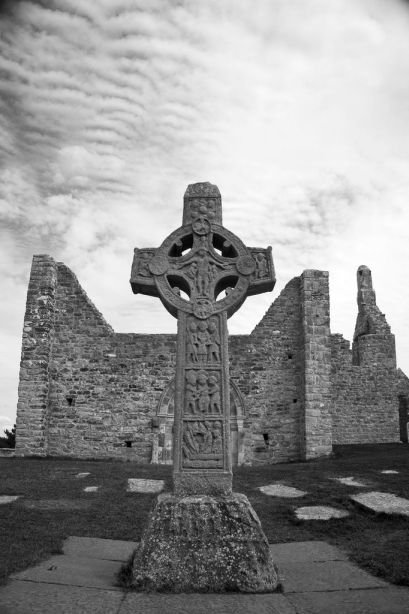
Before we begin its analysis, however, it is necessary to introduce the Celtic cross, which was presented to Ida Peerdeman. The Celtic cross is a characteristic form of a cross with a ring connecting its arms (Photo 1). Ida Peerdeman sees the inscription "IHS" at its center, a Greek monogram for the name of Jesus Christ.
The oldest examples of this type of cross are found primarily in Ireland and take the form of so-called high crosses—monumental, carved stone structures erected on monastic grounds. Early crosses were often richly decorated with bas-reliefs depicting biblical scenes and served both educational and symbolic purposes.
The meaning of the Celtic cross is not entirely clear and is subject to various interpretations, but the Message of the Lady of All Nations clarifies its true significance. This topic will be discussed in detail later in the text.
Now let's look at where the Celtic nations are located and what criteria determine their inclusion in the so-called "Six Celtic Nations." The modern Celtic nations include six areas, located primarily in the United Kingdom: Scotland, Wales, Cornwall, the Isle of Man, and Northern Ireland (part of Ireland), as well as areas outside the United Kingdom: the Republic of Ireland and Brittany (France) (Photo 2).
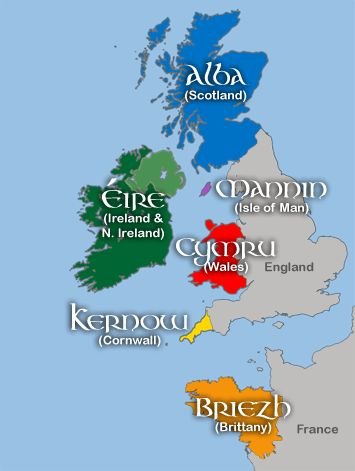
These regions lie in areas historically linked to Celtic culture, encompassing traditions, art, language, and customs derived from the Celtic peoples. Furthermore, a living tradition of Celtic language is preserved, used to varying degrees in each region. In practice, Ireland and Scotland—countries with exceptionally strong Celtic roots—still actively cultivate their Gaelic languages. Regions such as Cornwall and Brittany, where Celtic traditions and languages have been preserved primarily in culture and education, are also considered Celtic nations due to their historical, linguistic, and cultural heritage.
It is significant for our purposes that only four of the six regions of the "Six Celtic Nations" adopted Protestantism under the influence of the Church of England. These are the regions of the United Kingdom: Scotland, Wales, Cornwall, and the Isle of Man. The remaining two regions of the "Six Celtic Nations"—the Republic of Ireland and Brittany (France)—did not adopt Protestantism and remained predominantly Catholic. In the case of the Republic of Ireland, Catholicism was deeply ingrained in both culture and society, preventing the Anglican Reformation from gaining significant influence there. Similarly, Brittany, historically linked to France, retained its Catholic tradition despite the Reformation movements in Western Europe. As a result, Catholicism remained the dominant religion in these regions, contrasting with the four Celtic regions of the United Kingdom, where Protestantism—primarily Anglican—left a lasting mark on the religious and cultural fabric.
In the image of the Message, Ida Peerdeman first sees the number "4" with a circle around it. Then the image disappears, and a Celtic cross appears, also surrounded by a circle, with the monogram of Jesus Christ at its center. Ida Peerdeman is forced to take this cross in her hand and display it around her. Many people gather around her, but they do not look favorably upon this symbol. As mentioned earlier, the current of Protestantism has led to people turning away from the Catholic Church and from God. In many of these countries, society has become largely secularized. Throughout the United Kingdom, almost the entire population has lost faith in God.
The Celtic cross depicted in the Message is meant to draw our attention to the United Kingdom, where the numbers "4" and "0" have specific meanings, indicating both the area, the time, and the manner in which certain events will unfold. This is a prophecy in which the value of the numbers and their shape indicate the location, time, and nature of these events. We have already mentioned the location—the United Kingdom with its four Celtic regions.
Now let's move on to time. The number "4" enclosed in a circle represents 40. Adding 40 years to the year of the Message, 1947, gives us the year 1987. It turns out that 1987 brought a traumatic event to the United Kingdom, one that remains vivid in the collective memory to this day, and whose anniversary is commemorated each year. In October of that year, England was hit by a violent cyclone—known today as the "Great Storm of 1987." The element passed over the United Kingdom, encompassing the entire area—the "Six Celtic Nations" referred to in the Message of the Lady of All Nations. This corresponds to the image shown to Ida Peerdeman: a circle with the number "4" at its center (photo 3)(photo 4).
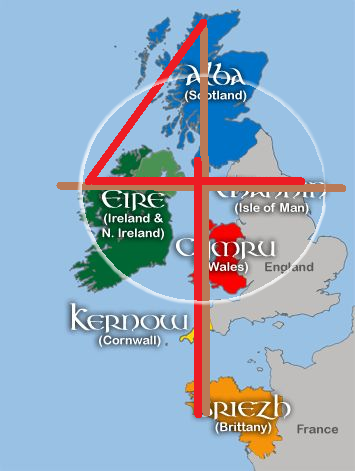
Photo 3 shows the United Kingdom, along with the Celtic regions discussed earlier. A red line bisects these areas, forming the shape of the number "4." Brown highlights a Celtic cross, whose arms intersect exactly where the Isle of Man is located. This is where the cemetery with the largest collection of early Christian Celtic crosses is located—which corresponds to the final image of the Message discussed, in which Ida Peerdeman sees a cemetery full of crosses.
In the 5th and 6th centuries, a monastery existed there, traditionally founded by a converted highwayman, St. Maughold, a disciple of St. Patrick. At the time, the Isle of Man was an important center for Celtic monks, who left behind a rich legacy of Christian symbolism, visible in numerous crosses and funerary steles.
White highlights a simplified outline of the cyclone that passed over these areas in 1987. Its trajectory creates a ring shape, corresponding to the circle characteristic of the Celtic cross.
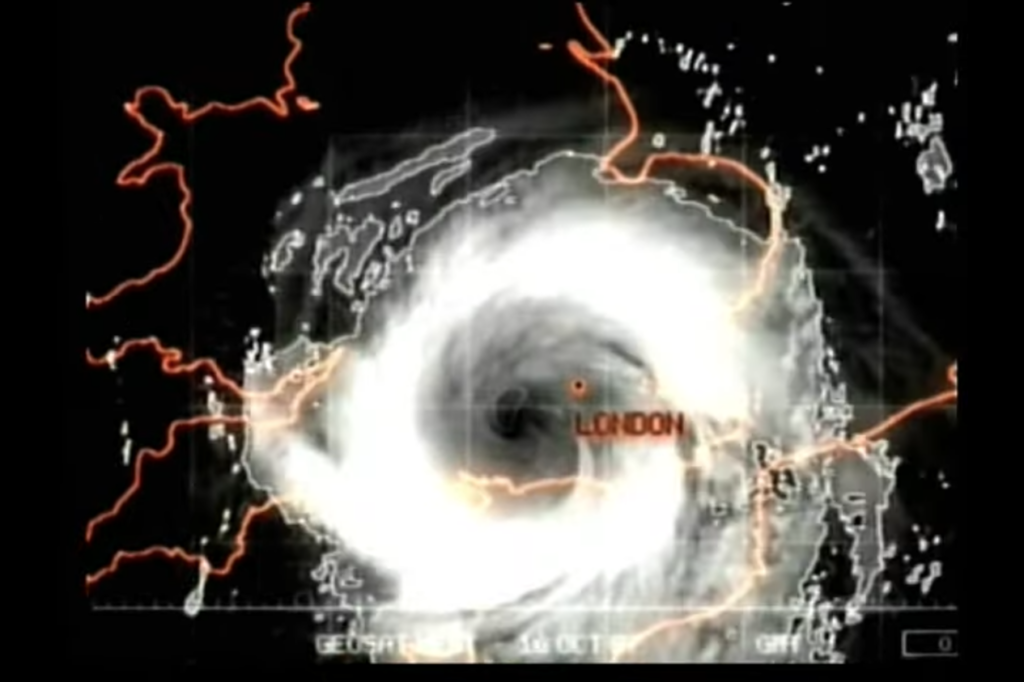
The "Great Storm," which hit the United Kingdom on the night of October 15-16, 1987, was an extratropical cyclone. With wind gusts reaching around 160 km/h (100 mph), it caused widespread destruction. It killed 18 people in the United Kingdom and four in France.
Approximately 15 million trees were downed, many of which fell onto roads and railway tracks, causing significant disruptions to transport. Others downed power and telephone lines, leaving thousands of homes without power for over 24 hours.
Numerous reports and videos documenting the scale of the destruction caused by this storm are available online. Interestingly, no one in England expected such a violent event. Weather forecasts preceding its arrival even suggested there was no cause for concern.
The event is still remembered to this day, and its anniversary is regularly cited in the media. The storm itself is considered one of the most devastating weather events to hit England in modern times.
Let us now turn to the Book of the Prophet Zechariah, because the image of the "Great Storm" is reflected there.
Zechariah 6:1-15
6:1. Then I lifted my eyes again and looked, and behold, four chariots were coming from between two mountains, and the mountains were bronze.
6:2. The first chariot was drawn by chestnut horses, the second chariot by black horses,
6:3. The third chariot by white horses, and the fourth by piebald, strong horses.
6:4. Then I asked the angel who spoke to me, saying, "What do these mean, my lord?"
6:5. And he answered me, "These are the four winds of heaven, which have come forth, presenting themselves before the Lord of all the earth.
6:6. The black horses will drive northward, followed by the white horses, and the piebald horses will drive southward ."
6:7. The strong horses were coming out, eager to run to circumambulate the earth . And he commanded, "Go forth and run around the earth!" And they ran to the ends of the earth.
6:8. He called to me, " Look at these running toward the north ; they will make my Spirit rest in the land of the north . "
6:9. The word of the LORD came to me:
6:10. "Gather [gifts] from the exiles, from Heldai, Tobiah, and Jedaiah, the exiles. Go today to the house of Josiah son of Zephaniah, where they have come from Babylon.
6:11 Take the silver and gold, make a crown, and put it on the head of Joshua son of Jehozadak, the high priest.
6:12 Say to him, 'Thus says the LORD of hosts: A man will come, and his name will be the Branch. He will grow in his place and build the house of the LORD.
6:13 He will build the house of the LORD and bear the banners of majesty. He will sit as ruler on his throne, and the priest will sit on his throne. Concord and unity will be between them both.'"
16:14 Let the crown be a memorial in the house of the LORD, a sign of favor for Heldai, Tobiah, Jedaiah, and the sons of Zephaniah.
6:15 And men from far places shall come and build the house of the LORD, and ye shall know that the LORD of hosts hath sent me to you. And this shall come to pass, if ye will diligently hearken unto the voice of the LORD your God.
Before we compare the vision described in the Book of Zechariah with the events that unfolded in the United Kingdom in 1987, it's worth first examining the colors of the horses featured in this prophecy. Unlike the previous vision, related to the first chapter of Zechariah, here we encounter four different colors, each carrying its own symbolic meaning.
In the original Hebrew text, these colors are as follows:
- סוּסִים אֲדֻמִּים – susim adummim
→ red horses (lit. red-reddish-brown) - סוּסִים שְׁחֹרִים – susim shechorim
→ black horses - סוּסִים לְבָנִים – susim levanim
→ white horses - סוּסִים בְּרֻדִּים אֲמֻצִּים – susim beruddim amutsim
→ spotted / speckled / spotted horses
In the Book of Zechariah (Zechariah 6:1–15), chariots drawn by horses of four different colors symbolize the four winds that God sends to circle the earth. This motif surprisingly alludes to the "Great Storm" of 1987, which—through its vast reach and cyclonic force—also seemed to "circle" the earth.
In Zechariah's prophecy, we read that white and black horses were sent to the land of the north. Their mission is to bring about the resting of the Spirit of the Lord in this land, where Joshua is to be crowned. It is worth recalling that the name Joshua, in its meaning, corresponds to the name Jesus, which gives this scene a messianic dimension.
In this light, we turn our attention once again to the Isle of Man—a place with a unique early Christian heritage. It turns out that there is an ancient cemetery there with numerous Celtic crosses and a monastery associated with the activities of the first monks. In the final part of this Message, Ida Peerdeman envisions a cemetery with a multitude of tombstones and crosses rising from the ground. This image particularly resonates with the cemetery on the Isle of Man. It is the coming of the Spirit, sent by God through the intercession of the Lady of All Nations, that is to resurrect the fallen bones, which in turn alludes to the prophecy in the Book of Ezekiel. This Spirit, sent by God through the Lady of All Nations, is Christ, for which we pray in the prayer of the Lady of All Nations. We will return to the motif directly related to the vision in the Book of Ezekiel and the prayer later.
Zec 6:8 He called to me, " Look at those who are running toward the north ; they will make my Spirit rest in the land of the north . "
When Ida Peerdeman sees the Celtic cross, at its center is the monogram of Jesus Christ—IHS. This indicates the presence of Christ at the very heart of this symbol.
We can thus see that the United Kingdom, along with the four Celtic lands—which historically separated from the Roman Church, adopting Protestantism—in light of the symbols and events discussed, appear as places called to return to God and Christ.
It is also worth noting that during the "Great Storm" of 1987, two powerful storms were heading towards the United Kingdom. One struck directly on the British Isles, while the other swept across continental Europe. This is reminiscent of the description in the Book of Zechariah, where the chariots separate: some head for the north to circle it, while others head south, traversing the remaining regions of the earth.
The prophet Zechariah (Zechariah 6:13–15) foretells the appearance of a man referred to as "the Branch." It is he who is to rebuild the Lord's temple and exercise royal authority, sitting on his throne. Next to him, a priest—Joshua—also appears, taking his place, and between them there is harmony and complete unanimity.
This prophecy can be read as a foreshadowing of the restoration of unity between the royal and priestly authorities: the king rebuilds the temple, and the priest serves God within it. This harmony is a picture of the order established by God, in which both orders—secular and spiritual—cooperate rather than conflict.
In this context, one can see the contrast with the historical events that led to the rupture of this unity—the decision of King Henry VIII of England in 1534, separating the English Church from communion with Rome.
However, we read further that the fulfillment of this prophecy is contingent on one condition: it will become a reality only when the land of the north listens to the Word of God. Obedience to His instructions becomes the key to restoring the unity and harmony revealed by the prophet.
In this light, the prophecy can be interpreted as a foreshadowing of future reconciliation between the See of Peter and the English monarchy. According to this symbolism, the restoration of unity can only occur if the United Kingdom turns to Christ through the intercession of the Lady of All Nations, upholding His covenant and guided by justice, righteousness, and love of neighbor.
Then I see heavy clouds gathering over Europe, and below, great waves washing it away. Now I see the Lady standing in a very bright and sharp light. She is dressed in white. Her arms are spread, and a thick beam of rays emerges from her hands. I have to hold my hand open, and it is as if this beam of rays were entering it. I feel it sting and sting. Then the Lady smiles at me, points to her hand, and nods. I don't know what this means. Now the Lady's face becomes very sad. She points to the heavy clouds and waves and says,
"They will have to pass through this flood first, and only then..."And
now I see these words written, and after the word "only" an ellipsis, as if something more were to be added, something that must remain hidden.
Then the Lady's face brightens, and I see water rising like steam. And it seems as if the sun briefly peers through it. The Lady points again to the earth, and I see that all the water has evaporated. And now I see human bones scattered on the ground: skulls, arm bones, and leg bones. It's a very terrible sight. I hear the Lady saying,
"This is a misfortune. Work, however, work, however..."
The Message of the Lady of All Nations reveals the future consequences of the "Great Storm" that would hit the United Kingdom in 1987, exactly forty years after the Message was delivered. Numerous documentary materials are available online demonstrating the extent of the devastation that occurred.
As the cyclone moved between the coasts of the United Kingdom and France, it appeared as if it were emerging from between two mountains, which can be compared to the description in Zechariah (Zechariah 6:1).
In biblical tradition, moments of revelation and God's speeches were often accompanied by storm-like phenomena—strong winds, lightning, and violent weather phenomena, which in Old Testament language were sometimes described as "winds," "whirlwinds," or violent storms. However, these phenomena are caused by the Cherubim, whereas God comes in a gentle breeze.
Contemporary accounts from 1987 indicate that tornadoes and intense lightning were also observed during the "Great Storm"—an extratropical cyclone—further emphasizing the dynamic and violent nature of the phenomenon.
A good example of such a biblical description is the prophet Ezekiel's vision:
Ez 1:4 "I looked, and behold, a mighty wind came from the north, a great cloud, and a burning fire, and out of the midst of it was shining something like the gleam of gold and silver, out of the midst of the fire."
The 1987 cyclone formed over the North Atlantic before striking Europe, which also coincides with the prophet Ezekiel's vision.
The Message of the Lady of All Nations features the motif of the flood, which directly alludes to the Book of Genesis and the description of God's punishment upon a world steeped in iniquity. In this sense, the imagery of the Message corresponds to a certain extent with the events described in Genesis, creating a symbolic reference to the "Great Storm" of 1987.
In Ida Peerdeman's vision, dark clouds, accompanied by winds and great waves, sweep over Europe. This image brings to mind the biblical description of the flood and its destructive power.
In the Book of Genesis, God, seeing Noah as the only righteous man, commands him to build an ark on which to take his family and representatives of all animal species. This makes it possible to save life and restore it after the floodwaters recede.
According to the biblical account, the flood lasts forty days, after which the waters gradually recede, and the ark rests on Mount Ararat, identified with the area of ancient Urartu (present-day eastern Turkey, Armenia, and northern Iran). In this context, it is worth recalling that Abraham, from whom the nation of Israel descends, was called by God to the land of Canaan from the regions of Mesopotamia, from Ur of the Chaldees.
A remarkable similarity can also be seen in the events that unfolded during the "Great Storm." Surviving documentary materials from that period depict a passenger ferry washed ashore, symbolically evoking the image of the flood and Noah's Ark (photo 5). Significantly, the vessel was devoid of both passengers and its captain.
Certain messages can be discerned in this event: first, by separating from the See of Peter, the United Kingdom, in a sense, distanced itself from the teachings of the Church, resulting in the ongoing process of secularization of society. In this view, the absence of Christ – understood as the New Noah – leaves the “ark” empty, devoid of those who could find salvation in it.
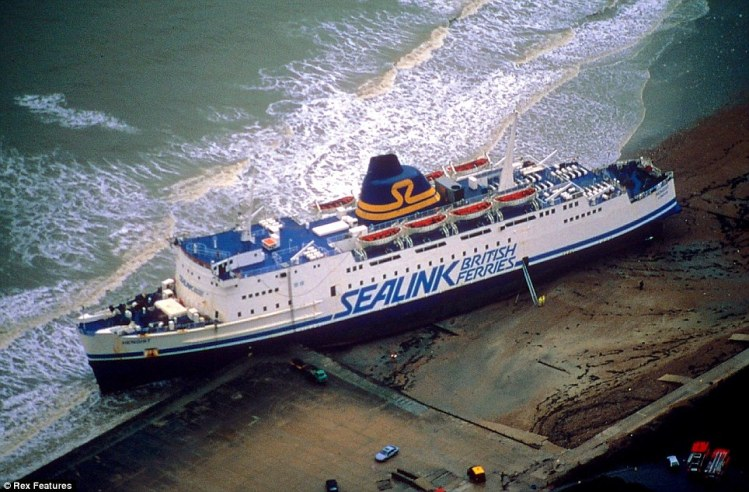
To understand the second message conveyed by the ferry beaching during the "Great Storm," a brief historical introduction is necessary. The ferry ran aground on the coast near the town of Folkestone.
It is worth noting that the name "Folkestone"—translated as "people's stone"—is associated with a figure of significant religious significance: St. Eanswythe. She was an Anglo-Saxon princess, granddaughter of King Ethelbert of Kent, who, according to tradition, was the first Anglo-Saxon ruler to convert to Christianity through the mission of St. Augustine of Canterbury.
Around 630, St. Eanswythe founded the first nunnery in England in Folkestone. To this day, the town houses a church dedicated to St. Mary and St. Eanswythe, now belonging to the Church of England—and therefore no longer practices Catholic Marian devotion there.
In 1885, during conservation work, a small niche was discovered behind the altar, containing the bones of a young woman from the 7th century. In 2020, detailed anthropological analysis confirmed that the remains belonged to a woman from the Anglo-Saxon elite, living at the time of St. Eanswythe's death.
This discovery is now considered one of the oldest confirmed Christian relics in England.
The message of the ferry beaching near Folkestone can be interpreted in light of the tradition associated with the Church of St. Mary and St. Eanswythe. In this symbolic representation, St. Mary is the Ark of salvation, while St. Eanswythe appears as the chosen and righteous one, similar to Noah during the biblical flood.
The Church of England, which, after converting to Protestantism, does not recognize Mary's role in God's plan of salvation, has retained the church's original name, but devotion to Mary is not celebrated there. From the perspective of the Ark, which is the Lady of All Nations, this is a great spiritual loss affecting the entire society of the United Kingdom.
The Protestant refusal to recognize Mary—the Ark of Salvation—in God's plan of salvation deprives the faithful of a refuge from all the turmoil taking place in the world. Against this backdrop, the event of the beaching of the empty ferry becomes significant.
In this way, this event can be seen as a call to Anglicans to once again turn to Mary, whose role in salvation history is preserved and emphasized in the tradition of the Catholic Church.
In the Message of the Lady of All Nations, we see a powerful beam of rays emanating from her hands, which has a double meaning. To understand this image, a brief introduction is necessary. In the Old Testament, God revealed himself to the Israelites in a cloud. Over time, this cloud became a symbol of the Tent of Meeting—God's first earthly Temple.
The Tent of Meeting of God was divided into two parts: the Most Holy, which housed the Ark of the Covenant, God's earthly throne, and the Holy, where liturgical objects were placed, including the Menorah, symbolically alluding to the seven colors of God's arc—the rainbow.
When God, residing in the Most Holy Place, "unfolded" the curtains of the Tent like clouds, a sign appeared before His eyes—the seven-branched Menorah. Mosaic Law commanded that its flames never be extinguished, which also had a practical dimension: the Menorah's eternally burning light was meant to protect the world from a new flood if God came to His temple unannounced.
One of Christ's parables about the wise and foolish virgins alludes to this symbolism. The wise women always kept their lamps burning; thus, when the Bridegroom arrived unexpectedly, they could enter the Kingdom of Heaven. The foolish women, whose flames remained unlit, suffered a fate similar to those who perished in the flood of Noah's day.
In turn, the bow of God itself refers to values such as righteousness, justice, and love of neighbor, which make people holy. Anyone who carries these values in their heart—values to which Christ leads—becomes a bow of God.
Let us now move on to the vision of Ida Peerdeman. The Lady of All Nations appears dressed in white, and rays of light radiate from her hands. This image shows her as the Temple of God—the Cloud and Tent of His presence. When God, residing in His Temple, "unfolds the cloud," he sees a beam of light reaching out into the world—as from a Menorah—flowing onto Ida Peerdeman's hand, which becomes the arm of the Lady of All Nations on earth.
When we look at the image of the Lady of All Nations, we see an inscription in the form of an arch stretching above her figure: "Lady of All Nations." Ida Peerdeman's task, as Her "arm," is to make this sign visible and present among people. According to the message, this is the last chance for salvation for a fallen world increasingly plunged into chaos—to avoid a fate similar to the times of Noah, when the waters of the Flood cleansed the earth of all wickedness.
These times are evoked by the image of the Message, during which Ida Peerdeman sees waves washing over Europe, preceded by approaching dark clouds and a violent storm. It is a warning: the world is once again approaching a threshold beyond which only catastrophe will be able to purify it—unless God recognizes Mary on earth as the Lady and Mother of all nations. God offers humanity a chance to convert from the path of sin through the intercession of the Lady of All Nations, who leads people to her Son, Jesus Christ, and He to God, purifying human hearts so that righteousness, justice, and love of neighbor can reign on earth.
The ray emerging from the hands of the Lady of All Nations should also be interpreted as a ray of sunshine breaking through the clouds during the "Great Storm." It heralds the end of the storm, which, if it had lasted forty days, as it did during the flood, would have claimed many more lives. It is the Lady of All Nations who ensures that all catastrophes and wars can be stopped if one trusts in Her and allows oneself to be led to Christ. It is important to note here that each nation corresponds to the "world" of the flood. This catastrophe can therefore befall individual countries as well as the entire world. We then speak of the foolish and wise virgins. Those nations that kept the flame are like the wise virgins, while those that did not keep the flame are like the foolish ones. The great storm of 1987 presents the United Kingdom as the first place where the flood could occur, because this country, as a Protestant country, does not recognize Mary in God's plan of salvation, and by not recognizing her, it denies itself a place of salvation. The Lady of All Nations was sent to us by the Father and the Son as the one through whom Christ is to come again to the United Kingdom and to the whole world that has denied Him.
The "Great Storm" is interrupted thanks to the Lady of All Nations, through whom God sends the Holy Spirit to humanity. It is this work of the Spirit—meant to guide humanity toward discernment of good and evil—that sanctifies people and becomes their protection against wars, moral decline, and all kinds of catastrophes, including those foretold by Ida Peerdeman in the Message. However, not everyone listens to the voice of the Holy Spirit; those who reject His Word will have to endure the foretold suffering. This is foretold by the mysterious words of the Lady of All Nations: "They will first have to pass through this flood, and only then..."In
the image shown to Ida, immediately after these words, a vision alluding to the biblical flood appears: the waters recede and evaporate, and on the exposed earth, the bones of people swallowed by the element are visible. This scene corresponds to the prophecy from the Book of Ezekiel, in which God instructs the prophet to speak to the dry bones of the Israelites, asking them to breathe into them the Spirit coming from God and resurrect them.
The final image of the Message—a field full of fallen crosses and graves, from which new, white crosses begin to grow—also refers directly to the resurrection of the soul after death. This motif will be discussed in greater detail in an analysis of the symbolism of "crosses growing from the earth," which foreshadow renewal and the return of life through the power of the Holy Spirit.
It is worth emphasizing here that in Sacred Scripture, bones have symbolic meaning and refer to the human soul. It was from Adam's symbolic rib—understood as his spiritual essence—that God formed Eve.
The final words of the Lady of All Nations: "This is a calamity. Work, however, work, however..." clearly indicate that neither the flood nor other catastrophes, wars, or collapses need come if man trusts the Lady of All Nations and allows himself to be led by Her Son—He who has the power to raise the dead. Moreover, these words emphasize the importance of human actions: observance of law, justice, and love of neighbor—values to which Christ leads, and which open man to the blessing sent by the Lady of All Nations.
This is an echo of the Old Testament covenant made at the foot of Mount Gerizim and Mount Ebal, which proclaims that for good, the earth becomes a blessing for man, and for evil, a curse. In light of this, we see that the great storm depicted in the vision is precisely such a curse, resulting from the breaking of the Covenant with God.
Then the Lady points upward and says,
"Read!"I
see letters appear and read: RIGHTEOUSNESS. Then I feel an incredible pain in my hand, which becomes as heavy as lead. Then I hear the Lady say,
"Come, read on!"And
I see the words written in large letters: LOVE OF NEIGHBOR. Above them appear icicles, hanging and dripping. Then I hear a Voice saying,
"Read on!"But
when I want to read, I am unable to do so because of the flames that appear around the letters. For a moment, the flames subside, and I read: RIGHTEOUSNESS.
The meaning of the Celtic cross remains the subject of numerous interpretations to this day. In the Christian tradition, it is most often interpreted as a symbol of the connection between heaven and earth, the fullness of salvation, or the permanence of faith. Meanwhile, in contemporary spiritual trends, drawing on ancient Celtic beliefs, this symbol is sometimes perceived as an image of the unity of nature and the four elements. Significantly, this very interpretation corresponds to the content of the Message of the Lady of All Nations.
In the above image of the Message, the inscription "Righteousness" appears, and after reading it, Ida feels pain in her hand; her hand becomes as heavy as lead. This is a clear reference to the element of earth. Then Ida sees the words "Love of neighbor," and above them appears a dripping icicle—a symbol associated with the element of water. The next inscription, "Justice," is surrounded by flames, clearly indicating the element of fire.
Since three elements—earth, water, and fire—already appear in the Message, there remains a fourth: wind, which is particularly evident during the "Great Storm" that swept over the United Kingdom. It is significant that the year 1987, the year of this violent cyclone, brought first one of the harshest winters on record, followed by an exceptionally hot summer. During the storm itself, the element of wind caused enormous destruction—it is estimated that some 15 million trees were downed in the United Kingdom.
Thus, all four elements—earth, water, fire, and wind—made their presence felt in the British Isles exactly forty years after the Message of the Lady of All Nations was delivered. In light of these events, the Message appears clearly prophetic.
Let us therefore summarize the symbolism of the four elements in the Message of the Lady of All Nations and in the light of God's covenant, the breaking of which makes the earth cursed to man.
• For lack of righteousness, Ida's hand becomes heavy as lead, indicating the punishment associated with the element of earth.
• For lack of love for one's neighbor, the element of water appears over the world.
• For lack of justice, the element of fire afflicts it.
• For turning away from God, the element of wind falls, symbolized by the catastrophic storm experienced by Protestant England. From the Old Testament perspective, the four elements refer to the biblical horsemen who are to bring punishment to the world for its iniquity.
Then the Lady points to something, and I see a soldiers' cemetery with endless rows of white crosses. I see them fall, one by one. They all fall backward. Now the Lady points to it all again, and I see new white crosses appear. As far as I can see, they rise from the earth. Then I hear the Lady say,
"This is the message I bring today.
Then I see the Lady slowly withdraw from the light. I feel a great emptiness around me, and it seems as if everything on earth has become gloomy.
The above fragment of the Message alludes to a vision from the Book of the Prophet Ezekiel, in which the prophet is confronted with a valley full of dry bones—the bones of the children of Israel, lying forgotten, bereft of hope and life. God commands Ezekiel to prophesy over these bones, announcing that he will breathe his Spirit into them and call them to life anew as a great, revitalized army.
Similar symbolism appears in Ida Peerdeman's image of the Message: we see a vast military cemetery with a row of white crosses. At a certain point, the crosses begin to fall to the ground, after which the scene changes—and new white crosses emerge from the ground. The falling crosses represent people who died without inner transformation, rejecting righteousness, justice, and love of neighbor, remaining bound by the bonds of carnal sin. The fallen white crosses thus become a symbolic equivalent of the bones from Ezekiel's vision.
However, the Scriptures foretell that all people will rise at the Last Judgment (Mt 25:31–46): some to the glory of God, others to damnation. Some will enter the Temple of the Kingdom of Heaven, while others—for their own sins—will only be able to guard its gates like an army, but not enter its interior (Ezek 44:11–14).
Ezekiel 37:1-14
37:1 Then the hand of the LORD came upon me, and he brought me out in the spirit and set me down in the midst of the valley. It was full of bones.
37:2 Then he commanded me to pass through them, and behold, there were many bones in the midst of the valley, very dry.
37:3 Then he said to me, "Son of man, can these bones live again?" I said, "O Lord God, you know."
37:4 Then he said to me, "Prophesy concerning these bones and say to them, 'O dry bones, hear the word of the LORD!'"
37:5Thus says the LORD God: Behold, I put spirit in you, and you shall live.
37:6 I will put sinews on you, and cause flesh to grow upon you, and clothe you with skin, and put spirit in you, that you may live, and know that I am the Lord."
37:7 And I prophesied as I was commanded. And as I prophesied, behold, there was a noise and a cracking sound, and the bones came together.
37:8 And I looked, and behold, the sinews returned, and flesh came forth, and skin covered them, but as yet there was no spirit in them.
37:9 And he said to me, "Prophesy to the spirit, prophesy, O son of man, and say to the spirit: Thus says the Lord God: Come from the four winds, O spirit, and blow upon these slain, that they may live."
37:10Then I prophesied as he commanded me, and the spirit entered them, and they lived and stood on their feet— a very, very great army.
37:11 And he said to me, "Son of man, these are the bones of the whole house of Israel. Behold, they say, 'Our bones are dry; our hope is gone; we are finished.'
37:12 Therefore prophesy and say to them, Thus says the Lord God: Behold, I will open your graves, and raise you from your graves, O my people, and bring you into the land of Israel,
37:13 And you shall know that I am the Lord when I open your graves and raise you from your graves, O my people.
37:14 And I will put my spirit in you, and you shall live, and I will bring you into your own land. Then you shall know that I the Lord have spoken it and performed it, declares the Lord God.
Ezekiel's prophecy about the valley of dry bones is linked to the prayer that the Lady of All Nations gave to Ida Peerdeman. Everyone who recites this prayer participates in prophetic action—much like the Prophet Ezekiel. In this prayer, we ask that the Spirit of Jesus Christ descend upon the earth and that the Holy Spirit dwell in the hearts of all nations, transforming and spiritually resurrecting them while still alive.
A change of heart brings God's blessing, while breaking the covenant with God brings wars, disasters, and downfalls upon people. Sanctification is not an instantaneous act, but a process: by submitting to God's Will and working on oneself, one gradually achieves a state of sanctification consistent with God's plan.
"Lord Jesus Christ,
Son of the Father,
send now Your Spirit upon the earth.
Grant that the Holy Spirit
may dwell in the hearts of all nations
and protect them from decline, disaster, and war.
May the Lady of All Nations,
who was once Mary,
become our Advocate.
Amen."
The theme of Ezekiel's prophecy is linked to events that occurred in the Gospel of Christ. It speaks of the power of the Holy Spirit, through which Christ healed the sick, raising them to life. When we read Ezekiel's prophecy about the bones, they are compared to the entire house of Israel, both the living and the dead, as the Israelites themselves compared themselves to dry bones.
Ezek 37:11 And he said to me, "Son of man, these are the bones of the whole house of Israel. Behold, they say, 'Our bones are dried up, our hope is gone, it is over for us.'
The Gospels contain many descriptions of people who have lost all hope for a normal life. Were it not for the coming of Christ—who, by the power of God's Spirit, healed and thus, in a sense, resurrected both spiritually and physically—many of them would have died in despair, bereft of any hope. Let's examine one such event.
One of the pericopes features a woman who had been suffering from a hemorrhage for twelve years. She had spent all her wealth on doctors, but no one could help her; she was utterly helpless. Yet, filled with inner faith, she approached Jesus from behind and touched his cloak—and in that very moment, she was healed by the power that emanated from Christ.
In her hopeless situation, this woman resembles the Israelites in Ezekiel's prophecy, who say of themselves: "Our bones are dried up, our hope is gone." Her condition was so dramatic that it was as if she had been in the grave while still alive, from which Christ had brought her to new life.
The healing she experienced becomes a kind of fulfillment of the prophecy from the Book of Ezekiel, which says that God will breathe his Spirit into the dry bones, resurrecting them to new life.
Mk 5:25-34
5:25 Now a certain woman had been suffering from a hemorrhage for twelve years. She had suffered greatly under the care of many physicians
, 5:26 and had spent all she had, and nothing helped her; instead, she grew worse.
5:27 She had heard about Jesus, so she came up behind him in the crowd and touched his cloak.
5:28 For she was saying, "If only I could touch his cloak, I will be well."
5:29 Immediately her hemorrhage stopped, and she felt in her body that her disease was healed.
5:30 Immediately Jesus realized that power had gone from him. He turned around in the crowd and asked, "Who touched my cloak?"
5:31 The disciples answered him, "You see the crowd pressing in on you, and you ask, 'Who touched me?'"
5:32 But he looked around to see who had done this.
5:33 Then the woman came, fearful and trembling, knowing what had happened to her, and she fell down before Him and told Him the whole truth.
5:34 And He said to her, "Daughter, your faith has saved you. Go in peace and be healed of your infirmity."
Another example referring to the prophecy from the Book of Ezekiel about the valley of dry bones is the healing of the paralytic who was brought to Jesus. It was to him that Christ commanded, "Arise, take up your bed, and walk!"—restoring him to full strength and, as it were, "resurrecting" his bones to life.
In Holy Scripture, we also find examples of resurrections in the full sense of the word, such as the incident with Lazarus, whom Jesus brought out of the tomb after four days. His body was already in a state of decay, as reflected in Martha's words: "Lord, already he stinks." In this case, resurrection signified not only a return to life but also a miraculous restoration of the body—exactly as in Ezekiel's vision, where sinews and flesh began to grow on the bones.
We see, therefore, that all the healings and resurrections performed by Christ can be understood as fulfilling the prophecy of the prophet Ezekiel. God promised to send His Spirit to breathe life into dry bones—and this promise is fulfilled in the Person of Jesus.