
Apparitions of Our Lady in Ngome


Sister Reinolda's encounters with Our Lady are among the most emotional apparitions that have occurred in the world. The apparitions in Ngome demonstrate that the path to knowledge of God is intertwined with science and the development of human civilization. Without scientific advancements, which have enabled humanity to create modern technologies, we would not be able to fully understand the message conveyed by Our Lady of Ngome's apparitions. Even before the creation of man, God left certain signs on earth, understanding of which will become possible as humanity develops, both spiritually and technologically. Human development encompasses not only the distinction between good and evil but also an increase in knowledge of the world around us. The apparitions of Our Lady of Ngome are closely linked to Holy Scripture, and to fully understand their message, in addition to technology, we will also need verses from the Book of Genesis.
Note that the apparitions are sparse in their narrative. This indicates that these apparitions are based primarily on images and symbols, similar to the apparitions of Our Lady in Pontmain. It is worth beginning by introducing Sister Reinolda and describing the details of all ten encounters with Our Lady. It is important to emphasize that the apparitions, with the exception of the tenth, took place in Nongome, while the site indicated by Our Lady for the construction of the chapel is in the village of Ngome. Hence, these apparitions are commonly referred to as the Apparitions of Our Lady in Ngome.
Between 1955 and 1971, Our Lady appeared ten times to Sister Reinolda May, giving her short messages that were more symbolic in nature, based on gestures and images. Franciszka, who took the name Reinolda in her order, was born on October 21, 1901, in Bavaria, Germany. She was the youngest of nine siblings. Her parents were devout and passed on their faith to their children, which was deepened by the care of the local parish priest, who was devoted to God. From a young age, Franciszka showed an interest in missions, which led her to join the Benedictine Missionaries of Tutzing. Her first attempt to join the order ended in failure, as she was told she was not healthy enough to embark on the demanding missions. However, Franciszka persevered and, after another attempt, was accepted into the congregation on March 1, 1922.
As Sister Reinolda, she was assigned to missionary work in Zululand, South Africa. The Benedictine sisters' missionary work included working in the local school and hospital. All sisters were also trained in midwifery. After the construction of the hospital in Nongome, Sister Reinolda was appointed head of the maternity ward, and the Catholic missionary station where she worked was dedicated to Christ the King. Sister Reinolda assisted with over ten thousand births. Thanks to her hard work and generous heart, she gained the trust of the local Zulus. Besides her work in the maternity ward, she always preached Jesus, setting a good example of life that allowed people to see her as the true God.
Let us now move on to describing her encounters with Our Lady. Below are ten accounts of these encounters, written by Sister Reinolda.
My first encounter with Our Lady was on August 22, 1955.
In the hospital chapel, shortly after receiving Holy Communion, Mary stood before me, very close. (Everything was seen in spirit.) I was drawn into another reality. Mary appeared in a miraculous light, more beautiful than the sun. She was dressed entirely in white, with a flowing veil from head to toe. A large Host rested on her breast, surrounded by a shimmering crown, radiating life. She was the "Living Monstrance." Mary stood on the globe, her hands and feet invisible. I felt as if I were entering a cloud that Mary had drawn from the earth. Even though my eyes were closed, I saw so much light that I was blinded for several days by the beauty and light I saw. Mary said, "Call me the Tabernacle of the Most High. You too are such a tabernacle, believe it! I desire to be called by this title for the glory of my Son. I desire that more such tabernacles be prepared. I desire that the altars be surrounded more often by praying people. Don't be afraid, let them know." Sister Reinolda: "To whom?" Our Lady: "Don't be afraid, tell your priest."
Some publications describing Sister Reinolda's first encounter with Our Lady contain discrepancies regarding prayer at the altar. In our version, Our Lady expresses a desire for "altars to be more frequently surrounded by praying people" (Fr. Michael Mayer, OSB, Inkamana , 2007), while other accounts state that Our Lady desires "more people to kneel before altars in churches."
If we examine the context of the apparition, which focuses primarily on the Monstrance and the Host, it is more likely that the words "kneeled before the altars" were meant. During the exposition of the Monstrance, the faithful kneel before the altar on which it is displayed.

The second and third encounters with Our Lady
took place on October 20, 1955, and October 22, 1955. This happened immediately after Holy Mass. It was the same person, the same place. The same requests were repeated, but with the addition: "Say these words to everyone. Do not be afraid, you are an instrument of God." Then Christ emerged from that great Host and was in unity with me.
My fourth encounter with Our Lady on March 15, 1956.
After Holy Mass, Mary stood before me solemnly. She said, "My child, I know your anxiety. (She leaned down and drew me to herself.) "Did you ask for a sign?" Sister Reinolda: "Not for me, for others to believe; they don't believe me." Our Lady: "I would like a Chapel to be built for Me at the confluence of seven streams. There I will allow My graces to flow abundantly. Many people will turn to God." When I asked where this place was, she made a silent movement with her hand. With her left hand, she majestically pointed upwards in a certain direction. This gave me great joy and made me feel more confident. "Don't be afraid, let me know; this is My work. We will see each other again."
My fifth encounter with Our Lady was on June 5, 1956,
the Feast of the Sacred Heart, during a blessing. She emerged from the Monstrance and approached me as the "Living Monstrance."
Sixth meeting with Our Lady on March 15, 1957.
"I come to strengthen you. I take advantage of your nothingness. Be completely humble." In silence, she drew me to herself and said, "I want to save the world through the Host, My Fruit. I am completely one with the Host, just as I was one with Jesus under the cross. Terrible things await you if you do not convert." Sister Reinolda: "We?" Our Lady: "Yes, if religious people do not convert and the world does not convert." "Mother, just give me a sign!" "Be full of love and willingness. All people who hear and believe in My Words will receive a sign from Me. Make all these Words known!"
Seventh meeting with Our Lady on May 24, 1957.
The following words were clearly heard: "Do not lose heart."
On this day, Sister Reinolda received a personal message from Our Lady, which has not been revealed.
Eighth meeting with Our Lady on April 17, 1958.
"Return to your place. (Do your part). Hurry, time is running out. I must forcibly hold back the streams of graces because you are not making an effort to help Me. I am asking you, My chosen ones, for help." Sister Reinold: "Who are we to be?" Our Lady: "Be hosts! Prepare hosts for Me that will place themselves completely at My disposal. Only a burning sea of hosts can drive out hatred from the godless world and stay the angry hand of the Father. Do not lose heart. I find comfort in being able to appear to you. I will never abandon you." Sister Reinold: "Where is this place of streams?" Our Lady: "In your mansion on the mountain." With a gesture of her hand, she pointed a second time in the same direction! "Do not be afraid, hurry to announce this."
The ninth encounter with Our Lady on March 23, 1970.
It was the second night that this terrible devil appeared. I was awakened from my sleep. There was light around me. Mary, the Tabernacle of the Most High, stood beside me. She took me in her arms and comforted me. She said, "I know your fear, I am with you, I will not abandon you." Before she disappeared, she said, "Look the other way." There stood Michael in armor, holding a spear. To his right stood a Cherubim dressed in white with his arms crossed. After about two minutes, they disappeared, and with them a bright light. This was a great comfort to me.
The tenth encounter with Our Lady was on May 2, 1971,
in the chapel in Ngome. Shortly before leaving, I went back to the chapel with a small group of women. A catechumen was complaining loudly that she had a problem, that she wanted to believe. One of her neighbors challenged her, and they had an argument. I prayed aloud with the woman and asked Mary to help her and convert this troublemaker. Suddenly, I noticed that the image was very vivid. [Mary] stepped forward, and her face was extraordinarily beautiful. In my excitement, I shouted, "Look at Mary!" I am convinced that these women also saw Mary. Personally, I was so moved that I left in silence. The same troublesome man asked the priest for forgiveness, and from then on, peace reigned."
Place of Apparitions
We are now entering an incredibly emotional moment that will surely inspire profound reflection. Places where Our Lady appeared always speak to us in biblical language – full of symbolism and spiritual meaning. This is no exception in the case of Ngome, a small village that has become an image of the biblical events described in the Book of Genesis.
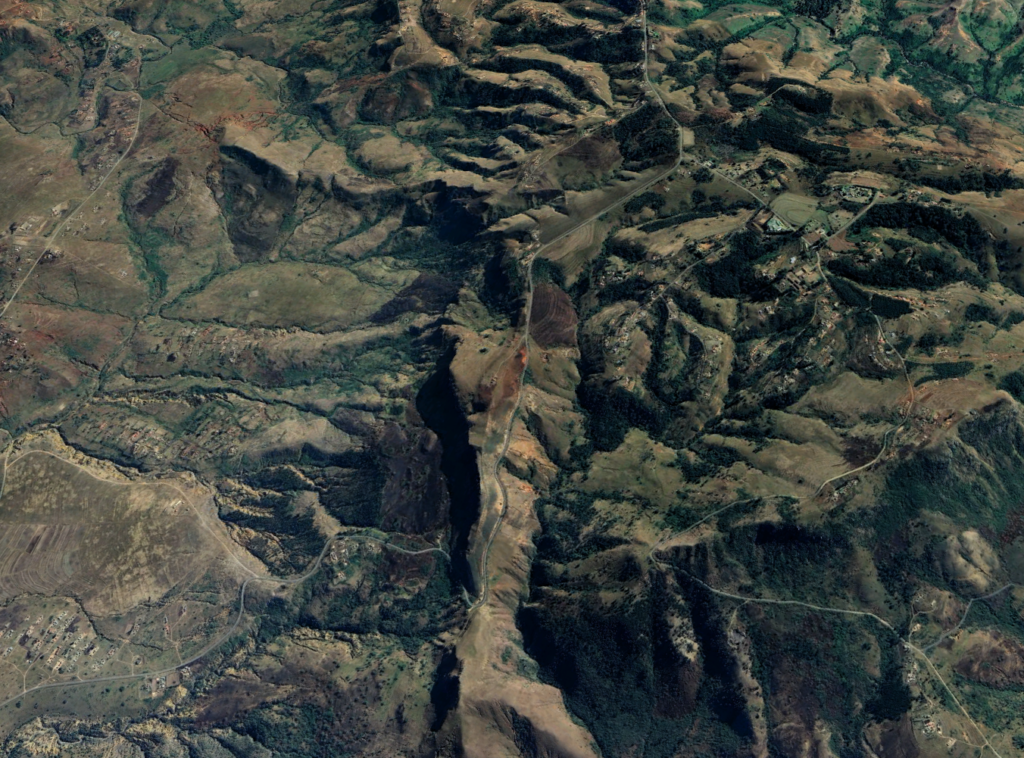
Let's now take a look at the satellite image in the headline, which shows Ngome. At first glance, if you're unfamiliar with the history of Our Lady's apparitions, it's difficult to see anything extraordinary. However, upon closer examination, it becomes clear that the area surrounding the village resembles a bas-relief, the details of which are astonishing.
In the following steps, we will discuss each element of the bas-relief separately. Before we move on to a detailed analysis of the image in the photo, it's worth citing passages from the Book of Genesis that directly refer to the biblical image depicted in this extraordinary bas-relief.
Genesis 2:8-10
- 2,8. The LORD God planted a garden in Eden, in the east, and there he placed the man whom he had formed.
- 2,9. And out of the ground the LORD God caused to grow every tree that is pleasant to look upon and good for food, and the tree of life in the midst of the garden, and the tree of knowledge of good and evil.
- 2,10. A river flowed out of Eden to water the garden, and there it divided into four branches.
- Gen 2:15-17
- 2,15. Then the LORD God took the man and put him in the garden of Eden to work it and keep it.
- 2,16. And the LORD God commanded the man, saying, "You are free to eat from every tree in the garden,
- 2,17. but from the tree of the knowledge of good and evil, you shall not eat of it, for when you eat of it you will surely die!”
- Genesis 3:1-14
- 3,1. Now the serpent was more crafty than all the wild animals that the LORD God had made. He said to the woman, "Has God said, 'You shall not eat from any tree in the garden'?"
- 3,2. The woman answered the serpent, "We may eat of the fruit of the trees in the garden,
- 3,3. but of the fruit of the tree which is in the midst of the garden, God said, "You shall not eat of it, nor touch it, lest you die."
- 3,4. Then the serpent said to the woman, “You will not surely die!
- 3,5. But God knows that in the day you eat of it your eyes will be opened, and you will be like God, knowing good and evil.”
- 3,6. And when the woman saw that the fruit of the tree was good for food and pleasant to the eyes, and that the tree was a source of knowledge, she took of its fruit and ate, and gave also to her husband who was with her, and he ate.
- 3,7. Then the eyes of both of them were opened, and they knew that they were naked. So they sewed fig leaves together and made themselves aprons.
- 3,8. When they heard the voice of the LORD God walking in the garden in the cool of the day, the man and his wife hid themselves from the presence of the LORD God among the trees of the garden.
- 3,9. And the LORD God called to the man, saying to him, “Where are you?”
- 3,10He replied, "I heard your voice in the garden, and I was afraid because I was naked, so I hid myself."
- 3,11. He said, "Who told you that you were naked? Have you eaten from the tree of which I commanded you not to eat?"
- 3,12. The man replied, "The woman you gave me, she gave me some of the tree, and I ate it."
- 3,13. And the LORD God said to the woman, “Why did you do this?” The woman replied, “The serpent deceived me, and I ate it.”
- 3,14. Then the LORD God said to the serpent, “Because you have done this, cursed are you above all livestock and above all wild animals; on your belly you will go, and dust you will eat all the days of your life.
Satan on the horned beast.
A closer look at the satellite image on the right reveals a distinct shape resembling a horned beast, likely representing a demon or dragon mounted by a gnome-like figure. Below the horns, the beast's skull, seen in profile, is clearly visible. Additionally, its right leg, tipped with a hoof, can be seen. The left side of the beast's head appears crushed. Interestingly, above the fractured skull is the shrine of Our Lady of Ngome, giving the impression that Our Lady is crushing the beast's head with her foot. The image of the beast, carved into the rock, has both distinct outlines and shadows, resembling a bas-relief.

Tree of Life
In the satellite image, we see a structure resembling a green tree. The Chapel of Our Lady in Ngome is located within this tree, as if Our Lady had appeared within it, which is consistent with many other apparitions in which Our Lady appears in trees. However, it is worth noting that during apparitions, Our Lady usually appears on thorny bushes, which alludes to the parable of Jotham, in which the thorn bush dominates other trees. In reality, the thorn bush symbolizes the Cherubim that God placed on the path to the Tree of Life to prevent any unauthorized person from plucking the Fruit of Life.
During the sixth meeting with Sister Reinolda, Our Lady states that she wants to save the world through the Host, which is her Fruit. Because this Fruit is Jesus, Our Lady becomes the Tree of Life. Symbolically, the Tree of Life represents the Monstrance, which, like Our Lady, carries within itself the Body of Jesus. In the following words, Our Lady speaks of conversion, which should encompass both religious people and people around the world. If this conversion does not occur, disaster awaits us. Looking closely at the bas-relief, we see a terrifying, horned creature, likely symbolizing hell and associated with upcoming events. It is worth noting, however, that conversion is not only for laypeople but also for believers, because true conversion means abandoning the path of sin.

The words of Our Lady are consistent with the image of the bas-relief from the satellite image. Our Lady appears to us as the Tree of Life, offering us Her Fruit, through which we can achieve salvation and avoid the terrible consequences of eternal damnation. To receive eternal life, it is not enough to simply partake of the Fruit of Life – the Eucharist – but we must first learn to choose good over evil. The Church and Christ's sacraments provide assistance on this path. The bas-relief can be viewed in two ways. In the first case, the green area resembling a tree symbolizes the Tree of Life, which grows on the ground, which is also the altar. The monstrance, at the center of which is the Body of Christ, also rests on the altar. The Mother of God, appearing on the ground, is a symbol of both the monstrance and the Tree of Life.
When we look closely at the bas-relief, we see that in the center of the green tree there is a lake that resembles the shape of a human body (see the photo opposite), which confirms that the shape resembling a green tree refers to both the Monstrance with the Body of Christ and the Tree of Life.
Gen 2:9 And out of the ground the LORD God caused to grow every tree that is pleasant to look upon, and good for food; also the tree of life in the midst of the garden, and the tree of knowledge of good and evil.

On the other hand, we can view the tree-shaped area from the perspective of Paradise. The distinct green border, resembling a tree, forms part of the Ngome Forest Reserve, home to lush, beautiful vegetation. Many plant and animal species inhabiting this reserve, due to their uniqueness and the fact that they occur nowhere else in the world, are threatened with extinction – for them, the reserve is like Noah's Ark. At the very center of this "tree" lies a lake that irrigates the vegetation growing there. If we examine the lake, we notice that it branches into branches, a fact confirmed by the text of Holy Scripture.
Gen 2:10 A river flowed out of Eden to water the garden, and there it divided into four branches.
The tree in the relief is green, as if alive, while beyond its borders stretches barren earth. It is worth returning for a moment to the Body of Christ, which is the Temple of God. His Blood symbolizes the Holy Spirit, who gives life. In turn, the water in the lake, taking the form of a body, symbolizes the Body of Christ. Thus, the fish that inhabit this lake represent the Spirit of God. When Jesus multiplies the bread and fish in the desert, the bread represents His Body, and the fish represent the Holy Spirit. The apparitions of Our Lady allow us to better understand certain aspects of biblical symbolism that were previously incompletely understood.
During Sister Reinolda's fourth meeting with Our Lady, a sign was discussed that would help everyone believe in the Apparitions. Sister Reinolda prayed for this sign in spirit. It was believed that this sign would be the construction of a Chapel, which was to be built at the confluence of seven streams. However, from the perspective of this apparition, it was not only about the Chapel itself, but also about the entire area in which it was located. The Chapel is one element of this sign. It was built on the outskirts of the "green tree," on a mountain from which seven springs flow. Symbolically, it stands on the border of Paradise, as if it were the entrance to it. Twelve gates led to the Temple in Jerusalem, symbolizing the twelve tribes of Israel. In our case, the seven springs represent seven gates and seven churches. Paradise can be entered through the Church, which is the gate to Heaven. However, it is worth remembering that the Temple in Jerusalem was destroyed and now remains only a part of the past.
If we examine the bas-relief depicting the Tree of Life, we notice that the Chapel, built in honor of Our Lady, stands almost on the horn of the beast, as if Our Lady were trampling it with her foot. This image alludes to the Apparitions of Our Lady at Guadalupe, where we see a similar scene in the adjacent photo.
Let us now move to Paradise, at the center of which stands the Tree of Life. Since Paradise is represented in the bas-relief as a green tree, the figure of Our Lady, as the Tree of Life, should be located at its very heart, on a specially created island in the middle of a lake.
As mentioned, at the center of this green tree is a lake, located in a valley between mountains. During rain, water flows down from the mountains like a waterfall and then flows through channels into the lake. Thus, we have two places where the springs meet. The first is the mountain with the Chapel, from which flows seven springs, symbolizing the seven Churches. The second is the lake in the center of Paradise, into which the water from these seven springs flows. Interestingly, there is a third meeting point for the seven springs. Our Lady requested that a chapel be built at the meeting point of the seven springs, which remains somewhat of a mystery to us, so it is important to precisely identify these locations.

If we look at the trunk of the green tree, we notice that at its end is a basin that fills with water during rainfall. This is clearly visible in the satellite image showing the terrain. This basin lies in a valley between mountains, and water flows into it through several gullies. Distinctive green streaks form along the troughs of the water flowing down from the mountains. The appearance of these formations gives the impression that the tree is being watered. Therefore, a statue of Our Lady should also be placed here.
A certain conclusion emerges from this symbolic image. Water flows from Paradise, irrigating the parched lands, and then, through the mountains, which symbolize the churches, returns to its source in Heaven. This illustrates the cycle of the transmigration of souls. The water is souls that "fall" from heaven, irrigating every human being, only to return to where they came from. It is worth adding that the Ngome Apparitions take place in Zululand, and the word "Zululand" translated means "Heaven".

Other trees
As we move on to the description of Eden's structure, we read that besides the Tree of Life, other trees grew there, the fruit of which was delicious to eat.
Genesis 2:9: "And the Lord God caused to grow out of the ground every tree that was pleasant to look at and good for food, and the tree of life in the midst of the garden, and the tree of knowledge of good and evil."
Looking at the bas-relief, we see characteristic green furrows. During rain, water flowing from the mountains irrigates the areas along the channels of these furrows, allowing all sorts of vegetation to grow. Viewed from above, these formations appear as if they were trees. We see many such places in the bas-relief. One of them is shown in the photo to the right. All of these formations refer to the other trees mentioned in the Book of Genesis.

Tree of Knowledge of Good and Evil
In the photo to the right, we see the tree of knowledge of good and evil. Its branches curved to the right, as if, from the perspective of the bas-relief, the wind were blowing from the east. This is a result of God's arrival, as we can read about in Genesis
3:8: "Now when the man and his wife heard the sound of the Lord God walking in the garden, at the cool of the day, they hid from the Lord God among the trees of the garden.
Looking at the satellite photo to the right, we see human settlements in the rocky clefts that form the branches of the tree. Roads and houses are visible there. It should be added that the trees are not inhabited by humans, but by monkeys – this topic should be left for personal reflection.
We now come to an important conclusion: the fruit of the knowledge of good and evil was the natural man, while Adam and Eve were spiritual beings that God breathed into the material man.

Adam and Eve's plucking of the forbidden fruit may have been in accordance with God's plan, so that human souls would one day attain God's likeness in the ability to distinguish good from evil.
The Tree of Knowledge of Good and Evil symbolizes our material world, while the Tree of Life refers to the spiritual world, composed of elements of which man has no knowledge.
To return in spiritual form to Paradise, we must leave the material world. To do this, we must partake of the Fruit of Life, brought to us by the Mother of God. What can free us from the bonds of sin inherent in the human body is death. However, in this case, if a person has not learned to choose good over evil, their soul will not be able to enter the Kingdom of Heaven. Therefore, it is important to cleanse ourselves of sin while still alive.
God sent us the Mother of God and Jesus to help us break with sin while still alive. Each of us builds our own Temple; no one will do it for us.
Snake
Looking at the bas-relief, just next to the tree of knowledge of good and evil, we see the head of a serpent to its left. Notice how the serpent is turned toward the beast, as if listening to what it is saying. This image conveys a clear message: the serpent acted at the will of Satan and, by deceiving Eve, and indirectly Adam, led to the breaking of God's command, which resulted in their deaths. Looking at the serpent, we notice something resembling a long tongue emerging from its mouth, while on the other side of the tree, we see its tail, which curls back toward its head.
The Face of God
When Adam and Eve eat the fruit of death, after a while, with a gust of wind, God appears. It is important to note that man is the fruit of death, for it is certain that he will die. Immediately after "eating" this fruit, their eyes open, they begin to feel cold and experience bodily sensations. Let us now examine the face of God and consider His appearance. In the bas-relief, we see that He has features similar to those of a human being—eyes and a mouth are visible. However, the overall shape of His face differs from that of a human. It appears as if composed of flames of fire, somewhat resembling a fish, or even a lion. The interconnected lines extending beyond His face make it reminiscent of the sun. When we refer to Holy Scripture, we see that the appearance of God's face in the bas-relief is consistent with biblical descriptions, in which God is often compared to fire, the sun, or a fish.

The faces of Adam and Eve
In the bas-relief on the right, we see two faces that belong to Adam and Eve. The face above most likely belongs to Adam, as he was the first to speak with God, turning his face upward. Adam and Eve heard God's voice but lost the ability to see Him directly. Looking at the bas-relief, Adam and Eve stand behind a tree, their backs to God. Adam and Eve hear God's voice but do not see Him.
Genesis 3:7-13
- 3,7. Then the eyes of both of them were opened, and they knew that they were naked. So they sewed fig leaves together and made themselves aprons.
- 3:8 And when they heard the voice of the LORD God walking in the garden in the cool of the day, the man and his wife hid themselves from the presence of the LORD God among the trees of the garden.
- 3,9. And the LORD God called to the man, saying to him, “Where are you?”
- 3,10He replied, "I heard your voice in the garden, and I was afraid because I was naked, so I hid myself."
- 3,11. He said, "Who told you that you were naked? Have you eaten from the tree of which I commanded you not to eat?"
- 3,12. The man replied, "The woman you gave me, she gave me some of the tree, and I ate it."
- 3,13. And the LORD God said to the woman, “Why did you do this?” The woman replied, “The serpent deceived me, and I ate it.”

Ngome and Mali
The word "Ngome" also refers to the bread made in Mali, a republic in West Africa. It is a flatbread made exclusively from millet, water, and vegetable oil. Our Lady appeared to Sister Reinolda with the Eucharist, which is also " flatbread." This is no coincidence—the flatbread is meant to lead us to Mali, also located in Africa. The apparitions of Our Lady were shaped so that, through search and reflection, the Word of God could penetrate deeply into human consciousness, bringing with it the goodness that surrounds God.
Looking at the landscape of Mali, one immediately notices a huge statue carved into the rock, known to the inhabitants of the country as "Our Lady of Mali." As with the bas-relief in Ngome, in Mali we encounter a carved likeness, this time of Our Lady.

End
The bas-relief was created before man was created, before everything God created on earth. We see that God leaves us signs that we can discover as we develop spiritually, intellectually, and technologically. Until recently, we couldn't rise above the ground enough to decipher the meaning of the bas-relief; at most, we could climb a tree. It's important to note, then, that God desires human development in the field of science and certainly supports this process. However, human sin stands in the way, thwarting all efforts.
During the meetings with Sister Reinolda, Our Lady points to the location of the bas-relief, saying that it is her work. We see that God Himself speaks through Mary, just as He did with Jesus. Mary is dressed entirely in white, symbolizing the Tabernacle of God, the Tent of Knowledge.
Since the bas-relief was created before everything happened, it means that everything was planned in advance. God decided to create man in His image, in terms of the ability to distinguish good from evil. It's possible that at some point in human history, a cataclysm occurred, caused by human scandal, as described in Holy Scripture. Then, through God's work, an Ark was created, in which part of the body survived. In such a case, the bas-relief could depict a person from before this cataclysm, or perhaps it even took place on another planet.
God created two worlds: the final one is the spiritual world, while the intermediate world is our material world, in which we learn. Material man is impermanent, merely clay. If one assimilates God's teachings, he gains his soul; if he doesn't, he loses it. In the worst case, he can even kill it. At La Salette, Our Lady speaks of rotting potatoes, referring to this very state. To prevent this from happening, God gave us Jesus and Mary, through whom we can gain our souls. However, this will not happen on its own; man must work on himself and independently build his "temple of the body." Our Lady appeared in Ngome as a Living Monstrance, containing the Body of Christ, symbolizing the Tree of Life and the Fruit of Life. Looking at the bas-relief, the Monstrance and Tree of Life are a green, tree-shaped area with a lake at its center. The lake is shaped like a human body, and fish swim in its waters, referring to the Spirit of God. We see that we are entering a world of symbolism here, which, when properly defined, leads us to a proper understanding of God's message through Our Lady's apparitions. During one of her meetings with Sister Reinolda, Our Lady refers to herself as the Tabernacle of the Most High and asks for a host to be prepared for her. This image alludes to the Most High Church, which is Our Lady, and the faithful within her symbolize the hosts. Since Our Lady is our Mother, then we are all—like Jesus—Her hosts. Furthermore, every true believer who allows themselves to be guided by God is a temple of God. God does not need a Temple of stone or people in beautiful robes occupying high positions. God needs you—true believers, temples of flesh. All believers should be like water, washing over this sinful world, contributing to the salvation of their neighbors. Every true believer should fulfill the role of a priest of God in their daily life. The bas-relief depicts the moment when man began learning to distinguish good from evil. Satan, in the form of a horned beast, uses a serpent to cunningly lead man to his downfall, inducing him to disobey God's prohibition against eating from the tree, which, like the Tree of Life, stands in the center of the garden.
Genesis 3:1-3
- 3,1. Now the serpent was the most subtil of all the wild animals that the LORD God had made. He said to the woman, "Has God said, 'You shall not eat from any tree in the garden'?"
- 3:2 The woman answered the serpent, "We may eat of the fruit of the trees in the garden,
- 3:3 but of the fruit of the tree which is in the midst of the garden , God said, "You shall not eat of it, nor touch it, lest you die."
After "eating" the fruit of the knowledge of good and evil, Adam and Eve could not return to Paradise because they were bound to their sinful, material bodies. They were shackled by the bonds of carnal sin. If they were then freed through death, their souls would be saturated with sin, which would prevent them from returning to Paradise anyway. Therefore, purification from sin is necessary even during life. After all this, with a gust of wind, God appears, and Adam and Eve hide behind a tree. It is worth emphasizing here that God created man both spiritually and materially, forming him from the dust of the earth.
The bas-relief will undoubtedly become the subject of scientific research in the coming years, including theological studies. There is undoubtedly much more to be discovered regarding the apparitions of Our Lady in Ngome. The bas-relief provides irrefutable proof of God's existence, and I hope that this awareness will contribute to human spiritual transformation.