
Apparitions of the Lady of All Nations
The Lady of All Nations – this was the title under which Mary appeared to Ida Peerdeman in Amsterdam. These apparitions, which lasted from 1945 to 1959, included 56 messages containing an exceptionally rich and profound message addressed to all humanity.
The messages transmitted through Ida Peerdeman are not easy to interpret. Perhaps for this reason, the Church has not yet issued an official ruling on their authenticity. This seemingly simple message, considered by some to be mundane, is in fact a complex one based on imagery and symbolism that – without a knowledge of the entire Holy Scripture – cannot be properly understood.
Nevertheless, as we will see in this publication, this message is not only beautiful but also full of spiritual depth and theological significance. The publication focuses on a content-based and theological analysis of the messages, attempting to reveal their meaning in the light of Divine Revelation.
It is worth noting that the manner in which the messages were transmitted – often in an enigmatic and symbolic form – has a profound purpose. Their ambiguity does not obscure the message, but provokes reflection, stimulating the mind and heart to seek truth. This type of message allows God's message to take deeper root in people, leading to a transformation in their behavior. A thoughtless word easily fades into oblivion, while one that sinks into the depths of human consciousness has the opportunity to "sprout" and bear fruit in the form of inner transformation.
Christ used a similar teaching method – he spoke to his disciples in parables that continue to inspire and remain a challenge for many to interpret. The Spirit of God must be sought with faith and openness so that it can dwell in the human heart.
The fundamental criterion for assessing the authenticity of all revelations coming from God is their correspondence with Holy Scripture. As will be demonstrated later in this study, this criterion – in relation to the Amsterdam apparitions – was fully observed. The messages of the Lady of All Nations abound with numerous references to the Bible, which correspond to her message in a surprising way. They allow for a deeper understanding of the Spirit of Sacred Scripture, which still remains a mystery to many.
We will begin our reflections with the vision of the Temple of God that Our Lady of All Nations revealed to Ida Peerdeman during one of her apparitions. We will focus on its location, its external appearance, and the symbolism of the altars within. It is worth noting that the temple requested by Our Lady has not yet been built. However, a visualization exists, based on descriptions provided by the visionary.
Both the temple's structure and the location indicated by Mary are key to understanding the message of the messages. This aspect of the apparitions—essential for their full interpretation—has remained largely omitted in available studies.
Temple of the Lady of All Nations
During her 52nd apparition, which took place on May 31, 1956, the Lady of All Nations showed Ida Peerdeman the exact location where the temple was to be built, as well as its appearance. In her vision, Ida saw a meadow with trees and a familiar teahouse located on the southern side of Wandelweg Street. It was there, according to the apparition, that the temple of the Lady of All Nations was to be built.
"Now She waits for a long time. Then, looking around, She says, "Now, the Lady, in the presence of those gathered, allows you to see where and how the church of the Lady of All Nations should be built." Again, the Lady says nothing for a long time. Then it is as if we were suddenly standing in a meadow. The Lady now allows me to see very clearly where the new church is to be built. She points to the left and says, "Look carefully! Not there, but here." And now she points to the right. "I will show you this now. Later, tell the others!" Now I see the place clearly: a meadow with trees and a teahouse on the southern part of Wandelweg . The Lady says again, "Look carefully!" She waits a moment and then continues: "They will have difficulties. This is a large area; later, it will be surrounded by half the city." Then I see a truly large area, surrounded by new houses and buildings. Part of the dike that is now here is gone."
During the fifty-fifth apparition, Ida Peerdeman saw a mysterious light that she was to follow. This light led her to the exact spot where the temple was to be built. This place was designated as the "place of return to God," indicating that through the temple of the Lady of All Nations, humanity is given the opportunity to spiritually return to the Creator—to renew one's relationship with God and reconcile with Him.
"Then, as the Lady slowly walked away, I heard her say, 'Listen, follow the light!' Suddenly, the light came out of the room. I looked for it in the next room, but it preceded me, leading me out of our house. I followed it all the way to the street. It went ahead of me towards Wandelweg . Suddenly, it stopped. I was searching on the ground there, and then I heard the Lady's voice. 'What are you looking for?' Then I saw the Lady standing between two clouds with the Cross, the globe, and sheep. She herself stood
in radiant blue. As she rose very slowly upward, I heard her say, 'This is the place of My return to Him. Build here one Community for all nations.'"
If we look at the satellite map of the place where the Temple of the Lady of All Nations was to be built, we will notice that Wandelweg is located near the Amstel River.
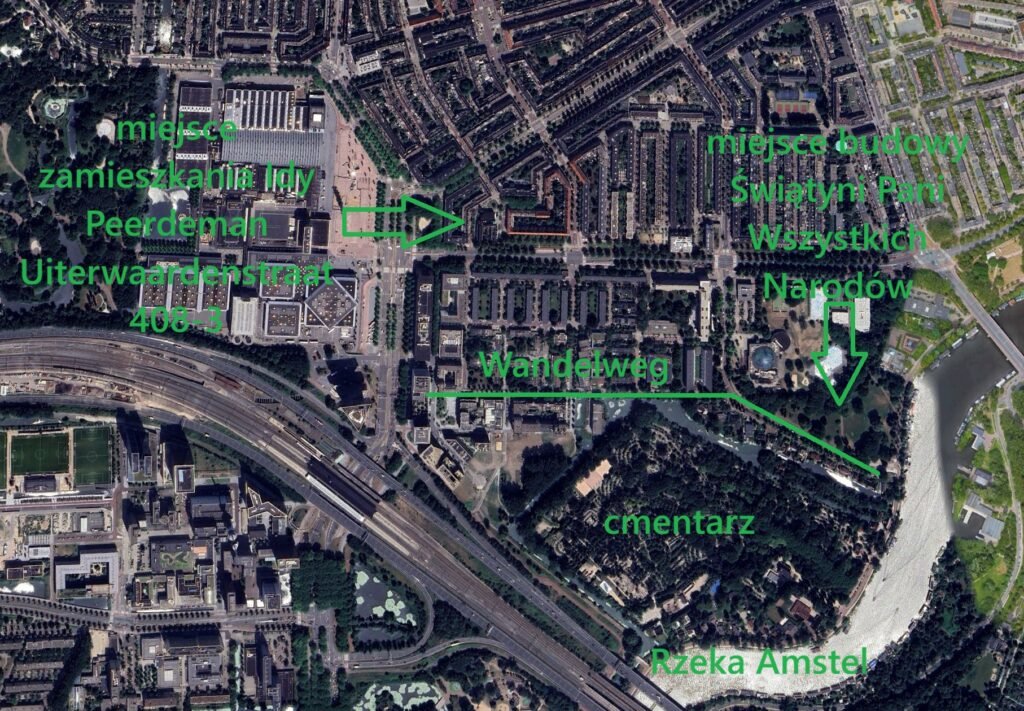
This location is no accident in terms of its spatial character. Both the location of the Temple of the Lady of All Nations and its exterior and interior design allude to events described in the biblical Book of Joshua.
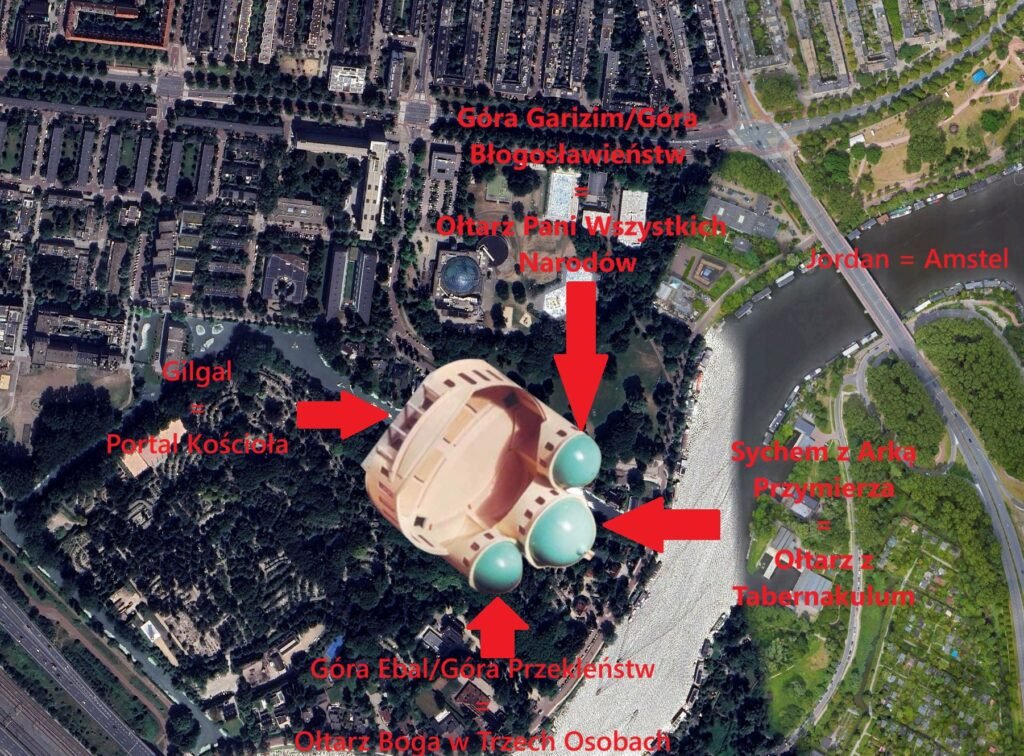
Looking at the satellite image (photo 1), we notice that the site where the Lady of All Nations desired the temple to be built is located on the Amstel River. This river is a symbolic reference to the biblical Jordan, which the Israelites crossed on their way to the Promised Land.
During the fifty-second message, the Lady of All Nations allowed Ida Peerdeman to see the exact location of the temple in a vision. In the vision, Ida first had to look to the left, after which Mary revealed to her that the temple was to be located on the right side of Wandelweg Street. On this side was a meadow with trees and a small teahouse – a place well known to the visionary.
This area was called Amstelpark and was part of a vast green area. In 1968, after the messages had been delivered, the area was divided into two parts, one of which was named Martin Luther King Park in honor of the Black Baptist pastor who was assassinated that same year by political opponents. Martin Luther King Jr. championed racial equality, fighting for human rights and the abolition of discrimination against African Americans, for which he received the Nobel Peace Prize in 1964.
It is worth noting that in several of her messages, the Lady of All Nations explicitly appealed for respect for the rights of Black people. In this context, Martin Luther King's assassination can be read as a prophecy and confirmation of Mary's words about conflicts stemming from racial prejudice, which humanity should renounce. Mary reminded everyone that all people are children of God, regardless of skin color—"both black and white."
On the left side of Wandelweg, looking from the west, lies the Zorgvlied Cemetery. The spatial layout of this site is exceptionally symbolic – on one side stretches a park with a meadow, and on the other a cemetery. This is no coincidence. This image alludes to the biblical Mounts Gerizim and Ebal, located beyond the Jordan River. Mount Gerizim was the mountain of blessings, symbolizing the Tree of Life, while Mount Ebal was the mountain of curses, corresponding to the tree of death.
In this context, the Zorgvlied cemetery can be read as an image of the Tree of Death, while the site where the Temple of the Lady of All Nations was to be built symbolizes the Tree of Life, personified by the Lady of All Nations herself.
Let us now recall the references to Mounts Gerizim and Ebal in Holy Scripture. When Joshua and the children of Israel crossed the Jordan River, they were obligated to renew their covenant with God at the foot of these two mountains – Mounts Gerizim and Ebal.
The ceremonial reading of the Book of the Mosaic Law, containing the text of the covenant, took place in the city of Shechem, located opposite and directly between these mountains. In this place, the entire Israelite community gathered, and the Covenant, which the Israelite community had promised to faithfully keep, was solemnly read at the Ark of the Testimony.
Its provisions were clear: if the Israelites broke the covenant, God's curses would descend upon them from Mount Ebal; however, if they remained faithful, God's blessings would descend upon them from Mount Gerizim.
Looking again at photo 1, we notice that the city of Shechem in the biblical description corresponds to the place where Ida Peerdeman lived. From her perspective—looking from Ida's apartment—on the left stretched the area corresponding to Mount Gerizim, while on the right—an area symbolically referring to Mount Ebal.
Furthermore, on Mount Ebal stood the altar of the Lord, where the Israelites offered peace offerings and offerings of praise to God. Therefore, one could say that the altar was the place where the victims died, and thus, in a sense, their grave. In this light, it is particularly significant that the Zorgvlied cemetery is located in the place corresponding to Mount Ebal.
As we will see below, not only is the content of the messages in strict accordance with Sacred Scripture, but the site of the apparitions itself is a living interpretation of the biblical message.
Let us now turn to the description of the appearance of the Temple of the Lady of All Nations (photo 2), for it too symbolically alludes to Mounts Gerizim and Ebal. The two outer domes of the temple, painted in green, reflect these very mountains—Gerizim and Ebal—covered with grass. This is a symbolic image, depicting a meadow where God's sheep, symbolizing people, graze. In Sacred Scripture, Mount Gerizim is described as fertile and full of vegetation, while Mount Ebal remains barren and dry. This contrast served as a sign for the Israelites—a reminder that the barrenness of this mountain results from a lack of faithfulness and proper reverence for God.
Between these two mountains rises a central dome, symbolically referencing the city of Shechem—the place where the Israelites renewed their Covenant with God. It was there, between Mounts Gerizim and Ebal, at the Ark of the Covenant, that the Israelite community reaffirmed their fidelity and devotion to God.
Similarly, beneath the central dome of the Temple of the Lady of All Nations stands the Tabernacle, which should be understood as the new Ark of the Covenant for our times—a place where God remains vividly present among his people.
Further, the circular portal in front of the domes alludes to the place known as Gilgal. It was there that the children of Israel purified themselves and prepared for their journey to fight evil. In Christian spirituality, Gilgal becomes a symbol of the purification of the heart and preparation for the spiritual battle against evil. This purification is accomplished in the sacrament of penance, while the Eucharist strengthens the soul to face daily trials and challenges.
Thus, the central dome and the circular courtyard symbolically represent the Church of Christ, existing between the tree of life and the tree of death. It is worth emphasizing that the tree of death is the place where man learns to distinguish good from evil. From this place, one can return to God only after physical death, when one has fully understood God's teachings. It is no coincidence, then, that this is the location of the cemetery and tombstones – symbolic altars for every person, where everyone should offer a sacrifice pleasing to God.
As we can see, the structure of the temple possesses profound theological and symbolic significance. Let us therefore take a closer look at the individual elements of its architecture, comparing their meaning and function with the message of Holy Scripture.
"Suddenly, I see a large church standing in the place the Lady indicated. It's a majestic church in a large square. A very special church. One we don't know, but at the same time, you can recognize something from all existing churches. The back part – the eastern part, the front part – in a more Western style. The church is built of yellow-beige natural stone. The light green domes are very striking, one large with two smaller ones on either side. The Lady points to them and says, "You see three domes on the church, one large and two smaller ones on either side." The green color of the domes harmonizes beautifully with the yellow-beige walls of the church. These walls contain large windows. In the part near the domes, the windows are located only directly below the domes. A cross stands on the large dome."
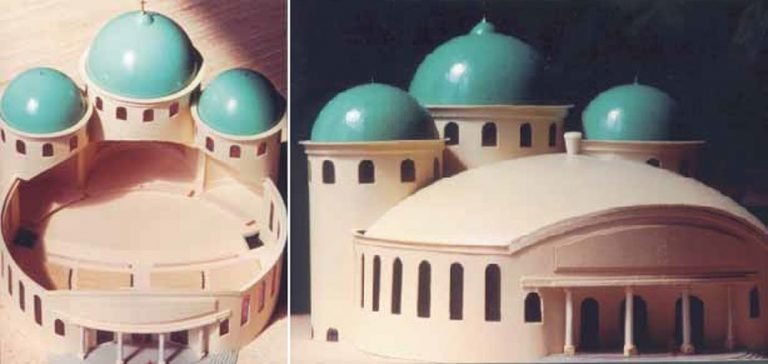
The dome and altar located on the left side of the church
"Now the Lady points to the Gospel reading and says, 'The altar of the Lady is presented as she appears.' I see a scene of the Lady of All Nations standing on a globe; behind her are the Cross and sheep. All three scenes are like carvings in dark brown wood, including the scene of the Lady of All Nations." (Message 52)
We see that the altar located under the left dome—referring to the Mount of Beatitudes—belongs to the Lady of All Nations.
It was from this mountain, according to the biblical account, that blessings were to descend upon the children of Israel, provided they remained faithful to God's Covenant, as recorded in the Book of the Law of Moses. Keeping this Covenant was to ensure Israel's divine help and success in all their actions and endeavors.
The text of the Covenant was solemnly read in the city of Shechem, opposite Mount Gerizim and Ebal, and the entire Israelite people publicly promised to keep it.
However, for God's graces to truly flow to the people, bodily purity was necessary, but man is born impure—a weak being prone to sin. Therefore, God, knowing human nature, gave man the opportunity to work on himself. He raises us up after every fall and gives us the chance to work on our weaknesses.
The Israelites could purify themselves through rituals, especially by offering The sacrifice of an animal without bodily blemish. This sacrifice had a profound symbolic meaning. By permitting animal sacrifices, God wanted to suggest something more: that man himself should be a flawless sacrifice—without the sin that separates us from God and prevents us from fully receiving His blessings.
Therefore, the spiritual meaning of this practice reveals that it is not about animals, but about the transformation of the human heart, who—working on his purification—can receive blessings from Mount Gerizim, symbolically depicted as the left, green dome.
Representatives of the six tribes of Israel were responsible for imparting the blessing to the children of Israel, provided they remained faithful to the Covenant with God. Their role was mediatory—they stood between God and the people, imploring God's blessing and necessary graces for the community.
Symbolically, they were to be located on Mount Gerizim, from which they observed the entire community of Israel, just as God looks down from on high upon the earth, keeping an "eye" on everything that happens among His people.
The presence of these tribes on Mount Gerizim was a sign that God was keeping His Covenant, and His instrument in bestowing blessings were precisely these six appointed tribes of Israel, which in His name imparted blessings to the entire nation.
Deuteronomy 27:12. These are the tribes to stand on Mount Gerizim to bless the people: Simeon, Levi, Judah, Issachar, Joseph, and Benjamin.
A similar role in modern times – in Jewish tradition – is fulfilled by the so-called tzaddik (Hebrew: צַדִּיק), meaning "righteous one." He should be a person of exceptional holiness and moral integrity, who intercedes with God on behalf of the community, asking for grace, protection, and blessings.
Tzadikim, especially in Hasidic Judaism, are considered spiritual leaders and intermediaries between God and the people. Their lives are to be transparent, in accordance with the Law, and full of devotion – only then can their prayer be effective for the good of the community.
In the Christian tradition, this role is played by the Mother of God – she who, as the Immaculate One, intercedes for people for grace and blessings from God and the Son. Her mediation stems from exceptional holiness, obedience to God's will, and maternal care for all of God's people.
However, it must be remembered that for a person to truly receive grace, they must remain in the Covenant with God. When this Covenant is broken by sin, conversion is essential. By purifying themselves in the Holy Sacraments, a person demonstrates their desire to be a better person by repenting of their sins.
The principle of receiving blessings is particularly eloquently demonstrated by one of the revelations experienced by Ida Peerdeman. In this vision, she saw the globe plunged into deep darkness. From the darkness, human silhouettes gradually emerged – individual figures, their gaze directed upward toward God.
These were people engaging in a spiritual struggle with their own sin, striving for inner transformation, and yearning to become better. They recognized their weaknesses and repented for them with heartfelt sorrow. It was they who were to receive the blessing of the Lady of All Nations, because through persistent work on themselves, stemming from a sincere desire for conversion, they had learned to distinguish good from evil. And because they had understood this lesson, they could now begin a new stage – serving others, fulfilling the will of the One who had given them the time and opportunity for transformation.
"Then I saw, beneath this glorious scene, a piece of delicate blue sky, and beneath it, the upper part of the globe. It was completely black. This evoked in me a terribly sad and repulsive feeling. Then I saw the Lady wagging her finger, this way and that, and shaking her head reproachfully and warningly – towards that black earth. I heard her say, 'Do penance!'
Then I saw something very special. From that dark, black globe, human heads began to emerge. The heads slowly rose upward, followed by their bodies, and finally I saw these people, all intact, standing on this round part of the globe. As I looked at them, I thought to myself, "How is it possible that there are so many different races and people?" While I gazed at them in admiration, I saw the Lady spreading her hands over them in a gesture of blessing. Then her look was no longer so sad. I heard her say, "Make reparation to Him!" (Message 56).
The dome on the right
"Then the Lady points to (...), then to the altar on the side where the Epistles are read. With her hands joined, she says with great solemnity and reverence: 'The altar of the Father, the Son, and the Holy Spirit.'"
As mentioned earlier, the right dome of the temple symbolically refers to Mount Ebal. It was from this mountain, according to the Book of the Law of Moses, that curses were to descend upon the people if the Israelites broke the Covenant with God.
Representing the six tribes of Israel, they were stationed on Mount Ebal, responsible for ensuring their fidelity to this Covenant. Looking from on high, they had a symbolic insight into the people's lives and exercised spiritual oversight over them. Their presence served as a reminder that any deviation from the Law carries inevitable consequences.
Deuteronomy 27:13. Reuben, Gad, Asher, Zebulun, Dan, and Naphtali are to stand on Mount Ebal to pronounce curses.
On the summit of Mount Ebal stood an altar set up to God, where the children of Israel offered peace offerings and praise offerings. The right dome of the Temple of the Lady of All Nations, symbolically alluding to Mount Ebal, also references an altar – this time as the altar of God the Father, the Son, and the Holy Spirit.
Mount Ebal is also a symbol of the tree of death, which is why the sacrifices we offer to God while standing at its foot are so crucial. If our sacrifices – our actions – are an expression of disobedience to His Will, we bring a curse upon ourselves.
Every person must, at some point in their life, ascend this mountain to worship God. However, the key factor is the spiritual attitude with which we approach Him. If we ascend this mountain impure, as the Book of Moses reminds us, curses would fall upon us. Therefore, it is impossible to truly worship God and simultaneously persist in sin and do nothing about it.
In this way, the structure of the Temple of the Lady of All Nations becomes a reflection of Holy Scripture and the Covenant made with God.
The living image of this Covenant is the temple of the Body of Christ and the Lady of All Nations. By imitating them, we become like God, who is their embodiment.
On God's altar today, we offer our own sacrifices – our daily gestures of reverence for God. Kneeling before the Blessed Sacrament, adoration, prayer, and an attitude of respect are concrete expressions of worship that – if they flow from the heart – become our daily sacrifice.
Christ, through his life, showed us what sacrifice is pleasing to God and how He should be honored. His attitude serves as a model and a lesson for us. This is not just about external acts of piety or even just efforts to bring peace between people, but above all, about imitating Christ in the fight for righteousness, justice, and love.
Only such a sacrifice is pure and without blemish and can truly please God.
The belief that Christ's Sacrifice automatically saved everyone, regardless of their attitude, is a false teaching. Salvation, though offered to every person, demands a human response. This is precisely why God sent us Christ—so that, by imitating Him, we might become like Him.
Therefore, if we seek justice, righteousness, and love in the world, if we offer God the honor due and bring peace among people, then we will bear fruit pleasing to God. Each of us must make our own sacrifice.
There are souls in the world who have truly understood God's teachings—not only accepted them mentally but put them into practice. Such souls, following in the footsteps of Jesus, offer themselves in service to others. Their lives—offered to God and others—become a support for the world. It is thanks to such self-sacrificing souls that the world still exists, because they bear the burden of the consequences of others' sins—our curses.
In this context, Jesus' death on the cross fulfills the symbolism of Mount Ebal—the mountain of curses. In his case, it was Golgotha, on top of which stood the altar of God. According to Old Testament law, the penalty for breaking the Covenant and ascending "God's mountain" without purification was stoning or impaling. Jesus, scourged and humiliated, appeared to be stoned—and ultimately, he was pierced by a Roman soldier's spear. He took our curses upon himself, in accordance with the principle: "It is better that one man die for the people than for the whole nation to perish" (cf. Jn 11:50).
The claim that Jesus "took our sins upon himself" automatically and without human intervention leads to a misunderstanding of the meaning of His Sacrifice. Christ's sacrifice does not exempt anyone from personal responsibility—on the contrary, it calls everyone to participation and imitation.
If Jesus—the exemplary Sacrifice—had not been present on Golgotha at that moment, God's justice could have immediately fallen upon the people present. It was His presence that stopped the action of God's justice. Where Christ is present, God's justice is suspended, and man is given time and a chance for reformation—through the Church of Christ, which should be a space for rising from the fall.
This dramatic aspect is also revealed in the Third Secret of Fatima. In this vision, the Pope ascends a mountain—to God's altar—which turns out to be empty. There is no sacrifice there. There are no people who devote themselves entirely to God, who, in the spirit of Christ, dedicate their lives to others. Therefore, all present on the mountain perish—symbolically stoned by gunfire. On the mountain, there is no one pleasing to God in their behavior, no one who would take upon themselves the burden of humanity's sins and curses. The entire Church has ceased its mission of leading people to God.
The Third Secret of Fatima is not merely a vision of future events, but a warning—addressed to the Pope, the clergy, and the entire Church. It is a warning that the Church should not conform to this world, which is permeated with evil, but should return to forming people in the image of Christ, for if it follows the ways of this world, it will suffer the same fate as others.
A Church that ceases to be a place of sacrifice, hardship, and spiritual struggle becomes merely an empty institution that persists for some unknown reason—an altar without sacrifice, before which the world turns away indifferently.
Central dome
After crossing the Jordan River, Joshua, together with all the people, renews the Covenant with God, written in the Book of the Law of Moses, at the foot of Mount Gerizim and Mount Ebal. This Book is solemnly read before the entire assembly – at the Ark of the Covenant – in the city of Shechem, located precisely between the two aforementioned mountains.
The central dome of the Temple of the Lady of All Nations symbolically refers to the city of Shechem, the place where the renewal of the Covenant between God and His people took place. The central dome, together with the circular courtyard of the Church of the Lady of All Nations, reflects all the Churches of Christ existing among us. The Church thus becomes the symbolic city of Shechem – the place where the renewal of the Covenant between man and God takes place.
Three sacred symbols were stored in the Ark of the Covenant: manna – the food given by God, which nourished the people of Israel during their forty-year wandering in the desert; the tablets of the Ten Commandments – a symbol of the Law and fidelity to the Covenant; and Aaron's rod – a sign of spiritual leadership and God's election.
In the Temple of the Lady of All Nations, the central altar contains the Tabernacle – the New Testament Ark of the Covenant. It is within it, in the form of the Eucharist, that Christ truly dwells. He himself is the contents of the Ark of the Covenant: He is the Law, the Food, and the Shepherd who leads his people to the Father.
"On the dais stand three altars, arranged in a semicircle. The Lady points to the central and says: 'In the center is the Cross, the Daily Miracle, the altar of the Sacrifice of the Cross .'
Then the Lady points to the low tabernacle , with a small cross on it."
The Ark of the Covenant had a lid, called the mercy seat (Hebrew: kapporet), which played a key role in the ritual of atonement. Once a year, on the Day of Atonement (Yom Kippur), the high priest entered the Holy of Holies and sprinkled the lid with the blood of the sacrifice. This was the holiest liturgical moment of the entire year – a symbolic act of atonement to God.
The mercy seat was not only the cover of the Ark, but also God's throne – the place of His presence, where God's judgment took place. It was there that atonement took place: not as an abrogation of sins, but as a suspension of the consequences of God's justice, which should naturally have fallen upon the people for their unfaithfulness to the Covenant. It was an act of God's mercy – a time granted to humanity for conversion and return to God.
In New Testament symbolism, the Tabernacle is the spiritual continuation of the Ark of the Covenant. It is within it that Christ is truly present, and at the same time – as the incarnate Spirit of God – He Himself sits on His throne, which is the Cross placed on the lid of the Tabernacle.
Just as in the time of Moses the mercy seat was sprinkled with the blood of the sacrifice, so the Blood of Christ "suspended" the divine justice that would otherwise have fallen upon humanity. In His Blood, God showed mercy to the world, opening a time of conversion for humanity.
In a vision received by Ida Peerdeman, a scene depicting the Last Supper was depicted behind the central altar of the Temple of the Lady of All Nations. This image is not coincidental – it is a direct reference to the institution of the Eucharist by Jesus Christ.
It was the Last Supper that foreshadowed the giving of the Body of Christ as manna for humanity, the spiritual food through which humanity would gain the strength to abide in God.
In this way, Christ illustrated for us, in Himself, a spiritual reality that has its roots in the Old Testament, in the miracle of the manna from heaven. Just as manna was supernatural nourishment for the people of Israel during their forty-year journey through the desert, so the Eucharist is spiritual nourishment for all Christians – a community pilgrimaging through the desert of this world towards eternal life.
The scene of the Last Supper, placed behind the altar in Ida Peerdeman's vision, thus emphasizes a fundamental truth: at the center of the Temple of the Lady of All Nations – and thus at the center of a person's spiritual life – is the Eucharist. It is not only a commemoration of Christ's Sacrifice, but the living, real presence of God, who continues to feed his people with the Bread from heaven.
"Then the Lady says: 'The sacrificial altar in the center ; behind it, at the back – the Last Supper depicted.' Now the Lady allows me to see clearly the scenes behind the three altars. Behind the central altar, almost across the entire width of the circular back wall, I see the scene of the Last Supper. The figure of Christ is magnificent, a figure full of dignity. Before Him stands the Chalice. In His hands He holds the Host. It is as if He were breaking the Host. At the table are the Apostles, in a semi-reclining position."
During one of her apparitions, Ida Peerdeman saw a procession of people led by a priest carrying the Eucharist. The procession was heading towards Wandelweg Street – the site where the Temple of the Lady of All Nations was to be built. This vision directly alludes to the events described in the Book of Joshua.
After crossing the Jordan River, Joshua – in accordance with Moses' command – was obligated to renew the Covenant with God. On the day of this momentous event, the entire Israelite community set off in a solemn procession to Shechem, leading the Ark of the Covenant, which was carried by the priests. There, at the foot of Mount Gerizim and Ebal, next to the Ark of the Covenant, a Levitical priest read the Book of the Mosaic Law.
We see, then, that Ida Peerdeman's visions are deeply rooted in the symbolism of the Old Testament, which remains alive and relevant for Christians today. At the head of the procession in Ida's vision was the Eucharist – the true God, and at the same time, the spiritual content. The Ark of the Covenant. The procession headed towards the Church of the Lady of All Nations, where, in God's presence, the covenant with God was renewed.
God reveals spiritual truths through earthly events. Just as the Israelites once fought to cleanse the Promised Land of all evil, so today every person is called to expel evil from their own "promised land," which is their body.
The New Testament is the fulfillment and embodiment of the Old Testament – in the person of Jesus Christ, who is the Living Word of God, the living Holy Scripture. Therefore, when reading the Old Testament, we should remember that its message refers primarily to the spiritual reality, and the events described are images of the truths revealed in Christ.
"Then the Lady says: 'For this purpose, I have sought out the Dominican fathers. The founder will place the Image there. The Image must arrive in Amsterdam quickly. I have chosen Amsterdam as the place of the Lady of All Nations. This is also the place of the Sacrament. Understand all this well.'" Then I see a procession with the Blessed Sacrament. Among the many people passing by, I also see priests. One of the priests walks ahead with the Blessed Sacrament. The procession is approaching from the Old Town, from the Begijnhof, and is heading towards Wandelweg, which the Lady indicated to me.
Then the Lady says: "The distribution will be carried out by the monasteries among all the clergy, among all the nations. Dominicans, understand well what you have in your hands! " "This last point is emphasized."
In the message of the Lady of All Nations, there is a clear reference to Amsterdam as a special place—the City of the Sacrament. This designation alludes to an event from centuries ago: the Eucharistic Miracle that occurred on March 25, 1345, exactly 600 years before the first apparition of the Lady of All Nations.
In an Amsterdam house, a terminally ill man lay. During the administration of the Sacrament of Extreme Unction, he received the Eucharist but soon vomited it up. The woman caring for him threw the vomit and the Host into the fire. However, the next day—after rekindling the fire—it miraculously floated above the flames.
The shocked caretaker wrapped the Host in a piece of cloth and placed it in a box, which she gave to the priest. The next day, however, it turned out that the Host had mysteriously returned to its original location. This happened twice more. On the third occasion, the decision was made to transfer the Host in a solemn procession to the church—and only then did it remain in its new location.
Since then, Amsterdam has celebrated this event as the Eucharistic Miracle, commemorated by an annual procession called the "Mirakel." It begins in the chapel built on the site of the former sickhouse and follows the historical route to the church—exactly as it did on the day of the Host's miraculous transfer.
The portal located in front of the three domes
"The entrance to the church is particularly majestic, lofty, and elegant. A staircase leads to a large open portal. This portal has four massive pillars in front, decorated with ornaments, both at the top and bottom. The pillars are not smooth, but rather grooved from top to bottom. The roof above the entrance, supported by these pillars, has a protruding cornice with some kind of sculpture or bas-relief on it. Now the Lady solemnly says,
'We now enter the House of the Lord.' Suddenly, I find myself standing with the Lady inside the church. It is a large and warm church. All the windows are stained glass, in rich, warm colors; a kind of oriental red and blue predominates. These are colors not seen in our churches. As we walk with the Lady through the church, I notice that the floor slopes down slightly, as if in an amphitheater. It is also striking that everything in the church is arranged in a semicircle. Everything inside and outside the church is circular. In the front part of the church, I see a dais of enormous dimensions. In its front part, there are stairs built in a semicircle. The seating areas are also arranged in a semicircle. I see communion railings in front of the platform."
In our case, the round portal of the Temple of the Lady of All Nations symbolically alludes to Old Testament Gilgal – a place of profound significance in the history of Israel. Gilgal was the place where the children of Israel prepared for battle with the enemy inhabiting the land of Canaan. It was also there that Passover was celebrated for the first time in the Promised Land – no longer by eating manna, but bread baked from the produce of this land. Gilgal was also a place of purification, and it was there that the Israelites were circumcised.
In this spirit, the round portal of the Temple of the Lady of All Nations becomes a symbol of New Testament Gilgal – a place of preparation for the inner struggle within the human heart with its true adversary, Satan. It is also the place of Passover, where we consume the Bread of Life – Christ, baked from the produce of this land. This portal is also a place of purification in the sacrament of penance and reconciliation, and of the spiritual circumcision of the heart.
Messages of the Lady of All Nations
The correct interpretation of the messages of the Lady of All Nations is only possible in the light of Holy Scripture. This should not be surprising, since we are dealing with a message coming from God. These messages are a reminder of truths that have already been revealed by God's prophets and recorded in Holy Scripture—although presented from a different perspective, adapted to modern times.
The meaning of the messages of the Lady of All Nations is rich in symbolism and profound in meaning, which constitutes an invitation to contemplate them. Only a thorough knowledge of Holy Scripture allows for a proper reading of their message—by understanding the events described in the Old Testament and viewing them in the light of spiritual reality.
A good example of how to read the Old Testament is the Book of Joshua, in which, under his leadership, the children of Israel had to expel evil from the Promised Land. From a spiritual perspective, the "promised land" is our body, from which every person should remove all foreign deities and evil—under the leadership of Jesus. The name Joshua (Hebrew: Yehoshua) is one of the equivalents of the name Jesus.
By meditating on the words of the Lady of All Nations, one opens one's heart to the power of God's Word, which can take deeper root in the soul, strengthening faith and leading to inner transformation.
Through Ida Peerdeman, the Lady of All Nations delivered 56 messages, including prophecies. Their purpose is to confirm the authenticity of the entire message. Individual messages address a wide variety of topics, so they will be divided into sections (in italics), followed by commentary.