
Apparitions of Our Lady in Gietrzwałd
All Marian apparitions carry a profound message addressed to humanity. However, understanding this message without knowledge of the Old Testament proves impossible. In this way, Our Lady encourages us to delve into the entirety of Holy Scripture, not just the New Testament, for the Spirit of God is present in every word contained in the Bible. Ignorance of the Old Testament is one of the main reasons why almost all Marian apparitions remain misunderstood to this day. It is worth emphasizing here that if the content of the apparitions seems mundane or too simple, we are dealing with mere appearances, and these revelations have simply not been properly interpreted. The process and content of all apparitions are constructed to trigger deeper thought processes in the human mind, so that the Spirit of God can take deep root. Their interpretation, therefore, cannot be easy or superficial. Jesus' parables fulfill a similar function—their structure serves not only to convey the teaching but also to root the Word of God in the hearts and minds of the listeners. The apparitions in Gietrzwałd are an example of a message that requires a special introduction and spiritual engagement. To interpret them properly, one must first seek common ground with Sacred Scripture and compare them with other revelations that, although seemingly distinct, in fact form a coherent whole. The common features of Marian apparitions and Sacred Scripture are not easily discernible. Their hidden nature, however, provides a strong argument for their authenticity. It is worth noting that the visionaries are most often children – individuals who do not yet possess the developed biblical knowledge or analytical skills necessary to create such complex messages. Imagination alone is not enough to create content with such a deep theological structure and coherence with Sacred Scripture.
Maple instead of thorns - the secret of Gietrzwałd
It's worth noting a recurring motif associated with Marian apparitions. In the vast majority of cases, Our Lady appears surrounded by plants—most often shrubs or trees with thorns. This detail is not coincidental and carries profound symbolism that references both spiritual and biblical realities. Against this backdrop, the apparitions in Gietrzwałd stand out in a special way. Our Lady appears there on a maple—a tree without thorns. This difference, seemingly minor, is nevertheless significant and constitutes the core of the message coming from Gietrzwałd. Before we delve into its interpretation, however, it's worth first recalling several instances in which Mary appeared among thorny plants. This comparison will allow us to better understand the uniqueness of the Gietrzwałd apparition and the depth of its symbolism.
Fatima
At Fatima, Our Lady appeared on a shrub known as ilex , a dwarf variety of oak. It was just over a meter tall and provided a natural backdrop for the apparitions.

Holly, also known by its Latin name Ilex aquifolium , is native to western, central, and southern Europe, and northern Africa. This plant grows as a tall shrub or small tree. In Poland, holly is not native; it is mainly planted in gardens as an ornamental shrub, where it grows to a maximum height of about 3 meters. Its greatest asset is its distinctive, evergreen , dark green leaves . The leaf margins are wavy and covered with thorns . The plant blooms from May to June, producing small, whitish flowers with a pleasant fragrance. In autumn, spherical, red fruits appear, which persist on the branches until spring, giving the holly a decorative appearance well into the winter months.
Lourdes
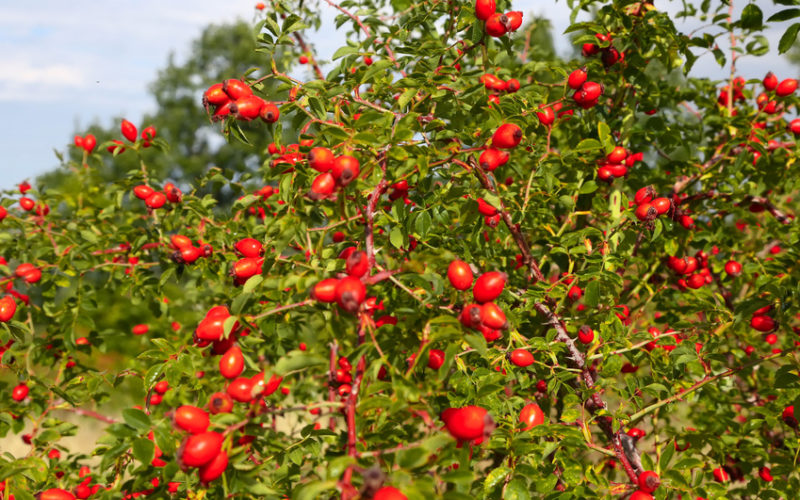
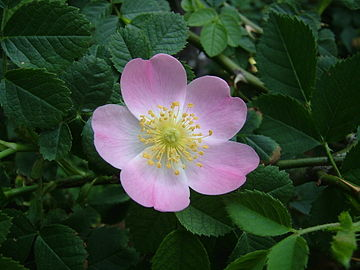
The wild rose (Rosa canina L.) is a species of shrub belonging to the Rosaceae family. It occurs naturally in the temperate and warm zones of the Northern Hemisphere. The plant can be found throughout almost all of Europe (up to an altitude of about 1,500 m above sea level), as well as in North Africa, Asia, Madeira, the Canary Islands, and—as an introduced plant—in Australia and New Zealand. The wild rose typically reaches a height of up to 3 meters, although it sometimes takes the form of a climber reaching up to 12 meters. Its branches arch toward the ground, and the shoots are covered with strongly curved, hooked thorns . The leaves are composed of 5 to 7 ovate-elliptical, sharply toothed leaflets with singly or doubly serrated edges. They are usually green , rarely with a bluish hue.
Garabandal
In San Sebastian de Garabandal, the Virgin Mary appeared against the backdrop of a pine tree.
Pine trees are evergreen , meaning they retain their needles year-round. Their thin, long needles are usually clustered in pairs or clusters of several. These trees are highly resistant to changing weather conditions and tolerate both frost and drought well. They also have a deep root system, making them stable and difficult to break in strong winds.

Gietrzwałd
In Gietrzwałd, Our Lady appeared against the backdrop of a maple tree—a tree that, unlike plants associated with apparitions elsewhere, lacks thorns. This seemingly minor detail has profound theological significance and distinguishes Gietrzwałd from apparitions such as Lourdes, Fatima, and Garabandal.
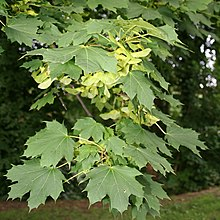
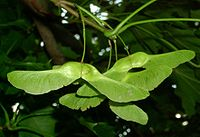
The maple tree on which Our Lady appeared is a seasonal tree— it loses its leaves in the winter . It is characterized by a spreading crown and distinctive leaves, which change color especially beautifully in autumn. Its fruit, called "noses," are small nuts with wings at the ends, which enable them to be dispersed by the wind.
Let us consider the implications of these comparisons.
In the Holy Scriptures, it was in a thornbush that the Spirit of God appeared to Moses—on Mount Horeb, also known as the Thorny Mountain. According to Jewish tradition, the burning bush that was not consumed likely belonged to local plant species, such as acacia or desert thorn.
We see a clear analogy here: just as the Spirit of God appeared to Moses in a thornbush, so too does the Spirit of Our Lady appear during apparitions surrounded by thorny plants. This is no coincidence—the thornbush carries profound biblical symbolism, dating back to the Book of Genesis.
Exodus 3:1-2
3:1 Now Moses was keeping the flock of Itrich his father-in-law, the priest of Media. And he led the flock beyond the wilderness and came to Horeb, the mountain of God.
3:2 And the eternal angel appeared to him in a flame of fire out of the midst of a thornbush . And he looked, and behold, the thorn was burning with fire, and the thorn was not burned.
It's worth noting here that most popular translations of the Holy Scriptures translate the Hebrew word for the plant in which the Spirit of God appeared to Moses as "bush."
However, this translation is imprecise and even misleading, as the original Hebrew text uses the word seneh , which means a thorny plant—not necessarily an ordinary bush. The quoted verses from the Book of Exodus come from Rabbi Isaac Cylkow's translation—one of the first Polish translations of the Hebrew Bible made directly from the original language.
When Adam and Eve, deceived by the serpent, ignored God's warning and ate from the tree of knowledge of good and evil—the tree of death—God closed them off to the Tree of Life. From then on, only those who have learned to distinguish good from evil and choose only good in life have the right to eat from this Tree. Therefore, God places cherubim with flaming swords as guards around the Tree of Life—for sin cannot partake of eternal life.
Adam and Eve must therefore first cleanse themselves of sin before they can once again gain access to eternal life. Against this backdrop, the figures of Jesus and Mary as the New Adam and New Eve acquire profound significance. For they, by maintaining perfect obedience to God and guided solely by goodness, become for humanity a new Tree of Life and Fruit of Life. Jesus is the Fruit that gives eternal life, and Mary is the Tree that produced Him. In this context, Mary's apparitions among the thornbushes take on significance, bringing to mind cherubim with flaming swords guarding the path to the Tree of Life—to Mary.
The subsequent course of the apparitions in Gietrzwałd reveals Mary's coronation as the Tree of Life, which bears the Life-giving Fruit: Jesus Christ. The image of the Infant Jesus in her arms becomes an eloquent sign that it is through Mary that humanity once again gains access to eternal life. We will return to this image in our further reflections. Now, however, let's return to the maple tree that appears in Gietrzwałd—a tree completely devoid of thorns, and thus carrying a different message. The mere sight of a thorn evokes fear and chills. Looking at a maple, in turn, especially in autumn, when its leaves take on beautiful, golden-red hues, evokes positive associations—peace, beauty, harmony. This difference carries a profound message. In the Book of Genesis, we read that when Eve looked at the fruit of the tree of knowledge of good and evil, it seemed beautiful and alluring to her. Its apparent beauty led her to death. One could say, then, that its deceptive attractiveness obscured her Divine Will. And so it is in our world as well: what is outwardly beautiful often leads to sin and, consequently, to spiritual death. In this context, the maple does not symbolize the Cherubim with fiery swords, like the thorn bush, but the very tree of death—the one that brought sin and separation from eternal life to man. The symbolic significance of the maple tree is also confirmed by the apparition's location. In Gietrzwałd, beneath the maple tree against which Mary appeared, there was a cemetery with tombstones. In later years, the cemetery was moved to another location, which weakened the clarity of the apparition's message. Thanks to preserved chronicles, however, we can reconstruct the course of events and—based on them—decipher the meaning of the message Mary was sending to Poles. We see, then, that the maple tree in Gietrzwałd symbolizes the tree of death—teaching us to distinguish good from evil—and its surroundings—the cemetery and tombstones—are intended to reinforce this image. Most importantly, however, Mary appears against the background of this tree, trampling its withered branches as the Victor over death and sin. The withered branch is not an insignificant detail—this branch symbolizes the serpent that once seduced Eve, coiling on the tree of death. Moreover, one can notice the presence of two dead branches, which can be interpreted as the two heads of the dragon, identified in the Book of Revelation with Satan. During one apparition, some witnesses even claimed to have seen Mary trampling the dragon, further confirming this symbolic image of the battle between good and evil.
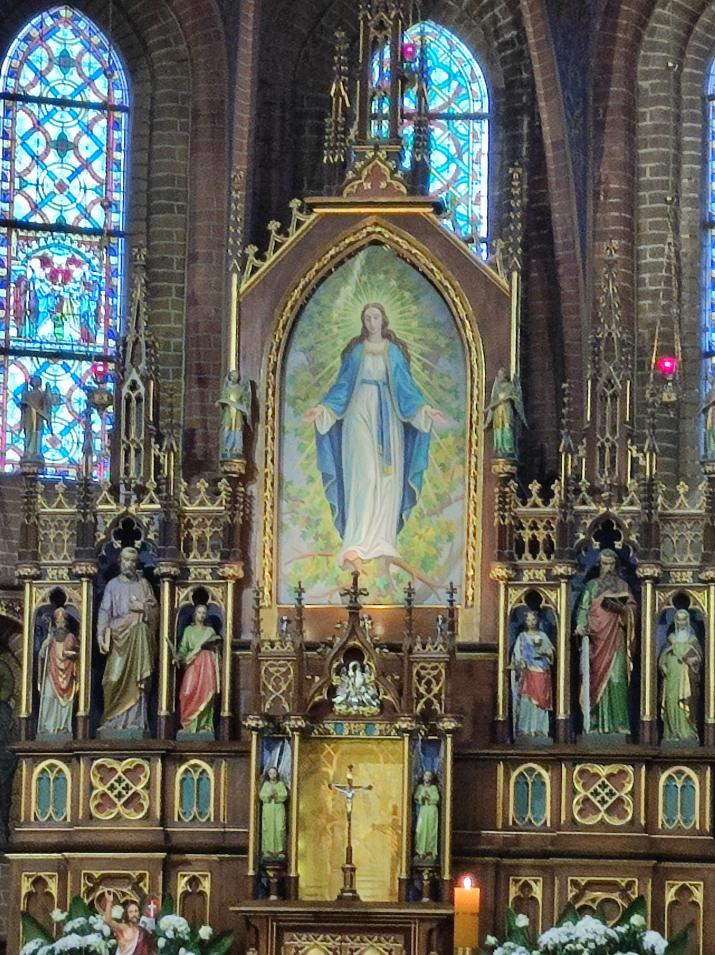
However, if we compare the leaves of the shrubs in the cases discussed, we notice that only the maple tree loses its leaves in winter. Holly and wild rose typically retain their leaves year-round. Similarly, the pine tree does not shed its needles, symbolically indicating permanence, life, and permanence. The maple, on the other hand, as a symbolic tree of death, shedding its leaves each autumn gives the impression of dying. Its cyclical defoliation should be interpreted as a period of impermanence—all the more significant when we compare it with the context of the revelations and the place where they occurred (a cemetery). This contrast becomes even more striking when we consider the prophetic image contained in the Book of Ezekiel. In the vision of the messianic temple, the prophet describes trees growing by the river flowing from beneath the tabernacle:
Ezekiel 47:12. " Their leaves will not wither , and their fruit will not fail. They will bear new fruit every month, for the water flows from the tabernacle. Their fruit will serve as food, and their leaves as medicine."
Thus, through the unfading leaves of the shrubs and trees accompanying the apparitions, Mary shows us a foretaste of Paradise – a place where immortality and eternal life reign. It is a symbol of God's constant presence and the spiritual vitality of those who persevere in His Will.
A significant event during one of the apparitions in Gietrzwałd deserves particular attention: Mary appeared at a spring from which a stream of water flowed. It is worth noting, however, that the spring itself was not located directly at the site of the apparitions, but several dozen meters away, on a nearby hill. This seemingly insignificant shift, however, carries profound theological significance. In Sacred Scripture, mountains are often the site of God's revelation – it was on mountains that Moses met with the Lord, where altars were erected, and where the Temple in Jerusalem was built on Mount Moriah. The mountain symbolizes the Temple of God, the Tent of Meeting, the place where man can come to know God's Will. In this context, Mary's apparition near the hill with the spring becomes a clear sign. The spring flowing from the mountain recalls the description from the Book of Ezekiel:
Ezekiel 47:12: "Their leaves will not wither, and their fruit will not fail. They will bring forth new fruit every month, for the waters flow from the tabernacle . Their fruit will be for food, and their leaves for medicine."
In light of this passage, Mary appears as the Tabernacle of God—the living Temple of God on earth. It is from her, as the Vessel of the Holy Spirit, that the spiritual source flows, bringing life, renewal, and healing. Anyone who draws on this grace with faith—who listens to Mary and perseveres in her Word—will bear fruit for eternal life. Moreover, Mary always leads to her Son—to the Fruit of Life, who brings salvation. Even if the world around us seems to be immersed in a spiritual "winter"—a time of trial—whoever accepts Mary's Word will not wither, but will bear good fruit, because they draw strength from the Divine Source. They will be like a tree that never ceases to bear fruit, for its roots reach into the waters of life. In this light, the apparitions in Gietrzwałd allude to the biblical story of Adam and Eve, who—disobedient to God's Will—choosing evil, bore evil fruit, and lost access to the Tree of Life. Mary, as the New Eve, comes to reopen this access. The spring in Gietrzwałd, where Mary appears, symbolizes the water flowing from the Tabernacle—the water with which she is filled and which brings a blessing for us—healing. There are many documented testimonies of healings associated with the water from this spring, confirming the spiritual and physical dimensions of the blessing flowing from this apparition.
Also worth mentioning are the maple's fruits, which are characteristic nuts hidden in winged "noses" (Photo 6). Carried by the wind, they resemble small, symbolic winged creatures. In light of the earlier interpretation, in which the maple appears as a tree of death, its fruits also have a symbolic dimension. If the maple itself is identified with the tree of death, then its fruits will symbolize its offspring, i.e., demons. Note that the maple's fruits appear in clusters – creating the impression of a mass, a crowd, almost like a legion, which brings to mind the biblical image of evil spirits:
Mark 5:9 "My name is Legion , for we are many ."
When autumn comes and the maple tree loses its leaves, its fruit falls to the ground in huge numbers. This can be read as a symbolic casting out of demons upon the world, as the Apocalypse of St. John says:
Rev 12:9 "And the great dragon was thrown down, the serpent of old, called the devil and Satan, who deceives the whole world; he was thrown down to the earth, and his angels were thrown down with him."
In light of Marian apparitions, Mary repeatedly warns that in our times demons attack man with unprecedented fury, like "mad dogs" trying to drive man to death. The juxtaposition of this symbolism with the place of apparitions is not accidental—God desires to reveal invisible realities through visible things.
At this point, since we speak of winter and the shedding of leaves, it is worth noting the symbolism of the seasons, through which God shows man the path of grace—an opportunity that can be accepted or rejected. When Adam and Eve broke God's commandment, the spiritual time of winter came for them, illustrating separation from God—the source of warmth and love. When the weather turned cold, they realized they were naked—a sign of the loss of God's presence, which had previously clothed them. Many accounts from people who have experienced clinical death returning to the physical world describe the sensations they experienced during the separation of their soul from their body. We often hear about the warmth and love that envelope the soul in this state. Every person carries within them a soul—a seed from which the Word of God can sprout. The soil of this growth is their body and daily life. If a person keeps their covenant with God, a tree grows within them, bearing good fruit. However, if this tree sheds its leaves—meaning they turn away from God, from warmth—then it becomes barren, fruitless, and spiritually dead. And yet—as in the cycle of nature—spring can come after winter. Conversion is like an awakening after spiritual lethargy. God, as a Merciful Father, gives each person time and opportunity to return to His path. When a sinner repents, life returns—the first spiritual leaves and flowers appear, heralding fruitfulness. The seasons thus reflect God's spiritual laws: sin distances us from God, the source of warmth and love, while conversion—like spring—awakens the soul to new life. It is worth recalling that when God came to Adam and Eve after their fall, He did not leave them naked. He clothed them, giving them warmth and love.
Let us return to the thornbush. When Adam and Eve broke God's commandment, the path to the Tree of Life was closed to them. God then placed Cherubim with flaming swords, whose task was to guard access to Him. The path to the Tree of Life was blocked for those who had not yet learned the difference between good and evil.
Therefore, when Mary appears in a thornbush—as happened at Fatima, Lourdes, and Garabandal—this thornbush symbolizes the Cherubim with swords guarding access to the Tree of Life. To pluck the Fruit of Life—Jesus—a person must pass through thorns, which symbolize not only physical suffering and wounds but also the struggle for the good that gives eternal life. We see, then, that eternal life is not granted automatically, but is granted only to those who strive for good in this world full of evil. Anyone who strives for good in this world demonstrates that they have learned to distinguish good from evil. By striving for good, man is shaped into God's image, while simultaneously learning firsthand what evil is. This path is consistent with God's commandment recorded in the Book of Genesis, where God tells Adam that the land he cultivates will produce weeds and thorns for him. Once again, God seeks to show us the things of Heaven through earthly matters. The struggle for food, thanks to which man can live in this world, requires cultivating the land that produces weeds and thorns. This image symbolically refers to the struggle for good in this world full of evil, which requires the sacrifice that Christ made. Anyone who wants to be in His image must imitate Him.
Therefore, we learn in the world how to fight for the good that gives life, while also learning what evil is. It is important to note that learning to distinguish good from evil can occur in several ways. We can learn by taking sin upon ourselves, that is, when someone sins against us. In this case, the factor that determines the acquisition of this teaching is the act of forgiveness. When someone harms us, we learn from that experience, not doing similar things to our neighbors, because we know the consequences of that sin on ourselves. However, if someone is burning with vengeance and inflicts evil upon others, we move on to learning by inflicting sin upon others. It is important to emphasize that Jesus' teaching is based primarily on taking sin upon ourselves, and if we want to be like Him, we must imitate Him. Christ's entire suffering on the cross is taking the sin of others upon ourselves, and ultimately, forgiving our tormentors. This teaching indicates that evil begets evil, so we should oppose evil by doing good.
We can therefore learn about sin by inflicting it on others – but then, if this is not accompanied by sorrow and repentance, and the sin is repeated, it means we have not learned the lesson. For those who learn by inflicting evil on others, there is the sacrament of penance – confession. However, if we do not feel sorrow for sin flowing from the heart, it means we have not understood the lesson. Human conscience is a determinant that should lead us to conversion. Those who do not feel remorse for sin and do not turn away from it have learned nothing. We can also learn about sin through suffering – all illnesses beyond our control cause us to recognize the evil in our own bodies. In such a case, however, we must forgive God, for He created this world. We can also learn by inflicting suffering on ourselves – for example, through addictions or bad behavior that cause physical and spiritual ailments, without the intervention of others. In such a case, however, we must make the decision to leave this state and forgive ourselves.
Virgin forest – the symbolism of the apparition site and the meaning of the name Gietrzwałd
It's worth pausing over the site of the apparitions in Gietrzwałd, as its choice was no accident. As mentioned, the apparitions took place near a maple tree, near which there was a cemetery at the time, later moved to a nearby hill. During the apparitions in 1877, pilgrims coming to Gietrzwałd stood between tombstones, often wading through mud.
It's also worth noting the name of the village itself – Gietrzwałd. The etymology of this name goes deeper than one might think. Historical documents contain various forms: Dittrichswalt (1583), Dittrichsuald (1615), Ditrichswaldt (1656), and Ditterichswalde (1755). The foundation charter stipulated that the village was to be called Dytherichswalt, which later became Ditrichswalde in German. It wasn't until 1879, thanks to Wojciech Kętrzyński, that the Polonized version – Gietrzwałd – was officially adopted.
However, it's worth considering an interesting etymological hypothesis put forward by Viktor Roehrich, a researcher of the German colonization of Warmia. He believes the original spelling of the name may have been completely different: Dichterurwald, literally meaning "virgin forest." This hypothesis gains credibility when we consider the Prussian character of many nearby towns' names, such as Woryty (from the Prussian woras, meaning "old") and Rentyny (from rantas, meaning "shore"). The translation of Gietrzwałd as "virgin forest" perfectly aligns with the theological symbolism of the apparitions that occurred there. Although Gietrzwałd is surrounded by dense forests, the site of the apparitions itself – the area near the maple tree where Mary appeared and the place where the spring flows – is almost devoid of trees. This contrast brings to mind the biblical image of the Garden of Eden – a pristine garden – in whose center grew two exceptional trees: the Tree of Life and the Tree of Knowledge of Good and Evil, and around them grew other trees. The focal points of the apparitions – a lone maple tree amidst a former cemetery – refer to the Tree of Death, while Mary, who appeared at the spring, refers to the Tree of Life. The forests surrounding the town symbolically reflect the remaining part of Paradise – the other trees of God's Garden. In this view, the entire Gietrzwałd – as a "pristine forest" – becomes a spiritual image of Eden, the Paradise that God planted for humanity at the beginning of creation, and to which, through Mary, humanity can rediscover its path.
The parallel of the apparitions in Gietrzwałd and Guadalupe as a revelation of the New Eve
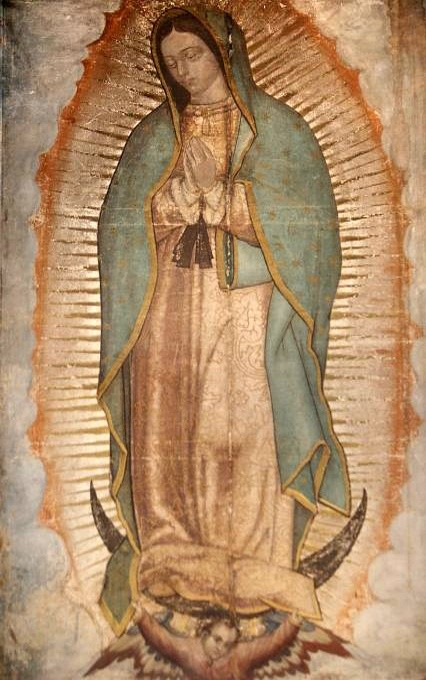
The course of the apparitions in Gietrzwałd is in many respects reminiscent of Mary's apparition at Guadalupe. In Gietrzwałd, Mary appears by stepping on a branch resembling a snake. In Guadalupe, however, Mary stands on horns, associated with evil, which rest on the head of an angel. Recall that Eve is said to have crushed the head of the serpent, whose fangs, sinking into the victim's flesh, cause pain and sometimes even death. In this symbolic key, the angel with horns, located under Mary's feet, can be interpreted as a fallen angel – the devil – whom God cast down to earth. Both images, from Gietrzwałd and Guadalupe, depict Mary as the New Eve, who – as foretold in the Book of Genesis – defeats the serpent.
Genesis 3:15: I will put enmity between you and the woman, and between your offspring and her offspring. It will lie in wait for your head, and you will lie in wait for its heel.
The image in Guadalupe, as in Gietrzwałd, thus represents the New Eve, who defeated the tempter and evil. Because Mary defeated the tempter, she has the power to dominate him. Therefore, by having Mary in our hearts, we become capable of overcoming him as she did.
Let us consider the symbolism stemming from the elements depicted in the miraculous image of Our Lady of Guadalupe, immortalized on a cloth woven from agave fibers. At the center of this image is Mary, bound with a black ribbon, which, according to Aztec culture, signifies a blessed state. The image thus informs us that Mary carries Jesus, the Fruit of Life, beneath her heart. Her tunic is colored like tree bark. It features patterns reminiscent of branches, leaves, and fruit. This symbolism of a tree—specifically, the Tree of Life—can be discerned. In turn, Mary's blue cloak, covered with stars, can be read as eternal, heavenly leaves containing fruit—stars illuminating the darkness. These stars symbolize fruit that is to be abundant and eternal—just like the stars promised to Abraham as a sign of the blessing of his offspring. Therefore, everyone who is Mary's offspring illuminates the darkness like stars in the sky, and these are the ones who crushed the serpent's head. Furthermore, Mary is depicted against a background of intense light, the rays of which resemble sword blades. In this light, we can see a reference to the biblical description of the Cherubim with flaming swords, which were placed by God to guard access to the Tree of Life.
Genesis 3:24: " He cast out Adam and settled him outside this garden of pleasure. There he placed the Cherubim and a flaming sword, upturned, to guard access to the Tree of Life."
Surprisingly, the canvas depicting the biblical image of the Tree of Life is made from agave, a type of cactus that is evergreen and has thorns. The canvas thus represents the Cherubim, who is immortal, which is likely why the canvas still exists despite its age.
Images speak louder than words – the symbolism of the Gietrzwałd apparitions
Given that Mary speaks few words during the apparitions in Gietrzwałd, it can be assumed that their main message will be based primarily on the images shown to the visionaries. The words, therefore, merely complement the deeper message hidden within the symbolism. What is not said is shown—and it is the images that play a key role in understanding the spiritual meaning of these apparitions. We see that each element of the apparition—from the location, through the gestures, to the smallest details—carries symbolic meaning. Even the words Mary spoke are neither simple nor obvious, but rather have a mystical character and demand a deeper understanding in light of Sacred Scripture.
A Symbolic Ribbon and a Mysterious Inscription—A Reflection on the Meaning of an Apparent "Nothing"
One of the symbolic elements of the apparition that took place on July 18th was the ribbon noticed by the visionaries at Mary's feet. A mysterious inscription appeared on it, but it was visible only for a fraction of a second—so briefly that the girls were unable to read it. When they asked Mary about its meaning, she replied briefly but eloquently:
"It meant nothing."
This answer—though seemingly simple—opens a space for profound reflection. Why should something revealed at such a unique moment "mean nothing"? Or perhaps the question should be worded differently: what does this "nothing" mean?
It seems that the ribbon was not accidental. Its form, winding at Mary's feet, brings to mind the figure of a serpent—as depicted in numerous images of Mary trampling the ancient serpent, a symbol of the tempter, as foretold in the Book of Genesis. In this context, the ribbon can be read as a symbol of the serpent, which has already been defeated by Mary—the New Eve. Now, however, defeating it becomes the task of her offspring, who, like stars in the sky, are to dispel the darkness of the world. The inscription that appeared briefly on the ribbon could therefore have contained the serpent's name—a name that no longer "means anything" to Mary, because she had defeated it. We see, then, that even seemingly insignificant elements of the revelation, in fact, fit perfectly into the broader picture of the apparitions. Every detail, every form, every gesture—can carry profound spiritual meaning.
The Mystery of the Ring – The Gietrzwałd Apparition of Mary with the Child Jesus.
Another element of the Gietrzwałd apparitions, which carries profound symbolism, is the extraordinary image in which we see Mary wearing a ring, surrounded by angels. The theological meaning and symbolism of this image deserves special attention. Let us quote an excerpt from the visionaries' accounts, written down by Fr. Franciszek Hipler, who was a direct witness and documenter of the events in Gietrzwałd:
"At the Angelus bell, a strange brightness enveloped the tree, as if from lightning. In the same place where the beautiful lady had appeared yesterday evening, I saw an elongated, glittering ring, and in it, during the third joyful mystery, appeared a magnificent throne, already familiar to me, shimmering like gold, set with pearls; it had two armrests, and at the back a high, rounded backrest. Soon after, a beautiful Lady descended from heaven between two angels in white with bright, green-shining wings. The Lady sat on the throne, and the angels, having released her arms, which they had been supporting during the procession, bowed deeply and stood on either side. The Lady sat in the form of an incomparably beautiful virgin, aged 16 to 18; an extraordinary brightness, brighter than snow, surrounded her along with a blue cloud. From her uncovered head, raindrops fell. Rich, long, fair hair stretched beyond her shoulders and breasts to her knees, leaving her ears partially uncovered. Her eyes, glowing with a gentle glow, were blue; the cheeks of her elongated, rounded face seemed pinkish-gold; her neck was bare to the high buttoned hem of a flowing white robe falling to her legs; her arms were covered by close-fitting sleeves; a white sash encircled her hips; her hands rested with quiet dignity on her knees; from her hands, as well as from her neck and feet, rays about half a cubit long radiated; her legs, of which only the right was visible, wore no shoes. Moreover, her entire figure had quite defined and certain outlines, not like a painted or carved image, but like a truly living body, differing perhaps only in its radiance and beauty from an ordinary female figure. The miraculous vision sat quietly for a moment, then two angels brought from heaven a radiant child dressed in a white robe woven with gold. This child she held in her left hand. A shining sphere with a cross at the top, the right hand resting on the right knee. The angels placed the Child on the left knee of the venerable Lady and disappeared into the sky. Then two other angels appeared carrying a crown composed of large, magnificent, wide rings, whose brilliance surpassed everything else. As if suspended in the air, they held the crown above the Virgin's head. A little later, a third angel arrived, holding in his right hand a beautiful staff, a "pike," as Justina called it, with a golden flower at the tip, which, according to the description, could only mean a scepter. This angel stood behind the two holding the crown and, at the same height as the others, held the scepter above the crown. Finally, a shining cross, the size of the cross in the church, but without the image of the Savior, descended above the three angels and hung horizontally on the bright clouds.
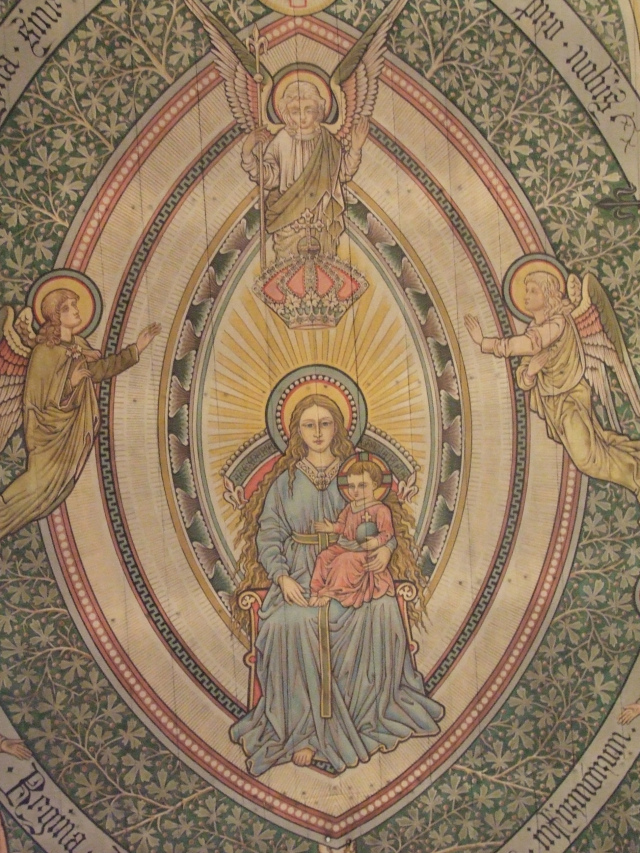
What was shown to the girls during this apparition in Gietrzwałd can be divided into two distinct images: the first, located inside the ring, and the second, outside it. Let us first focus on the first, encompassed by the circle. In its center, we see Mary surrounded by angels. One of them holds a pike, at the tip of which is a rose. The angels have green wings, which immediately brings to mind the image of the thornbush mentioned earlier. The symbolism of this scene is incredibly profound and rooted in Sacred Scripture. The angels surrounding Mary should be interpreted as Cherubim, which—according to the Book of Genesis—were placed by God to guard access to the Tree of Life, so that no sinful creature could have eternal life. The green wings of the angels symbolize evergreen leaves, a sign of life that never fades, while the rose at the tip of the pike resembles a bud of fire—a subtle but clear image of the cherub's fiery sword, rotating to guard access to the Holy Tree. It is particularly significant that the girls first see the ring, and only then are Mary and Child Jesus led into it, crowned by God's angels. In this light, the entire image should be read as an apparition of Mary in a thorny rosebush—a motif also present in the apparitions in Lourdes, Garabandal, and Guadalupe. Mary's coronation in this scene is not merely a symbol of glory, but signifies that she has been chosen by God as Queen of all humanity. Consequently, Jesus, as her Son, becomes the Prince. In the context of the symbolism of the Tree of Life, Mary appears as the Tree, and Child Jesus as its Fruit—the one who must be eaten to gain eternal life. This echoes the words of Christ himself, who says: "Whoever eats of this bread will live forever." Another detail with profound significance appears in this extraordinary image: Mary's bare foot. In this depiction, the serpent is absent from beneath her, clearly indicating that she has already defeated it. This image refers us to an earlier sign—a mysterious ribbon with an inscription about which Mary said, "He meant nothing." It should be emphasized here that the serpent was defeated by her personally, which does not mean that the world has been cleansed. Each person must defeat their own serpent, with the help of Mary and Jesus. Her bare foot no longer needs to trample the serpent, because she has defeated it. The serpent no longer has any power over her. It is also worth mentioning a symbolic event that occurred during one of the apparitions: the dry branch on which Mary stood—interpreted as a serpent or the head of a dragon—broke. We see, therefore, that once again the symbolism of this event indicates that Mary defeated the serpent.
In the image of the apparition, we also see Mary sitting on a throne adorned with pearl beads. This motif is not coincidental—these pearls symbolize the beads of the Rosary, of which Mary is Queen. The Rosary is a spiritual weapon—a prayerful weapon with which we stone the evil present in our hearts. Looking at the Rosary, we can see that its beads resemble small stones, and the cross with the image of Christ at its tip resembles a sword. This is not only a symbol of prayer but also a sign of spiritual weaponry. The Rosary corresponds to an event described in the Book of Joshua, where we read:
Joshua 10:11 : "And as they fled from before Israel, and were on the slope of Beth-horon, the Lord cast down great stones from heaven on them, even to Azekah, and they died. More of them died with the hailstones than those whom the children of Israel had slain with the sword."
This passage, although describing a military event, when read from a spiritual perspective, reveals the power of God's action, which aids man in the fight against evil. The Old Testament, in fact, reveals a spiritual reality through physical events. It is not about waging war between people, but about the inner spiritual battle that rages within the heart of every person. In this light, the Rosary becomes like a hail of stones—aimed not at others, but at the sin rooted in human hearts. The Rosary is a weapon not of violence, but of love. A weapon that does not wound, but purifies. In this way, Mary's throne of pearl beads reveals not only her royal dignity but also recalls her role as Guide in spiritual battle—one who teaches how to triumph not by sword, but by prayer and faith.
The entire image contained within the ring seems to be directed specifically at children. The cherubim that appear within it do not inspire fear, nor do they appear as menacing guardians, but rather resemble gentle angels, with serene faces and a delicate appearance. Through this image, Mary conveys a subtle yet profound message: shaping the human heart should begin with children. Parents are the first responsible for leading their children to God—through example, prayer, participation in the sacraments, and the daily presence of faith in the home. This is understandable: if we learn what goodness is from a young age, then in adulthood we will live in accordance with values such as love, justice, and righteousness. And through the transformation of individual hearts, the entire society changes. Goodness that begins in the family has the power to transform the face of this world.
The ring, in the center of which we see Mary with the Child Jesus, is a symbolic representation of the interior of Paradise—a place where humanity lived in unity with God, in peace and without sin. At the center of this spiritual garden is the Tree of Life, represented by Mary—the New Eve, bearing the Fruit, which is Jesus Christ. It is worth noting that Christ holds a globe in his hand, with a Cross at its summit. This gesture is not accidental—it was He who placed the Cross at the center of the world as a symbol of the struggle for good. The cross simultaneously becomes an altar on which man is to offer a spiritual sacrifice to God: a sacrifice of his own commitment to making the world good. When God created the world, he said, "And God saw that everything he had made was very good." However, this goodness was an announcement, a goal to be achieved, not a fully realized reality. God works through man, making this world good. This action, however, can only proceed when man's will is in harmony with God's Will. Christ came into the world to fight for good. Everyone who fights for good in the Spirit of God shares in the Cross of Christ. And whoever shares in His Cross will also share in His glory.
As for the second image, on the outside of the ring, we see a maple tree, symbolizing the tree of death—a world in which we learn to distinguish good from evil. The maple tree does not bear edible fruit, therefore it in no way gives life. It is important to note that Paradise is not found in our material world, but in the spiritual one. Matter serves only to teach and shape the human soul. Mary reveals herself in a spiritual state, therefore the Kingdom of Heaven is also spiritual. To be born into the Kingdom of Heaven, a person must bear fruit pleasing to God, a fruit reflected in their entire life in the material world.
Prophecy – the branch that did not break Mary
"The people began to disperse peacefully from the cemetery in the dark night, for it was already after nine o'clock. And later, after ten o'clock, the gendarmes were ushering the remaining pilgrims out of the cemetery. Then—amazingly!—suddenly, one branch, as thick as a good-sized peasant, of the maple tree on which the Blessed Virgin Mary had appeared, cracked, broke, fell onto the new chapel standing nearby, and also broke it in half, but did not overturn it—and fell with a rustle to the ground!!"
The falling maple branch broke the chapel and—significantly, although not included in the above account—broke the Cross atop it.
This event should be read as a prophecy, foretelling Satan's battle with the Cross, the Church, and the Mother of God. The symbolism is clear and telling: Satan will attempt to destroy the unity of the Church, its credibility, and authority, causing people to turn away from it. However, and crucially, Mary is not defeated. The chapel, though damaged, does not fall. This is a sign that although the Cross and the Church experience suffering and attack, Mary, as the Tree of Life, will remain unwavering. This is precisely why we should seek refuge in Her maternal arms—in Her we will find strength that no evil can break. It is also significant that this scene takes place at the moment when the gendarmes are forcing people out of the place of the Apparitions. This is a sign that Satan is behind people's turning away from God. People's turning away from the Church is often the result of politics, government decisions, and scandal, which unfortunately comes from the clergy themselves. Priests, who, instead of bringing light, become instruments of darkness. Modern times clearly confirm the fulfillment of this prophecy. People are being almost forcibly drawn away from God—just as the serpent drew Eve away from God, tempting her with apparent goodness. One of the most painful causes of today's spiritual crisis is the sins committed by the Church's pastors—especially sexual crimes against children, and their systemic cover-up by some Church structures. Such profound scandal leads to a mass exodus of the faithful and a loss of the Church's authority.
The lack of response is all the more striking. Instead of cleansing the Holy Land of sin—as Joshua and later Jesus did—some hierarchs remain indifferent. Their attitude seems to indicate a profound weakening of faith. This ongoing process has also been completed by the pandemic. Restrictions have led to the closure of many churches, and where liturgy was available, people were often afraid to participate. Simultaneously, the Cross has begun to disappear from public spaces—from the roofs of churches, schools, and offices. This is another sign of spiritual erosion and the ongoing struggle between politics and Christianity. Behind these phenomena stands evil, which always opposes good, seeking to maintain its dominion over the world. Although we don't always recognize it, Satan works through people—including the clergy. We are reminded of this in the Gospel, in which Jesus enters the synagogue and encounters a possessed man, most likely a priest. Christ casts out the evil spirit from him, thus demonstrating that even those who are supposed to lead can fall victim to the darkness. The incident of the falling branch is therefore not only a sign—it is a call: to vigilance, to conversion, to trust in the Mother of God. For although Satan relentlessly strives to draw people away from God—even using priests—Mary does not fail. In her lies salvation and victory.
Water source
As mentioned earlier, a spring flowing from a nearby hill was blessed by the Mother of God. This extraordinary event took place on September 8, 1877, and finds its spiritual roots in Holy Scripture. In the Book of the prophet Ezekiel, we find a symbolic image of water flowing from God's temple:
Ezekiel 47:12 "Their leaves will not wither, and their fruit will not fail. They will bring forth new fruit every month, for the water flows from the sanctuary . Their fruit will serve as food, and their leaves as medicine."
The water flowing from the Gietrzwałd spring has special healing properties. This is evidenced by numerous testimonies from people who experienced healing—both physical and spiritual—after drinking it. Many pilgrims report deliverance from serious illnesses, peace of heart that returned after long periods of suffering, and profound conversion. However, what is particularly moving are the events that began to unfold when the spring was blessed by Mary and the faithful returned to the maple tree – the original site of the apparitions. Many present then experienced extraordinary visions. Some saw the Mother of God dressed in white, others saw a dragon present in the tree. These accounts indicate that the spiritual reality began to unfold before those gathered. A profound spiritual truth can be drawn from this: water blessed by Mary not only brings healing to the body but also strengthens the soul. It causes one to perceive the spiritual world. They become more sensitive to the things of God – as if, for a moment, the veil separating the visible from the invisible worlds had lifted. The events of that day were described by one of the priests, who witnessed them firsthand. Here is his account:
" When the clergy returned from there with those chosen ones, it was already 8 o'clock. So they lit candles and, together with the children, left the rectory, as usual, for the cemetery to say the Holy Rosary. Now I was pressed in with them again. The singing fell silent. Silence. The proper prayers began, with a certain girl, Anna Maternowa, leading the way; then the proper Rosary itself. In the second mystery, the Blessed Virgin Mary appeared to those four chosen beings, who, as if struck by an electric spark, made a low bow. At this, the trumpet sounded a signal so that the gathered people would know that the Blessed Virgin Mary had already appeared. After a short while, those chosen beings in ecstasy suddenly cross themselves together and, falling – making a deep bow – because the Blessed Virgin Mary is blessing with her benevolent right hand, perhaps for the last time! At this, the trumpet sounds the signal again. The people, falling, pray humbly with an outpouring of their spirit. When The rosary was coming to an end, and it seemed to me that Our Lady was leaving at that moment. Suddenly, a terrible and terrifying scream broke out, not just a roar, a howl, a moan, a sob, and some strange, ineffable voices, which continued for a long time and filled the air. It was already calming down a bit, but then it became even more terrifying, until finally everything became silent, and one of the priests ordered a heartfelt Hail Mary to be said. At that terrifying moment, probably even the hardest hearts were broken. They thought that the earth was opening up and swallowing everyone, or that the Last Judgement was beginning, or that Hell was suddenly devouring people, etc. I, too, was trembling, like everyone else, with my whole body, and looking in all directions, especially at the maple tree, staring wide-eyed, but seeing nothing anywhere, and I thought to myself that this was where everyone was worthy of seeing Our Lady, so they were screaming so out of emotion; and I alone was the one who was Most unworthy—which is what I truly consider myself—so I see nothing. Then a priest standing nearby asks me what he saw? "Nothing," I reply. "Neither did I," he says. And the others kneeling nearby also saw nothing. The rain began and stopped during the Rosary. Finally, the Rosary, the Litany, and the usual prayers were finished—one priest said a few words from heart to heart, reassuring, and intoned "Hail, Queen." Oh, what power was this harmonious singing, when at once, from so many thousands of people gathered from various parts, this beautiful melody in heartfelt words resounded and reached its conclusion in the best harmony and unison! It was truly exceptionally enchanting. When the singing ended, they immediately began asking each other in the cemetery: what was the reason for those piercing cries, accompanied by a strange wind, rustling the trees and waving the banners with a roar. And they began to learn that it wasn't without reason. For some said they had actually seen the Blessed Virgin Mary, white in the maple tree, and there were many of them; others saw an extraordinary brightness there, others a bright pillar at the corner of the church; others a dragon in the maple tree, which the Virgin Mary immediately trampled; one academician claims to have seen a devil, whose form he described more peculiarly; another, an unbeliever, screamed shrilly for help, trembling with his whole body, as if the devil was about to kidnap him and was fending him off with a stick, calling for a candle; the devil also allegedly wanted to kidnap another woman and put her in a barrel, and then she saw him riding in a carriage carrying people; Others saw a pale star, as if emerging from the maple tree, rising above it, and setting off toward the west.
We see that at the moment Mary departs, a violent wind rises, and a terrifying fear grips the people. Many of those present are convinced that death is approaching and that they themselves will be swallowed up by hell. This image brings to mind the scene from the Gospel in which Jesus' disciples, sailing by boat to the other side of Lake Genesareth, are caught in a storm. Overcome with fear and convinced that they will perish, they awaken the sleeping Christ, who calms the wind and waves, at the same time rebuking them for their lack of faith. We can see a profound analogy in this event: when people prayed the Rosary and Mary was present, there was spiritual peace. However, at the moment of her departure, a "storm" broke out. Just as Christ's disciples turned to Him during the storm, so too, in moments of spiritual turmoil, we should "awaken" Mary—through prayer. It is also significant that the priests present during these events experienced neither fear nor perceived the threat that so powerfully moved the other participants in the apparitions. It can be assumed that the source of this peace was their deeply rooted faith. When Christ's disciples, surprised by the storm on the lake, are gripped by panic and awaken Jesus, thinking they will perish, Christ calms the storm but simultaneously rebukes them for their lack of faith. This event demonstrates that faith alone has the power to overcome fear and bring peace even in the face of real threats. It seems that the panic-stricken people lacked the faith of the priests present, whose faith was more firmly rooted.
A wonderful canvas
On July 5th, as is customary in many holy places, a cauldron of water was placed and a cloth was placed on the stem of the cut branch over which the apparition had appeared. The children asked the Blessed Virgin Mary to bless the water and the cloth; they heard only the words: "The cloth is to lie on the ground." The next evening, they asked the Most Pure Virgin what more she desired besides praying the rosary? They received the answer: "A brick cross with a statue of the Immaculate Virgin is to be erected here, and at its feet a cloth for the healing of the sick is to be placed."
As we can see, initially the people placed the cloth on the withered branch, unaware that it symbolized a snake—a sign of evil and sin. However, at Mary's request, the cloth was moved and placed at the feet of the statue of Mary. Let us pause for a moment and consider: what does this symbolic gesture mean? What power does the cloth placed there—at Mary's feet—have? To better understand this, we must return to the Old Testament scene of Moses' encounter with the Spirit of God. When God appeared to Moses in the burning bush, he commanded him to remove his sandals, because the ground on which he stood was holy—sanctified by the very presence of God's Spirit. Similarly today, Mary, as the Immaculate One, is the true Temple of God, the place of His presence. Therefore, since the cloth has been placed at her feet, it takes on a special meaning: it becomes, as it were, a fragment of the Holy Land, sanctified by God's presence in Mary. Moreover, such a consecrated cloth can be taken to a sick person—carried home or to a hospital and placed on the suffering person. It is, as it were, a piece of the Holy Land possessing the power to sanctify.
Cross or Chapel?
July 9th - the children asked: "Should a chapel or a cross be erected?" They received the answer: "It doesn't matter, a chapel or a cross." The children asked: "Should the statue be standing or sitting?" They received the answer: "The statue should be standing."
The answer to the question about the difference between a cross and a chapel has, in essence, already been given. From Our Lady's statement, it follows that there is no essential difference between them—both signs refer us to the same mystery. As has already been said, Mary is the Tree of Life, which bore the Fruit—Jesus Christ. If we read this truth in light of the Cross on which Christ hung, we can say that Mary is the Cross—she who "carries" her Son becomes the Tree on which the Fruit of Life hung. We see a profound analogy here: Mary as the Tree of Life and as the Temple of God—the One in whose womb Jesus dwelt. Thus, both the Chapel, a place of God's presence, and the Cross, symbol of the Tree of Life, point to one and the same person—Mary.
Furthermore, it is worth noting the posture of the figure of Mary, which should be depicted standing. This posture is not accidental—it alludes to the mission of the Church, whose task is to lift fallen souls.
Another apparition, which took place on August 22, 1877, in Gietrzwałd, is associated with the cross. It was unique because of the way Our Lady appeared to the seers—each girl experienced this vision in a slightly different way. On that day, Barbara Samulowska saw only Our Lady's right foot. Rays of light emanated exclusively from her hands. The sash on Mary's robe was narrow, pleated, and visible only at the sides. Justyna Szafryńska, although she participated in the same apparition, experienced it completely differently. She saw both of Our Lady's feet, and light radiated not only from her hands but also from her feet and from beneath her neck. The sash of the garment was wide and visibly taut. Concerned by these differences, the girls asked Our Lady about their meaning during the next apparition. Barbara was told that she should be satisfied with how Mary appeared to her. Mary, in turn, explained to Justyna that these differences existed to make people more faithful. How, then, should we understand these differences? We have already mentioned that Mary, as the Tree of Life, is also symbolically identified with the Cross to which Christ was nailed. Recall that Jesus had wounds in his hands, feet, and in his heart, which was pierced by a spear from the side. Note that Justyna Szafryńska perceived light emanating from Mary precisely where Christ was pierced by the nails. Since Mary is the Tree of Life to which Jesus was nailed, she too—in a spiritual sense—was "pierced" by the same nails. This does not mean the physical suffering experienced by her Son, but rather a deep compassion for his spiritual pain. Every mother, looking at the suffering of her child, experiences pain—not in body, but in spirit. The child's physical pain is transferred to the mother's spiritual suffering. This was also the case with Mary.
It is worth noting another detail: Christ's heart was pierced with a pike, which did not penetrate the Cross. Meanwhile, in Justina's vision, light also emanated from beneath Mary's neck. This can be interpreted symbolically: the two beams of the cross connect and are pierced with nails precisely in the area of the heart, thus also becoming a source of light. We see, then, the profound symbolism of this revelation.
Mary, as the Tent of the Holy Spirit, is, as it were, "torn" by the nails with which her Son was pierced. In these "torns" of the Tent, light emerged—a sign of the Holy Spirit's presence. The belt around her hips is wide and taut, which also indicates the presence of the fullness of the Holy Spirit within her.
Here we reach the crux of the matter. Barbara saw only the light emanating from Mary's hands, and the band around her hips was loose. In this context, the words of Our Lady become particularly significant, saying that differences in perception of the apparition stem from faith. Barbara did not yet have as open a heart as Justina. This is also indicated by the fact that she saw only one of Mary's feet—which may suggest that she still had to overcome certain spiritual obstacles that prevented her from fully experiencing the apparition. The loose band symbolizes that Barbara does not yet possess the fullness of the Holy Spirit within her—the same as Justina. The images the girls experienced therefore also refer to themselves. They reveal what Barbara still needs to work on to be able to perceive spiritual reality the way Justina did.
The Cross and Two Banners
July 25th - the girls asked, "Are people praying well now?" They received the answer: "I wish that two banners and a cross be placed in the churchyard under the maple tree during the recitation of the rosary."
On July 25th, another difference emerged in the girls' testimonies. Justyna Szafryńska said that Our Lady had expressed the wish that two banners and a cross be placed in the churchyard under the maple tree during the recitation of the rosary. Barbara Samulowska, on the other hand, did not mention any wish of Our Lady—she only described that during the apparition she saw a cross and two banners next to Mary. Another difference in the perception of Mary indicates that Barbara was not fully purified. We see that Justyna not only had previously perceived the fullness of Mary's apparition, but now she also hears Her Voice clearly. However, Barbara, just as she did not fully see Mary's apparition, did not fully hear Her. We see that the differences in the girls' perception of the apparitions stem from the purity of their senses—primarily sight and hearing.
Throughout the entire period of apparitions, these differences in perception occurred three times. Let us now examine the third, which—as will turn out—also indicates that Justyna was more open to the Holy Spirit than Barbara. The third apparition, during which differences in the girls' perceptions were revealed, occurred on August 23, 1877. These differences concerned the day and hour when Our Lady was to appear for the last time. Justyna Szafryńska was told that the last apparition would occur on the Feast of the Nativity of Mary, Saturday at 9:00 PM. Barbara Samulowska, on the other hand, understood that it was to occur on Sunday evening, also the Feast of the Nativity of Mary. When the girls asked Our Lady again about the day of her last apparition, it turned out that Justyna was right.
Barbara received a warning from Mary to listen better next time. As we can see, once again, Justyna heard Our Lady more clearly. Her spiritual hearing was clearer, allowing her to better understand the words Mary conveyed.
A closer look at the lives of both visionaries reveals distinct differences in their subsequent fates. Barbara entered a convent and remained consecrated until her death, faithfully pursuing her vocation. Justyna also initially joined a religious order, but after some time she left and married. Some accounts suggest that she regretted this decision, later confessing that married life was much more difficult for her.
How do these life choices relate to their spiritual experience during the apparitions? After all, it was Justyna who seemed more open to the Holy Spirit than Barbara. At first glance, it might seem that their subsequent lives do not reflect the spiritual level they represented during the apparitions. However, this is only an apparent contradiction. It is here that the profound truth about femininity and her spiritual mission is revealed. The role of woman, as recorded in the Book of Genesis, involves, among other things, supporting man and bringing life and love. A woman's ministry in marriage is often much more difficult than life in the consecrated state, which by its very nature fosters concentration, prayer, and the purification of one's heart. Marriage, in turn, brings with it constant relational, emotional, and spiritual challenges that require great inner strength. Justina, who was already more open to the Holy Spirit as a child, was therefore able to undertake a more difficult path—not to protect herself, but to purify others through her own sacrifice and daily struggle. Her earlier spiritual depth was not squandered, but transformed into a quiet, hidden form of service. It should be added here that Barbara also lived for others, carrying out missionary work in Guatemala, but this was of a somewhat different nature.
The cross and the two banners, which were to be erected during the recitation of the Rosary, are part of the overall message of the revelation. The cross between the two banners again refers to the Tree of Life and the Cherubim guarding access to it. These elements were to be displayed during the recitation of the Rosary, because people did not want to say it while looking at the maple tree on which Mary stood in a mystical way.
Satan's Deception
On the feast of St. Lawrence, Justina did not return in the morning. After praying the morning rosary, as she usually did, she did not go straight to the house of the owner who had taken her in, but stopped on the way to the house where the seamstress Katarzyna Hennig lived with her mother. (...) The girl, always so healthy, suddenly felt weak and, at the urging of those present, lay down on the bed. She fell asleep immediately, but soon woke up because it seemed to her as if someone had taken her by the hand. Upon waking, she saw the Blessed Virgin above her in the same way as always, and at her feet were six coffins. One of these was marked as her own. It also seemed to her as if, even before the vision disappeared, she heard the call: "Come here always." The next day, after the afternoon service, Justyna told little Barbara what had happened to her and called her to go with her to the seamstress's house, as the apparition there was clearly for her as well. (...) Barbara dozed off a bit, but, without knowing from whom, she felt awakened, and saw, like Justyna, who this time had not fallen asleep at all, the same figure she had seen in the maple tree, surrounded by a multitude of angels, hovering over the bed. After some time, the vision said to the children: "I will now always appear to you here. Come here every day, even if others strictly forbid you." Then the vision ended, and the figure of an angel appeared, holding a ribbon in his hand, on which the following words could be read in Polish: "Illumination over your sins, wanting to know them well."
After the apparitions that occurred in the seamstress's home, the girls went to the parish priest to tell him about the event. When the priest heard their account, he strictly forbade them from visiting the seamstress and instructed them to ask Mary about the origin of these visions. In response, Our Lady said that they should listen to the parish priest, and that the vision itself was from the devil. It is therefore worth considering Satan's purpose in perpetrating such a delusion. It is important to emphasize here that the interpretation of such events must take place in the context of Holy Scripture, which holds the key to understanding them. As we will see, knowledge of the symbolism and message of the Gietrzwałd apparitions allows for a proper understanding of what happened in the seamstress's home. In light of the apparitions in Gietrzwałd, Mary symbolizes the Tree of Life. Meanwhile, the apparition that impersonated Mary in the seamstress's home manifested itself as a tree of death—in this case, a maple tree, at the feet of which were coffins, the fruits of this tree's influence.
In Gietrzwałd, Mary did not appear as a maple tree, but as the one trampling it. We can therefore clearly see that Satan wanted to deceive Justyna. It is important to note that Justyna was very close to Mary, which particularly provokes Satan's anger. Those close to God are often a particular target of his attacks, and he tries by every means to draw them away from God. The same was true in Paradise, where the serpent deceived Eve, who was close to God. Satan deceived her, camouflaging evil with apparent good. Justyna and Barbara came from poor families. The seamstress's house, which offered apparent peace and comfort, was meant to be a temptation for them—an illusion of bliss and prosperity, intended to draw them away from the Tree of Life and Mary's true apparitions. The coffins at the apparition's feet, on the other hand, were meant to evoke fear and discourage the girl from continuing to visit the maple tree. Justyna was given the impression that one of the graves was intended for her. Recall that Adam and Eve—after breaking God's prohibition—hid from God behind a tree. Satan tried to achieve the same effect: to make the girls flee from Mary and take refuge in the seamstress's wooden hut. Disobedience to the parish priest, who, as a pastor, is God's vicar, would be tantamount to breaking God's commandment. As for the seamstress herself, who sewed Justina's clothes, in a sense she usurped God's role. Scripture tells us that God clothed Adam and Eve after their fall, when they were filled with sin. Thus, the seamstress—by sewing the clothes—symbolically takes on the role of the Creator, but she does so as an imitation, not as a true helper, which constitutes another deception. The events that unfolded in the seamstress's house are deeply connected to the biblical story of Adam and Eve—with the difference that they have been translated into the present day. In this story, Justine symbolically takes on the role of Eve, who, after her first visit to the seamstress, tries to persuade Barbara—playing the role of Adam—to come along. This temptation with apparent goodness was supposed to lead to their mutual departure from God. During the second vision, the apparition disappeared, and in its place appeared an Angel with a ribbon bearing the inscription: "Illuminate (meditate) on sin, so that you may know it well." It can be assumed that the presence of the Angel—presumably the Guardian Angel—caused the deceptive apparition to depart. It is worth noting that the inscription on the ribbon is directly linked to the biblical tree of knowledge of good and evil. The theme of distinguishing between good and evil, so important in the Book of Genesis, fits perfectly with the message of the revelations. This is not only a call to reflection but also a spiritual instruction: "Meditate on sin"—that is, know its essence, its roots, so that you can avoid it. The words on the ribbon are true and universal. Every Christian should reflect on their own sin, because understanding its nature leads to conversion. There is a spiritual principle: whoever recognizes that something is sin and desires good from the heart will avoid sin. However, whoever knowingly and willingly commits evil, even though they know it is sin, rejects God and becomes the offspring of the serpent. Such people have come to love sin and refuse to break away from it. Their hearts are hardened, and their will has been given over to evil.
Jonah
Here we come to one of the most important messages of the Gietrzwałd revelations, addressed to the entire Polish nation. It has a profound connection to the Book of Jonah. Let us briefly recall the story of Jonah. His story—though short—is incredibly rich in symbolism and in many respects is based on patterns found in the Book of Genesis, which, in turn, is also alluded to in the Gietrzwałd revelations. God gives Jonah a specific command: to go to Nineveh and proclaim to its inhabitants the call to conversion. However, Jonah refuses, thus violating God's command, and flees from God. He seeks refuge aboard a wooden boat, hiding below the deck—symbolically, like Adam and Eve hiding from God in the Garden of Eden. In the context of the Gietrzwałd revelations, the seamstress's house is said to be the place where the girls hid from Mary, thus abandoning their divine calling. When God sends a storm and churns the sea, his fellow passengers—terrified—throw Jonah overboard, fearing for their lives. As Jonah sinks, he prays fervently to God. He is answered: the Lord sends Jonah a huge fish—His Spirit—to help him, swallowing him, thus saving him from death. After three days, the fish spits him out onto the shore, giving him a new chance. Jonah accepts God's call and fulfills his mission. We see clearly here that it was fervent prayer that saved Jonah from death—even though he had sinned. Through an act of repentance and faith, he is saved, and God gives him a new chance to reform. But what connects Jonah to the apparitions in Gietrzwałd? To better understand this similarity, it's worth recalling the historical context of the apparitions. At the time of the Gietrzwałd apparitions—which took place in 1877—Poland did not exist on the world map. After the third partition in 1795, our country was erased from the political reality of Europe by three occupying powers: Russia, Prussia, and Austria. The period of captivity lasted 123 years, until Poland regained its independence in 1918. Recall that Jonah was disgorged by a fish after three days, as was Poland, which regained its independence after the third partition, a captivity that lasted 123 years. So what is Poland's role, given to it by God but not fulfilled by it? It doesn't have to be the specific task Jonah had, but rather the simple failure to honor God's covenant, which is the breaking of His Law. At the end of Mary's apparitions in Gietrzwałd, Mary gives the Polish nation, which had been swallowed up by other countries, the instruction to pray fervently. These words directly refer to Jonah, who prayed fervently to God and thus regained life. Mary gives us guidance on how to regain independence, which can only come through God.
The root cause of all the partitions of Poland was sin—both on the part of the ruling elites and the citizens themselves. Among the Polish nobility and magnates, quarrels, selfishness, disunity, and a preoccupation with their own interests at the expense of the common good prevailed. Internally weakened, the Commonwealth became an easy target for neighboring powers. Many of those in power betrayed their country—not only by action but also by omission. Governments were often taken by people devoid of true national, spiritual, and moral identity. The Fathers of the Fatherland turned away from God, and the spiritual void brought political catastrophe.
Poland—like Jonah—was thrown overboard by its neighbors and plunged into the depths of slavery. The question is: has Poland learned any lessons from these events? Looking back at contemporary times, it's safe to say that Poland has learned nothing and continues to make the same mistakes. Jonah was given a second chance by God and took advantage of it. Poland, however, continues to repeat its mistakes, as if it had understood nothing.
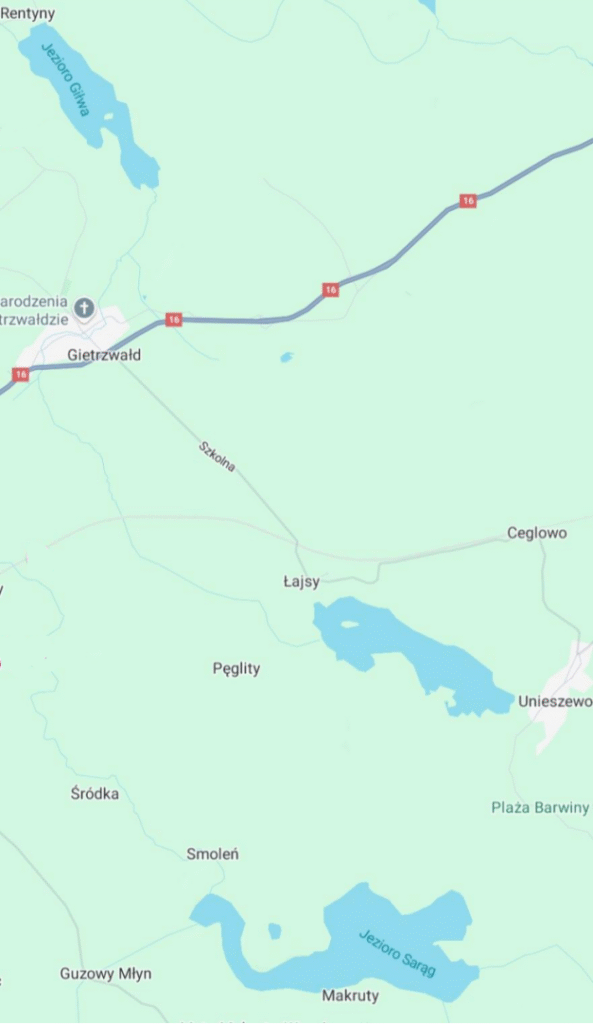
To conclude this reflection, let us point out a curious fact that—for those who truly believe—may be a sign confirming the authenticity of Mary's apparitions in Gietrzwałd. For those far from God, however, this sign will have no significance. It is a sign that—in a symbolic way—heralds Poland's return to world maps. It can be seen in satellite images of Gietrzwałd and its surroundings. In photos 10 and 11, Lake Giłwa, also known as Lake Rentyńskie, is visible in the upper left corner. Its shape resembles a huge fish with an open mouth, from which Gietrzwałd seems to be "spewing."
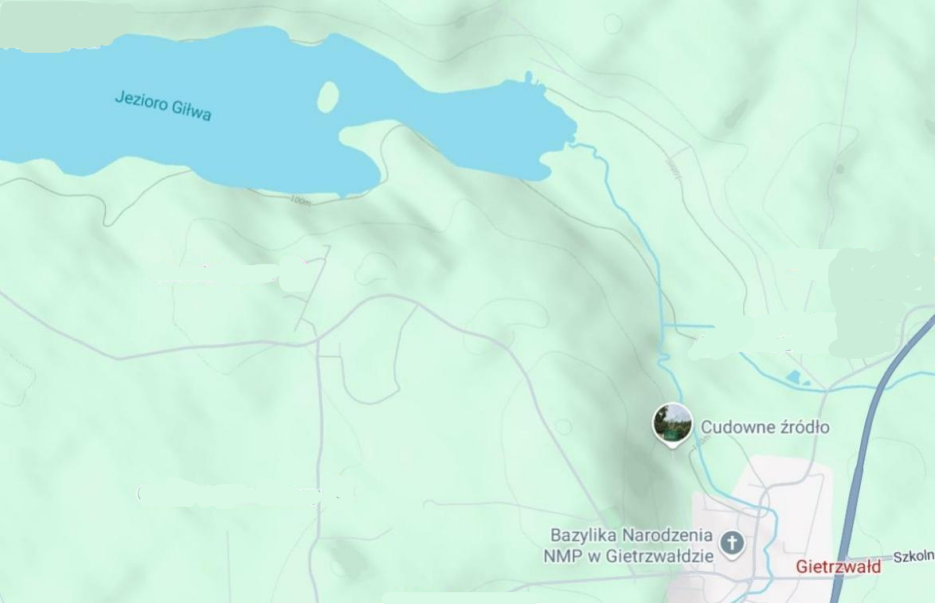
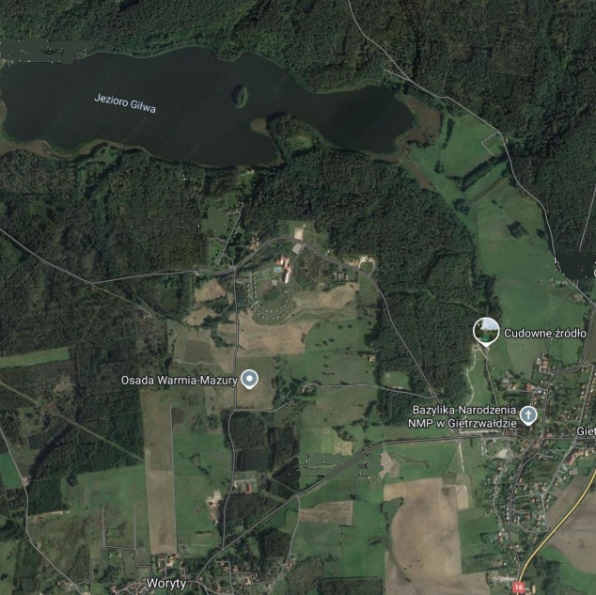
This symbolic image fits into the story of Jonah and once again refers to the spiritual message of the apparitions. Thanks to the Mother of God, who in Gietrzwałd called for fervent prayer of the rosary, Poland was, as it were, "spat out"—like Jonah—reclaiming its life and receiving another chance for conversion. Our task is to make good use of this opportunity. Interestingly, if we look at satellite images of Gietrzwałd from a slightly wider perspective, we discover that there are more lakes in the region, shaped like fish—as shown in photo 12. This is another sign that—for a person of faith—can become a confirmation of God's presence.
Will Poland Ever Free itself from Russia? Reflection on the Gietrzwałd Revelations
From Paradise to Gietrzwałd – a Symbolic Analogy.
At the very beginning, Adam and Eve lived in God's presence. They conversed with Him and enjoyed paradise's happiness and harmony. However, when God withdrew and they were left alone, Satan, in the form of a serpent, tempted Eve to break God's commandment with the appearance of goodness. Eve plucked the fruit from the tree of knowledge of good from evil and tasted it, giving it to Adam as well. Even though Adam and Eve knew God's Law and were pure, they could not resist temptation – their wills proved too weak. This biblical scene is incredibly relevant – many people today still know what good and evil are, but life – with its temptations, illusions, and false happiness – tests our will. It is our willpower, aligned with God's will, that determines whether we remain in covenant with God. The greater the temptation we resist, the greater our spiritual strength grows.
Poland as a Place of Trial
It seems that all of Poland—like Eve—stands perpetually under the tree of death, tempted by the serpent. Through the apparitions in Gietrzwałd, Mary tries to help us expel this tempter, crush his head. However, we must listen to what she says. The Rosary is our main weapon, a hail of stones sent from God, which has the power to stone evil. One of the first words Mary utters in Gietrzwałd is the wish to pray the Rosary. Mary appears in a maple tree, crushing the serpent, announcing the spiritual battle that every Pole must wage within their own heart. It is also a harbinger of victory, which, however, does not come without trial. When we examine the history of Poland—especially in the context of partitions, wars, and the loss of independence—it may seem that God has abandoned us. But this is only an appearance. Just as with Adam and Eve, God was not visibly present—yet their trial was part of God's plan. Poland is also undergoing a test of faithfulness, in which its willpower is strengthened.
The light of the Holy Spirit
. The Gietrzwałd revelations are full of clues that help distinguish good from evil. In response to questions about those behaving indecently, Mary clearly states: they will be punished. But she also adds that prayer for such individuals can help them avoid the punishment they deserve. Prayer thus becomes spiritual support, thanks to which someone can receive grace – light that leads to good. But the ultimate choice still belongs to the individual. Mary also mentions alcoholism – a sin that destroys many Polish families and is one of the tools of evil. Alcohol tempts with apparent, short-lived happiness, leading people to break God's Law. Gietrzwałd is a place where Our Lady helps people recognize these spiritual traps and overcome them through prayer and conversion.
Covenant and the Consequences of Its Breaking:
At the foot of Mount Ebal and Mount Gerizim, God renewed his covenant with the people of Israel, clearly defining the conditions of blessing and curse. Faithfulness to God's Law was supposed to bring blessings to the nation, while breaking the covenant brought curses. One of the most severe punishments for infidelity was exile from one's homeland. Isn't this also a familiar experience in Poland? The revelations in Gietrzwałd seem to fit this biblical pattern: a nation that strays from God's commandments experiences suffering, decline, and loss of independence. Poland, like ancient Israel, experienced periods of spiritual infidelity, which resulted in dramatic consequences – partitions, wars, loss of sovereignty. Russia – the invader and persecutor – can be seen as the instrument through which the punishments announced in the Book of Moses' Law (Leviticus 26:14-45) are carried out. There is no escape from sin – except through repentance and conversion. Let us recall the story of Nineveh. When the prophet Jonah called upon the inhabitants to repent and repent, the entire city sprinkled ashes on their foreheads and fervently implored God for forgiveness. And then – despite the earlier prophecy of destruction – God averted the punishment. This scene is an eternal reminder that even in moments of greatest danger, God's mercy is open to those who return to Him with a contrite heart. It is also worth adding that the nations that became instruments in God's hands – executors of His judgment – were not without responsibility either. The Old Testament prophets call them "lambs fed for the slaughter," which God Himself makes fat so that in the end He will mete out justice. Their pride, cruelty, and abuse of power will be judged – not by man, but by God Himself.
Mary's words that Poland will "never" free itself from Russia should be understood not in a political sense, but in a spiritual one – as a reminder that the Covenant with God is binding always and everywhere. Blessings are reserved exclusively for those who keep this Covenant. Curses, however, inevitably fall for those who break it. Russia, as Poland's neighbor and historical occupier, can be seen as a tool for realizing this Covenant—consciously or not. What happens between nations is not always the result of politics alone—it can also reflect a spiritual order, the meaning of which is understood only in the light of God's Word. Therefore, Poland must remember that its fate—as a nation—depends on its fidelity to God. Only by persevering in goodness, rejecting sin, and resisting the appearance of happiness offered by the serpent can it emerge victorious from this trial. Just as Mary in Gietrzwałd crushed the serpent's head, so too can Poland—through prayer, conversion, and perseverance in truth—overcome that which spiritually enslaves it.