
Apparitions of Our Lady in San Sebastian de Garabandal

All Marian apparitions are based on specific principles, the most important of which is their contextualization of biblical events to which God desires to draw our attention. Through these apparitions, Sacred Scripture comes alive, and we gain the opportunity to view them from a new perspective. Marian apparitions aim to remind us of the unchanging principles relating to human salvation and to enable a deeper understanding of them.
Furthermore, each apparition serves as an admonition to lead a person to conversion, abandoning sin, and preparing for an encounter with God. The moment of death is the liberation of the soul, but it is the degree of its purification during life that determines its future fate. If a person becomes holy in this world, their soul will go directly to Paradise. However, if they do not have time to purify themselves of sin, the gates of Paradise will remain closed to them.
The goal of Marian apparitions is, therefore, to lead a person away from the path of sin, which served as a kind of learning tool. It is worth emphasizing that the acquisition of the teaching on distinguishing good from evil is expressed in abandoning sin. God could have created the perfect human being from the very beginning, but he chose not to do so because it had a profound purpose. A perfect human being would have been an artificial creation from the very beginning, and, moreover, everyone would have been the same. Human free will guarantees their authenticity and diversity, and at the same time indicates that they must achieve this ideal on their own. To facilitate this, God gave them the Holy Scriptures and the Marian apparitions, which serve as a guide to salvation. We can learn about sin not only by avoiding it, which demonstrates the acquisition of the teachings, but also by accepting it without the desire for revenge. Knowing its effects on our own bodies, the lesson becomes forgiveness and not allowing ourselves to make the same mistakes against others. Faith in God should awaken in us a desire to explore the principles and matters of Heaven, because only by understanding them can we consciously and truly fulfill God's will.
Everything associated with the Marian apparitions is not accidental and has some significance. The apparitions are a perfectly tailored setting, alluding to biblical events. To decipher their message, we must focus on aspects such as the location of the apparitions, its name, the events that took place and are taking place there, the course of the apparitions themselves, the content of the Messages delivered by Our Lady, and the forces of nature that serve as a means of communication between God and humanity.
The seers play a crucial role during and after the apparitions. In addition to serving as intermediaries between people and God, they also play the role of biblical heroes. When interpreting the apparitions, we must consider their lives and deaths, remembering that the biblical events unfolded over time. Apparitions that occurred many years ago can therefore still be interpreted, proving their truthfulness today.
The apparitions in San Sebastian de Garabandal contain all of the above aspects, which, as we will see, create a single, coherent message closely linked to Sacred Scripture. Let us begin our considerations with the name of the place where the apparitions took place: San Sebastian de Garabandal.
The meaning of the name San Sebastian de Garabandal
There are towns near San Sebastián de Garabandal with similar names, so it's important to use the full name of the apparition site. Furthermore, as we'll see, the first part of this name provides key information that will help us fully understand the message.
Let's begin our reflection with San Sebastián, which translates into English as Saint Sebastian, a martyr who died for the faith. Sebastian was the commander of the bodyguard of Emperor Diocletian, who unleashed the persecution of Christians in the Roman Empire. Saint Sebastian spiritually supported those condemned to martyrdom and also accused the emperor of cruelty, for which he was sentenced to death. He was tied to a tree and pierced with arrows. However, according to chronicles, he survived. He was mistakenly declared dead and left tied to the tree.
When Saint Irene of Rome wanted to bury the body, she noticed signs of life and decided to care for Sebastian. After recovering, Saint Sebastian went to the emperor again, accusing him of cruelty. In response, the emperor, in a fit of anger, ordered him beaten with clubs to ensure that this time he would surely die. This entire event took place in the third century, around 288.
Saint Sebastian ignored the fact that Emperor Diocletian held supreme power in the Roman Empire, thus proving that there was no man on earth who was not bound by God's Law. His stance was a testament to his courage and devotion to God.
Saint Sebastian's attributes, which will be important in our further considerations, are: his courage in admonishing, regardless of the person, and his resistance to all types of weapons with a spearhead. Let us now turn to the second part of the name of the town. Garabandal comes from the Basque word gara , meaning high, great, peak, and vandalo , derived from the word bandal (or bandálico ), which translates as vandal. The word "Vándalico" refers to the Vendul River, which flows through Garabandal.
The Vandals were the Germanic people who invaded the Roman Empire and established a kingdom in North Africa. Vandal troops were stationed near Garabandal, so it is believed that the river's name derives from this people. The Vandal troops wreaked great havoc, hence the term "vandal" came to mean someone who wreaks destruction or engages in vandalism.
At first glance, translating Garabandal as "great vandal who wreaks havoc" may seem abstract and incongruous with the Apparitions of Our Lady. However, as we will see, this is a completely accurate translation. In the next chapter, we will learn that the full name, San Sebastián de Garabandal, refers to the army of great vandals led by Saint Sebastian.
Let us now turn to the site of the Apparitions itself.
Place of the Apparitions of Our Lady
San Sebastián de Garabandal is a small Spanish town nestled in the Cantabrian Mountains, at an altitude of approximately 500 meters above sea level. At the time of the apparitions, it had a population of around 300, whose primary occupations were farming and raising livestock for subsistence. The town was quiet, deeply religious, and almost completely isolated from the rest of the world. To reach the nearest town, one had to travel about 5 kilometers over muddy, rocky roads that were unlit.
The town boasts a church dedicated to San Sebastian, where Father Valentín Marichalar would come every Sunday from nearby Cosío. Let us now look at a satellite image of San Sebastián de Garabandal, for it holds the key to understanding the message of Our Lady's apparitions.
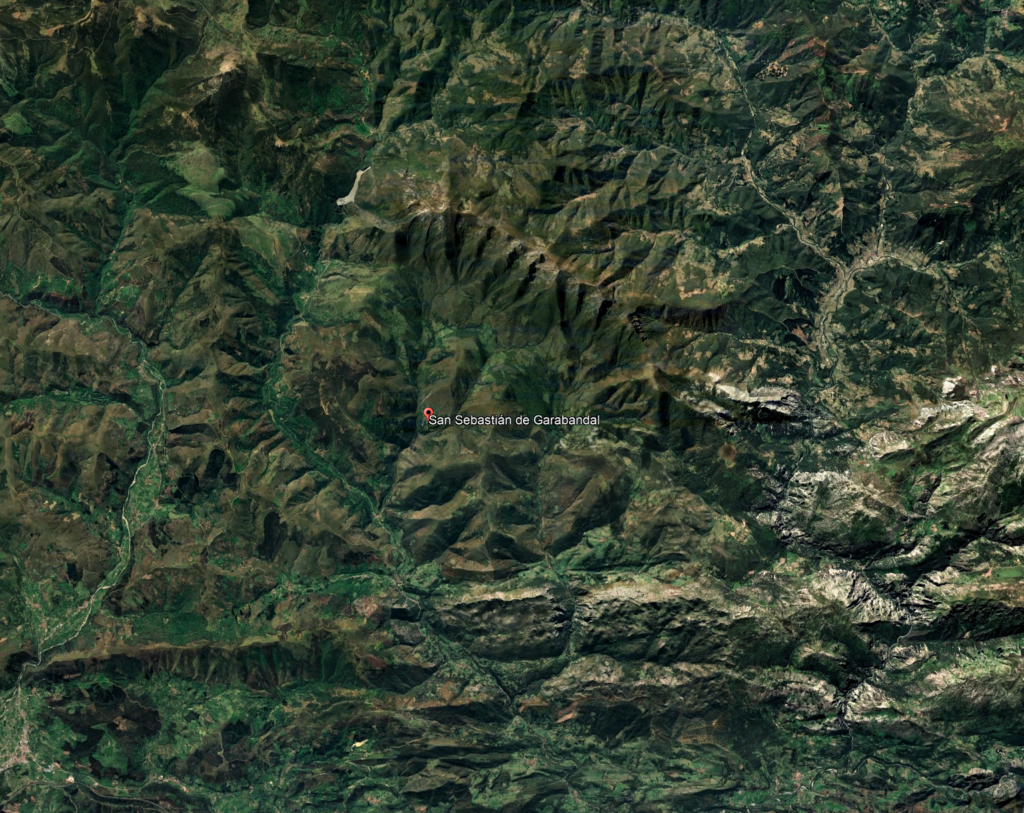
In the photo above, we see that the landscape of San Sebastián de Garabandal is dominated by mountains, whose peaks emerge as if from a flat, greenish surface of mud. Now let's take a look at the photo next to it and compare them. As you can see, the similarity between the two photos is striking. "Crocodiles" perfectly reflects the meaning of the name San Sebastián de Garabandal, which means "Great Vandals of Saint Sebastian." The stone crocodiles emerging from the water appear embedded in the greenish mud, leaving only their backs visible. As the mud level drops and we move towards land, the crocodiles become increasingly visible.
Now let's try to decipher the message of the Apparitions of Our Lady in San Sebastián de Garabandal conveyed by this image.

A message about crocodiles
- 1. Location of San Sebastián de Garabandal.
- 2. Saltwater crocodile first.
- 3. Saltwater crocodile second.
- 4. The face of the Cherub belonging to the third rosary crocodile, designated number 5.
- 5.Saltwater crocodile third.
- 6. The face of the Cherub belonging to the fourth rosary crocodile, designated number 7.
- 7. Fourth saltwater crocodile.
- 8. Alligator trying to get to the Tree of Life.
- 9. A fire-breathing alligator trying to get to the Tree of Life.
- 10. The face of the Cherub corresponds to the first rosary crocodile, marked with the number 2.
- 11. The face of the Cherub corresponds to the second rosary crocodile, designated number 3.
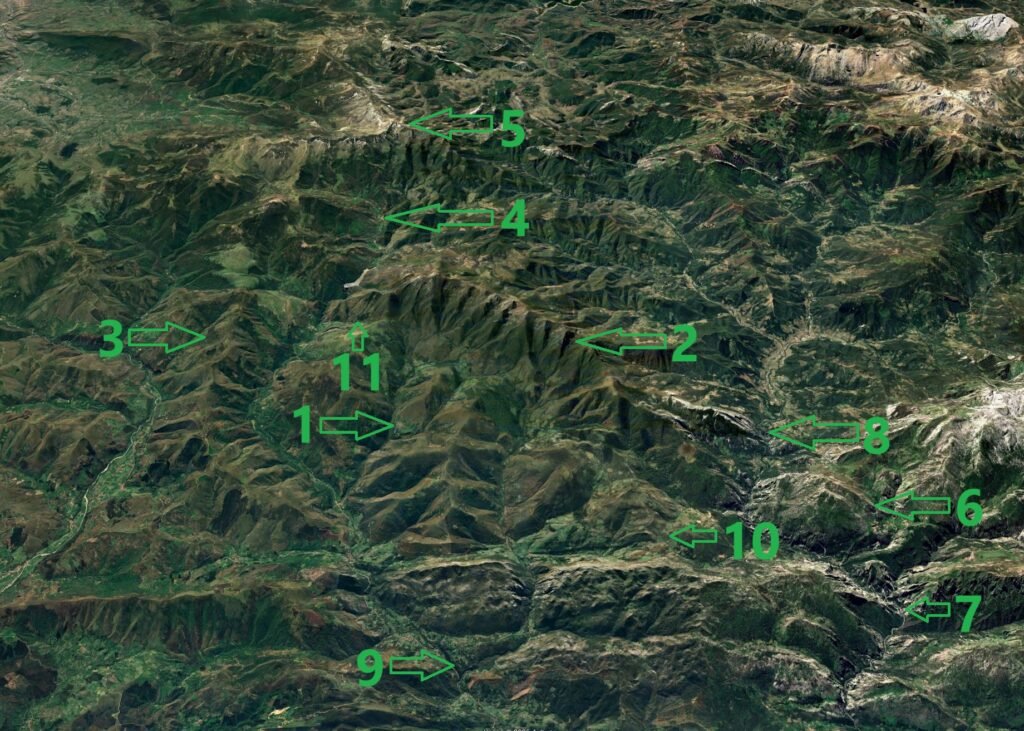
In the photo above, we see numbered key elements that will help us interpret the message. Let's begin our considerations with element number 1 , where San Sebastián de Garabandal is located. In the satellite image, we see that the town (1) is surrounded by massive mountain ranges (2)(3) , which resemble the backs of two large saltwater crocodiles.
Where the ranges (2)(3) don't connect tightly, we see two critical points through which unwanted individuals – alligators (8)(9) . However, in these places, we also see two other crocodiles (7)(5) , which, as it were, complete the ring around San Sebastián de Garabandal (1) and the Tree of Life, symbolizing the Virgin Mary.
The four crocodiles (2)(3)(5)(7) are known as saltwater crocodiles, which are among the largest modern reptiles living on Earth. These four rosary crocodiles symbolize the four Cherubim mentioned in Sacred Scripture. When the prophet Ezekiel sees the Procession of God, he is led by four Cherubim guarding access to the Tree of Life. This image alludes to the Book of Genesis, where, after Adam and Eve's sin, God closes access to the Tree of Life by placing Cherubim with flaming swords around it until human souls learn to distinguish good from evil.
Additionally, in the photo above we can see two alligators with open mouths (8)(9) , one of which looks as if it is breathing fire (9) . Thus, the four Cherubim, referring to the four rosary crocodiles, guard access to the Tree of Life from two sinful alligators that could pose a threat to the residents and pilgrims coming to San Sebastián de Garabandal.
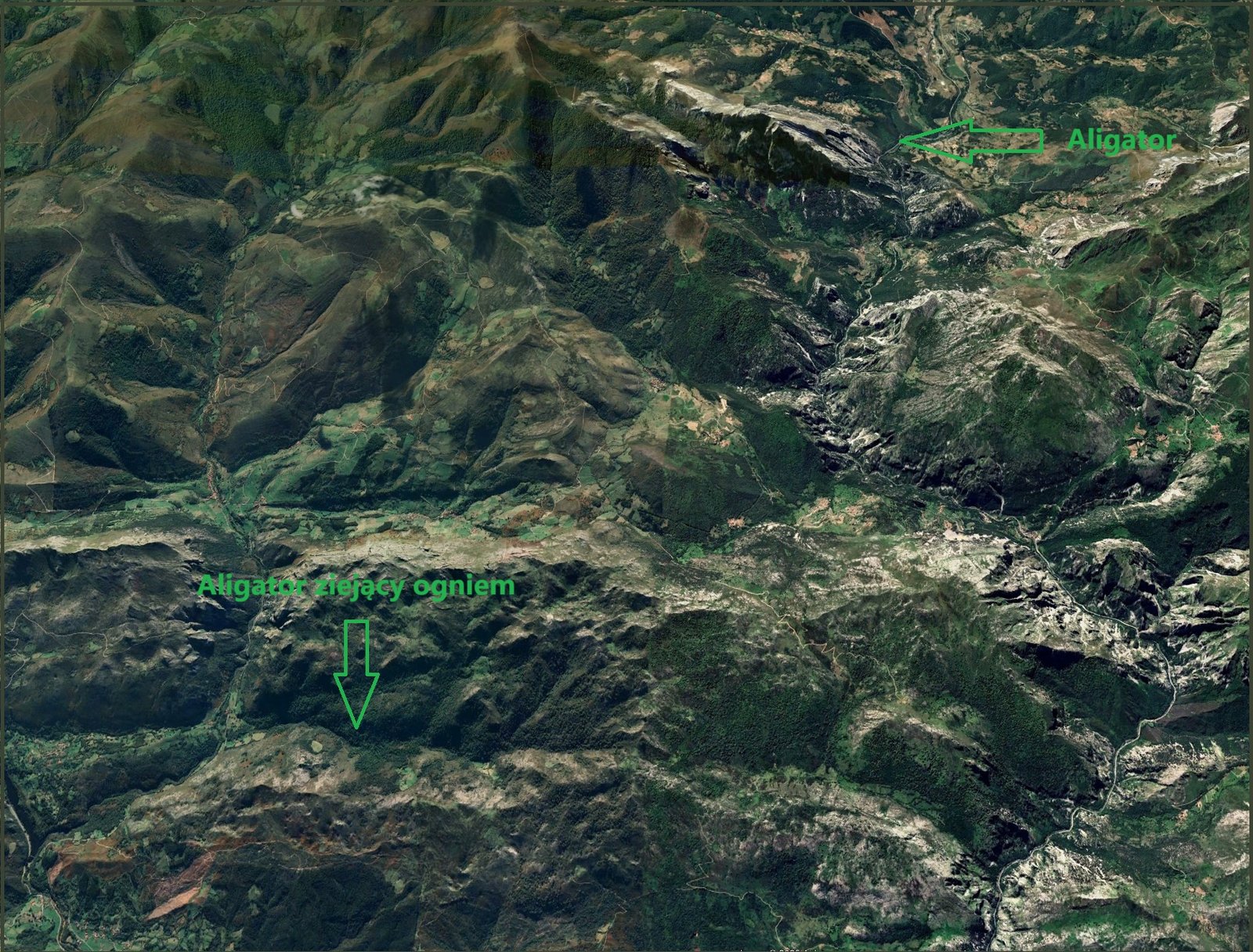
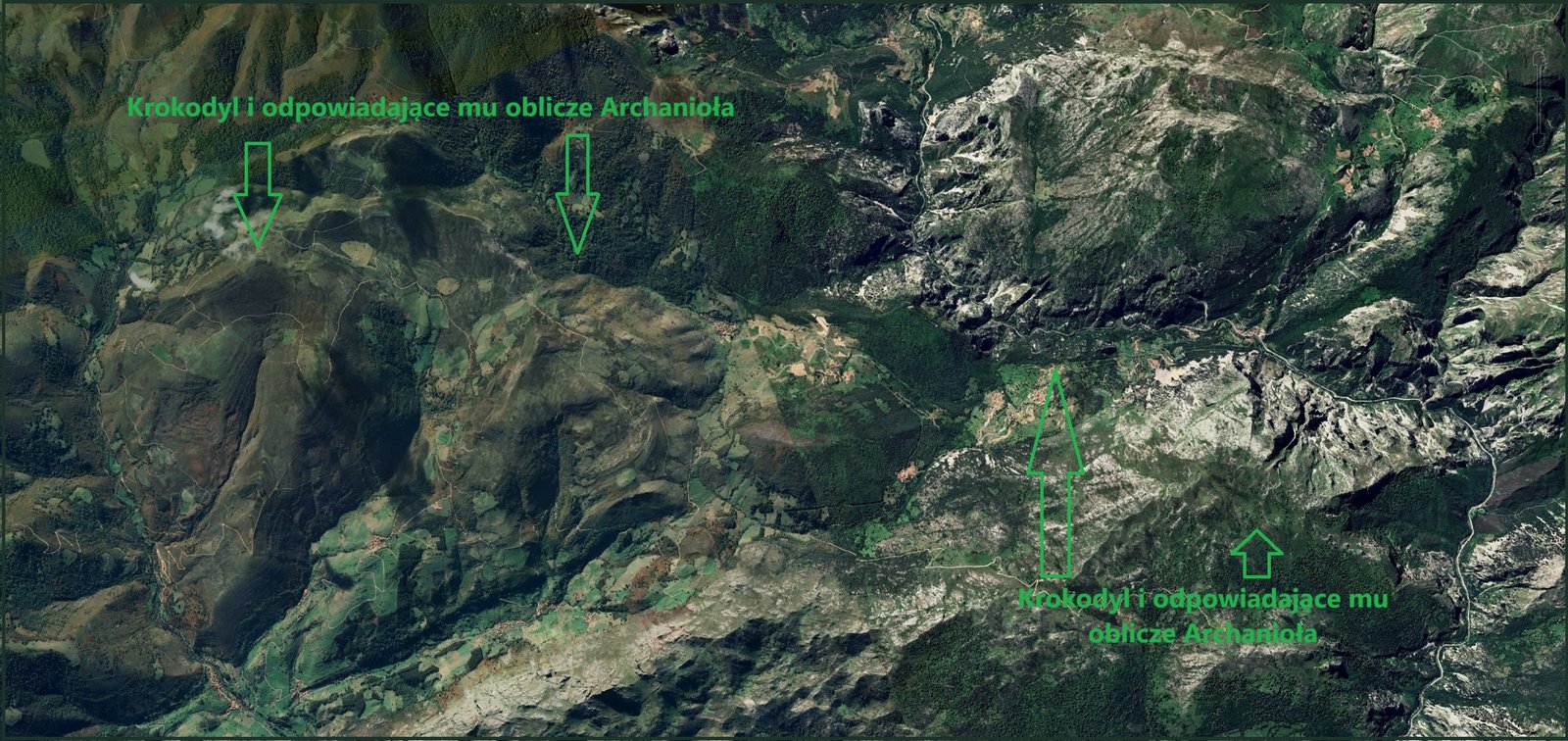
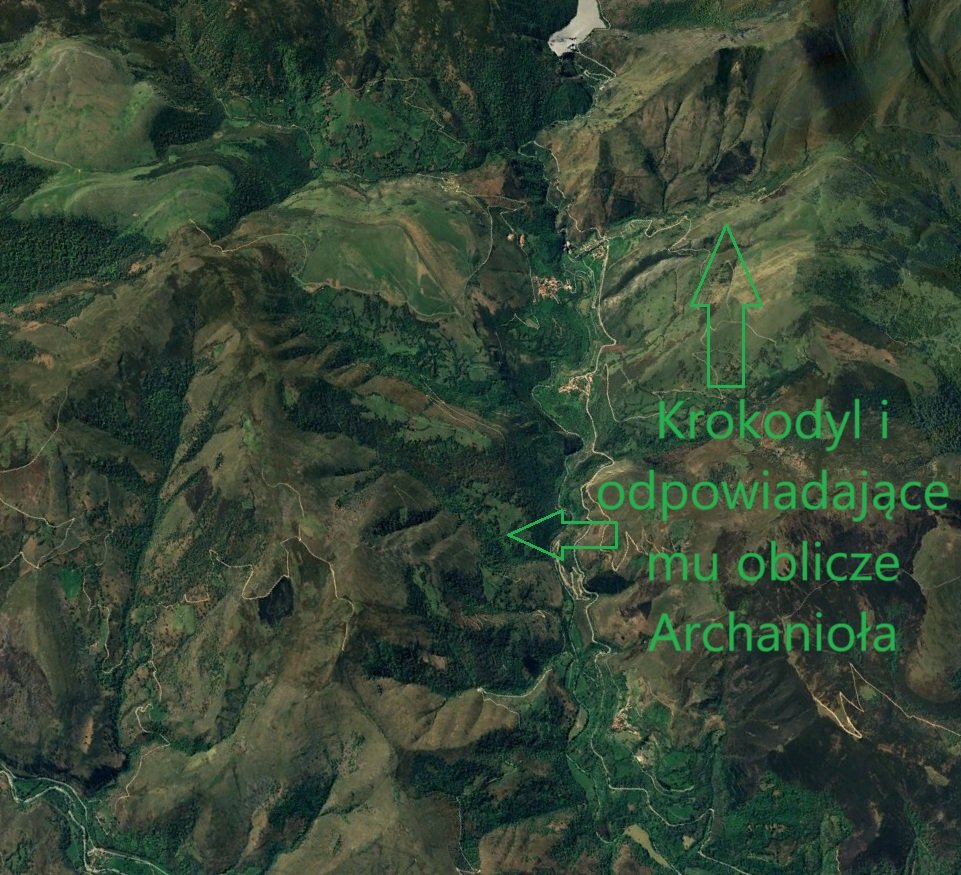
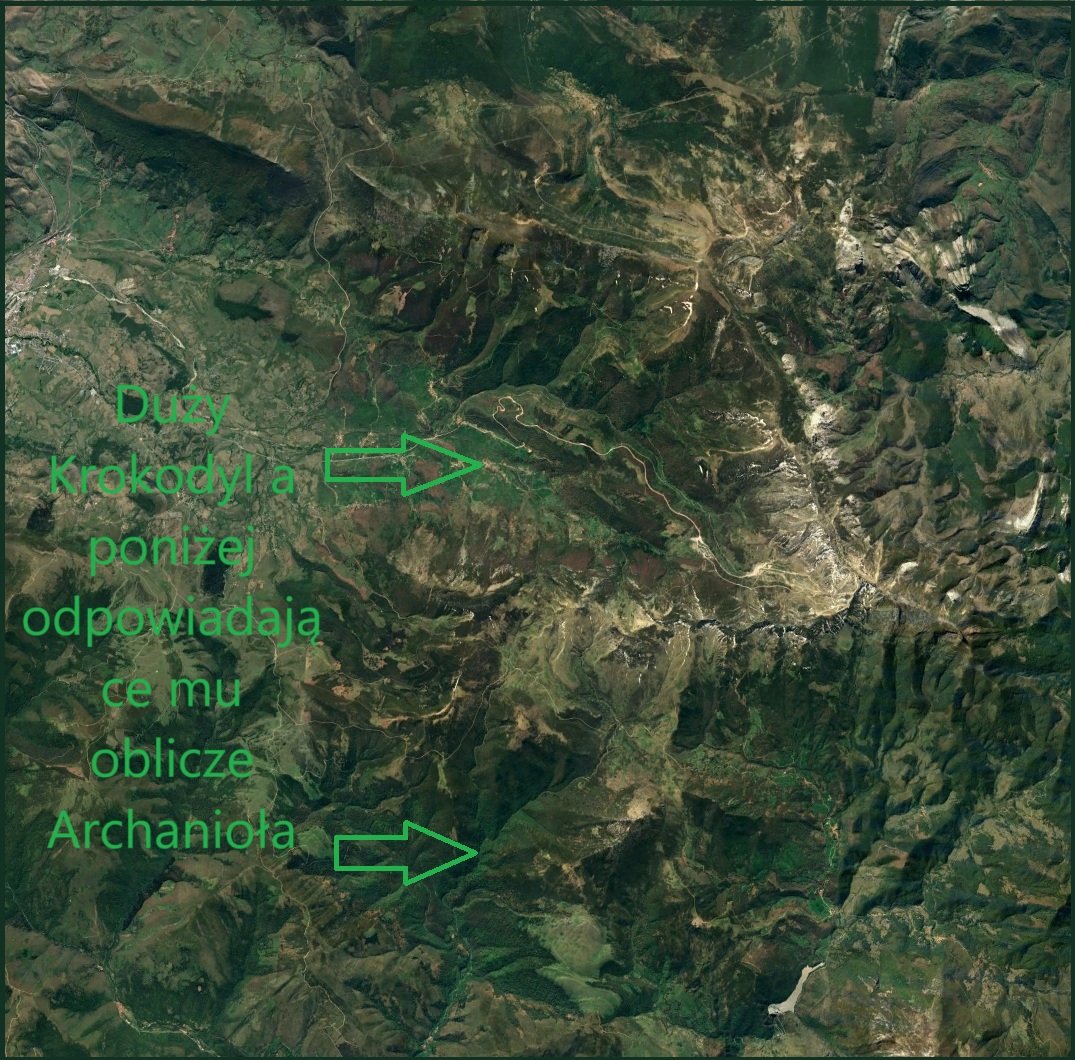
The message of this image relates to the recitation of the Rosary. If we pray the Rosary daily, the four rosary crocodiles will support us, preventing evil from harming us. Our Lady, who appeared in San Sebastián de Garabandal, symbolizes the Tree of Life, whose fruit is the infant Jesus, held in her arms. Four Cherubim guard access to this Tree. The idea is to prevent sinners from plucking the Fruit of Life, because then they would live forever. As we can see, no sinner can enter Paradise because sin could spread there.
Each rosary crocodile head displays the face of a specific Cherub. Thus, crocodile (2) corresponds to face (10) , crocodile (3) to face (11) , crocodile (5) to face (4) , and crocodile (7) to face (6) .
In Ezekiel's vision, which we read about in Holy Scripture, the four Cherubim each had four faces, representing the most valiant creatures on earth. This indicates that no one and nothing can stand against them. The four faces visible in the satellite image correspond to those Cherubim in Ezekiel's vision, which he attempted to describe based on the earthly creatures he knew. We see how beautiful and simultaneously terrifying this image is. Alligators differ from crocodiles in the shape of their mouths. An alligator's mouth is shorter and wider, resembling the letter U, while a crocodile's mouth is narrower and longer, forming a V. Furthermore, an alligator's head is wider and more rounded compared to the crocodile's triangular, narrower skull. As you can see, the above description matches the image visible in the satellite image.
Fire-breathing alligators symbolize sinners who are denied access to the Tree of Life, guarded by the rosary crocodiles. Saltwater crocodiles are the largest modern reptiles, meaning that no one and nothing can defeat them—a reference to the Cherubim. Saltwater crocodiles, associated with the Cantabrian Mountains, are extremely sensitive to any noises, which symbolize sin. They react to every sin because they are supposed to guard access to the Tree of Life and thus fulfill God's Will.
It is worth recalling an event from World War II, when, during an Allied offensive against Japanese forces off the coast of Burma, Japanese soldiers were forced to retreat to marshy areas, where they refused to surrender for three weeks. On the night of February 19, 1945, saltwater crocodiles attacked and killed almost all the Japanese soldiers, irritated by the noise of gunfire. In this case, the Japanese soldiers were like fire-breathing alligators.
Even before the apparitions of Our Lady, San Sebastián de Garabandal was an exceptionally pious town. The Rosary was prayed daily, and residents lived in peace, protected by the "heavenly messengers" to whom the rosary crocodiles refer.
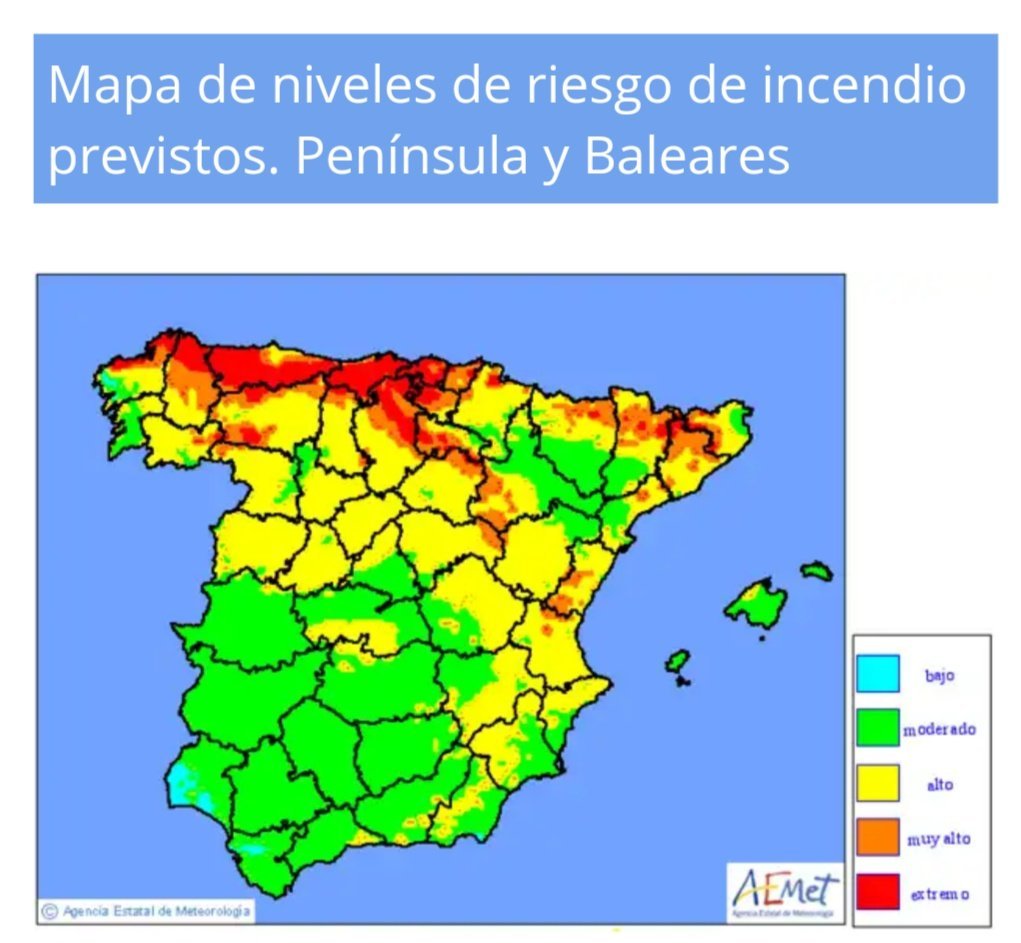
Looking at the events that have taken place in San Sebastián de Garabandal in recent years, we see that the Cantabrian Mountains have been severely affected by fires. Anyone who has visited the area could see vast swaths of burnt forest, of which only black stumps remain. The photo below shows a map of the fires that recently ravaged Spain. Red highlights the areas where the fires were most intense, and these are located precisely in the Cantabrian Mountains, where San Sebastián de Garabandal is located. It is worth noting that despite numerous fires, none of the homes of San Sebastián de Garabandal's residents were damaged. The fire consumed the surrounding forests and fields, reaching as far as Los Pinos, the site of the apparition of Our Lady. However, miraculously, just when it seemed the pine grove was lost, the fire was extinguished.
The message of the Apparitions in San Sebastián de Garabandal doesn't end with the rosary crocodiles. It's through them that we are led to the Book of Job. Speaking of this book, we are faced with doubt in God's goodness, an experience shared by the visionaries. However, we will discuss this a little later. For now, let's cite a passage from the Book of Job that refers to fire-breathing crocodiles. Depending on the translation of the Book of Job, references are made to crocodiles, alligators, and sometimes even leviathans—monsters identified with fire-breathing beasts. For greater clarity, a commentary comparing them to the Book of Job will be included under the verses referring to the Apparitions of Our Lady in San Sebastián de Garabandal.
Job 40:25-32
- 40.25 "Whether you catch a crocodile with a hook
or pull out its tongue with a rope, - 40:26. Will you put a rope through his nostrils,
and pierce his jaw with a hook? - 40:27 Perhaps he will ask you for a favor?
Or perhaps he will say a kind word to you? - 40:28 Will he make a covenant with you,
or will you enlist him in your service permanently? - 40:29 Will you play with him like a sparrow,
or bind him for your daughters?
During the apparitions of Our Lady, the apparitions were accompanied by the beautiful singing of birds, which directly alludes to the above verse. Furthermore, the verses above speak of tying up a crocodile for her daughters, and the daughters of Our Lady were the visionaries. As the girls prayed the Rosary during the apparitions, those standing around could hear them adding the phrase "our Mother" to the "Hail Mary." It is also worth noting that among the gathered participants in the apparitions were certainly sinners. However, by reciting the Rosary, it was as if the mouths of the rosary crocodiles were "tied," their purpose being to keep sinners away from the Tree of Life.
Although we are talking about symbolic images here, we should draw conclusions from them that serve our salvation. One such conclusion is the presence of Our Lady in our lives. By praying the Rosary, we create her image in our minds, banish evil from ourselves, and thus avoid the punishment for our sins. Moreover, by carrying Our Lady in our hearts through the prayer of the Rosary, we are protected from all evil.
- 40.30 Will his companions sell him and
divide him among the merchants? - 40:31 Will you pierce his skin with a harpoon, or
pierce his head with a spear?
The above verse refers directly to Saint Sebastian, whom arrows could not kill, as if protected by armor resembling crocodile skin. It seems that Saint Sebastian, who was the commander of the Roman army, also became the commander of God's army – the great vandals, or Rosary crocodiles. In the satellite image, in addition to the four Cherubim discussed earlier, numerous "crocodile" backs protrude from beneath the surface of the greenish mud, stretching across the entire northern coast of Spain. This image indicates the role that San Sebastian de Garabandal is meant to play – the town is meant to become an example for other parts of the world, leading to conversion and faith in God.
Residents of the area around San Sebastian de Garabandal, seeing that the town survived the devastating fire, are asked to believe in God and imitate its residents, who are faithful to God, visit the Blessed Sacrament, and pray the Rosary. This gives them the protection of "saint crocodiles" from fire-breathing alligators. This image directly alludes to the Book of Jonah, which we will discuss in greater detail in subsequent chapters. When Jonah was thrown overboard, the storm that threatened the other passengers abated, causing them to believe in God and repent from their sinful ways.
Looking at the satellite image, we also see that the crocodiles and alligators have holes in their shells, as if they had been shot with arrows or pierced with spears or harpoons. Yet, they are still alive, which alludes to the above verse.
- 40:32. Be bold enough to lay your hand on him;
remember, you will not return to the battlefield.”
- Job 41:1-26
- 41.1. "Your hope will be dashed,
for the very sight of him terrifies you, because - 41:2 Who will dare to wake him up?
Who will come to meet him? - 41.3 Who will dare to touch him with impunity? –
No one under the whole heaven. - 41.4 I cannot keep silent about his voice;
I know his power is incomparable. - 41.5 Can anyone turn aside the brim of the breastplate
and approach with a double bridle? - 41:6 Will he open his mouth?
It is a fearful sight to look into his teeth. - 41.7. Its back is like the plates of a shield,
joined together as if by a seal. - 41.8. Tightly connected,
not even air can pass through. - 41.9. They are so tightly attached to each other
that the connections cannot be loosened. - 41:10 His sneezing is dazzling,
his eyes are like the eyelids of the dawn: - 41:11. Flames shoot out from his mouth,
fiery sparks fly.
The above verse refers to the fire-breathing alligator. When the alligator comes ashore, it breathes deeply, and hot steam rises from its mouth, resembling a blazing fire, and smoke rises from its nostrils.
- 41:12 Smoke comes out of the nostrils
like a boiling pot. - 41:13 He ignites coals with his breath,
and fire shoots out of his mouth. - 41:14 His strength is hidden in his neck;
terror leaps before him, - 41.15 . body parts joined together
as if cast, immovable. - 41:16 His heart is as hard as a rock,
as a lower millstone. - 41:17 When he gets up, they tremble with fear
and are terrified and lose consciousness. - 41:18 For the cutting of a sword is ineffective,
as is the cutting of a spear, an arrow, or a javelin. - 41:19 To him, iron is chaff,
and bronze is like rotten wood. - 41:20. The arrow from the bow does not frighten him;
the stone from the sling is stubble to him. - 41.21. A club is like a straw to him, and
he laughs at a flying spear. - 41.22. Underneath it are sharp crusts,
leaving a mark like a dike in the mud. - 41:23 He stirs up the deep waters like a cauldron;
he turns them into boiling water. - 41.24 Behind him a streak of light shines on the water,
a depth resembling grey hair. - 41.25 He has no equal on earth;
he has been made fearless: - 41:26 Every strong animal fears
him, the king of all creatures.”
Eye of God
The apparitions in San Sebastián de Garabandal began on June 18, 1961. For the first few days, until July 1, the girls saw only the Angel of God, who remained silent until the end of June. Only on July 1 did the Angel speak, announcing the coming of Our Lady the following day. On that day, he also revealed a secret that, it seems, remains unrevealed to this day.
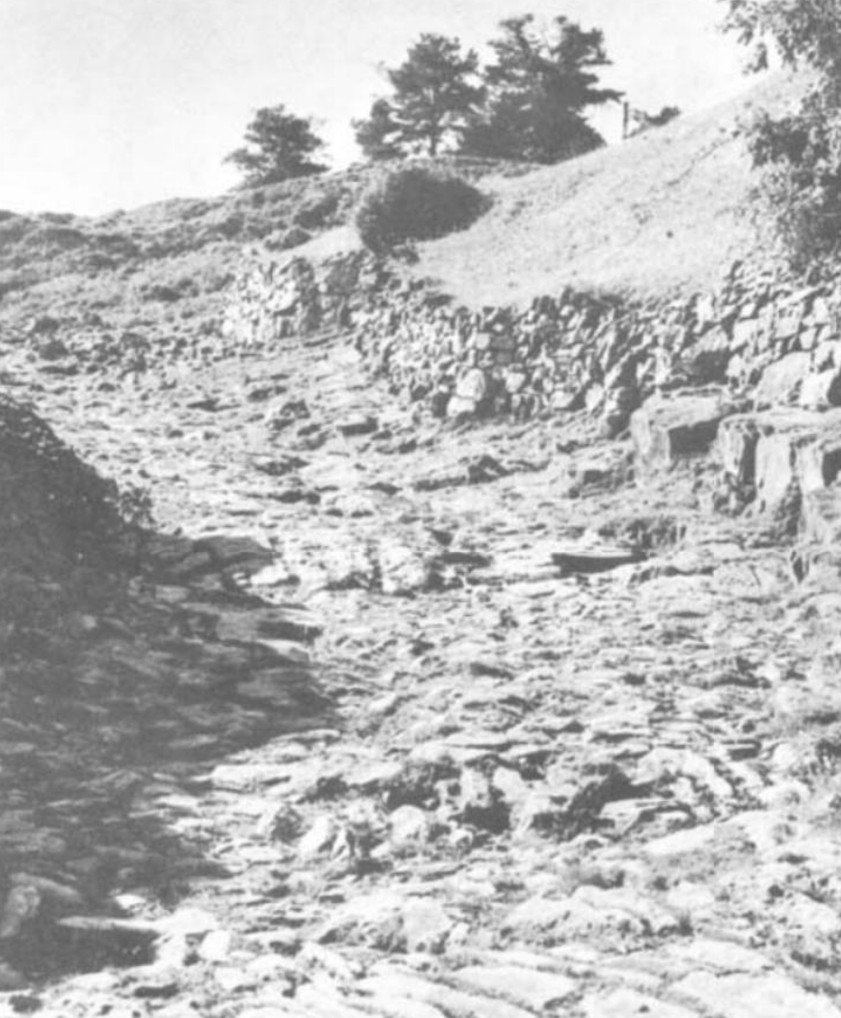
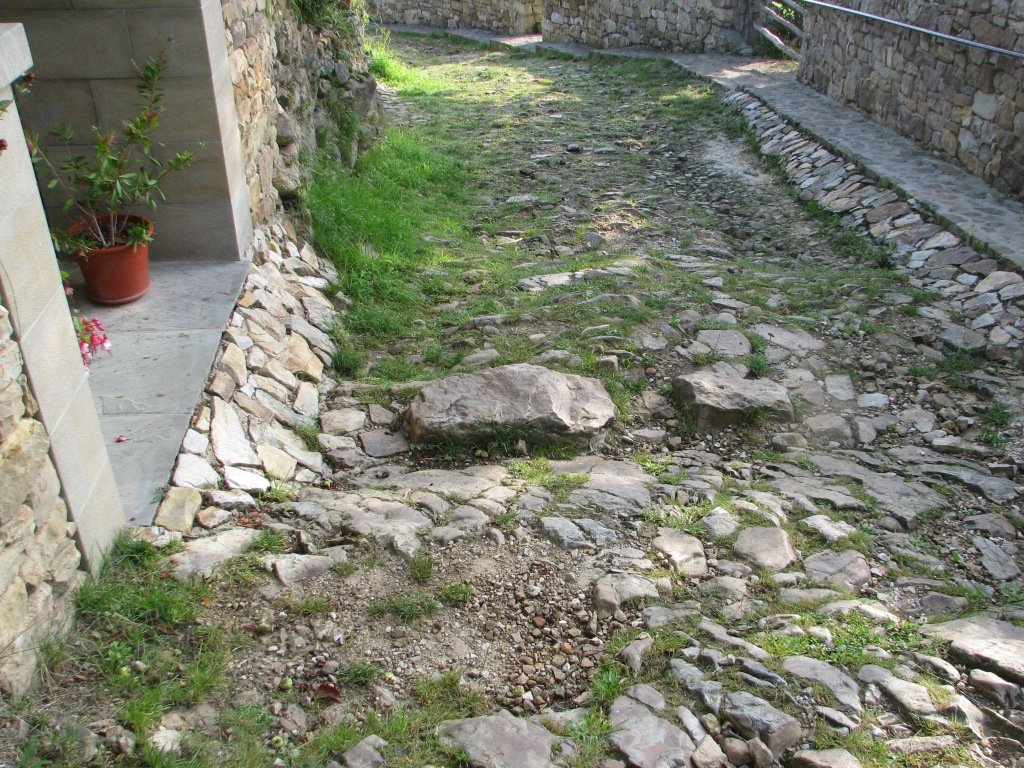
Until July 29, the apparitions of the Angel and Our Lady occurred in a place called "The Square," on a rocky path. On July 29, when the makeshift, square-shaped wall surrounding the seers collapsed, Our Lady instructed them to move to the pine grove of "Los Pinos," where further apparitions would take place from then on.
During the first apparition of Our Lady, which took place on July 2, 1961, two angels appeared on either side of her. One was the angel who had previously appeared to the girls. It turned out to be the Archangel Michael. The second angel, resembling him, remained nameless, and his identity has not been revealed, a fact that continues to spark speculation. According to the girls' accounts, on that day, above the angel standing on the left side of Our Lady, they could see a huge eye, which they called the Eye of God. The photo to the right shows a painting depicting this apparition, painted by Izabel Daganzo according to the girls' instructions.
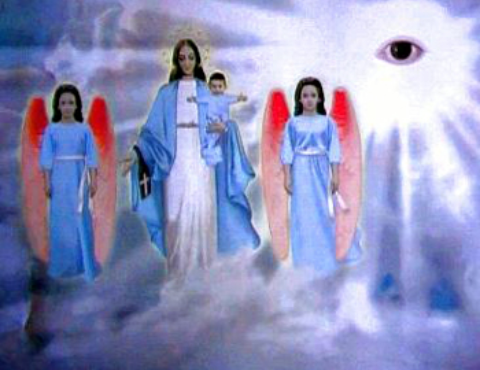
Some publications offer a slightly different description of the above vision, in which the Eye is inscribed in a triangle, surrounded by a flaming square frame. However, these elements are not visible in the painting. It was painted, as has been said, according to the visionaries' instructions. The symbolism of the large Eye in the triangle refers to the Tent of God, where God resides, while the flaming square symbolizes the Cherubim with fiery swords guarding the entrance to this Tent.
Transferring this symbolic vision of the Eye inscribed in a triangle and square to a painting depicting Our Lady with the Child Jesus and two Angels, we can see their mutual convergence. Our Lady is the Tent of God from which God looks down upon us. At her side, we see the Cherubim, which include Archangels with pink wings, ultimately alluding to the rosary crocodiles. Her Fruit, in turn, is the Child Jesus, whom she holds in her arms.
It seems that the vision of the Eye within a triangle and a flaming square may have been shown to the girls at a later time, as an explanation for the earlier vision of the Eye. It is also possible that the children and the artist were pressured not to include these symbols in the painting. This issue remains to be clarified.
Although the Eye within a triangle and a square is consistent with the interpretation of the Tent of God and the Cherubim, the Eye also alludes to another message. As mentioned, San Sebastián de Garabandal lies among the Cantabrian mountains, which resemble the rosary crocodiles. It is worth taking a closer look at the satellite image of this town.
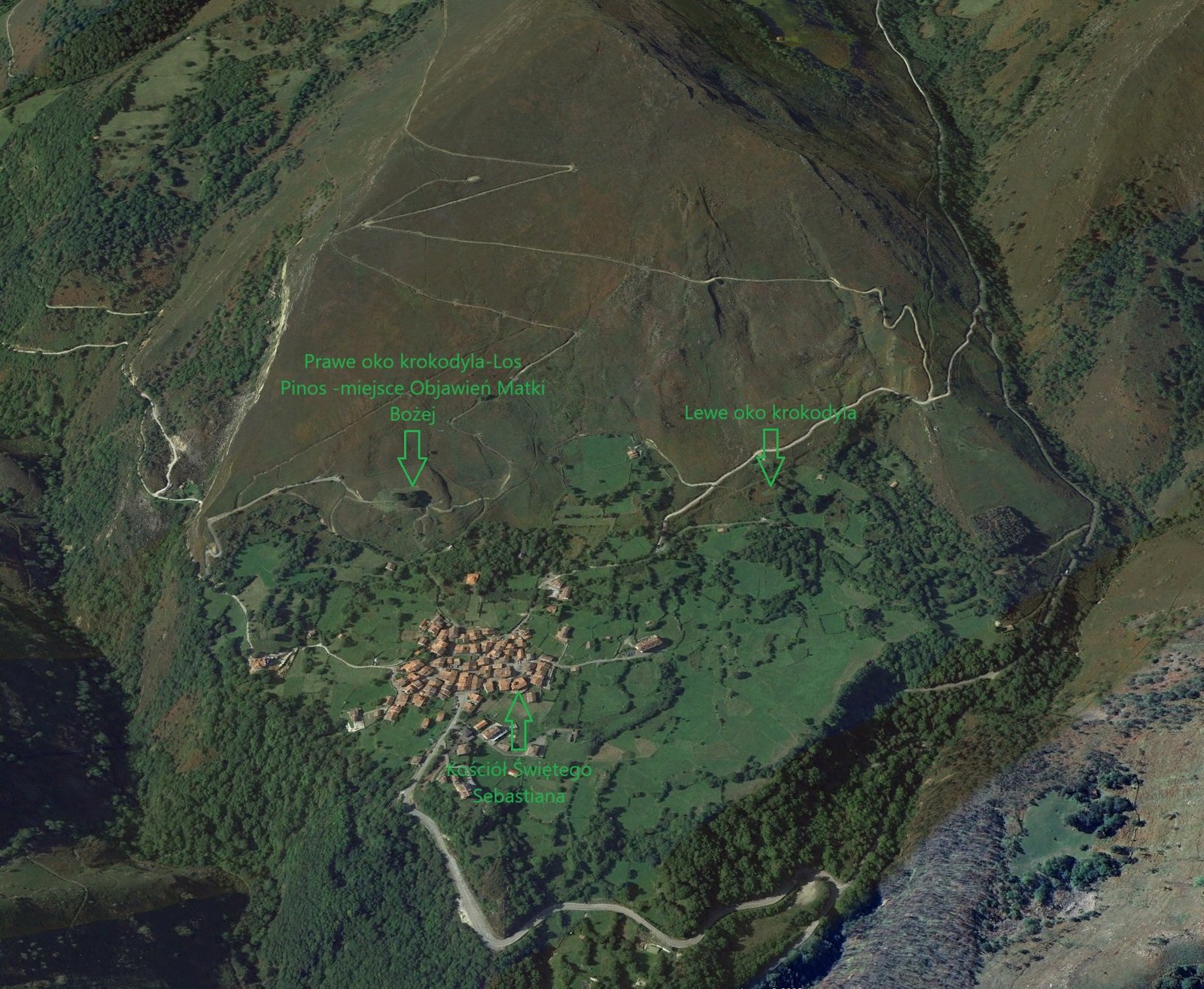
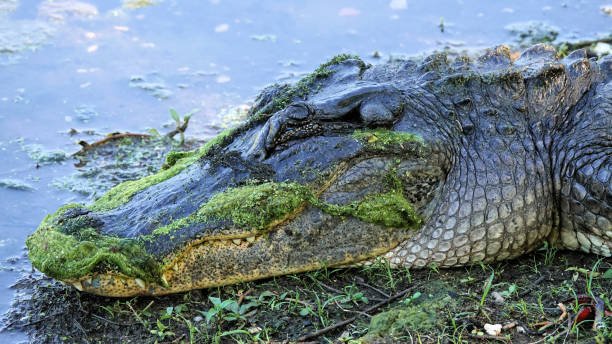
San Sebastián de Garabandal sits as if on the upper jaw of a crocodile, while Los Pinos, the site of the apparitions of Our Lady, is located precisely at the right eye, which, together with the left eye, forms a triangle. In the adjacent photo, we see the crocodile's left eye, while the right eye is covered by the Virgin Mary.
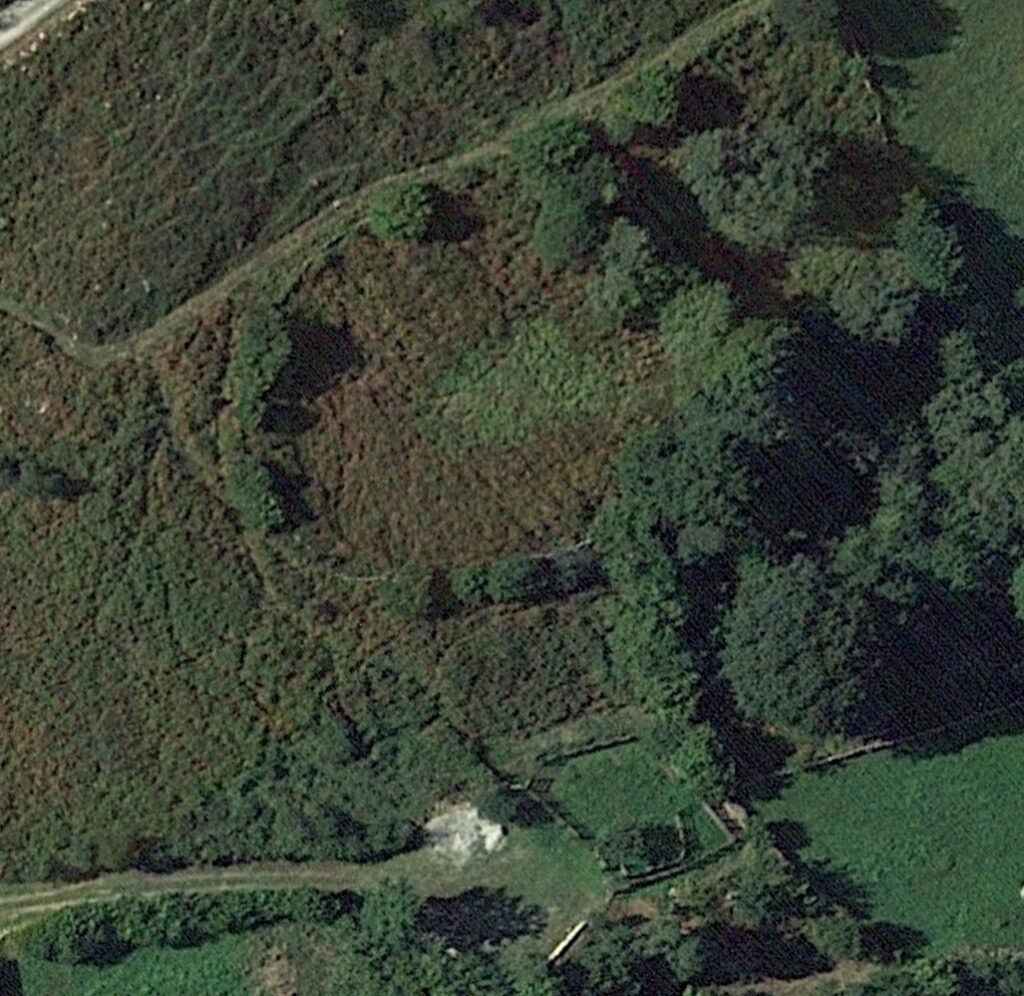
Returning to the satellite image of San Sebastián de Garabandal, we notice that to the right and left are two mountain formations symbolizing cherubim, which is reflected in the painting by Isabel Daganzo. Furthermore, in the above satellite image, we can see that the "crocodile's mouth" is divided into an upper and lower jaw, with a path running through it that also resembles a crocodile's fangs.
Purification and the path back to Paradise
The consequence of Adam and Eve's violation of God's command was their being filled with carnal sin, which prevented them from returning to Paradise. They were imprisoned within the body, bound by the shackles of sin. The return of their souls to Paradise was only possible through purification from sin, a process aided by hard labor, labored by the sweat of their brows, on an earth that had become unfavorable and fraught with difficulties. To return to Paradise, a person must break the shackles of sin while still alive, to become worthy of God's promise, which requires strength from us. A soul not purified from sin during life becomes too weak for eternal life.
God gave us Jesus and the Mother of God to help us break the shackles that bind our souls to the body. The example of the children of Israel shows us certain principles of returning to Paradise. The Israelites' path to the Promised Land—symbolizing Paradise—led through the desert, where they experienced forty years of torment and hardship. In Egypt, they labored hard, learning to distinguish good from evil. However, the forty-year wandering in the desert was a test of faith for them. It is important to remember that Adam and Eve, knowing God personally, were not subjected to a test of faith, while the generations that followed them did not have the same knowledge.
Jesus' baptism by John in the Jordan marked the moment when his teaching on the distinction between good and evil ended. Then, led by an Angel into the desert, he underwent a forty-day test of faith, which he successfully completed, being saved during his lifetime and becoming a Saint. His further mission, described in the Gospels, is to serve God, who, through Jesus, shows us the way back to Paradise. Jesus, as the Holy One of God, sacrificed himself for humanity, to show us this way through pain and suffering, thus becoming the Messiah—the liberator who frees man from the slavery of the sins of the flesh.
We will discuss this aspect in greater detail in subsequent chapters, especially in the analysis of the so-called Ecstatic marches in San Sebastian de Garabandal. Jesus became the Word of God, therefore we should look to Him, imitate Him, and combined with reading the Holy Scriptures, it will be easier for us to understand His teachings. It is important to remember that Jesus was born to show us this path, something that was planned back in Heaven. Thanks to the Apparition of Our Lady in San Sebastian de Garabandal, God indicates a tool that will help us more easily traverse the path back to Paradise. This is the stone path, the Calleja, which refers to the practice of praying the Rosary. If our path is strewn with stones, or Rosary beads, it will be easier for us to pass the test of faith we will now discuss. By praying the Rosary, we stone Satan, resisting his temptations.
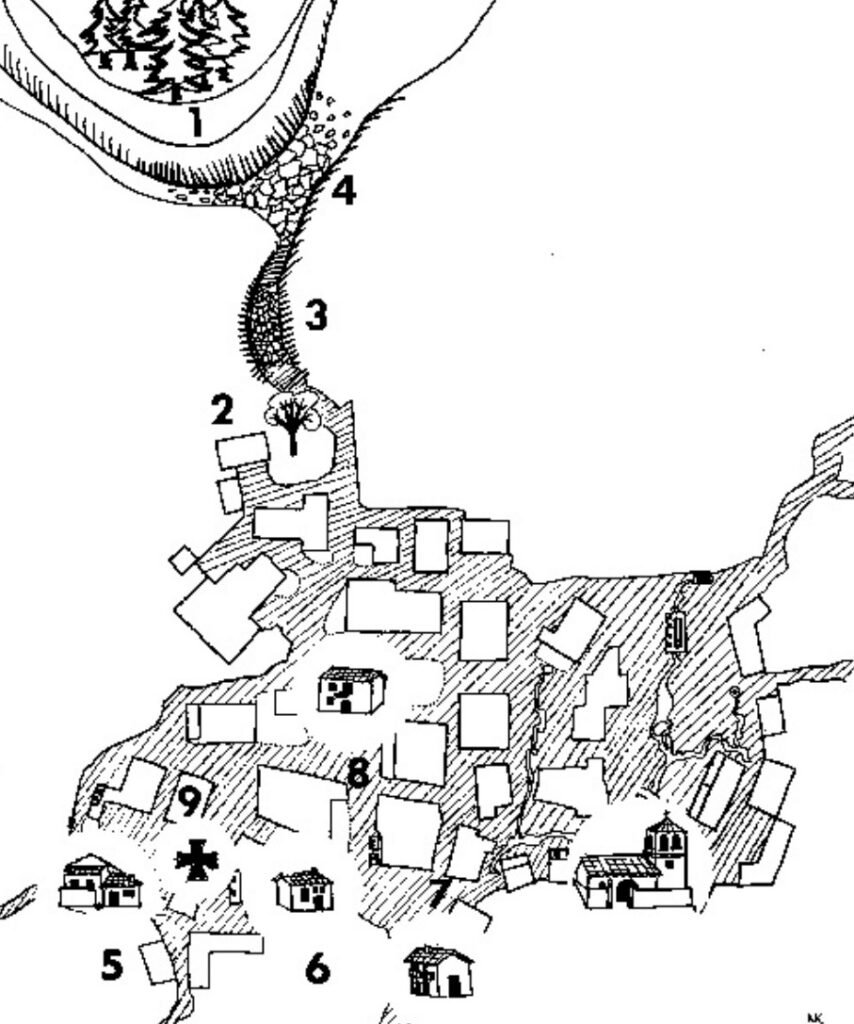
In the adjacent drawing, at point 2, there is an apple tree that belonged to the school teacher. The apple tree refers to the tree of learning to distinguish good from evil. It was from this apple tree that the seers picked apples just before the first apparition of the Angel. Point 3 marks the place known as the "square," where on June 18, 1961, the Angel first appeared to the girls, and from July 2, the Virgin Mary also appeared. The apparitions continued in this place, with few exceptions, until July 29, 1961. Point 4 marks the "Calleja"—a rocky path leading from the apple tree to Los Pinos-1, the spruce grove where the apparitions took place from July 29, 1961.
As previously mentioned, the children of Israel wandered through the desert for forty years before returning to the Promised Land, which symbolized Paradise. This journey was a test of faith for them. However, it is worth emphasizing that not one from this generation passed this test, and only generations that had to relearn the distinction between good and evil entered the Promised Land. The reason they all failed this test was the casting of the golden calf and its divine obeisance. The generation that committed this act perished, and their successors began their studies anew.
In the Promised Land, at the foot of Mount Ebal and Mount Gerizim, the covenant with God, concerning blessings and curses, was renewed. If the covenant with God was broken, the curses contained in the Book of the Law of Moses were to fall upon the children of Israel from Mount Ebal. However, if the covenant were fulfilled, God's blessings, also recorded in the Book of the Law, were to flow down to the Israelites from Mount Gerizim. Such "Promised Lands," with Mounts Ebal and Gerizim, exist throughout the world, including, as we will discuss later, in San Sebastian de Garabandal.
Unlike the children of Israel, Jesus Christ passed the test of faith and returned to Paradise. That is why it is so important to imitate Him. However, for this to be possible, we must learn the principles of return, which involve contemplating His life on earth. His path of return serves as an instruction and guide for us. One of the key principles of return is the forty-day test of faith, during which we are subjected to Satan's temptations. We mentioned earlier that the Revelations in San Sebastian de Garabandal are linked to the Book of Job, which is difficult to interpret. However, comparing it with what has been said in this chapter, it becomes more understandable. Job was a man who fulfilled God's Law in every detail, and when his training in discerning good from evil was drawing to a close, he was put to a test of faith by Satan, just as Jesus Christ was. Although Job appears to have failed this test because he doubted God's goodness, as we will later demonstrate, this was for a purpose, and Job ultimately passed the test of faith.
The difference between the children of Israel and Job is that the children of Israel not only doubted God's goodness but also renounced Him. Job, on the other hand, did not renounce God; he merely doubted His goodness. When Job saw God, he apologized for his unbelief and repented. A test of faith always involves the loss of what a person most clings to in this world. Job had wealth, money, respect—one might say he had everything. Yet, during the test, he lost it all. In contrast, Jesus, led into the desert, had nothing. Satan had nothing to take from him, because Jesus was not attached to worldly goods. The more attached a person is to earthly things, the more difficult it is to pass the test of faith.
We will discuss Job in subsequent chapters, but for now let's return to the Apparitions in San Sebastian de Garabandal. The journey the girls took from the apple tree to the spruce grove lasted 42 days. The apple tree symbolizes the tree of learning to distinguish good from evil, while the spruce grove refers to Paradise, in the center of which grows the Tree of Life, the Virgin Mary with the child Jesus. If we exclude the first day, which is the day of sin, and the last, which marks the entrance to Paradise, we find that the journey lasted exactly 40 days.
On the day the girls eat the forbidden fruit and then repent of their sin by stoning Satan for having tempted them to it, they complete their learning to distinguish good from evil. By throwing stones over their left shoulders, the girls imagined they were stoning the devil. We see, then, that repentance for sin is a sign of assimilation of the teachings on sin. After all this, their forty-day journey back to Paradise begins.
The first days of the Apparitions were a great ordeal for the girls. They were subjected to numerous medical examinations, and they were not believed—just as Job was not believed. However, they prayed the Rosary daily, which helped them through this difficult time of trial. During this time, Satan attacks those places where people are most attached to this world. By praying the Rosary daily, in moments when we are subjected to tests of faith, it is easier to overcome them and not doubt God and His goodness. Those who succeed in this path are saved in life, following the example of Jesus Christ. However, like Him, they are obliged to sacrifice themselves for their brothers and sisters who are still far from God, to help them on the path to salvation.
We can save ourselves, but if we do nothing for others, we will be empty-handed, and our souls will have no merit to offer to God as a sacrifice. Jesus offered his body as a sacrifice to God, showing us the way. Whether we will find ourselves empty-handed before God depends on our willingness to help others. The more souls we help to save, the fuller our hands will be before God.
Those who have their hands full of merit will receive even more, while those who lack it will have even what they were given taken away. These words of Jesus Christ also apply to God's priests, who received salvation for their service to Jesus. However, simply being a priest, as we see, does not guarantee salvation. If a priest stands before God empty-handed, salvation will be taken away. These are the words of Jesus, who established these principles. However, to serve God, we must first ensure our own salvation. The stony path alludes to the Rosary, which is a hail of stones hurled by God at man's enemies, as we can read in the Book of Joshua. Each Hail Mary is like stoning the evil one, just as the visionaries in San Sebastian de Garabandal did when they realized their sin. The empty hands we have when we stand before God are alluded to in one of Conchita's conversations with Our Lady when she saw Her for the last time. "Oh, how happy I am to see you! Why don't you take me with you now?" And She replied, "Remember what I told you on your saint's day: when you stand before God, you must show Him your hands full of the works you have done for your brothers and for the glory of God, and now you have them empty." Let us remember that on the day of Our Lady's last apparitions, Conchita was 16 years old. The rest of her life was devoted to serving God by proclaiming the Gospel of Our Lady's apparition in San Sebastian de Garabandal. Through this service, souls still far from God can come to know God and His love. Revelations are inspired from Heaven, so they present what has already been said and written in Holy Scripture, thus reminding us of God's plan of salvation.
Messages of Our Lady
The first Message of Our Lady was given to the girls on July 2, 1961, at a place called "the square" on a rocky road. Our Lady instructed that the Message be made public only on October 18, and until then, the girls were to keep its contents secret. The Message was announced on June 24 by an Angel who had been appearing to the girls since June 18, 1961. However, the manner of the announcement was veiled, so the seers understood nothing of it. That day, the Angel appeared with the inscription "MUST... XVIII... MCMLXI," which, as it later turned out, meant the first word of the Message and the date of its revelation.
Regarding the secrets, on July 1, the Angel gave the girls another message, which they were not to reveal to anyone—neither at home, nor to the bishop, nor to the Pope—until he himself permitted them to speak of it. It seems that this message has not been revealed to this day. The angel also instructed the girls to pray the Rosary daily, which was intended to help them keep their secret. The girls were repeatedly subjected to a test of silence, which could have been difficult to pass due to Satan's influence. However, by praying the Rosary, he had no access to them. Recall that the girls had to undergo a four-month test of silence concerning Our Lady's first Message, as well as a secret that may never be revealed.
In the previous chapter, we discussed the test of faith, and as we see, there are more such tests in our lives. In the Book of Job, we read that it was Satan who tested Job's faith, and he is responsible for all the tests we undergo. Job learned to distinguish good from evil, and then God commanded Satan to pay attention to Job. The test is therefore inevitable, but to pass it, we have the help of Our Lady. When we pray the Rosary, we keep evil away from us, so that it cannot sow in us rebellion against God.
However, how we pray the Rosary is important. Praying only with our lips is not enough—it must be a prayer with the heart, with the full involvement of our minds. In the "Our Father," we ask that God not lead us into temptation, but that He deliver us from evil. This passage is crucial because it is Our Lady and the recitation of the Rosary that help us be delivered from evil. The world is full of temptations—on television, in the newspapers, on the streets. If these temptations are amplified by Satan, as was the case with Adam and Eve, there is a high probability that we will succumb to them.
God created this world with temptations that lurk at every turn. Temptation is therefore part of God's plan. After all, it was God who created the tree of knowledge of good and evil, and therefore created the temptation that seduced Adam and Eve. All of this was intended to make man like God, in the sense of distinguishing good from evil, so that man might possess eternal life. The Mother of God and the Angel instructed the girls to keep the messages secret, so if Satan had succeeded in breaking this prohibition, the girls would have been disobedient. The question arises: how could Satan have accomplished this? To answer this question, we must understand that Satan attacks us where we are most attached to this world. For example, if we are attached to wealth, Satan will cause us to lose it, with the goal of making us doubt God's goodness. The Book of Job shows that Satan attacks only those who have a strong faith in God. If the girls were attached to obedience and acceptance among their peers, Satan would have stripped them of that obedience—exactly as he did with Job, who, losing people's respect, began to doubt God's goodness.
When Job lost his wealth, it didn't have a significant impact on his faith; he accepted the loss by saying, "Naked I came into this world, and naked I will leave it." What broke Job, however, was not being the center of attention. Job had great respect among people, and that was most important to him. When Satan took this position away from him, he broke his faith in the goodness of God. It's important to emphasize that being the center of attention often goes hand in hand with pride. It's precisely this pride that makes one dependent on the opinions of others, and losing this position can be one of the most serious attacks Satan can launch. Let's return now to the first Message, which was delivered on October 18, 1961. Let's quote the words of Our Lady recorded by Conchita in her diary:
"The Virgin, still smiling, the first thing she told us was: 'Do you know what the inscription held below by the angel meant?' And we simultaneously exclaimed: 'No, we don't know.' 'Now he wanted to communicate a message to you. I will give it to you, so that on October 18, you can say it publicly.'" And she said: "We must make many sacrifices, do much penance, visit the Blessed Sacrament, but first we must be very good. And if we are not, we will be punished. The cup is already filling, and if we do not change, a very great punishment will come upon us." The reading of the above Message was to take place according to the instructions of Our Lady, who ordered that the content of the Message be given to Father Valentín and read by him in front of the Church of St. Sebastian, so that all present could hear its content. When Father Valentín received the Message, he expressed fear that its contents would not please the people. Therefore, he decided not to read it publicly. Moreover, he forbade the reading of the Message in front of the Church and ordered the faithful to go to the spruce grove, where the girls were to read it.
In this instance, Father Valentín disobeyed Our Lady, driven by a lack of understanding of the situation and fear of judgment from the people and Church hierarchy present in San Sebastián de Garabandal that day. What others thought of him mattered more to him than fulfilling God's Will, as communicated to him by Our Lady. Ultimately, the girls, along with the assembled people, went to "Los Pinos," where, despite initial difficulties, they read the Message. This entire event, involving the priest's reading of the Message in front of the Church, which houses the Tabernacle, symbolizing the Ark of the Covenant, leads us to the Old Testament and the Book of Joshua. Joshua, sent by God, was tasked with reading the Book of the Law of Moses in the presence of the children of Israel and all who were with them, at the Ark of the Covenant in Shechem. This place, Shechem, has a spiritual connection to San Sebastián de Garabandal, where Our Lady appeared to the girls.
In the Old Testament, the Book of the Law was to be read at the foot of Mount Ebal and Mount Gerizim, which were supposed to guard the fulfillment of the covenant with God. If the covenant with God were broken, curses would descend from Mount Ebal upon the children of Israel. Conversely, if the covenant with God were fulfilled, blessings would flow from Mount Gerizim.
These mountains served as a spiritual reference point and a reminder to the people of Israel of the terms of the covenant with God. In San Sebastián de Garabandal, as in Shechem, the goal is to remind people that fulfilling God's commandments brings blessings, while breaking them leads to curses. Our Lady's message is therefore a kind of Book of the Law, the content of which can be summarized in a few key points. It indicates that the cup of wickedness is filling, and if people do not repent and amend their ways, the punishment associated with the curse will fall upon them. The Book of Moses consists of ten main points, the first two of which call for repentance and reformation to avoid the coming punishment. The third point announces a miracle that will help people believe, leading to their reformation and repentance.
The last seven points, however, refer to the consequences that will befall those who do not heed God's call to conversion. In the context of these points, the question arises: where in San Sebastián de Garabandal are the mountains symbolizing Mount Gerizim and Ebal? To answer this question, we must again look at the satellite map of San Sebastián de Garabandal.
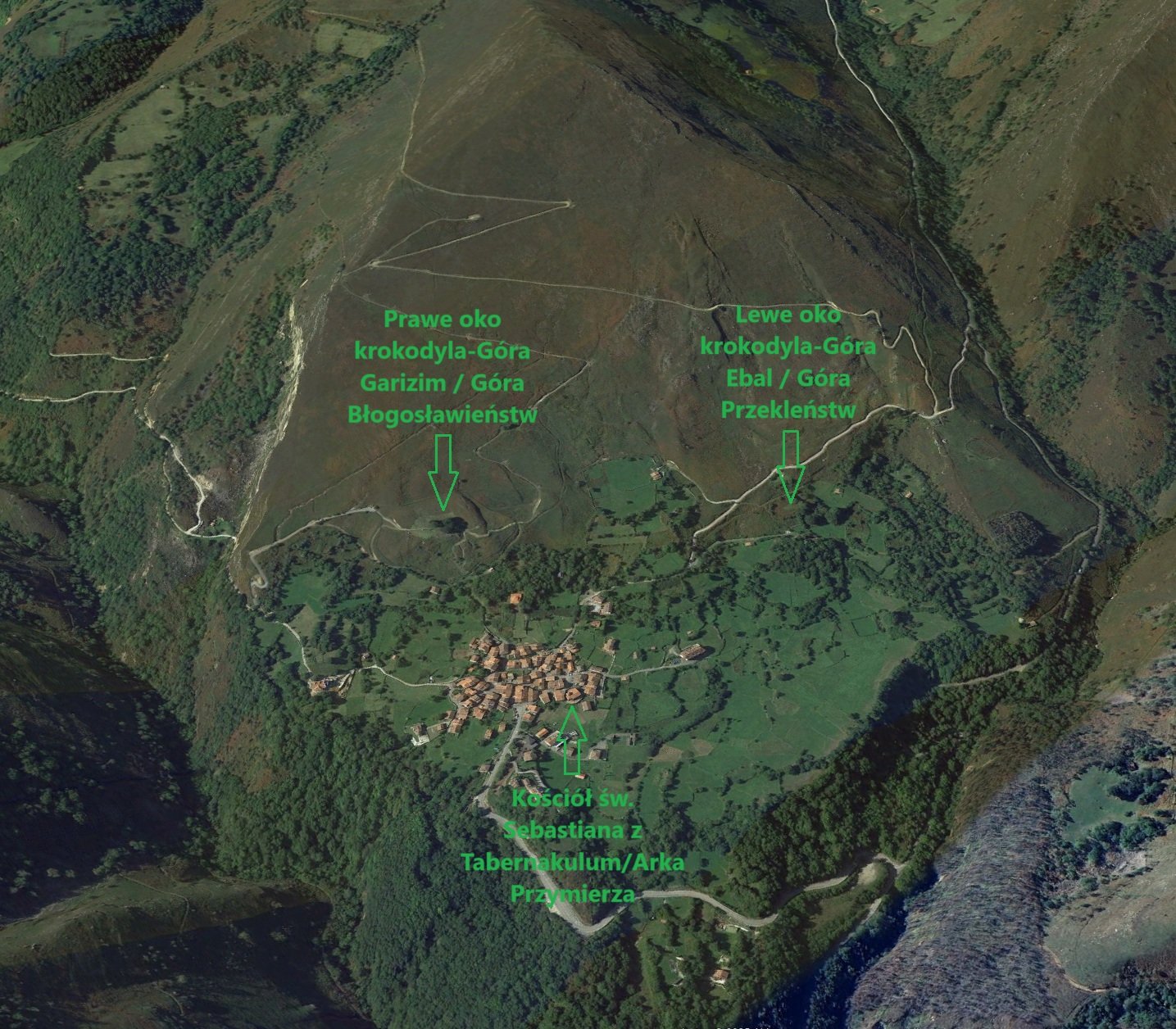
As you can see in the photo, in place of the "crocodile's" right eye is Los Pinos, which symbolizes Mount Gerizim, the Mount of Beatitudes, where Our Lady appeared. The left eye of the rosary crocodile, on the other hand, corresponds to Mount Ebal, the Mount of curses. Interestingly, this Eye appears to be open, confirming the painting created by Ms. Isabel Daganzo, which we mentioned earlier. As with Shechem, the Church of St. Sebastian is located between these two "mountains." The open Eye symbolizes the Eye of God, which sees all—no sin escapes His notice. Furthermore, since the crocodile's left eye represents Mount Ebal, it signifies that punishment comes from God, as it is from there that curses will fall upon those who break God's covenant. In the satellite image, we see that the area of the Eye corresponding to Mount Ebal is empty. Recall that on Mount Ebal stood an altar where the children of Israel offered peace offerings and offerings of praise to God. To ascend Mount Ebal, one first had to cleanse oneself of sin by symbolically washing one's garments. At the foot of Mount Ebal were smaller altars on which sin offerings were offered, which in the Christian context correspond to confessionals.
Through the Message, Our Lady calls for numerous sacrifices, penance, and frequent visits to the Blessed Sacrament, which alludes to Mount Ebal. For Christians, peace offerings represent all good deeds, while offerings of praise to God are prayer and presence before the Blessed Sacrament. Penance, in turn, is accomplished through confession in the confessional, where the faithful repent of their sins and strive to purify their souls. Looking at the above satellite image of San Sebastián de Garabandal, we see that the crocodile's right eye is obscured by Los Pinos, where the Apparition of Our Lady took place. When we compare this with the image the girls saw during the first Apparition of Our Lady, captured by Mrs. Isabel Daganzo, we see a profound symbolism. The obscured eye does not perceive sin because it is intended for blessing, thanks to Our Lady, who is the right Eye of God.
Jesus, on the other hand, is the left Eye of God. Our Lady repeatedly mentioned that she holds the hand of her Son before punishing people for their sins. Jesus and Our Lady constitute the Tents of God, the left and right hands of God. The right hand is responsible for blessing, and the left for punishment. Meanwhile, Our Lady, by kissing crucifixes, rosaries, and other devotional objects, blessed these objects, thanks to which numerous healings and miraculous interventions occurred. We also see that blessings do not flow to all who come to San Sebastian de Garabandal and other places of apparitions. The rules for receiving blessings are clear and were established centuries ago at the foot of Mount Gerizim and Mount Ebal.
Miracle
The Book of Mosaic Law is divided into three main parts. The first calls for worship of the true and One God, assuring blessings to those who faithfully observe the covenant with God. The second part contains a foretelling of the miracle of God's presence among his people. The third part warns of the curses that will be incurred by those who break the covenant with God. However, it also contains a promise of return to God if one acknowledges their sin and repents.
The message of Our Lady is closely linked to this book, serving as a reminder of God's plan for humanity. If people visit the Blessed Sacrament and live in accordance with God's commandments, they will experience God's blessings and the miracle of His presence among them. However, if they persist in sin and do not repent, as indicated in the third part of the Book of Mosaic Law, they will face the punishment associated with the curses.
All of Our Lady's Apparitions allude to the miracle of God's Presence among humanity, which is the greatest blessing that can be bestowed upon those who remain faithful to God. Let us begin by recalling the first part of the Book of Moses, containing the first ten verses of Leviticus, which chart the path to faithfulness and God's blessing.
Leviticus 26:1-10 – verses that make up the first two points of the Book of the Law of Moses concerning the warning
- 26,1. You shall not make for yourselves idols, nor shall you set up for yourselves graven images or sacred pillars. You shall not place carved stones in your land to bow down to them, for I am the LORD your God.
- 26,2. You shall keep my Sabbaths and revere my holy temple. I am the Lord.
- 26,3. If you walk in my statutes and keep my commandments and do them,
- 26,4. I will give you rain in its season, the land will yield its produce, the trees of the field will yield their fruit,
- 26,5. your threshing will last until the vintage, and the vintage until sowing; you will eat bread to the full, and you will dwell securely in your land.
- 26,6. I will grant peace to the land, so that you may go to bed without fear. Wild animals will disappear from the land. The sword will not pass through your land.
- 26,7. You will pursue your enemies, and they will fall by the sword before you,
- 26,8. so that five of you will pursue a hundred, and a hundred of you ten thousand [of your enemies]. Your enemies will fall by the sword before you.
- 26,9. I will turn to you, make you fruitful, multiply you, and establish my covenant with you.
- 26,10. You will eat from the old stores, and when the new harvest comes, you will remove the old ones.
Let us now turn to the second part of the Book of the Law of Moses, which announces a miracle intended to awaken faith in God and lead people to repentance and reformation, thus averting the impending punishment. On June 22, 1962, an Angel announced to Conchita a Divine Miracle in which they were both to participate. This miracle consisted of the Angel giving Conchita the Eucharist, which would transform into the Holy Species on her tongue. This event was to be witnessed by the people, a clear sign of God's presence among His people.
Before delving into the details of this miraculous event, it is worth recalling the second part of the Book of the Law of Moses, which deals with the announcement of the miracle. It consists of two verses that speak of God's intervention and His presence among the people, reminding them of the need for conversion and repentance.
Leviticus 26:12-13 – verses that make up the second part of the Book of the Law of Moses concerning the miracle
- 26,12. I will walk among you and be your God and you will be my people.
- 26,13. I am the LORD your God, who brought you out of the land of Egypt so that you would no longer be slaves to them. I broke the bars of your yoke and enabled you to walk with your heads held high.
The appearance of the Holy Figures on Conchita's tongue directly refers to Leviticus 26:12, in which God speaks of dwelling among people. This extraordinary event had a profound symbolic meaning – God, in His presence, comes among His people to strengthen faith and lead them to repentance and conversion. Meanwhile, Leviticus 26:13 refers to the seers' ecstatic marches, during which their bodies moved in an extraordinary way, with their heads raised, a sign of their supernatural closeness to God. We will return to this aspect, but for now let us focus on the Miracle of the Eucharist itself, which became a sign of God's presence.
After the Angel's announcement of the Miracle, which was also confirmed by the Mother of God, six days later Conchita received the exact date – the miracle was to occur on July 18, 1962. On that day, thousands of people gathered in San Sebastián de Garabandal, eager to witness this supernatural event with their own eyes. Many brought cameras, hoping to capture this supernatural phenomenon. It wasn't until July 19th, around 2:30 a.m., that Conchita fell into ecstasy in her home and then emerged, offering the crucifix to the assembled crowd for them to kiss. After a moment, she began running and then fell to her knees. The crowd then fell to the ground, fascinated by what was about to happen.
Conchita uttered a few incomprehensible words and stuck out her tongue. At that moment, the Angel placed the Eucharist on Conchita's tongue, which many present could see. The Eucharist began to form into a luminous form, moving on Conchita's tongue. It seemed slightly larger than the one received in Church, and its movements were full of majesty and divine presence.
This extraordinary event demonstrates the fulfillment of the prophecy contained in Leviticus 26:12, where God walks among his people. In this case, the Eucharist becomes a sign of God's presence among the faithful, calling for prayer, repentance, and conversion. Those gathered who witnessed this miracle were able to experience God's direct presence, which served to strengthen their faith.
Let us now cite several accounts from witnesses to this supernatural event, which perfectly illustrate the nature of this miracle.
Felicidad González recounts: "I was running, and if I had looked back, someone else would have taken my place... I didn't have time to do anything except settle down near Conchita, and as we rounded the corner, I heard, 'Oh, Conchita on her knees!' Then I turned back and saw her kneeling in ecstasy." I was in front of Conchita, and to my eye there was no one in front of me. I could see the tongue clearly... [with] a round, whitish shape forming. Something round, as if very luminous, was placed there. There was this Eucharistic form, fleshy and shimmering. I felt moved, yes, moved; I saw Conchita raise her tongue slightly, as thick as a fingernail. At no point did I have the impression that the girl could have placed the host on her tongue with her hand. Nothing of the sort. It was a mysterious thing. If anyone can explain it in any way, please do so; for me it was inexplicable"(F. González, Testigo de Garabandal, in: R. Pérez, Garabandal. El pueblo…, p. 311).
Benjamin Gómez reports: "I was a little over a foot away from the girl. I checked that there was nothing on her tongue. The girl didn't make the slightest movement. Out of nowhere, out of the air, out of the air, the host appeared before me: white and shining... I guarantee you, the girl didn't move her hands, tongue, or anything... We all had time to slowly observe the phenomenon, and there were many of us. Until that day, I didn't believe it. [What the host was like], it's hard to say. It was white, but that whiteness was not of this world. Sometimes I look for a comparison and I only find one, but it's far from reality: it was as if it were made of snow, like a snowflake with sunrays glued to it. In such a case, whiteness stings the eyes, but that host didn't dazzle. And it was the size of two twenty-five-peseta coins placed one on top of the other" (B. Gómez, Testigo de Garabandal, in: R. Pérez, Garabandal. El pueblo…, p. 266)
Josefina Cuenca reports: "[From the house I saw] Conchita at the very moment the girl, in ecstasy, was coming out into the street. [Everyone] started walking when suddenly Conchita fell to her knees in front of them... [I] could see her face perfectly, nothing stood in the way... It came from the Virgin. There were about five thousand people in the village... I hadn't even planned to leave the house that night... But inside I was three steps from Conchita, face to face with her." "A circle of people formed around the girl in ecstasy. Josefina, moved, recalled the profound silence... [that fell on the crowd.] Completely absorbed, she watched as Conchita's tongue emerged from her mouth. She held it long enough for Josefina to be certain there was absolutely nothing on it... Conchita's gestures indicated anointing. A large white host appeared on the girl's tongue. Josefina's attention was drawn to the fact that it was larger than the Hosts. received from the parish priest at every Mass, and that the mold that carved it must have had diamond-like edges. Josefina felt as if she were emanating light. Suddenly, someone from the village, unable to muster patience, jumped in front of Josefina, wanting to see something of what was happening. Josefina was seized with severe dissatisfaction" (B. Liaño, Extracto del testimonio de Josefina Cuenca, in: Garabandal.it, Yo vi la comunión entera, Garabandal 2015, p. 1).
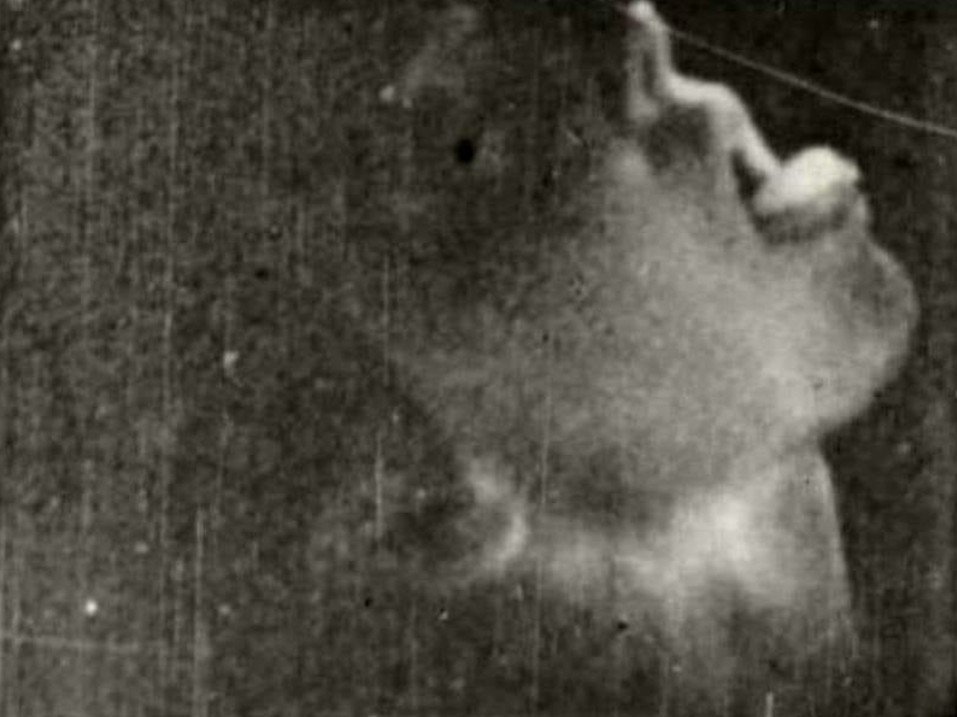
The person who stood before Josefina, blocking her view of Conchita, was Alejandra Damiansa. He carried a camera with him, thanks to which he managed to immortalize the extraordinary Miracle of the Eucharist on Conchita's tongue. It is important to emphasize that this is the only known photograph documenting this supernatural event, which constitutes exceptional proof of God's presence among humanity. In the above photograph, we see Conchita with her tongue sticking out, on which the Eucharist had formed. It is worth emphasizing that this photograph can be seen by everyone in the world and represents a sign of conversion for all humanity. This miracle was given to humanity as a last chance for conversion before the coming chastisement, which was announced once again in the second Message proclaimed in San Sebastian de Garabandal. Let us now return to Leviticus 26:13.
Lev 26:13 I am the LORD your God, who brought you out of the land of Egypt, so that you would not be their slaves. I broke the bars of your yoke and set you free to walk with your heads held high.
This is a very interesting verse referring to the so-called ecstatic marches that took place during the girls' ecstasies in San Sebastián de Garabandal. Let's consider its deeper meaning. Each time the girls fell into ecstasy, they moved with their heads raised. This begs the question: what does the reference to Egypt mean in this context?
Egypt symbolizes the human body, while in this verse God speaks directly to the human soul. The Egyptian yoke is the body in which the soul is bound by the shackles of sin. God announces that he will break these shackles so that the soul can walk with its head held high, which perfectly illustrates the experience of the seers in ecstasy. During these experiences, the Mother of God caused the girls' souls to be separated from their bodies. This explains their complete lack of sensation of any physical stimuli during the visions. The girls were pricked with needles, their eyes were shined, thrown to the ground, and even burned with cigarettes, yet none of them felt pain. This demonstrates that the human body and soul are separate entities.
During their ecstatic marches, the girls moved incredibly fast, and many athletic people couldn't keep up with them. They walked with their heads held high, without stumbling, both day and night. This is another lesson God wants to teach us – if we allow God to guide us, we will not stumble, even in this world full of darkness. Our Lady appeared mostly in the evening and at night, leading the girls through dark valleys where there were no dangers. When the girls asked Our Lady the reason for these late-night meetings, she replied in a way they could understand: "I come at this hour because most crimes are committed at night."
Our Lady is the Light that descends upon this world, and whoever allows themselves to be guided by Her will not fall. Let us not forget that both Our Lady and Jesus are Temples of God, through whom the same God speaks. Remembering this helps us understand that even in the greatest darkness, God is with us and leads us to the Light.
The Second Message and the Final Warning
On January 1, 1965, Our Lady announced her second and final Message. The reason for this, as she herself stated, was the insufficient dissemination of the first Message among the people. It is worth noting that the Church did not make sufficient efforts to explain the meaning of the Message to the faithful. Instead, the public sphere was dominated by the discussion about the authenticity of the apparitions. In response to this controversy, a special ecclesiastical commission was established to investigate the events in San Sebastián de Garabandal. The commission found the events to be devoid of supernatural origin, effectively declaring the apparitions false. As it later turned out, the commission had been negative about the apparitions from the very beginning, and its members had falsified witness statements.
Therefore, it is hardly surprising that in the second Message, Our Lady refers to priests as those who lead human souls to damnation. These are strong words that demonstrate Our Lady's deep-rooted concern for the salvation of souls. The second Message was given to Conchita during an ecstasy that took place on the night of June 18, 1965, in the so-called "square," on the stone path. This Message was proclaimed by Saint Michael the Archangel, who delivered it on behalf of Our Lady.
"Since my message of October 18th has not been fulfilled and has not been sufficiently made known, I tell you that this is the last message. Previously, the cup was filling up, but now it is overflowing. Many cardinals, bishops, and priests are following the path of perdition, dragging even more souls with them. The Eucharist is being given less and less importance. You must escape the anger of the good God against you through your efforts. I, your Mother, through the intercession of the angel St. Michael, wish to tell you to amend yourselves. This is the time of your last warnings. I love you very much and do not want your condemnation. Ask us with sincerity, and we will grant it to you. You must offer yourselves more. Meditate on the Passion of Jesus."
Our Lady's second message is essentially a repetition of the first, but with much greater gravity. Until now, the cup of wickedness had been gradually filling, but now it is overflowing. This message is meant to be a final summons, after which—as recorded in the Book of the Law of Moses—chastisement is to come if there is no improvement. It is worth remembering that between the warning and the chastisement, a miracle is predicted, intended to awaken consciences and motivate sinners to repent and reform. We have already discussed this miracle, and in the case of San Sebastián de Garabandal, it was the appearance of the Eucharist on Conchita's tongue.
These two messages, full of warnings, also have a profound connection to the Book of Jonah. It is worth examining its meaning, which can be summarized in a few sentences. When God commands Jonah to preach a warning to Nineveh, the prophet resists and escapes by ship to Tarshish. In response to his disobedience, God brings a powerful storm to the sea, designed to force Jonah to repent—to abandon his path of sin and return to fulfilling God's will. Unwilling to return, Jonah asks the ship's crew to throw him overboard to save them from destruction. When they do, the storm immediately ceases, and the crew begins to believe in Jonah's God. Here, the miracle serves as a faith-building experience, similar to that in San Sebastian de Garabandal, where the Miracle of the Eucharist inspires faith, leading people to repent and reform. Without faith in God, God's Word has no power to reach people's hearts. Without authority, no one will listen.
As Jonah sinks into the depths, he prays fervently to God, and God sends him help in the form of a large fish—a symbol of the Holy Spirit. The fish swallows Jonah, and for three days inside, the prophet promises to fulfill God's command. After this time, the fish disgorges Jonah onto land, and he fulfills God's will. This story contains the most important truths about conversion, obedience, and God's mercy. Comparing Jonah's story with the events in San Sebastian de Garabandal, we see a profound similarity. Our Lady delivers the first Message, full of warnings, to the pilgrims and inhabitants of this place, which in this case serves as "Jonah's tent." It is in San Sebastian de Garabandal that all present—residents, pilgrims, including foreigners, and priests from around the world—become modern-day Jonahs, called to proclaim Our Lady's Message throughout the world.
However, as Our Lady admonishes in the second Message, the Message has not been widely disseminated, and improvement among the people has not occurred. On the contrary, the cup of wickedness has begun to overflow. Almost four years after the first Message, Our Lady announces a second, and the number of people who came to hear it has increased significantly. At this moment, like Jonah swallowed by the fish, the pilgrims and inhabitants of San Sebastián de Garabandal are "swallowed" by Our Lady, only to be "spit out" back into the world after hearing the Message. This very moment gives them a second chance to proclaim this admonition to the world.
In this story, Our Lady plays the role of the "Great Fish"—a symbol of the Holy Spirit, through whom the Revelations can unfold. All the supernatural events that took place in San Sebastián de Garabandal were possible only through the power of the Holy Spirit, who is united with God.
The question that arises is: was God's Will fully fulfilled in San Sebastián de Garabandal? The second Message, announced last by Our Lady, was intended to be a final call to conversion. This event carries an important message for us: for all believers in God, to proclaim His Name among the nations that do not yet know Him. How much we do in His name, how effectively we spread His Message, will influence our status in the Kingdom of God when we stand before Him. When Jonah was given a second chance, he set out for Nineveh to proclaim the admonition that the city would be destroyed if it did not improve after forty days. In this way, Nineveh became a symbol of the place that was to be subjected to God's judgment. In a
similar way, San Sebastián de Garabandal serves as the "tent of Jonah," the place where God delivers His warning. Nineveh, which symbolizes the world, is the northern coast of Spain. Our Lady's messages, as she herself stated, were addressed not only to this region but to the entire world. This call to conversion is universal and applies to all nations, reminding them of the need for reform to avoid God's judgment.
Jonah 3:4-5
- 3,4. So Jonah began to go through the city a day's journey, and cried out and said, "Yet forty days, and Nineveh shall be overthrown."
- 3,5. And the people of Nineveh believed in God, and proclaimed a fast, and put on sackcloth, from the greatest even to the least.
In the case of Jonah, the Ninevites had forty days to reform, and the key question is whether this number of days is relevant today. If we knew the exact number of Ninevites, we could attempt to calculate the number of days for conversion using the proportional method, assuming that no one reformed. However, Jonah was one, while today there are many pilgrims. The calculation thus becomes more complex, and it is not easy to draw clear conclusions.
At this point, however, we should focus not on mathematical calculations, but on trusting God. He knows people's hearts, and only He knows how long we have for conversion. It is more important that we ourselves respond to the call to conversion and reform that comes from the Messages.
Penalty
The term "punishment" is clearly defined in the Book of Moses, and details regarding the curses associated with punishment are found in the Book of Leviticus. These curses are divided into seven sections, each containing several verses that detail the consequences of sin and disobedience to God's commandments. Each section reveals different aspects of God's judgment, which is inherent in His justice, but also His grace, which aims to restore order and convert hearts.
Leviticus 26:14-46 – the first section relating to punishment
- 26,14. But if you do not listen to Me and do not obey all these commandments,
- 26,15. if you despise my statutes, if you abhor my judgments, if you do not obey my commandments and break my covenant,
- 26,16. I will deal with you accordingly: I will send terror, exhaustion, and fever upon you, which will lead to blindness and ruin your health. Then you will sow your seed in vain. Your enemies will eat it.
- 26,17. I will set my face against you, and you will be defeated by your enemies. Those who hate you will rule over you, and you will flee even when no one is pursuing you.
- Leviticus 26:18-20 - the second section relating to punishment
- 26,18. If you do not listen to Me even then, I will continue to punish you seven times more for your sins.
- 26,19. I will shatter your proud power; I will make the heavens like iron to you and the earth like bronze.
- 26,20. You will labor in vain – your land will not yield any crops, and the trees on the earth will not yield any fruit.
- Leviticus 26:21-22 – the third section relating to punishment
- 26,21. If you continue to act contrary to Me and refuse to listen to Me, I will punish you sevenfold for your sins:
- 26,22. I will send wild animals against you, which will devour your children, destroy your livestock, and reduce your population, so that your roads will be desolate.
- Leviticus 26:23-26 – the fourth section relating to punishment
- 26,23. If even then you do not improve and act in spite of Me,
- 26,24. I will also deal contrary to you and punish you seven times for your sins.
- 26,25I will send a sword against you to avenge your broken covenant. If you flee to your cities, I will send a plague among you, and you will fall into the hands of your enemies.
- 26,26. I will break open a bread rack for you, so that ten women will bake bread in one oven. They will divide bread by weight for you, so that you will not be satisfied when you eat.
- Leviticus 26:26-33 – the fifth section relating to punishment
- 26,27. If even then you will not obey Me and will act in defiance of Me,
- 26,28. I will also come against you with anger and punish you sevenfold for your sins.
- 26,29. You will eat the flesh of your sons and daughters.
- 26,30I will destroy your solar heights, I will smash your pillars, I will throw your corpses on the corpses of your idols; I will abhor you.
- 26,31. I will turn your cities into ruins, I will devastate your holy places, I will not smell the sweet aroma of your sacrifices.
- 26,32. I myself will lay waste the land, so that your enemies who take possession of it will be astonished.
- 26,33. I will scatter you among the nations; I will draw out the sword after you; your land shall be desolate, your cities shall be laid waste.
- Leviticus 26:34-39 – the sixth section relating to punishment
- 26,34. Then the land will keep its Sabbaths all the days of its desolation, while you are in the land of your enemies. Then the land will rest and keep its Sabbaths.
- 26,35. All the days of her desolation she shall keep the sabbath which she did not keep in the sabbath years when you dwelt in her.
- 26,36. As for those who remain, I will send fear into their hearts in the land of their enemies; the rustle of a leaf blowing in the wind will pursue them; they will flee as if from a sword; they will fall even when no one pursues them.
- 26,37. They will fall upon one another as if before the sword, though no one pursues them. You will not be able to stand before your enemies.
- 26,38You will perish among the nations; the enemy's land will swallow you up.
- 26,39. And those who remain of you will rot because of their transgression in the lands of their enemies, because of the transgressions of their ancestors, they will rot just as they did.
- Leviticus 26:40-46 – the seventh section relating to the promise of returning to God if there is repentance and sorrow for sins
- 26,40. Then they will acknowledge their own transgression and the transgression of their ancestors, which is the treachery they committed against Me and the defiance they showed towards Me.
- 26,41. therefore I dealt contrary to them, and brought them into the land of the enemy, that their uncircumcised hearts might be humbled, and that they might recompense their transgression.
- 26,42. Then I will remember my covenant with Jacob, my covenant with Isaac, and my covenant with Abraham. I will remember these things and the land.
- 26,43. But before that the land shall be desolate because of them, and shall pay for its sabbaths, because it shall be desolate because of their iniquity, and they shall pay for their transgression, because they have rejected my judgments and abhorred my statutes.
- 26,44. However, even when I am in the enemy's land, I will not reject them or abhor them to the point of destroying them completely and breaking my covenant with them, for I am the Lord their God.
- 26,45. I will remember for them the covenant of their ancestors, when I brought them out of the land of Egypt in the sight of the nations, that I might be their God. I am the LORD."
- 26,46. These are the statutes, judgments, and ordinances which the Lord established between himself and the Israelites on Mount Sinai through Moses.
Certainly, every country, and indeed many people, could find something in the above verses that applies to their own situation. However, since the Apparitions took place in San Sebastián de Garabandal, it is worth examining the history of this town and considering whether we can find a verse in the Book of the Law of Moses that reflects its fate. Such considerations can help us answer the question of whether San Sebastián de Garabandal truly fulfilled God's Will.
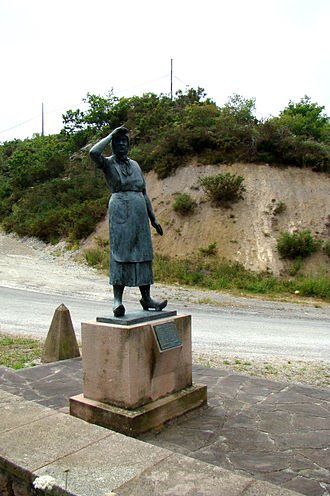
At the time of the Apparitions, San Sebastián de Garabandal had approximately three hundred inhabitants, whereas today that number has dropped to around one hundred. This means that the town's population has decreased by over sixty percent. Many people were forced to emigrate in search of work, and a monument called "Mother of Emigrants" was even erected on the outskirts of the town, symbolizing this difficult period. Let's consider which verse from the Book of the Law of Moses could apply to the situation in San Sebastián de Garabandal. The verses from section seven immediately catch our attention, as they speak of the exile of those who opposed God to foreign lands. They also contain a prophecy of the desolation of their lands, which would be left uncultivated. This is precisely what happens in San Sebastián de Garabandal: at the time of the Apparitions, the inhabitants were cultivating land that now lies fallow. Furthermore, in recent years, numerous fires have broken out in the area, threatening even Los Pinos, the special place where Our Lady appeared. Miraculously, the fire did not consume the pine trees, proving supernatural protection.
Anyone who visited San Sebastián de Garabandal at that time could see firsthand how the fire ravaged vast swaths of land. Furthermore, the penultimate verse of the Book of the Law of Moses speaks of the exodus from Egypt in the sight of other nations, a fact also reflected in the Apparitions. The ecstatic marches of the girls, during which their souls were "led out of Egypt"—symbolizing the body—occurred before the eyes of people of various nationalities. Pilgrims came to the town from the farthest corners of the world.
As you can see, nothing that happened in San Sebastián de Garabandal was accidental. Even the erection of the "Mother of Emigrants" monument is part of these spiritual events.
Leviticus 26:40-46 – the seventh section relating to punishment
- 26,40. Then they will acknowledge their own transgression and the transgression of their ancestors, which is the treachery they committed against Me and the defiance they showed towards Me.
- 26:41 Therefore I dealt contrary to them, and brought them into the land of their enemies , that their uncircumcised hearts might be humbled, and they might recompense their transgression.
- 26,42. Then I will remember my covenant with Jacob, my covenant with Isaac, and my covenant with Abraham. I will remember these things and the land.
- 26:43 But before that the land shall be desolate because of them, and shall pay for her sabbaths, and shall be desolate because of their iniquity , and they shall recompense their transgression, because they have rejected my judgments, and abhorred my statutes.
- 26,44. However, even when I am in the enemy's land, I will not reject them or abhor them to the point of destroying them completely and breaking my covenant with them, for I am the Lord their God.
- 26:45 I will remember for them the covenant of their fathers, when I brought them out of the land of Egypt in the sight of the nations, that I might be their God. I am the LORD.”
- 26,46. These are the statutes, judgments, and ordinances which the Lord established between himself and the Israelites on Mount Sinai through Moses.
After completing his mission, Jonah returned to his tent, and God brought out a plant that provided shade. However, because of Jonah's rudeness, the Lord sent a worm that ate the plant, making Jonah feel hot and want to die.
In the case of San Sebastian de Garabandal, the plant that provided shade is a pine tree, while the worm that would eat it is a fire-breathing alligator. As mentioned, during the fires, the fire approached the pine trees, but miraculously did not burn them, and they remain there to this day. Our Lady's providence ensured that San Sebastian de Garabandal remained alive. However, looking at the fires that occurred in northern Spain, we can conclude that the Warning Message was not fully fulfilled. Had it been fulfilled, the punishment could have been averted. It seems that the punishment was fulfilled to the extent that the warning had an impact on the world.
Now let us consider which section from the Book of the Law of Moses would best apply to the fires that occurred in this region.
Leviticus 26:21-22 – the third section relating to punishment
- 26,21. If you continue to act contrary to Me and refuse to listen to Me, I will punish you sevenfold for your sins:
- 26,22. I will send wild animals against you, which will devour your children, destroy your livestock, and reduce your population, so that your roads will be desolate.
The above verses best reflect the situation Spain faced during the fires. They speak of wild animals, symbolically represented by alligators, breathing fire, consuming everything in their path, including people. The fires left roads impassable, and the surrounding areas deserted. We see, therefore, that Our Lady's messages were not fully fulfilled, which had consequences not only for Spain but for the entire world. Each country could find something that applied to its situation, so the punishment was visible in various corners of the globe. In Spain, it was fires, while in other places, it could be other elements, such as water.
It is also worth recalling the emigration of the residents of San Sebastián de Garabandal, which served a purpose in God's plan. Since the residents were unwilling to voluntarily proclaim the warning, they were, as it were, "forced out" so they could spread the events unfolding in that town around the world. Note that three of the visionaries left for America, while one remained in Spain, leaving San Sebastian de Garabandal. God did the same with the children of Israel, driving them out of their land so they could proclaim the Word of God throughout the world. The Book of Jonah speaks of this very event. What took place in San Sebastian de Garabandal was not a coincidence, but part of God's plan, which assumed that those called to proclaim the message would be dispersed to fulfill the mission God had entrusted to them.
Mount of Beatitudes
As we have already established, the Mount of Beatitudes in the Book of Joshua refers to the right eye of a crocodile. It is in this eye that the pine trees where Our Lady appeared with angels are located. In this sacred place, people brought various objects to kiss, such as rosaries, medallions, wedding rings, and crucifixes. Our Lady's kissing of these objects brought a blessing to their possessors. Sometimes we don't notice these blessings, as they often act in a preventative manner. If we didn't have this blessing, our lives could have taken a completely different course, and we wouldn't have avoided certain undesirable events. We usually pray only when it's too late and we can't undo certain events, blaming God for what happened. The
Los Pinos pine grove is also worth mentioning, because the type of tree used during the apparitions is not accidental. Our Lady appears in shrubs or trees that have thorns. For example, in Lourdes, it was a rose bush, and in Fatima, it was a holly bush. A thorn bush, as in the case of San Sebastián de Garabandal, has a profound meaning. It refers to the bush in which the Spirit of God appeared to Moses on Mount Sinai. In the Book of Genesis, we read that God placed cherubim with fiery swords to guard access to the Tree of Life, and the thorn bush symbolizes the cherubim with a sword.
Our Lady is the Tree of Life, which manifested itself in a thorny tree—in the case of San Sebastián de Garabandal, it is a pine tree with sharp needles. It is also important that the leaves of the tree where the Apparition took place remain green year-round, which refers to the cherubim's unwavering obedience to God. We will discuss the thorn bush in more detail using the example of the Apparitions of Our Lady in Gietrzwałd.
Warning, Miracle and Punishment
The warning, miracle, and punishment we read about in Sacred Scripture are intended to help people understand that their path of sin distances them from God, and that His Laws are the only way to return to the path of salvation. However, simply reading Sacred Scripture does not have the same impact on a person as experiencing it in the real world. The apparitions of Our Lady in San Sebastian de Garabandal are particularly significant in this context, as Sacred Scripture becomes the Living Word there, fulfilling not only a didactic role but also evoking a profound spiritual experience. The warning, miracle, and punishment are reflected in both the physical and spiritual realms, with their primary goal being to prepare people for an encounter with God. The admonition addressed to people, encompassing these three stages, is intended to cleanse them of sin and prepare them for the great Miracle that will unfold in the spiritual realm. Before focusing on these three stages, however, it is worth recalling what they looked like in the context of the apparitions of Our Lady in San Sebastian de Garabandal. The two Messages delivered by Our Lady contained warnings to humanity, urging them to change their ways. These were similar to Jonah's warning to the Ninevites that if they did not convert and repent, they would be punished. Then, after the warning, a miracle occurred—a sign from God that would confirm the truth of His words and establish His authority, especially among unbelievers. Those who truly believe in God do not need miracles, for they already direct their lives according to His guidelines. However, for others, the miracle was intended to be an opportunity for conversion. An example of a minor "miracle" was the appearance of the Divine Persons on Conchita's tongue (Fig. 18), which was intended to strengthen faith in God's power. The minor "miracle," as it is commonly referred to, was the appearance of the Divine Persons on Conchita's tongue. However, if the first two stages of the admonition—the warning and the miracle—failed, the next and final stage would be a punishment, intended to convert the most hardened hearts. All these admonitions, which have a physical dimension, are meant to prepare us for the final Miracle, which will be seeing God through the eyes of the soul during the Last Judgment. Our Lady's apparitions are an attempt to reach the human heart, so that we may change our behavior and avoid the punishment of eternal damnation. If Our Lady's apparitions are meant to present the warning, miracle, and punishment from a human perspective, then the punishment that threatens us is hellfire. In recent years, we have witnessed massive fires, especially on the coast of northern Spain, where mountain ranges resembling crocodiles and alligators are found. Although the fires devastated the surrounding areas, San Sebastián de Garabandal remained untouched. This is a sign that no one was harmed where Our Lady was present.
Praying the Rosary became a means of protection that protected San Sebastian de Garabandal from "fire-breathing alligators." This is one of the important messages of the Apparitions—the power of prayer can protect against threats and convert hearts. Returning to the subject of fire, it is worth noting that Our Lady appeared in San Sebastian de Garabandal as Our Lady of Mount Carmel, holding the Carmelite scapular in her right hand. Recall that a similar image of Our Lady, holding the Carmelite scapular, appeared above the grotto of Elijah, whose attribute is fire—a symbol of God's purifying power. In the context of the Apparitions in San Sebastian de Garabandal, fire is not only an image of destruction but also of purification, intended to prepare people for an encounter with God. Let us now examine what the seers of San Sebastian de Garabandal themselves had to say about the punishment.
Excerpt from an interview with Mari Loli from October 18, 1982:
- Can you say that what you saw was the Tribulation or the Punishment?
- No, I don't know exactly.
- Didn't you see the fire?
- Fire, yes. People ran towards the water, but nothing extinguished the fire. I've never seen people in a fire, but running away from it.
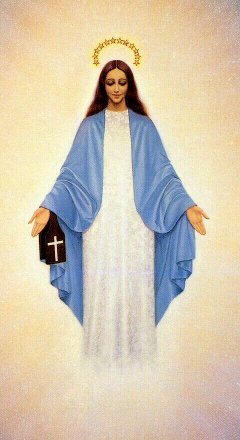
We see that the words spoken by Mari Loli in 1982 are reflected in the events that have taken place in northern Spain in recent years. These include massive fires that were almost uncontrollable. The images Mari Loli saw during the apparitions were therefore a prophecy of the punishment that would come if Our Lady's message were not fulfilled.
It is worth noting that Our Lady communicated with the seers, showing them images that could have influenced their subsequent perception and interpretation of events. Furthermore, there were suggestions from third parties, including clergy, who held their own views on the apparitions, and their presence in the girls' lives could have influenced them. Furthermore, it is important to remember that some members of the Church sought to discredit the apparitions by manipulating testimonies and using blackmail.
To this day, the apparitions at San Sebastian de Garabandal have not been fully researched or validated, and their interpretation remains open. All these factors have contributed to a certain informational chaos. However, by relying on Sacred Scripture and the accounts of the visionaries, we can arrive at the truth and understand the profound meaning of Our Lady's messages.
Excerpt from an interview given by Jacinta.
- “Can you tell us what this Warning will be?
- The Warning will be something that will first be seen in the air, everywhere in the world, and immediately transferred to the depths of the soul. It will not last long, but it will seem very long because of its impact on us. It will be for the good of our souls, so that we will see within ourselves, in our consciences... the good and the evil we have committed. We will then feel great love for our heavenly parents, for God our Father, and for Mary our Mother, and we will ask forgiveness for all offenses.
- Will the Warning be felt by everyone, regardless of their beliefs?
- The Warning will be for everyone, because God desires our salvation. The Warning is intended to bring us closer to Him and increase our faith. Therefore, we must prepare for this day. However, we should not await it with fear, because God does not send anything merely to terrify, but does it out of justice and love, and for the good of all His children, so that they may enjoy eternal happiness and not be condemned.
From Jacinta's statement, we can deduce that she is speaking of punishment, which, as already mentioned, serves as a warning. What would first appear in the air could be some phenomenon caused by natural forces, such as the great fires that raged in Spain, or some other cosmic event, visible to all inhabitants of the earth. These phenomena would not be intended to kill people, but to evoke a sense of fear of death, which would draw souls toward God.
Recall the story of Cain, who, after killing Abel, feared being persecuted and killed. However, God assured him that he would not allow anyone to harm him. Cain's fear of losing his life caused him to turn to God. All cataclysms that evoke a fear of death have a similar effect—they draw people to God and become a call to conversion.
However, the ultimate opportunity to turn to God is the fear evoked by death in the final moments of our lives. If a person does not convert at this point, they will see the great miracle of gazing upon God after bodily death. Seeing God with the eyes of the soul will make everyone believe, but for many it will be too late for conversion. God sends fear upon us out of love for His children, lest they be damned for eternity. During the apparitions at Fatima, we heard that God will punish humanity by sending persecution upon the Church. If God permits such punishments, it means that the Church is close to falling because of sin and unbelief. The persecution of priests is intended to instill fear in them, which will draw them back to God. However, observing the events currently taking place in the Church, we see that those leading the Church are trying to avoid suffering and persecution, and instead are bringing the Church into harmony with the world, making it increasingly like this world.
The suffering of the Church is not to be shed blood, but to strive to lead people on the path of sanctification. This requires abandoning comfort and hard work for God. God's punishment is a battle for every soul, because even Cain, who killed, remains precious in God's sight. This demonstrates the great love God bestows upon His children. Nevertheless, no one who does not learn the lesson of goodness in life can enter the Kingdom of God. If Cain did not repent, he certainly perished, and this applies to each of us.
The warning, the miracle, and the punishment are stages that, depending on the state of our soul, are meant to prepare us for the Great Miracle—the resurrection and seeing God with our own eyes. For some, the warning and the miracle can become a turning point in life, while for others, even a punishment that evokes the fear of death may prove ineffective. It is possible that there is a fourth stage of the warning, related to the so-called "illumination of conscience." This would be the final rung on the ladder of all warnings. During this illumination of conscience, the soul will see its sins and the good it has not done, which is intended to motivate it to improve. Let us now consider the great miracle that awaits every person. In San Sebastián de Garabandal, we witnessed the so-called "little miracle." This term likely comes from Conchita, who, upon learning from Our Lady what the miracle was supposed to be, described it as "a little small." The miracle was said to consist of the appearance of the Divine Persons on her tongue in the form of the Eucharist. Although called "little," this miracle is deeply reflected in the Great Miracle. God is present in the Eucharist, and therefore the true, ultimate Miracle will be seeing God with one's own eyes after the Resurrection. There are many statements confirming this. For example, Padre Pio said that for some, by the time they see the Miracle, it will be too late. Before the Majesty of God, everyone will believe in God because we will see Him with our own eyes. However, the conversion of the soul while in the body is more difficult. It is easy to believe when one sees God, but then the soul is weak. As soon as God is not with it, it will sin again. The closer we are to God in the flesh without seeing Him, the stronger our soul will be. Furthermore, when we stand before God, we must show Him our full hands of merit. Our status in Heaven will depend on this. The time when we will stand before God's Majesty refers to the Book of Job, to which God, through the Revelations in San Sebastian de Garabandal, wants to draw our attention. When Job saw God with his own eyes, his previous doubts about God's goodness disappeared. The very sight of God made Job realize his mistake, feel remorse, and apologize for his unbelief. Importantly, Job did not learn the reason for this trial. He simply accepted that it was for his own good. Returning to Conchita, Jesus told her that she would suffer greatly because no one would believe her, and she herself might doubt. He added that He had chosen her for her sanctification and for the glory of God. So we see that what happened to Job was meant to sanctify him and bring glory to God. Job was chosen by God so that others might be sanctified through his experience and that God's glory would increase among people. It is important that, like Job, we stand before God, acknowledge Him, ask for forgiveness, and humbly accept our experiences.
Job 42.5-6
- 42.5. "Until now I knew you by hearsay,
but now I have seen you with my own eyes, - 42:6. Therefore I retract what I have said and
repent in dust and ashes."
At the moment we stand before God, acknowledgment of our sin and repentance are necessary. If a human soul, standing before God, does not acknowledge God and its sin, it will mean its decay, for what soul, seeing God, could possibly place itself above Him? However, from the Revelations of God the Father experienced by Sister Eugenia Ravasio, we can learn that there are souls who, after death, stand before God and refuse to confess their sin or know God, and such souls then fall to damnation. We see, therefore, that sin can pass from the human body, infecting the soul. In San Sebastián de Garabandal, Our Lady drew attention to man's greatest enemy – the communist system. However, this is not about the communism of the Stalin era, but the contemporary one, which many call leftism. It is a completely atheistic system, in which man gives in to the lusts of the flesh and follows Satan's dictates. In such a world, there is no room for God, resurrection, or hope. Only the "here and now," materialism, and the pleasures of the moment count.
This system is the source of all sin, including abortion, which makes a person in a sense free from all the suffering associated with raising children. I can imagine that such souls, standing before God, might refuse His love. Let's return to Our Lady's statement about the Miracle. " The moment people see the Miracle, all will be healed." For example, if someone was blind during their earthly life, they will receive new eyes. This aligns with the accounts of people who have experienced clinical death. Many of them claim to have regained sight, hearing, or limbs after death.
Excerpt from an interview with Conchita:
- "What did Our Lady say about the sick on the day of the Miracle? When she said, 'The sick will be healed,' did she also mean people who were mentally or spiritually ill, or those with personality disorders?"
- The Virgin spoke these words: " The sick will be healed and sinners will be converted ."
(..) - "Joey Lomangino was promised 'new eyes' on the day of the Miracle. Does this mean spiritual eyes or physical eyes?
- The Virgin said that on the day of the Miracle he would see again. I understood that he would see normally.
It is worth quoting here once again a fragment from the Book of Job, in which Job, after seeing God with his own eyes, experiences deep regret.
Job 42:1-6
- 42,1.Then Job answered the Lord and said:
- 42:2. "I know that you can
do everything you set your mind to. - 42:3 Who obscures the purpose without understanding?
I spoke of lofty things.
It is too wonderful. I do not understand. - 42:4 Listen, please. Let me speak!
I want to ask a question. Please answer! - 42.5 Until now I had heard of you only by hearsay,
but now I have seen you with my own eyes, - 42:6. Therefore I retract what I have said and
repent in dust and ashes."
While in the body, we can hear God's Voice, but we have no way to see Him directly. In the context of the above verses, assuming this is not a description of a dream or a mystical vision, as was the case with the seers of San Sebastian de Garabandal, Job experienced a conversation with God after his death. It is after death, after seeing God's Face, that Job experiences deep repentance and conversion. Seeing God is possible only with the eyes of the soul, which then perceive spiritual reality in its fullness.
Our Lady also says that "we should not wait for the Miracle, for it will come suddenly." In essence, death is that unexpected moment that will touch every person. In this context, the Miracle, which is to be revealed to all, will also come suddenly, at a moment we do not expect. Our Lady emphasizes that it is God who will perform this Miracle. Man is unable to resurrect himself or restore himself to full life. Only God has the power to do this, and the Miracle of the Resurrection is His work, not our own strength.
Excerpt from an interview with Conchita:
- “Do you perhaps know that Jesus, Mary, Joseph, or an Angel will perform part of this Miracle?
- I know that God will perform a miracle . The Virgin told me about it and I can say so."
Regarding the Miracle, it's worth recounting a story related to Father Luis Maria Andreu, because, as we'll see, he became a living testimony to a dogma from Holy Scripture that no man can see the Face of God and live. Father Andreu, kneeling on a rocky path alongside the visionaries during an apparition of Our Lady, suddenly saw something that made such a profound impression on him that he cried out in exultation, "Miracle, miracle, miracle!" A few hours later, he died with an expression of inexpressible joy on his face. Father Andreu was young and in his prime, so his unexpected death caused great astonishment among the witnesses. Returning now to our dogma, Father Andreu must have seen the Face of God, or something of His Face, and therefore he died. The point is that the Face of God has the power to burn away sin, and since human flesh is sinful, to gaze upon God in His full glory would have made no flesh able to stand. After Father Andreu's death, Our Lady said he would be taken to heaven in the flesh. It should be emphasized, however, that this was not about the physical body, but rather the image of the body in the spiritual dimension. After several years, it was decided to open Father Andreu's tomb, where it was found that his body had decomposed. Only his skeleton was found in the tomb, and for some, this was evidence of the falsity of the Apparitions in San Sebastian de Garabandal. However, if Father Andreu were truly taken with his body, as is the case with saints, his body would not have decomposed. However, let us remember that Father Andreu is not playing the role of a Saint here, but of a sinner, therefore his body had to decompose, even though he had been saved in his own flesh and became a Saint. The priest's body had to decompose, because in this way, the dogma we are discussing was depicted in his body. Surely everyone present at the Apparition of Our Lady wanted to see Her, and Father Andreu was the one who demonstrated to us why this couldn't happen. God does not desire human death, but rather wants humanity to achieve holiness and salvation while alive. Let us now move on to the Face of Our Lady. The girls said that during the Apparitions, Our Lady didn't look them directly in the eye, but rather had her head slightly raised, gazing into the distance. The girls even asked why they weren't looked at, to which Our Lady replied that she was looking at all her children. We see, then, that looking at Our Lady's face didn't have the effect of burning away sin, but rather had Her gaze. Let us note that simply looking at the Face of God has the power to burn away sin, because His Holiness is too great for sinful flesh to bear. If gazing upon the Face of God has such power, we can assume that the Face of God is hidden within Our Lady, who is the Temple of God, and God Himself looks through Her eyes. It's also worth noting the location where the apparitions took place. As mentioned earlier, the spruce grove where Our Lady appeared to the girls symbolizes Paradise, while the rocky path leading to Paradise is located in this world. Therefore, when the girls saw Our Lady in the spruce grove, she likely looked directly into their eyes. However, if the apparitions took place on a rocky path, in the so-called "square," Our Lady looked straight ahead into the distance. It was in this "square" that God, through Our Lady, looked directly into the eyes of Father Andreu, causing him to die after a few hours. Let us now turn to Padre Pio, who is also said to have experienced a great miracle, but before it could occur, Padre Pio died. Conchita was extremely concerned, as Padre Pio was about to see a miracle, as Our Lady had foretold. We see that the visionaries don't know what the miracle is; they think it will be something visible in this world. When Conchita spoke with a brother who was with Padre Pio in his final hours, he confessed that he had seen a great miracle before his death. Padre Pio saw Our Lady before his death, and thus a miracle performed by God, a Temple of God from which God looks down. To confirm this, in 1962, Padre Pio sent the girls a letter stating that he had seen Our Lady:
"Dear girls! At nine in the morning, the Blessed Virgin Mary told me that she was saying this to you: 'Oh, blessed daughters of San Sebastian de Garabandal! I promise you that I will be with you until the end of time, and you with me at the end of the world. And then united with me in the glory of paradise.' I am sending you a copy of the Holy Rosary of Fatima, which Our Lady commanded me to send you. This Rosary was dictated by the Blessed Virgin Mary and must be spread for the salvation of sinners and the preservation of humanity from the worst punishments that threaten the good Lord. I give you only one piece of advice: pray and encourage prayer, because the world will soon be on the verge of perdition. You do not believe in yourselves or in your dialogues with the White Lady... You will believe when it is too late."
Let us also recall one of Our Lady's statements referring to a great Miracle – she stated that the Miracle would be performed by God. As we well know, God created Eve from Adam's rib, shaping her with his own hands, which constituted a great Miracle of Creation. Our Lady, however, is the new Eve – full of grace, who brings salvation to the world. Therefore, those who perceive God's work in Our Lady see in her not only herself but also God Himself and His great Miracle.
It is worth adding that those who believe that God is present in Our Lady, as is the case with Jesus, and who accept His teachings have the opportunity to achieve holiness. Those who live in accordance with God's teachings will be blessed with the grace of experiencing this closeness during their lifetime. Examples include Padre Pio and Father Andreu, who experienced this extraordinary Miracle – they saw Our Lady. Padre Pio was a saint, so he could look directly into the eyes of Our Lady without fear, fully purified and ready to encounter God's presence. Those who did not fully purify themselves during their lives will see God in all His glory only after death—and this will be a true miracle. However, at that point, it will be too late to build faith or repent of sin, because anyone who stands before God's Majesty will immediately believe and feel remorse for their sins, but then the soul will have no merit. It is worth noting, however, that there are exceptions to this rule. A person who has spent their entire life steeped in ideologies that deny the existence of God, which place humanity at the center of everything, may, after death, stand before God's Majesty and refuse to acknowledge Him and repent of their sins. Sin itself does not pass into the spiritual world, but the thought patterns shaped by a person's life can follow it. Today, one of the greatest threats to human souls is the modern communism spreading throughout the world, which denies God and promotes ideologies that distort true spirituality. When Job stood before the Majesty of God, he saw God with his own eyes and immediately believed. He repented of his earlier doubts, which questioned God's goodness. He didn't need any answers as to why these difficulties befell him—he saw the full greatness of God and His works. Souls immersed in modern ideologies, on the other hand, may encounter God only in denial, repeating their previous ways of thinking and refusing to acknowledge the True God. Such souls, as the Revelation of God the Father to Sister Eugenia Ravasio warns, are doomed because their hearts are closed to the truth and love of God. Let us return for a moment to the topic of warning, miracle, and punishment, summarizing it in a few sentences. These three elements—warning, miracle, and punishment—have their material reflection in the spiritual realm, as revealed to us through the Apparitions of Our Lady in San Sebastián de Garabandal. The message we received through Our Lady contains words of warning addressed to sinners and calls for conversion and a life of virtue. The spiritual counterpart of the warning is the so-called "illumination of conscience," which serves as a spiritual warning to the soul. During this "illumination," the soul has the opportunity to see all the evil it has committed and the good it has failed to do. As for the miracle, in its material form, it was the appearance of God in the form of the Eucharist on Conchita's tongue, while its spiritual counterpart will be seeing God with her own eyes after the Resurrection. In terms of punishment, in its material aspect, it was the massive fires that broke out in northern Spain, which were difficult to control. These fires are a symbol of the hellish punishment that awaits the damned souls who have rejected God's love.
The Book of Job and San Sebastián de Garabandal
As mentioned earlier, the Apparitions of Our Lady in San Sebastian de Garabandal have a profound connection with the Book of Job. Perhaps because of the difficulty of interpreting it—and it must be admitted that it is one of the most demanding readings in the entire Old Testament—the Apparitions in San Sebastian de Garabandal are intended to help us better understand it. Before we move on to a detailed comparison of the Apparitions in San Sebastian de Garabandal with the teachings contained in the Book of Job, it is worth briefly outlining its central theme. Job was a wealthy man, respected by the people, and had a large family. His life was filled with prosperity, and his wisdom and integrity led many to seek his counsel. Job was faithful to God in all he did, observing His Law, and in return, God blessed him in all his endeavors.
The blessing of God, as spoken of in the Book of Job, has deep roots in biblical tradition, particularly in the Book of Leviticus, and in the events surrounding Mount Gerizim and Mount Ebal in the Promised Land. It was there, between these mountains, that the covenant between God and the people of Israel was renewed. This covenant contains principles concerning blessings and curses: if the children of Israel obey God's Law, God will bestow upon them a blessing, but if they break it, God's curse will fall upon them. Let us now return to the Book of Job. When Satan returned to Heaven after his earthly wanderings, God asked him if he had noticed Job, identifying him as a righteous man and faithful to God. Satan responded by confirming that Job was indeed faithful, but noted that his righteousness and devotion to God stemmed primarily from the numerous blessings God had bestowed upon him throughout his life. Then, with God's permission, Job is put to the test by Satan – God allows all the blessings he has previously received to be stripped from him.
From one day to the next, Job loses all his possessions and offspring, yet he does not lose faith in God. Faced with tragedy, Job explains these events with the words: "If I have accepted good from God, why should I not also accept evil?" and "I came naked into the world, and naked I shall depart." Despite his suffering, Job does not turn against God, maintaining his faith and trust in His plan. Satan failed to break Job's faith, so this time, once again with God's permission, Job is subjected to another test – this time he is to lose his health. Satan claims that Job will deny God, because man is willing to sacrifice everything to save his life. In response to these accusations, Job is stricken with malignant leprosy, forcing him to withdraw from social life. As a result of this illness, he loses the respect and obedience of the people.
They begin to point fingers at him, and no one wants to believe that the curse fell upon him without reason. People are convinced that Job must have committed a sin that brought him such great suffering. In the eyes of the community, this sin becomes synonymous with guilt, and his suffering is seen as punishment for something that has not been revealed. It's worth noting that those suffering from leprosy were forced to isolate themselves from the community and go into seclusion, which meant that Job lost not only his health but also his respect among the people. As a sick man, forced to live apart from others, he became the object of rejection.
One day, sitting on a dunghill and scratching himself with a potsherd, Job is visited by his friends. Seeing his plight, they do not speak to him for seven days and nights, silently sharing his suffering. After this time, unable to bear it any longer, Job bursts into tears, expressing his grievances to God and questioning the meaning of his suffering. At this point, a dialogue begins between Job and his friends, who, knowing the covenant made at the mountain, which stipulates blessings and curses, try to convince Job that he must be concealing some sin that has brought upon him the curses of Mount Ebal. Despite diligently observing God's Laws, Job cannot understand why such punishment is being visited upon him. He soon begins to loudly doubt God's justice and goodness. His friends, seeing this, accuse him of blasphemy.
After this conversation, Job is left alone with his doubts. Later in the Book of Job, we see him before God, whom Job now has the opportunity to see and hear. God explains the complexity of the created world, asking Job a series of rhetorical questions. If God created such a complex world that man cannot fully comprehend, how can Job, with his limited human wisdom, understand God's intentions and point out His errors?
Hearing God's words and standing in His presence, Job acknowledges God's truth and confesses his regret for his earlier words. After all this, God restores Job's lost years and gives him back even greater blessings. During the Apparitions of Our Lady, we witness an extraordinary biblical spectacle, in which verses of Holy Scripture come alive, becoming the Living Word. This helps us understand the depth of certain themes and begin to apply them to our daily lives. In this spectacle, the central role is played by God, present in Our Lady, and by the seers, who act as intermediaries between Our Lady and humanity, following the example of Moses. The seers themselves also become the Living Word, referring to certain biblical figures.
Jesus Christ was the supreme example of the Living Word, who reflected almost all of Holy Scripture. Like Him, the seers dedicate their entire lives to playing these unique roles, which are not accidental but stem from a supernatural calling. This dedication is a gift from the Saints, who in some way reappeared in this world to lead humanity toward salvation. We have already mentioned Father Luis Maria Andreu and Padre Pio, who helped us understand the great miracle spoken of by Our Lady in San Sebastian de Garabandal. It is worth adding that all the visionaries, in a sense, play the role of Job, making their suffering easier to bear. Let us therefore examine the profiles of the visionaries, beginning with Conchita González.
Conchita was one of four visionaries in San Sebastian de Garabandal, and at the time of the apparitions, she was only 12 years old. She grew up practically without a father, who died prematurely, and later lost one of her brothers. In the early days of the apparitions, Conchita's mother did not believe that her daughter was actually being seen by an angel or Our Lady. Conchita's family lived modestly, without the wealth that Job could boast.
Let us now quote an excerpt from Conchita's diary, in which she recorded the words of Jesus during the locution in 1966:
"Conchita's Diary" p. 204, 1966: He [Jesus] replied... "I want to tell you, Conchita, that before the miracle happens, you will suffer greatly, because few people will believe. Your own family will believe that you have deceived them. I want all this, as I have already told you, for your sanctification and so that the world may follow the message. I want to advise you that the rest of your lives will be continuous suffering. Do not be afraid. In your suffering you will find Me, and also Mary, whom you love very much... I will be with everyone who suffers for me."
Jesus foretells Conchita that she will suffer greatly because people disbelieve her words, which is identical to the experiences of Job, whom no one wanted to believe. From the above note, we can conclude that Jesus consents to the suffering of Conchita and the other seers in order to sanctify them and those who will be sanctified through their mediation. This experience is reminiscent of Job, who was also tested by God, a test aimed at his sanctification. His suffering, recorded in Sacred Scripture, became a lesson for others, intended to lead people to sanctification.
We see, therefore, that both Job and the seers serve as "actors" in God's plan, through which the affairs of God's Kingdom are presented. Job was subjected to a test of faith, which had to be strong enough to avoid a repeat of the situation in Paradise, when Satan broke the faith of Adam and Eve. Although Job was attacked by Satan, his faith was far stronger than that of our first parents. His suffering, like that of the seers, has profound meaning in God's plan, which aims not only at their sanctification but also at the sanctification of others through their example and sacrifice. Let us now return to our comparison. Conchita, like Job, lost part of her family, and initially no one believed her in what she saw, not even her mother in the first phase of the Revelations. In Job's case, his wife disbelieved his words about his impeccability before God. As Job begins to lose everything he cannot rationally explain, he begins to doubt God's goodness.
He cannot answer the question of why God would send such immense suffering and curses upon the good man Job considered himself. Job cannot understand why no one, not even his wife, refuses to believe he has committed no sin. He wonders why everyone has turned against him and now points fingers at him. Job's suffering becomes for him not only an inner test of faith but also a question about justice and the meaning of God's decisions in the face of human suffering. What happens to the seers of San Sebastián de Garabandal is exactly what happened to Job. Over time, Conchita begins to doubt God's goodness, wondering how God could have sent such suffering to a good girl like herself during the apparitions. No one wants to believe her that she saw angels and the Virgin Mary. In response to these events, a special church commission is established to investigate the apparitions and engage in dialogue with Conchita, similar to the case of Job and his friends. In both cases, the other side tries to prove the girls and Job guilty.
It is worth noting that in Job's case, Satan impersonates his friends, trying to break his faith. In the case of the seers, this role is taken over by the church commission, which ultimately breaks the girls' faith by forcing them to sign a document admitting that the apparitions were a hoax. Several years later, the seers denied these signed statements, but this information did not reach the public.
Let us now recall a conversation between Conchita and her Mother Superior, which took place at a time when she wanted to join a convent.
- Conchita: " If it's true [about Our Lady, then I suffer] that I behaved badly, denying it and not acting generously. And if it's not true... then [I suffer] because of everything. If what happened to us when we were little and good girls is not supernatural and God allowed it to happen, with all its consequences, then I can no longer believe that God is good ... My mother and brothers will never be able to believe."
MOTHER NIEVES: " I present to you three hypotheses:
1. If everything was your deception, then God is good because despite everything, he forgives you.
2. If these are natural phenomena, God is still good, because it's like an illness that God doesn't want but has to allow, and He will protect you.
3. If it's something supernatural, God is incredibly good." - Conchita: "I don't understand the first two cases, because we didn't start it with any lies and I can assure you that we didn't collude."
- M.Nieves: "And in further developments?"
- Conchita: "It was the same as at the beginning. It's not true that we rehearsed. How can you think that?"
- M.Nieves: " So it is clear to you that this did not happen on your initiative?"
- Conchita: "I don't know how it happened, it's not clear to me - I only know that we didn't prepare it."
As we can see, Conchita doubted God's goodness, just like Job. The Book of Job is based on the story of Adam and Eve, whose faith in God was first tested by Satan. Let us therefore attempt to interpret the Book of Job based on the Revelations in San Sebastian de Garabandal. Job was wealthy, yet righteous—he obeyed God's Law and helped those in need. Wealth usually goes hand in hand with sin, so it was a formidable test for Job, one intended to determine whether he had learned to distinguish good from evil.
The wealth God bestows is one of the greatest trials, usually ending in failure. In Job's case, once he understood the teaching of distinguishing good from evil, he was put to the test of faith. On one scale was faith in God's goodness, and on the other, earthly goods and the obedience of men. Although Job possessed much, he also had much to lose, and being deeply tied to this world, his test was extremely difficult. Let us recall that Jesus was subjected to the same test of faith. After learning to distinguish good from evil, he was led into the desert, where for forty days he was tested by Satan, which he passed successfully. From that moment on, he could work for the glory of God, having proven himself worthy of salvation. Note that Jesus possessed no wealth, and therefore was led into the desert, where everything is in short supply. On one side of the scale were only thirst and hunger—the things that most plague the desert.
Therefore, it is not certain that the test of faith will unfold in the same way for all people. Satan tries to take away what a person is most attached to in this world. However, having little makes it easier to pass such a test. The very act of preaching the Gospel is also a test of faith—it is work for God, to which priests are most often subjected. It seems that today, all priests in the Catholic Church face a test of faith on which their future depends.
Based on the Book of Job, we can be certain that Satan is responsible for all the evil we encounter among priests. If it turns out that any priest fails the test—and everything indicates that many will—he will not be able to work for God in the afterlife. However, the final judgment belongs to God. Returning to the seers, the girls learned the lesson of distinguishing good from evil when, after picking apples that did not belong to them, they confessed their sin and felt deep remorse. This is a reference to Adam and Eve, who in Paradise picked the forbidden fruit. From that moment on, like Job, the girls are subjected to a test of faith by Satan. As already mentioned, Satan takes away everything that a person is connected to in this world. The more you have, the more severe the test becomes. Satan tries in every way to destroy a person's faith in God's goodness, even acting through priests living in sin.
One of the most precious possessions the visionaries of San Sebastián de Garabandal possessed in this world was the memory of Our Lady, which is why Satan tried to take it away. Over time, all the girls began to doubt whether they had truly seen Our Lady. They began to forget her image, leading to a doubt in God's goodness, as Conchita spoke of in her conversation with Mother Nieves. This moment in their lives is incredibly important because it illustrates how, in moments of trial, faith can be profoundly questioned, and one grapples with inner fears and questions whether one has truly witnessed something supernatural. Priesthood involves completely renouncing worldly attachments and dedicating oneself to the service of God. Let us consider how Satan can attack a priest. Since a priest is naturally impoverished, Satan can attempt to tempt him with wealth, thus binding him to earthly goods that distract him from his dedication to God. However, Satan's temptation of priests isn't limited to wealth—his range of activities is much broader. Since a priest is unmarried, Satan can introduce a woman into his life to break his vows of chastity.
In the context of the Catholic Church, Satan can also work through priests who remain in sin, sowing scandal and creating doubt among the faithful, which can lead to separation from God. It's worth emphasizing, however, that Satan can only work through those who remain in sin. In the case of Job, we see that Satan worked through his acquaintances, suggesting that they, too, were in sin. However, God confirmed that they were wrong, and their lives were saved because Job prayed for them.
In many of her Messages, Our Lady calls for prayer for priests, a direct reference to the Book of Job. A priest who has sinned can only be saved if people pray for him—though this can be difficult, especially if his sins have led to the scandal of others. Anything that deviates from Jesus' attitude toward priests comes from Satan. Recall that Jesus had neither wealth nor a wife, and his sole purpose was to preach the Gospel, the very purpose for which he was born.
A test of priests' faith is necessary. Not all who cry "Lord, Lord" are fit to serve God. Every true priest of God must be characterized by the highest purity, the ability to distinguish good from evil, and, most importantly, faith in God. In this context, the number 144,000 becomes understandable. It is the number of chosen, perfect servants of God. This number is finite, designed to select the best of the best. When we know we are running for a position among thousands, we will strive harder to be chosen. The number 144,000 is the number of mansions in Heaven, which Jesus mentions in the Gospel, referring to priests who, through their lives and faithfulness to God, will be able to serve God. The trial of priests led the entire Catholic Church to follow a path that, in many respects, distanced itself from God. It was enough for Satan to strike at the Church's authority, which began to abound in luxury. Let us remember that Satan can bestow wealth to tempt people to cling to earthly goods. However, all of this occurs within God's plan, so that no one can later accuse them of lying in Heaven.
The story of Job demonstrates that if someone learns to distinguish good from evil, they will certainly be subjected to a test of faith, which will allow them to determine what truly matters most to them. Theoretically, one can possess material goods, but the key is whether one has an attachment to them. The test is not about possessing wealth, but about how that wealth is treated—whether it is used for good, in accordance with God's will, or becomes an obstacle to salvation.
A priest who possesses wealth is not condemned for this reason alone. It is important that he does not become dependent on these possessions and does not prioritize them over his fidelity to God. If he knows how to use them for good purposes and does not allow them to become a source of attachment to this world, he will pass the test that will ultimately reveal what is truly in his heart. In the case of the seers of San Sebastián de Garabandal, Job's suffering was distributed among all the girls, as if each were a single Job. This was to ensure they were not burdened beyond their strength. An example is Mari Dolores Mazón (Mari Loli), who took on Job's illness. The seer died in 2008 from lupus erythematosus, a disease that caused immense suffering for many years. Lupus, which damaged numerous tissues and organs, especially the skin, is similar to the leprosy with which Satan afflicted Job.
Both Job and Mari Loli experienced diseases that affected their skin, which is a significant element of their suffering. Moreover, since Mari Loli died of this disease, it can be assumed that Job also died of his illness and saw God only after his death. In this way, the Apparitions serve as analogies, helping us better understand difficult and incomprehensible topics related to Sacred Scripture. Another person through whom God wanted to show us something was Joey Lomangino. At the age of sixteen, he lost his sight and sense of smell in an accident. His conversion story is incredibly moving – after visiting Padre Pio, Joey underwent a profound spiritual transformation. During confession, when he was ashamed to confess his sins, Padre Pio began to list them with incredible accuracy, which shocked the young man and prompted a true conversion. In later years, thanks to Padre Pio, Joey became one of the greatest promoters of the Apparitions in San Sebastian de Garabandal.
From the visionaries' accounts, we learn that Our Lady promised Joey new eyes on the day of the great Miracle. Let us recall that Joey remained blind until his death, and the only sense he regained was the sense of smell, thanks to Padre Pio's intervention. God, who speaks through Our Lady, is always Truthful. Therefore, the promise of regaining sight was not fulfilled during Joey's lifetime, which leads us to conclude that the day of the great Miracle is linked to the day of the Resurrection, when we will all stand before God. It seems that Joey Lomangino played another important role, intended to reveal to us deeper spiritual truths. Let us recall that the Apparitions in San Sebastián de Garabandal took place in a symbolic setting – as if on the upper jaw of a crocodile that could neither see nor feel, and therefore was unaware of the presence of humans on its body. It is worth noting that we are operating here in the realm of symbolism, not literal imagery.
Joey Lomangino, in this context, could be seen as the "crocodile" on whose jaw Our Lady appeared. When Padre Pio healed his sense of smell, Joey recalled smelling the scent of roses, and if we examine the location of the first apparition, we can see that Our Lady appeared near the nostrils of this symbolic crocodile. Furthermore, Joey could not regain his sight in this world, because then it could "end badly for the people" residing in San Sebastian de Garabandal, since Joey symbolizes the crocodile. Looking at Joey Lomangino, we must draw conclusions that will answer certain questions related to matters of God. Joey Lomangino did not lose his sight until he was sixteen, and until then he was a grievous sinner. One day, while inflating a car tire, it exploded and crushed his skull, resulting in the loss of both his sight and his sense of smell. This may sound terrifying, but as has already been said, the people through whom certain Truths have been presented to us are not coincidental. Thanks to their sacrifice, we can learn something. The crocodile depicting San Sebastián de Garabandal, in the case of Joey Lomangino, refers to a "sinful reptile" that feeds on other people, and let us remember that Joey was a great sinner. However, the apparition of Our Lady on the head of this crocodile causes her foot to crush its skull so that it cannot harm the inhabitants of San Sebastián de Garabandal or any pilgrims. When considering the Apparitions of Our Lady, we should always remember that the context of events can change. Just as in art, where the same exhibit can take on different meanings in different works, so too in Apparitions, different circumstances, places, or moments can convey new, deeper messages. Therefore, it is worth approaching these events with an open heart, ready to discover new aspects that God desires to reveal to us. Let's return to Job for a moment. When Job experiences God's power and begins to perceive the complexity of the world He created, he suddenly discovers his own smallness. Job realizes that he is unable to comprehend God's intentions, and that everything happening around him is not as simple as it seems. The Book of Job touches on many issues concerning human life, but it particularly focuses on the role of suffering, which has many dimensions. Let us consider, then, the role of suffering in learning to distinguish good from evil.
Job was a happy man. He had everything one could desire: wealth, a large family, respect from others, wisdom, health, and, above all, a deep faith in God. However, when his faith was tested, Satan took it all away. We see that in Job's case, we move between extremes. Job had the opportunity to experience both wealth and poverty; faith and unbelief; health and illness; having children and not having them; love and rejection; peace and anxiety; patience and impatience; joy and pain; Wisdom and foolishness; trust and distrust. The list could go on. God created man in His own image, endowing him with the ability to distinguish good from evil. So, who is closer to God: Job, who was happy, or Job, who found himself in great suffering? The former, Job, had theoretical knowledge of suffering, while the latter had practical knowledge. This can be compared to learning about dyslexia. One person learns about it from books, the other from their own body. It is obvious that someone who has experienced something personally will acquire this knowledge in a deeper and more authentic way. When someone tells us about their suffering, we cannot understand it to the same degree as when we experience it ourselves. This world serves us precisely to learn the difference between good and evil, which is inextricably linked to suffering. Although no one desires suffering, it is essential for acquiring knowledge. Theoretical knowledge gives us only a general outline, but it is learning through experience—through our own bodies—that allows us to truly feel and understand what it means to distinguish good from evil. Suffering can therefore be a path that leads us to greater wisdom and to the fullness of eternal life in God's presence. For a better understanding, we will summarize what was discussed above. Job learned the difference between good and evil. In the first years of his life, he experienced good, but when he began to lose everything, he also experienced evil, simultaneously undergoing a test of faith. Before Job lost his wealth, he had only a theoretical knowledge of evil, but when he began to experience it firsthand, he understood it fully. When Job lost what God had given him, he considered it evil, and God rebuked his friends who did not understand this situation, admitting that Job was right. As we can see, Job learned the difference between good and evil through personal experience, which is a deeper form of learning.
For us, as humans, knowing evil is more important, because true happiness awaits us in Heaven. Our Lady tells the visionaries that happiness in this world is not guaranteed, but in the next it certainly is. Padre Pio mentioned that angels envy people for two things: the Eucharist and suffering. The Eucharist, because in it we receive God Himself, and suffering, because learning through suffering in one's own body is far more effective. Suffering on earth has a higher value than happiness, because in Heaven there is no possibility of practical learning about evil. It seems that purgatory can fulfill such a teaching role.
Let us now relate the Book of Job to the Gospel of Jesus Christ by recounting the parable of the rich man. When the rich man comes to Jesus asking what he must do to be saved, Jesus tells him to keep God's commandments. To this, the rich man replies that he has kept them from childhood, meaning that he has learned to distinguish good from evil. The rich man, in this case, mirrors Job, who is about to lose everything overnight during his test of faith.
Jesus, however, tells the rich man to sell everything he has, give it to the poor, and then follow Him. The rich man leaves sad because he had many possessions and was unable to willingly part with his wealth, which he placed above God. Thus, he failed the test of faith—he refused to give up what he had to follow Jesus.
Jesus, addressing his disciples, tells how difficult it is for a rich man to be saved. In this world, it is better to have little, because then it is easier to pass the test of faith. Having little means we don't have to worry about Satan taking anything precious from us. A sinner who renounces the sin to which he was attached rids himself of evil, thus saving himself. In this context, it is easier to rid himself of sin than of wealth.
Just as Job lost everything to fully experience evil, so too the parable of the rich man illustrates how clinging to worldly things hinders the test of faith. In this sense, material things can become an obstacle on the path to salvation. Let us repeat this again so that this important lesson is clearly understood. A rich man is attached to his wealth and this world, while a sinner is attached to sin. If a sinner abandons sin for God, passes the test of faith, and learns to distinguish good from evil, he can enter the Kingdom of Heaven. In turn, if a rich man abandons his wealth for God, he will also pass the test of faith and understand true worth, which will allow him to enter the Kingdom of Heaven.
Who has it easier – the sinner who abandons sin, or the rich who abandons their wealth? The answer is obvious. This is a huge challenge for both, but the point is that everyone who has wealth should use it for God, helping those in need. The word "for God" is crucial here, because wealth can be used in a noble way, but also for the desire to gain public applause or for other nefarious motives.
Furthermore, the wealth of a wealthy person can come from dishonest sources, which automatically precludes a true test of faith. Such a person must first learn to distinguish good from evil, and only then, unexpectedly, will they be subjected to a true test of faith. Only then, after passing this test, can they enter the path to salvation. When Jesus says that it is easier for a sinner to enter Paradise than for a rich man, he is referring to the strength of the ties that bind a person to this world, and the most sensual of these ties is wealth. In Sacred Scripture, the camel is considered an unclean animal because it does not have cloven hooves, which symbolize sinners. In turn, the "eye of the needle" symbolizes the gate to Paradise. In this way, Jesus says that it is easier for a camel—that is, a great sinner—to pass through the eye of a needle than for a rich man, whose wealth strongly binds him to this world.
God created the world as good, but full of both good and evil, which are intended to serve our learning. It is easy to believe in God's goodness when we experience only goodness, but when we begin to experience scarcity, doubts about God's goodness become inevitable. An example is Job, who, despite his remarkable faithfulness, doubted God's goodness in moments of trial, just as the rich man, when asked by Jesus to give up his wealth, turned away from God, also doubting His goodness.
However, there is a lesson in all this: doubting God's goodness has a purpose in our spiritual development. In this context, Jesus' words on the cross become understandable: "God, why have you forsaken me?" This is an expression of doubt, which does not mean a loss of faith in God, but is part of the process by which a person becomes capable of a deeper understanding of the distinction between good and evil.
In Matthew 19:17, Jesus expresses faith in God's goodness, but on the cross he doubted, revealing two extremes, similar to Job's experience. It seems that every believer in God will have to go through a moment of doubt about His goodness, and this is a necessary element in learning to distinguish good from evil.
Matthew 19:16-30
- 19,16. And behold, a man approached him and said, "Teacher, what good deed must I do to obtain eternal life?"
- 19:17 He answered him, "Why do you ask me about good? Only One is good. And if you want to enter into life, keep the commandments."
- 19,18. He asked Him, "Which ones?" Jesus replied, "These are these: Do not kill, do not commit adultery, do not steal, do not bear false witness,
- 19,19. Honor your father and mother, and love your neighbor as yourself!”
- 19,20. The young man answered him, “I have observed all these things. What am I still lacking?”
- 19,21. Jesus answered him, "If you want to be perfect, go, sell what you have and give to the poor, and you will have treasure in heaven. Then come, follow me!"
- 19,22. When the young man heard these words, he went away sad, for he had many possessions.
- 19,23. Jesus said to his disciples, "Truly, I say to you, it will be hard for a rich man to enter the kingdom of heaven,
- 19,24. Again I tell you, it is easier for a camel to go through the eye of a needle than for a rich man to enter the kingdom of heaven.”
- 19,25. When the disciples heard this, they were greatly astonished and asked, “Who then can be saved?”
- 19,26. Jesus looked at them and said, “With men this is impossible, but with God all things are possible.”
- 19,27. Then Peter said to Him, "Behold, we have left everything and followed You. What then will there be for us?"
- 19,28. And Jesus said to them, "Truly I say to you, in the regeneration when the Son of Man sits on his glorious throne, you who have followed me will sit on twelve thrones, judging the twelve tribes of Israel.
- 19,29. And everyone who has left houses or brothers or sisters or father or mother or children or lands for my name's sake will receive a hundredfold and inherit eternal life.
- 19,30. And many who are first will be last, and the last will be first.
Another parable from the Gospels that draws on the Book of Job is Jesus' healing of a man with leprosy. As we know from the Book of Job, God wanted Satan to test Job, which involved suffering. Similarly, in the Gospel, God sent his Son, Jesus Christ, who wants to heal the man with leprosy, bringing him out of suffering. The word "will" is important here, as it not only expresses desire but also emphasizes God's power and authority. God's will is absolute and powerful – when God "wills," His will is unfailing, and His actions fully realize His plans.
Mark 1:40-45
- 1:40 a leper came to Him , and kneeling down, he begged Him, saying, “If You are willing , You can make me clean.”
- 1:41 Moved with compassion, he stretched out his hand and touched him, and said to him, " I am willing ; be clean."
- 1,42. Immediately the leprosy left him and he was cleansed.
- 1,43. Jesus gave him strict orders and immediately sent him away,
- 1,44. saying to him, "See, say nothing to anyone, but go and show yourself to the priest and offer for your cleansing the offering that Moses prescribed, as a testimony to them."
- 1,45. But after he had gone out, he began to preach and spread widely the news, so that Jesus could no longer openly enter a city, but stayed in deserted places. And people were coming to him from all over.