
12. Message, August 30, 1947
I hear this Voice and look. A feeling of heaviness comes over me, and I hear the words,
"There is great tribulation .
And then I see Italy clearly before me, and it seems like a very great storm is rising there, above it. I have to listen, and I hear,
"Exile .
I walk as if above Italy, and it seems like I have to distribute blows. Then I hear,
"It is as if blow after blow is coming there .
The above message, referring to Italy and the Vatican, should be interpreted in light of events related to Israel and Jerusalem—the temple city. In this approach, the prophecy of the Lady of All Nations becomes a kind of repetition of history, albeit presented in a different setting. In this symbolic parallel, Italy corresponds to Israel, while the Vatican to Jerusalem.
This message carries a grave warning: what happened in Israel's history can also be repeated in the Christian Church if the same mistakes are made.
The exile and oppression experienced by Israel were a consequence of the breaking of the Covenant made with God—the Covenant recorded in the Book of the Law of Moses. A similar danger can also befall the Church of Christ if it abandons fidelity to Love, Justice, and Truth—the three pillars that should continually guide its mission and action.
The punishment that fell upon the Israelites was neither sudden nor accidental. God repeatedly sent prophets into His "vineyard," exhorting the people and their "farmers" to remain faithful to the Covenant. Israel, however, did not heed their voice, disregarding both the prophets' warnings and the consequences of departing from God, clearly spelled out in the Mosaic Law. Only the persistent hardness of their hearts caused God's announced judgments to be fulfilled in all their severity.
Therefore, if the priests of the Christian Church do not heed the admonitions of Heaven—like the priests of the Jerusalem Temple—they will suffer the same fate. Shortly before returning to the Father, Christ promised to send the Spirit of Truth to the world, who would expose sin. The word "Truth," inscribed in the arch shown to Ida Peerdeman, is located precisely at the site of the Mount of Beatitudes—symbolically referring to the Lady of All Nations, whose Messages also serve as prophetic admonitions.
Jn 16:7-8
16:7. But I tell you the truth: It is for your good that I go away. For if I do not go away, the Helper will not come to you. But if I go, I will send him to you.
16:8. And when he comes, he will convict the world concerning sin and righteousness and judgment.
Jn 16:13. But when he, the Spirit of truth , comes, he will guide you into all truth. For he will not speak on his own initiative, but whatever he hears, he will speak, and he will declare to you the things that are coming .
As we will see, the Message under discussion is an example of such an admonition, one that has already found its fulfillment. It is also worth recalling in this context a fragment of the Law of Moses, contained in the Book of Leviticus, which—along with the words of the prophets—is a testimony to the Covenant with God. It records God's warnings and curses—the announced punishments that will fall upon those who break the Covenant and persist in persistent disobedience to His Will.
The following verses correspond perfectly with the situation described in the Message: they foretell "tribulation" and "exile," which may also affect the Christian Churches if they do not return to faithfulness to God.
Leviticus 26:27-28;31-33
26:27. If even then you will not obey Me but act in a way that is contrary to Me,
26:28 then I will also come against you with fury and punish you sevenfold for your sins.
26:31. I will lay waste your cities, desolate your holy places , and will not accept the sweet aroma of your sacrifices.
26:32. I myself will desolate the land, so that your enemies who possess it will be astonished.
26:33. I will scatter you among the nations ; I will draw out the sword after you; your land will be desolate, your cities will be laid waste.
Let us now turn to the prophecy contained in the Message of the Lady of All Nations, which concerns Italy and the Vatican. This prophecy's structure resembles a familiar pattern from the Old Testament: the prophets first denounced the sin and infidelity of the people, then called for conversion, and simultaneously reminded them of the Covenant made with God and the judgment that threatens its disregard. We see a similar pattern in the Message—the apostasy is presented, the call to return to God, and the announcement of the consequences for persisting in infidelity.
The Message of the Lady of All Nations largely parallels the prophecies of Isaiah and Zechariah, which we will refer to later.
Before proceeding, it is important to note that the Message does not refer exclusively to Italy and the Vatican, but also to all other nations, as evidenced by Mary's very title as Lady of All Nations. In this perspective, every state can be compared to biblical Israel, and its center of spiritual life—the Churches or religious communities—to Jerusalem. In the light of the Marian apparitions that have occurred around the world, each state where Mary appeared becomes a symbolic "Israel," while the location of the apparitions becomes a "temple city." Examples include Poland and Gietrzwałd, or France and Lourdes.
The Lady of All Nations also repeatedly refers to the Churches of other Christian traditions, admonishing and calling them to spiritual renewal and obedience to the See of Peter. As the center of Christianity, the Vatican receives a special mission: to build unity between divided communities of believers and to ensure the preservation of the truth of the Gospel among all nations.
Let us now look at the Message of the Lady of All Nations and consider whether the prophecy contained therein might allude to the events that occurred in Italy following its announcement in 1947.
When we trace Italy's postwar history and compare it with the image presented in the Message, the period known as the "Years of Lead" (Italian: Anni di piombo) comes to the fore—a time of profound social, political, and moral crisis that shook the entire country. Notice how, in the image presented in the Message, Ida Peerdeman experiences a feeling of heaviness as she is presented with a glimpse of the coming period of oppression. This imagery resonates remarkably with the metaphor of "lead"—a weight that, in the "Years of Lead," came to define an Italian era marked by violence, fear, and moral crisis.
This period, lasting from approximately 1969 to the early 1980s, was marked by violent political terrorism, bombings, murders, and profound social unrest. For nearly fifteen years, Italy experienced unimaginable brutality—over two thousand explosions occurred, and thousands of acts of terror claimed the lives of over twelve hundred people. Terrorist organizations spread throughout the country, dealing Italy blow after blow. In Ida Peerdeman's vision, as she "passes" over Italy, she feels the need to deal blows, which symbolically reflects the dramatic state of affairs prevailing during the "Years of Lead." A similar image is found in the Book of Isaiah, where the prophet portrays God's judgment on Israel as a consequence of breaking the Covenant with God.
Is 1:2-7
1:2. Hear, O heavens, and earth, listen!
For the LORD has spoken:
"I have reared and reared children,
but they have rebelled against me.
1:3. An ox knows its owner
, and an ass its master's crib;
Israel knows nothing;
my people understand nothing." 1:4. Woe to you, sinful nation, a people laden with iniquity,
a brood of robbers, perverted children!
They have forsaken the LORD, despised the Holy One of Israel,
turned back.
1:5. Where else can I smite you ,
seeing you multiply transgressions?
The whole head is sick, the whole heart is faint;
1:6. From the sole of the foot to the crown of the head there is no part untouched:
wounds, bruises, and swellings,
which have not been bound up, bound up, or
softened with oil.
1:7. Your land is desolate, your cities are burned with fire,
foreigners trample your fields before your eyes:
desolation like the destruction of Sodom.
Notice that the outline of the territory of Italy creates a form resembling a foot and a leg on the map, which symbolically corresponds to the quoted verse from Isaiah 1:6.
Now I see northern Italy and the extreme south of Italy, clearly stretching out before me. Between them, I see central Italy. A terrifying silence reigns there. There are no people there. Nothing, just a deathly silence.
Then I see a great dome rising. Suddenly, rain begins to fall over it, harder and harder, in larger drops. Then I suddenly see that these are not normal raindrops, but drops of blood falling from the sky onto the dome.
In the distance, I see the Cross, standing in the light, and I hear:
. "
The Message discussed here is closely connected to the Book of the Prophet Zechariah (Zechariah 1:1–17) and the Book of Exodus (Exodus 32:25–29), which describes the warning and punishment God sent upon Israel for their idolatry and turning away from Him. It is also worth noting that the Message of the Lady of All Nations was delivered in the eighth month, symbolically alluding to the Book of Zechariah, where God's word was also addressed to the prophet in the same month.
Zechariah 1:1-17
1:1 In the eighth month , in the second year of Darius' reign, this word came from the LORD to the prophet Zechariah, son of Berechiah, son of Iddo:
1:2 " The LORD was very angry with your ancestors.
1:3 " Now say to them, 'Thus says the LORD of hosts: Return to me,' declares the LORD of hosts, 'and I will return to you, ' declares the LORD of hosts.
1:4 Do not be like your ancestors, whom the former prophets warned, saying, ' Turn away your evil ways and your evil deeds ,' declares the LORD of hosts. But they did not listen; they despised me,' declares the LORD of hosts.
1:5 " Where are your ancestors now? Or do the prophets live forever?
1:6 And yet, did not my words and my commandments, which I commanded my servants the prophets, come true among your ancestors? And they repented and said, "As the LORD of hosts has purposed to deal with us, according to our deeds and our wickedness, so will he deal with us."
1:7 On the twenty-fourth day of the eleventh month, which is the month Shebat, in the second year of Darius' reign, this word came to Zechariah the prophet, son of Berechiah, son of Iddo.
1:8 I saw a vision in the night: behold, a certain man was riding on a chestnut horse, standing among the myrtle trees in the valley, and behind him were horses, chestnut, black, and white.
1:9 I said, "What do these mean, my lord?" The angel who spoke to me said, "I will tell you the meaning of these."
1:10 Immediately the rider who was standing among the myrtle trees answered and said, " These are the ones the LORD has sent to run around the earth .
1:11 But they themselves turned to the angel of the Lord, who was standing among the myrtle trees, and said, "We have traveled throughout the length and breadth of the earth, and behold, there is peace everywhere .
1:12 Then the angel of the Lord said, " O Lord of hosts, how long will you not forgive Jerusalem and the cities of Judah , with which you have been angry these seventy years?"
1:13 In answer to the angel who spoke to me, the words of the Lord were merciful and comforting .
1:14 Then the angel who spoke to me commanded me: "Proclaim that thus says the LORD of hosts: ' I greatly love Jerusalem and Zion,
' 1:15 but my anger has fallen upon the proud nations; for when I was only a little angry, they overreached themselves.
1:16 Therefore thus says the LORD: I will return to Jerusalem with mercy; my house will be established there again , declares the LORD of hosts, and a measuring line will be stretched out against Jerusalem.
1:17 And this also: 'Thus says the LORD of hosts: 'My cities shall again flourish with prosperity; the LORD will comfort Zion, and will again choose Jerusalem for himself.'"
The messages delivered to Ida Peerdeman are closely linked to Holy Scripture, and therefore their proper understanding is only possible in relation to the Word of God contained in the Bible. The messages of the Lady of All Nations often clarify passages of Scripture that have been misinterpreted or whose meaning—consciously or unconsciously—has been changed or omitted. The same is true of the text of the prophet Zechariah. Therefore, let us first examine the true meaning of God's Word, which may have been distorted by mistranslations or changes in vocabulary. Let us pay particular attention to the verse:
Zec 1:8: "I saw a vision in the night, and behold, a certain man was riding on a chestnut among the myrtle trees in the valley, and behind him were horses of chestnut, black, and white ."
In Christian translations of the Holy Scriptures, when referring to the colors of horses standing in a valley, we encounter terms that do not accurately reflect the Hebrew original. For example, the Millennium Bible refers to black horses—black and chestnut—which leads to a misleading interpretation of the words of the prophet Zechariah. In the Hebrew original, recorded in the Masoretic Text (Biblia Hebraica Stuttgartensia), all horses, except white ones, are shaded red, symbolizing blood—a detail crucial to correctly interpreting the prophet's message. The colors of the horses in the original are as follows:
- אָדֹם – adom – red
- אֲדֻמִּים – adummim – red, reddish
- שְׂרֻקִּים – serukkim – spotted, reddish-brown, striped or dyed red
- לְבָנִים – levanim – white
Another word that has been mistranslated in the Millennium Bible is the word "peace".
Zec 1:11 : "But they themselves turned to the angel of the Lord, who stood among the myrtle trees, and said, 'We have traveled throughout the length and breadth of the earth, and behold, there is peace .'"
In the original Hebrew, the word וְשֹׁקָטֶת (wəšōqəṭet) comes from the root שָׁקַט (šāqaṭ) and means "to be quiet," "to be still," "to be undisturbed." This means that a proper translation should refer to silence and an undisturbed state, not "peace" in the sense of the absence of conflict. A correct reading of this term is crucial to understanding the prophet Zechariah's message, in which silence symbolizes a state of cessation of activity and the absence of life, not peaceful harmony.
Another element requiring explanation for the proper interpretation of the prophet Zechariah's words is the myrtle bush growing in the valley, among which stood white and red horses. In ancient Mediterranean symbolism—both Jewish and pagan—myrtle (Hebrew: hadas) was considered a plant of purity, order, and justice. Myrtle wreaths were worn not only by newlyweds and participants in festivals, but also by individuals symbolizing moral order, including judges. This plant has white flowers and berries, whose juice, depending on ripeness, turns shades of red, which is symbolically linked to the color of red horses. The myrtle bush therefore symbolizes God's justice, whose purpose is to purify God's people, who have turned away from God and His commandments. White horses symbolically refer to judges upholding the Covenant with God, while red horses symbolically refer to the executors of God's justice.
The prophet Zechariah does not proclaim a new message, but recalls and renews the events described in the Book of Exodus (Exodus 32), when the children of Israel, by worshiping the golden calf, turned away from God. God then called the Levites—descendants of the tribe of Levi, who typically served as priests and cared for the temple—to execute His judgment and mete out punishment, symbolized by riders on blood-red horses. In this context, the Levites became the executors of God's judgment.
Exodus 32:25-29
32:25 And Moses saw that the people had become unruly, for Aaron had let them go to mock the enemy.
32:26 And Moses stood in the gate of the camp and cried out, "Whoever is for the LORD, come to me!" Then all the sons of Levi .
32:27 And he said to them, "Thus says the LORD, the God of Israel: Every man of you shall gird your sword upon your side. Go up and down from gate to gate in the camp, and kill: each man his brother, each man his friend, each man his kinsman."
32:28 And the sons of Levi did as Moses commanded, and about three thousand men were killed that day.
32:29 Then Moses said to them, "You have consecrated yourselves to the Lord, because each of you has been against his son and against his brother. May the Lord bless you today!"
Let us now turn to the Message of the Lady of All Nations. Ida Peerdeman observes the extreme parts of Italy – northern and southern – while in the central part of the country there is complete silence: "A terrifying silence reigns there. There are no people there. Nothing, only a deathly silence." These words symbolically refer to the silence that fell on the earth when the white and red horses encircled Israel, carrying out God's judgment.
In a contemporary context, the Message can be related to the "Years of Lead" (Anni di Piombo), which lasted from the late 1960s to the early 1980s. This was a period of intensified political terrorism, bombings, and social tensions. In both northern and southern Italy, extremist groups – far right and far left – were active, responsible for various terrorist attacks, often trying to shift blame and destabilize the state. The actions of these organizations left the streets of Italian cities empty for fear of attacks.
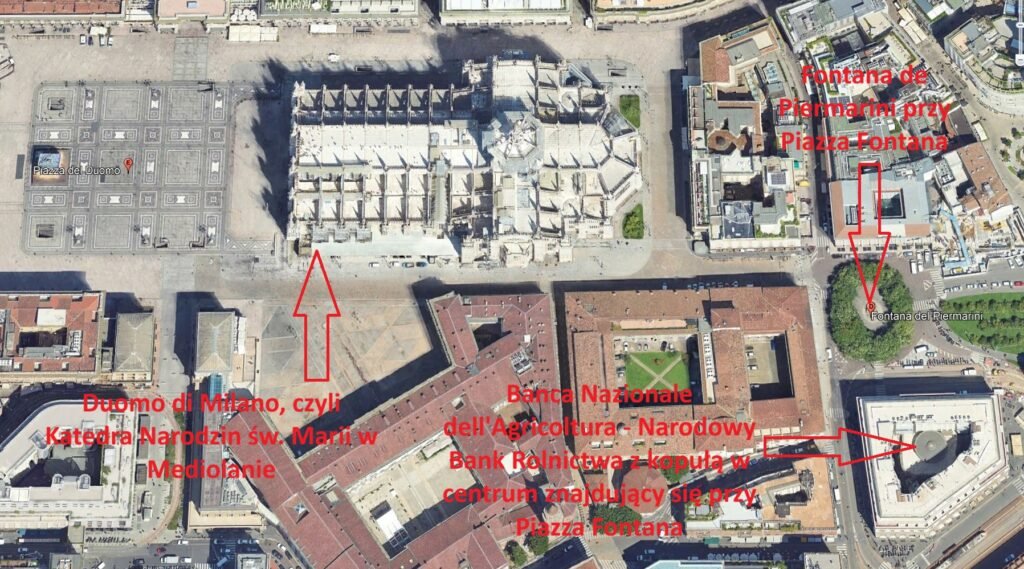
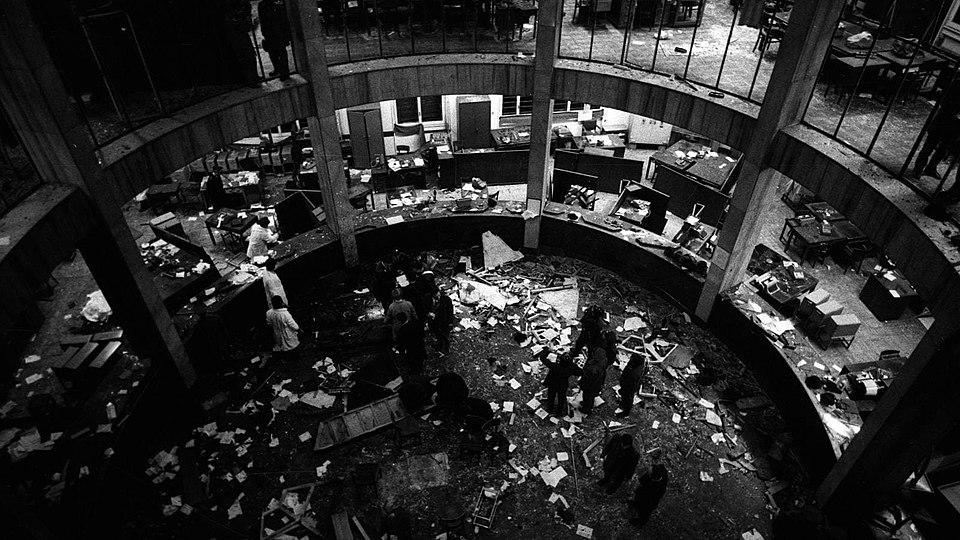
Northern Italy was the site of one of the most tragic acts of terrorism – the explosion at the National Agricultural Bank in Milan (December 12, 1969, Piazza Fontana), which killed 17 people and injured 88.
It is also worth noting that Milan (Milano) lies in the Padua Basin (Conca di Milano, Italian: Pianura Padana), part of the larger Padua Basin stretching across northern Italy. This is a symbolic reference to the basin described by the prophet Zechariah and to the red horses, which symbolize the blood that brings purification. In the Old Testament, it was the blood of sacrifices that purified the temple and all its elements.
Furthermore, the fact that the attack took place in a bank – in the center of the "golden calf" – clearly evokes the events described in the Book of Exodus, where the Israelites' turning away from God and the worship of the golden calf brought about God's judgment. In this way, the history of Milan symbolically reflects biblical themes.
Then Ida Peerdeman sees a dome, on which raindrops fall first, and then drops of blood. In the distance, she sees a Cross standing in light. As we will see, this is a prophecy referring to the bombing in Milan, which took place at the National Agricultural Bank in Piazza Fontana.
Analyzing a satellite map of the city (Photo 1), we can see that the dome is located in the central part of the Banca Nazionale dell'Agricoltura building, where the attack took place—it was precisely in this spot that the explosives detonated (Photo 2), killing 17 people and injuring another 88. Just a few meters away, in Piazza Fontana, stands the Fontana del Piermarini, which symbolically corresponds to the image in the vision: initially falling rain, then a shower of blood after the explosion.
Near the bank looms the monumental Duomo di Milano—Cathedral of the Birth of St. Maria in Milan, one of the most recognizable churches in the world and the largest Gothic church in Italy. On the highest spire (Guglia Maggiore, 108.5 meters high) stands the golden statue of La Madonnina, with a Cross above it.
The image Ida Peerdeman saw—the dome, rain, blood, and the Cross in light—is surprisingly consistent with the spatial layout of the place, combining the symbolism of vision with actual historical events.
We see, then, that the prophecy uttered in 1947 is reflected in the dramatic events that unfolded on December 12, 1969, at Piazza Fontana in Milan. These events took place in a country with a centuries-old Christian tradition, symbolically relating to the history of Israel and the people of God.
Suddenly, I see a large hall in the Vatican. The Pope is sitting there. It seems something is happening in the Vatican. The lady says,
"Secret meetings are being held. This happens many times. They meet secretly .
The lady points to someone, and I understand internally, "This is the envoy from America . Some documents lie in front of the Pope. The lady says,
"The Pope is kept informed of everything. He is fully informed of what must happen. There is so-called peace, but in reality, it is not. Everything is hidden from the world .
Then I have to run my right hand over my left hand twice, and I hear,
"This will happen twice .
And I see a specific period of time.
Before we turn to the Message of the Lady of All Nations, it is worth first presenting the political situation in Italy and the Church during the so-called "Years of Lead" (Anni di Piombo, 1969–1988). Without this context, it is difficult to fully understand the meaning of the Message's words: "This will be a great political-Christian struggle; ecclesiastical politics."
At that time, Italy became the arena of extremely intense political conflicts, linked to the activities of extremist organizations—both far-right and far-left—and groups operating "in the shadow" of the state. All this took place against the backdrop of the Cold War, when the United States and the USSR vied for influence in strategic Western European countries.
Two parties dominated the Italian political scene: the PCI—Partito Comunista Italiano, the most powerful communist party in the West, supported by the USSR and enjoying overwhelming support among workers, intelligentsia, and trade unions; and the DC—Democrazia Cristiana, a center-right party based on Catholic social teaching, supported by both the Vatican and the United States, which secretly financed it through the CIA.
For about two decades, the PCI and the DC functioned as political poles of the Cold War—unambiguously hostile to each other. However, in the early 1970s, this began to change. Support for the PCI grew so rapidly that it posed a real threat of electoral victory and communist entry into government, which caused great concern in both the Vatican and the United States. There were fears that the NATO state could fall toward Soviet influence.
In this situation, the new PCI Secretary General, Enrico Berlinguer, recognized that within the traditional balance of power, communist entry into government was impossible, and that further political polarization threatened the collapse of democracy. Therefore, he proposed a historic agreement—a compromesso storico—meaning cooperation between the PCI and the DC, joint governance, and the severing of the Italian left from dependence on Moscow through the idea of Eurocommunism. It was an attempt to create a stable state beyond ideological divisions.
Paradoxically, this proposal sparked a violent escalation of violence. The far left saw it as a betrayal of the revolution, while the far right saw it as an attempt to hand the country over to the communists. Far-right groups included Ordine Nuovo and Avanguardia Nazionale, which used bombings to instill fear of the left and destabilize the country. The far left, in turn—primarily Brigate Rosse—considered the PCI traitors and attacked DC politicians. This logic culminated in the kidnapping and murder of Aldo Moro, one of the main architects of the compromise, in 1978.
The struggle between these groups was so intense that it paralyzed the entire country. The streets emptied from fear of attacks, and one government after another fell.
In Ida Peerdeman's vision, the image of a desolate central Italy surrounded by the extreme north and south symbolically alludes to this reality—the extreme left and right led to the desolation of the entire country, much like the red and white horses in the Book of Zechariah, which emerged from the valley and circled the land, bringing it peace and tranquility.
Although the PCI and DC attempted to find a path to peaceful coexistence, this agreement faced too many opponents. Both the USA, fearing a communist victory, and the USSR, fearing an independent Eurocommunism, took actions that effectively destabilized the situation in Italy. Today, it is known that some of the attacks attributed to the extreme left were actually the work of the extreme right, which used explosives supplied through covert operations by intelligence services, including the CIA. Such events included the attack on the National Agricultural Bank in Piazza Fontana in Milan (1969).
During the same wave of attacks in Milan, a second bomb was discovered at the bank's headquarters in Piazza della Scala. However, it was successfully defused, preventing additional casualties.
In the image of the Message, the gesture Ida Peerdeman makes, moving her right hand twice over her left and saying, "This will happen twice," refers to the two bomb attacks of December 12, 1969, in Milan. One of them—the explosion at the National Agricultural Bank in Piazza Fontana—actually went off and claimed many lives. The second bomb, placed at the bank's headquarters in Piazza della Scala, was discovered and defused, thus avoiding another tragedy.
It is noteworthy that in the vision, Ida Peerdeman sees only one object of attack—blood falling on the dome—which symbolically corresponds to the single attack that actually took place. Thus, the prophecy she had been presented with was fulfilled, confirming the actual course of events.
The message features a particularly striking scene in which the Pope participates in a secret meeting with an "envoy from America," and the documents before him indicate the Church's knowledge of upcoming events, including CIA-backed attacks. The Lady of All Nations says there is peace, but it is only an apparent peace. Decisions with far-reaching consequences for the country are made behind the scenes, so that public opinion remains unaware. The actions of governments and some church structures did not lead to true peace and, in fact, contradicted the spirit of Christ's teaching.
Here, the depth of Gospel symbolism is revealed. In the Gospel according to Matthew, Christ speaks of giving alms in such a way that "the left hand does not know what the right hand is doing" (cf. Mt 6:2-3), which indicates unity of intention and action and peace between body and soul. These words refer to almsgiving—the Pharisees and scribes gave it to the people only for show, while in their hearts they felt reluctance. The right and the left can only be unaware of what they are doing when they act in harmony, in unity. Often, if there is a conflict between intention and action, it manifests itself in remorse.
The political reality in Italy revealed a similar situation: the far right operated under the "flag" of the left, creating the appearance of its guilt, while the forces declaring peace—the United States, with the Vatican's knowledge—covertly engaged in actions that led to an escalation of violence. This contradiction between what was said outwardly and what was done in secret constitutes a departure from the teaching of Christ.
Christ brings true peace—unity within and action in goodness. However, when institutions responsible for proclaiming the Gospel begin to participate in processes that bring scandal and violence, it becomes a sign of a profound spiritual crisis. The Years of Lead, therefore, reveal not only a political drama but also a departure from the Gospel spirit.
In previous Messages, the Lady of All Nations indicated that socialism can be good, provided it operates in the Spirit of Truth, Justice, and Love of Neighbor. It is worth noting that the Italian PCI party, guided by a more socialist program, in conjunction with the Christian DC party, may have laid the foundations for a form of "Christian socialism." Christ's Gospel message is to seek peace where there is none—and this strengthens the human soul in doing good and fulfilling God's Will.